Howdy, Stranger!

It looks like you're new here. If you want to get involved, click one of these buttons!

Here's a statement of the obvious: The opinions expressed here are those of the participants, not those of the Mutual Fund Observer. We cannot vouch for the accuracy or appropriateness of any of it, though we do encourage civility and good humor.
  • Jason Zweig: When A 10% Gain Makes You Feel Like A Loser
    FYI: Big gains can be hard to find in the financial markets. Nowadays, though, they seem to be everywhere — and that could change how you feel about taking risks.
    Regards,
    Ted
    http://jasonzweig.com/when-a-10-gain-makes-you-feel-like-a-loser/
  • Sterling Capital Long/Short Equity Fund to liquidate
    https://www.sec.gov/Archives/edgar/data/889284/000119312517349112/d497145d497.htm
    497 1 d497145d497.htm STERLING CAPITAL FUNDS
    LOGO
    STERLING CAPITAL LONG/SHORT EQUITY FUND
    SUPPLEMENT DATED NOVEMBER 21, 2017
    TO THE CLASS A AND CLASS C SHARES SUMMARY PROSPECTUS,
    INSTITUTIONAL SHARES SUMMARY PROSPECTUS,
    CLASS A AND CLASS C SHARES PROSPECTUS,
    INSTITUTIONAL SHARES PROSPECTUS,
    AND STATEMENT OF ADDITIONAL INFORMATION,
    EACH DATED FEBRUARY 1, 2017, AS SUPPLEMENTED
    This Supplement provides the following amended and supplemental information and supersedes any information to the contrary with respect to the Sterling Capital Long/Short Equity Fund in the Class A and Class S Shares Summary Prospectus, Institutional Shares Summary Prospectus, the Class A and Class C Shares Prospectus, Institutional Shares Prospectus, and Statement of Additional Information, each dated February 1, 2017, as supplemented:
    The Board of Trustees of Sterling Capital Funds has approved the liquidation of the Sterling Capital Long/Short Equity Fund (the “Fund”). The liquidation is expected to occur on or about January 26, 2018.
    As of the date hereof, shares of the Fund are no longer being offered for sale.
    Please contact your financial advisor or Sterling Capital Funds at 1-800-228-1872 if you have any questions.
    SHAREHOLDERS SHOULD RETAIN THIS SUPPLEMENT WITH THE PROSPECTUSES
    AND STATEMENT OF ADDITIONAL INFORMATION FOR FUTURE REFERENCE
    SUPPLS-1117
  • Why Buy A More Expensive ETF When A Similar Cheaper One Is Available?
    What I look at first (and I figure pretty much everyone looks at first) is what index is being tracked. "Similar" is a vague term. I wouldn't call the S&P 1500 "similar" to the S&P 500, or VOO "similar" to VTI. Likewise, I wouldn't call the EAFE index (900+ stocks, $16B mean average cap) similar to the EAFE IMI index (3,000+ stocks, $5B mean average cap). But those are what the article says are similar.
    After figuring out which index I want, I look at costs, all costs. That includes spreads, expense ratios, and to a lesser extent tracking error. Spreads relate to liquidity, but liquidity of an ETF is more than just the volume (in number of shares) traded daily identified in the article.
    Vanguard, "Understanding ETF Liquidity and Trading: Average daily trading volume is only a small part of an ETF’s total liquidity profile."
    The article says that "Well-known funds such as SPDR S&P 500 (SPY) and SPDR S&P MidCap 400 ETF (MDY) weren't changed for the same reasons EEM still exists."
    Maybe. But with these funds, there's more to the story. S&P 500 index funds exist not only for traders and institutional investors (the target audience given for EEM hanging around), but because retail investors buy the sizzle, the familiar name.
    About a decade ago, Vanguard worked with MCSI in designing indexes that could be tracked better, with lower turnover and better tax efficiency. Vanguard promoted funds based on these indexes, including VLACX / VV . Yet it kept VFINX around. When I questioned a Vanguard financial planner why he recommended VFINX over VLACX, I didn't seem to get an answer much beyond a couple of basis point difference in costs. The main reason appeared to be familiarity, i.e. sizzle.
    There's yet another reason why SPY and MDY won't be changed. They use an archaic unit investment trust structure. This has the cost disadvantage of cash drag (underling dividends cannot be invested by the fund but must be distributed quarterly to investors). Given their structural disadvantage, they're not good candidates for cost reductions.
    Vanguard: What are the Five Etf Structures?
  • U.S. Junk Bond Funds Post 4th-Biggest Week Of Outflows Ever
    Hi @Crash, with rising rates, in general, prices fall and yields increase.
    As far as HY goes, an old rule of thumb is buy HY at a spread to Treasuries of around 8 and sell around 4 **. If you look at the last ten years on this FRED chart, 8 was way too soon during the financial crisis, but about right at the peak spreads of 2011 and 2016. The spread dipped below 4 about the beginning of Q2 this year and continued slowly down till toward the end of October, and is mainly up since.
    ** That 'rule' refers to HY in general, on average, as that FRED chart tracks. Differently rated HY credits typically run at different spreads, so there's more nuance to get into for real junk aficionados.
  • A French Challenge To Gundlach's 'Disaster' Bond Theory
    It's the quality of the business much more than covenants that provide protection to bond holders. You're already giving up lots of protection by investing in junk - the entire company may be shaky, or these may simply be very junior bonds, the first to default if the company later develops problems.
    Here's a background paper by Loomis Sayles (admittedly written at the tail end of that 33% covenant-lite junk bond period, as opposed to the current 70% environment). Its headline states clearly that what matters is credit quality. The text goes on to explain what covenants can and cannot do in terms of protection.
    https://www.loomissayles.com/internet/InternetData.nsf/0/0BF67A378755F21085257B5000566A43/$FILE/CovenantLitePaper.pdf
    (Remember too, that Meridith Whitney predicted a massive run of defaults in munis, which she later clarified to include "technical defaults", i.e. minor breaches of covenants; for the most part real money wasn't affected.)
    LS writes that "As it turned out, covenant-lite loans did relatively well versus covenant heavy loans over the course of the global financial crisis [see graphic data in paper]. In fact, the [ratings] agencies admitted as much, but could not let go of the concern and warned that maybe next time it will be worse. Maybe, maybe not."
    Gundlach continues to push his sector of the market (mortgage backed securities) without explaining the specific risks associated with the asset class that relate directly to changing interest rates:
    “Buy things that people foolishly don’t understand, like mortgaged-backed bonds,” Gundlach advised.
    “Get out of things, like investment-grade bonds, that people don’t understand ..."
    Say what?
  • ARGH !!!! Hav'in a bad day, just one of those short term moods, OR just about right?
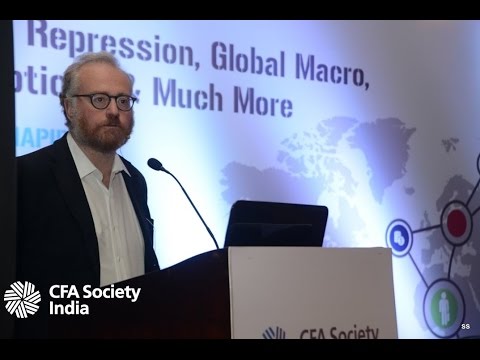
    Let me take an "espresso shot" at this by sharing the research of Russel Napier. The last few minutes of this interview explains the historical problem of chasing yield, especially EM corporate debt (High Yield).
    My paraphrasing his words:
    When open ended funds, seeking a 5% yield for their client (the pensioner), invest in HY debt and that HY bond defaults on its obligation, the manager ends up having to sell something else to meet redemptions and/or cover the bad debt, the risk here is contagion (where a bad asset impacts and spreads to "less bad" assets). Something small can have a very big impact on the larger whole.

    I will also link a longer presentation that is a bit "noisy" at the start of the video so fast forward through the introduction to the start of his presentation.
    Much like we have come to know words like "Quantitative Easing" and "Austerity", Mr Napier discusses the next possible financial tools still left in the tool box such as "Financial Repression" and "Macro-prudential Regulation".

  • Mohamed El-Erian – Which Asset Classes Are Most Vulnerable
    I’m starting to think that managing other people’s money is a tough racket. Like Miller’s Willy Lowman -
    A man out there in the blue riding on a smile and a shoe-shine. And when they stop smiling back, that’s an earthquake.
    What got me thinking is the half-hour “infomercial” broadcast throughout northern Michigan by Centennial Advisors every Sunday morning. Michael Reese is a slick “advisor”/promoter, usually with one or two less articulate “associates” tagging along on the (paid-for) broadcast. The sales line never changes: (1) Mutual funds are too risky for seniors. Bad things can happen, (2) Come in and see us about our superior product (artfully dodging the “A” word), (3) To prove what nice guys we are, we’ll treat you to a free dinner while we talk.
    In recent weeks these televised promotions have grown increasingly strident sounding. Appear really trying to frighten people and rope them in. I’m wondering if perhaps they’re attracting less money nowadays with public interest in the feverish equity markets so high? To top things off, I had a “cold call” (knock on the door) from a rep from Edward Jones last week. Turned the unexpected/unwanted visitor around and pointed them down the road quickly (in my usual diplomatic manner). Seem to be noticing more large ads from EJ in the area newspapers too (usually couched as “advice columns” - easy to see through).
    Tough times for the financial advisory profession?
    -
    After thought: Words can clarify. But they can also obsucate. I’m afraid that some well known financial “authorities” are using words for the second purpose.
  • Consuelo Mack's WealtTrack : Guest: Kristi Mitchem, CEO, Wells Fargo Asset Management
    FYI: Kristi Mitchem, CEO of Wells Fargo Asset Management has the research on the strong connection between control of your finances and happiness.
    Regards,
    Ted
    http://wealthtrack.com/retirement-expert-kristi-mitchem-why-financial-planning-makes-millennials-and-boomers-happier/
  • Mohamed El-Erian – Which Asset Classes Are Most Vulnerable
    FYI: Mohamed A. El-Erian is the chief economic advisor for Allianz SE. Before joining Allianz, Dr. El-Erian held positions as chief executive and co-chief investment officer of PIMCO and president and CEO of Harvard Management Company, the entity that manages Harvard’s endowment and related accounts. Dr. El-Erian was also a managing director at Salomon Smith Barney/Citigroup in London and spent 15 years with the International Monetary Fund in Washington, DC.
    Dr. El-Erian has published widely on international economic and finance topics. His 2008 best-seller, When Markets Collide, was named a book of the year by The Economist, and one of the best business books of all time by The Independent (UK). He was one of Foreign Policy’s “Top 100 Global Thinkers” for four years in a row, and is a contributing editor for the Financial Times. His newest book – The Only Game in Town: Central Banks, Instability and Avoiding the Next Collapse – is another New York Times best-seller.
    Regards,
    Ted
    https://www.advisorperspectives.com/articles/2017/11/15/mohamed-el-erian-which-asset-classes-are-most-vulnerable
  • Ben Carlson: Caution Alone Is Not An Investment Strategy
    FYI: There are no easy answers in the financial markets right now because of the run-up we’ve experienced over the past number of years. The alternative — lower valuations, higher yields, more bargains, etc. — is, however, worse because that would mean everyone would have less money in their portfolios. We have to play the hand we’re dealt and anyone who tells you with certainty they know how things will work out from here is nuts. Legendary investor Howard Marks gave investors 6 options in an update this summer. In a piece I wrote for Bloomberg, I give the pros and cons of the best options.
    Regards,
    Ted
    http://awealthofcommonsense.com/2017/11/caution-alone-is-not-an-investment-strategy/
  • Fair Game: After 20 Years, Gretchen Morgenson Retires From NY Times
    FYI: For the past 20 years or so, as a business columnist for The New York Times, I’ve had a front-row seat for bull and bear markets, scandals, crises and management mischief.
    But I am leaving The Times, and this is my last shot at Fair Game. So it seems a fitting moment to look back at what’s changed and what hasn’t in the financial world, for better or worse.
    Regards,
    Ted
    https://www.nytimes.com/2017/11/10/business/after-20-years-of-financial-turmoil-a-columnists-last-shot.html?rref=collection/sectioncollection/business&action=click&contentCollection=business&region=rank&module=package&version=highlights&contentPlacement=1&pgtype=sectionfront
  • Has A Mutual Fund Ever De-Mutualized? A "Financial Loose End" Story
    Wow, 25 shares! When Met Life demutualized, I got 10 whole shares. So little that when they spun off Brighthouse Financial I would have gotten less than one share, so I was forced to accept cash in lieu.
    I was notified about the shares when the demutualization occurred, and I was notified of the Brighthouse shares (well, cash) as well. So I'm a little surprised that you got no notifications. Perhaps the problem lies with your old insurer?
    My MET shares were held in a trust (also via Computershare) that enabled me to buy and sell shares with no commission. The Brighthouse shares would have been held there also, had there been any shares to hold. These days, one can trade stocks for next to no commission, so I don't see much value in retaining the shares in the trust.
    Be advised that the IRS has always asserted that your cost basis in the shares is zero. There is some disagreement across courts about this, but the IRS remains unmoved. https://www.journalofaccountancy.com/issues/2016/mar/basis-of-stock-in-insurance-demutualization.html
    Given the fact that I'd owe taxes on 100% of the value, or could get a deduction on 100% of the value by donating them, I figure I'll donate this year, while I can still itemize. (If the tax "reform" legislation passes, then between loss of SILT deductions and higher standard deductions, I'll not likely itemize in 2018.)
  • Has A Mutual Fund Ever De-Mutualized? A "Financial Loose End" Story
    As the result of a "de-mutualization" of my insurer (NE Financial merged with MET Life) I received 25 shares of MET Stock. These shares, originally held at BNY Mellon, recently were transferred to Computershare which provide shareholder services for the shares. Nothing that I initiated. In fact, I stumbles upon this revelation after doing a yearly checkup on the BNY Mellon account. I never received an email nor a mailing of this change. It was hell finding the correct department at Computershares and then proving to Computershares who I was since I was using BNY Mellon Accont information that I had screenshots of (the account nor longer was accessible to me online).
    Anyway, this year MET spun off BHF (Bright House Financial...an annuity service of MET) which provided me with 2 shares of BHF. I realize I am not going to get rich here, but these are the kinds of transactions (that even the owner has a hard time following let alone an heir). It happen all the time and these financial assets get lost in the shuffle of life.
    I mention this because my parent (a physician and original member of the formation of Mutual Hospital Insurance later known as Anthem) dead very young. My remaining parent, now 94, discovered (by another family member 40 years later) that she was the beneficiary of over $100K of WLP stock (which bought Anthem at one point in time and now WLP is traded as ANTM..don't try to keep score here).
    Here a brief history if you are interested:
    https://en.wikipedia.org/wiki/Anthem_Inc.
    My point is... Fast forward 40 years from today my MET/BHF stock could one day be a small fortune. The power of compounding over time.
    So, organize these financial "loose" ends for yourself as well as your heirs. It may seem time consuming, but it is worth every penny of the time that you spend on it.
    Also, has a Mutual Fund ever de-mutualized?
  • Consuelo Mack's WealthTrack: Guest: Kathleen Gaffney,Manager, Eaton Vance Bond Fund
    FYI: (I will link episode as soon as it becomes available, early Saturday morning.)
    Regards,
    Ted
    November 9, 2017
    Dear WEALTHTRACK Subscriber,
    Question: what have been two of the most distinctive features of the recovery from the financial crisis of ‘08-‘09? Answer: historically low levels of inflation and interest rates. Despite years of numerous predictions to the contrary inflation has stayed stubbornly subdued and, with some help from central banks around the globe, so have interest rates. But is this nearly decade long pattern finally being broken? This week’s guest says yes and there is evidence to back her claim.
    As a recent headline in The Wall Street Journal reads: “Inflation the slumbering giant begins to stir.” To illustrate the point the Journal showed a chart of year over year changes in consumer prices in the U.K., U.S. and Eurozone. They bottomed in 2015 and have slowly risen, with fits and starts ever since… Japan has shown a similar pattern.
    Meanwhile interest rates on benchmark 10-year government bonds are rising. U.S. rates ticked higher recently and yields in Germany and Japan are off their mid-2016 lows.
    There have been other episodes of rising inflation and interest rates before this which didn’t last. This week’s guest is betting this one is for real.
    She is Kathleen Gaffney, Director of Diversified Fixed Income at Eaton Vance where she is also the lead portfolio manager of the Eaton Vance Multisector Income Fund which she launched as the Eaton Vance Bond Fund when she joined the firm in early 2013.
    The fund is known for its flexibility to seek higher total return opportunities anywhere globally and throughout the capital structure of the companies chosen. As a result it can buy common and preferred stocks, convertible securities and bonds. It also invests in currencies. That approach however has also meant “significantly more volatility” than its peers in Morningstar’s Multisector Bond category. Case in point: the fund declined 17% in 2015 and rocketed up 22% in 2016.
    Gaffney is also lead portfolio manager of the somewhat more traditional Eaton Vance Core Plus Bond Fund. It carries a 5-Star rating and has ranked in the top performance percentiles in its category for the last 1, 3 and 5 year periods, both under her leadership and that of former managers.
    If you miss the show on television you can always watch it on our website at your convenience. If you’d like to see the show before it airs, it is available to our PREMIUM subscribers right now. We also have an EXTRA interview with Gaffney about how she finds "think time" in the midst of information overload. It will be available exclusively on our website.
    If you would like to take WEALTHTRACK with you on your commute or travels, you can now find the WEALTHTRACK podcast on TuneIn, Stitcher, and SoundCloud, as well as iTunes. Find out more on the WEALTHTRACK Podcast page.
    Saturday, November 11th is Veteran’s Day. Please take a moment to remember all of those past and present, who have sacrificed so much to give us the freedoms we enjoy today. I personally salute my Dad, Husband and Son. I am so grateful for their service.
    Have a great weekend and make the week ahead a profitable and a productive one.
    Best Regards,
    Consuelo
    Video Clip:

    M* Snapshot EBABX:
    http://www.morningstar.com/funds/XNAS/EBABX/quote.htmlutm_term=0_bf662fd9c0-2b02004c36-71656893
    Lipper Snapshot: EBABX:
    https://www.marketwatch.com/investing/fund/ebabx
    EBABX Is Unranked In The (IB) Fund Category By U.S. News & World Report

  • Investing Index Card
    (Double-dipping here)
    Along a similar vein to the card’s professed wisdom ... the simplistic slogan I credit with turning my financial life around more than 25 years ago is: “Pay yourself first.”
    I first heard it voiced by an (ironically) unlikely mutual fund promoter of the time, Richard Strong. His Strong Capital Management used the slogan prominently in its advertising. Up to that point I’d thought of saving only as depriving oneself of something. The slogan turns that idea upside-down and makes saving sound much more like a reward. Sure helped me get turned around.
  • Dan Fuss: U.S. Bonds Look Most Vulnerable In Four Decades
    Thanks @Ted,
    If you ever have an opportunity to read or listen to a Dan Fuss Interview, do so. Like Bogle, Fuss is a grandfather like figure that is both engagingly dry and full of financial wisdom.
    From @Ted's article on owning bonds in today's market:
    “I do know from my 59 years of experience, when the ice was very thin, it’s always good to be very cautious,” he said. “You can skate around the edges but you can’t go out to the middle.”
    and,
    “I‘m not trying to be an ‘end of the world person’ here, but it is a possibility,” he said. “It used to be one percent, now it’s a 15 or 20 percent possibility. Would you get on an airplane if there was a 15 percent risk? And that’s a good way to ask a person about risk,” he said.
    Maybe investor confirmation bias, but I sold my "middle of the pond" position in AGDYX about a month ago. His concerns about a lack of buyer of bonds and a higher risk of inflation paired with do nothing politicians is what you pay a bond manager to worry about. Bond index funds provide none of this risk management.
    Wish the article dug a little deeper into Dan Fuss and his bond choices over the next part of the market cycle.
  • Dan Fuss: U.S. Bonds Look Most Vulnerable In Four Decades
    FYI: Dan Fuss, one of the world’s longest-serving fund managers, said his flagship bond fund has cut exposure to high-yield corporate bonds and raised the quality of its holdings, warning that the U.S. bond market is more vulnerable to a sell-off now than at any time since the financial market rout of 1974.
    Regards,
    Ted
    http://www.reuters.com/article/usa-markets-loomissayles/u-s-bonds-look-most-vulnerable-in-four-decades-loomis-sayles-fuss-idUSL3N1NE2T3
  • Investing Index Card
    These rules may be dumb and hard for financial literates like the ones on this board, but provide very good, simple directions for 70% of us who are not financially literate by at least one measure (Google three question quiz). Those who do not save at all, those who don't know that minimum payment on credit cards should be ignored, those who do not contribute to retirement accounts, etc.