Howdy, Stranger!

It looks like you're new here. If you want to get involved, click one of these buttons!

Here's a statement of the obvious: The opinions expressed here are those of the participants, not those of the Mutual Fund Observer. We cannot vouch for the accuracy or appropriateness of any of it, though we do encourage civility and good humor.
  • A PIMCO Fund Manager You Might Not Know
    >>>Class D shares - Do not have an initial sales charge or a contingent deferred sales charge. Cannot be purchased and held directly with PIMCO Funds. These shares are offered through financial service firms, such as broker/dealers or registered investment advisors.<<<
    D shares are available for taxable or non-taxable accounts and widely available at most firms ala Fidelity, Scottrade, etc.
  • Stocking Stuffers For Santa Claus Rally : Top Advisers' Favorite Bond Funds
    Thanks Ted,
    SPHIX seems to make a nice rising rate bond fund. It duration is 2.9 years. It looks like it nvests in High yield income instruments which carry a higher default risk but, the risk reward seems worthy of consideration. SPHIX has a great track record and could be paired with a less volatile fund such as a GNMA fund as a way of monitoring crossovers:
    "The fund invests primarily in income producing debt securities, preferred stocks, and convertible securities, with an emphasis on lower-quality debt securities. It potentially invests in non-income producing securities, including defaulted securities and common stocks. The fund invests in companies in troubled or uncertain financial condition."
    Another article on the topic of income in a low interest rate world:
    forbes.com/sites/investor/2012/03/13/what-to-do-about-low-interest-rates/?partner=yahootix
  • You Bought An Annuity. Now What ?
    It seems ironic that as boomers reach the age where annuities might have some appeal (and possibly solve some planning issues), interest rates in general have fallen so low they appear to be a poor and potentially risky option.
    I guess in life (and financial markets) all things eventually even out. We rode the boom in housing, spiked the 70s inflation with outsized consumption and helped push up stocks in the 90's with tax-sheltered plans. While it's hard to assign cause and effect in such matters, we may have unwittingly contributed to today's dismal rate environment as our spending slowed and our (investment) risk appetite subsided.
  • A PIMCO Fund Manager You Might Not Know
    Reply to @ron: PIMCO just produced semiannual report for PDI (equivalent of PONDX) where they speak of performance contributors and detractors. Contributors are mostly non-agency MBS, financial and insurance companies' bonds, etc.... and the fact that people continue to reward investments with yields in this zero rate invironment. really -- there is no mistery for anyone doing just a bit of homework.
  • A PIMCO Fund Manager You Might Not Know
    Reply to @catch22: I'll speculate that there are couple reasons: 1) lack of education in investing options, which scott has written well about, and 2) distrust in just about any investment option beyond CDs after the 2008 financial melt down.
  • BBH Core Select Fund closed to new investors November 30, 2012
    http://www.sec.gov/Archives/edgar/data/1342947/000089109212007111/e50948_497.htm
    The following information supplements, and to the extent inconsistent therewith, supersedes, certain information in the Prospectus. Defined terms not otherwise defined in this supplement have the same meaning as set forth in the Prospectus.
    Effective close of business on November 30, 2012, and subject to certain exceptions, BBH Core Select (the “Fund”) is closed to new investors. An existing investor that has been a shareholder in the Fund continuously since November 30, 2012, either directly or as the beneficial owner of shares held in another account (an “Existing Shareholder”), may make additional investments in the Fund and reinvest dividends and capital gain distributions. In addition, an employee benefit plan that is an Existing Shareholder may continue to buy shares in the ordinary course of the plan’s operations, even for new plan participants. The Fund’s closure to new investors does not restrict any shareholders from redeeming shares of the Fund.
    In addition to Existing Shareholders, the Fund will remain open to:
    • shareholders of any of the funds in the BBH Trust that have at the time of investment in the Fund a combined balance of $100,000 in any of the funds in the BBH Trust (in their own name or as beneficial owner of shares held in someone else’s name);
    • shareholders that received shares of the Fund after November 30, 2012, as a gift or inheritance from an
    Existing Shareholder of the Fund;
    • an account for an employee benefit plan sponsored by an organization that is an Existing Shareholder or an affiliated organization;
    • an employee benefit plan or other type of corporate or charitable trust account sponsored by or affiliated with an organization that also sponsors or is affiliated with (or is related to an organization that sponsors or is affiliated with) another employee benefit plan or corporate or charitable trust account that is an Existing Shareholder of the Fund;
    • a director or officer of the BBH Trust, or a partner or employee of BBH or its affiliates, or a member of the immediate family of any of those persons;
    • a client of BBH or entity that otherwise has an existing business relationship with BBH, provided that, in the judgment of BBH, the proposed investment in the Fund would not adversely affect BBH’s ability to manage the Fund effectively;
    • a client of a financial advisor or a financial planner, or an affiliate of such financial advisor or financial planner, that has been notified by BBH that its clients may invest in the Fund;
    • an investor purchasing Fund shares through a sponsored fee-based program pursuant to an agreement with BBH, BBH Trust or its distributor, provided that the sponsor has been specifically notified in writing that shares may continue to be offered through such program;
    • a client of an institutional consultant, provided that BBH has notified the consultant in writing that the client may invest in the Fund.
    The Fund will accept new accounts for an employee benefit plan if the employee benefit plan is sponsored by an organization that also sponsors (or is affiliated with a sponsor of) another plan that is an Existing Shareholder. In addition, the Fund may accept new accounts for an employee benefit plan if the plan is a client of an institutional consultant or a Registered Investment Advisor that has an existing business relationship with BBH or BBH Trust, provided that BBH or BBH Trust has notified that consultant or Registered Investment Advisor in writing that the plan may invest in the Fund.
    Investors may be asked to verify that they meet one of the exceptions above prior to opening a new account in the Fund. The Fund may permit you to open a new account if the Fund reasonably believes that you are eligible. The Fund also may decline to permit you to open a new account if the Fund believes that doing so would be in the best interests of the Fund and its shareholders, even if you would be eligible to open a new account under these exceptions.
    The Fund’s ability to enforce the closure of the Fund and the exceptions listed above with respect to accounts held by financial intermediaries may vary depending on the systems capabilities of those intermediaries, applicable contractual and legal restrictions and cooperation of those intermediaries.
    To ask questions about your ability to invest in the Fund, please call BBH at 1-800-625-5759.
    PLEASE RETAIN THIS SUPPLEMENT FOR FUTURE REFERENCE.
  • Issues in Mutual Fund Distribution
    Hi bee,
    Time for my head to be at the pillow; but, I will presume your listed quote is from the working paper, of which, I read the first 10 pages.
    As to the quote, and what has been discussed here before; the majority of individual investors who have a preference to save (bravo for them) via IRA or related tax sheltered employer accts are not comfortable with the world of investing.
    Over 30 years, very few I have personally know have had a direct desire to learn about investing............the, "it's too complicated, etc." Most of these folks were more than capable of learning about investing, but did not have the passion.
    In 1984, I formed an investment club among 14 co-workers; in an attempt to help them become familiar with and motivated with investing and profiting from their net income monies that they worked their butts off for each and every day. After 6 months, I was asked to run the club without monthly meetings for learning. Okay, and that was the path for 3 years. Every month everyone received a report of financial status and why the monies were invested in particular areas.
    All of these folks were highly skilled in areas not involved with investing. The most common thought I discovered from them was that the whole money area was just too complex. Many of the work tasks they performed were very complex, when viewed by others not familiar with their work. I always tried to use this angle to move them along; that they were more that able to learn investing, but not in 2 or 3 months. It would require time and study, not unlike for their "work".
    A few still invest today, but have advisors manage their monies; for too high of a fee.
    Several of them have noted looking back more than 20 years to the beginning of the club; and what they would have learned by now, with just a few hours a week of their time.
    Away I must be...........
    Catch
  • Grandchildren
    Getting back to your generousity...Be sure you understand how this gift will impact other financial dynamics for your grandkids. Paying for college is a very large outlay. Often a FAFSA form is filled out to identify student need. Monies that are in the chid's name in taxable accounts will be used to identify their need. Your generousity might reduce their educational need putting more financial burden on their parents and your grandkids.
    As PBull mentioned above...start out with UGMA/UTMA accounts and as the kids earn income use this gift account to contribute to a Roth account in their name. Babysitting and cutting lawns is earned income. My kids contributed to a Roth as well as helped pay for college by running a small concession business. I proudly tell those that ask...my kids earned their college degrees one hotdog at a time. By the time your grandkids reach college age and FAFSA needs to be filled out, these gifts will have been positioned in a way that is most beneficial to the entire family.
    Something I came across that might be worth checking out. This is part 4 in this series of articles:
    thechoice.blogs.nytimes.com/2012/01/12/kantrowitz-part-4/
  • conference call, RiverPark Long/Short, Thursday: other questions?
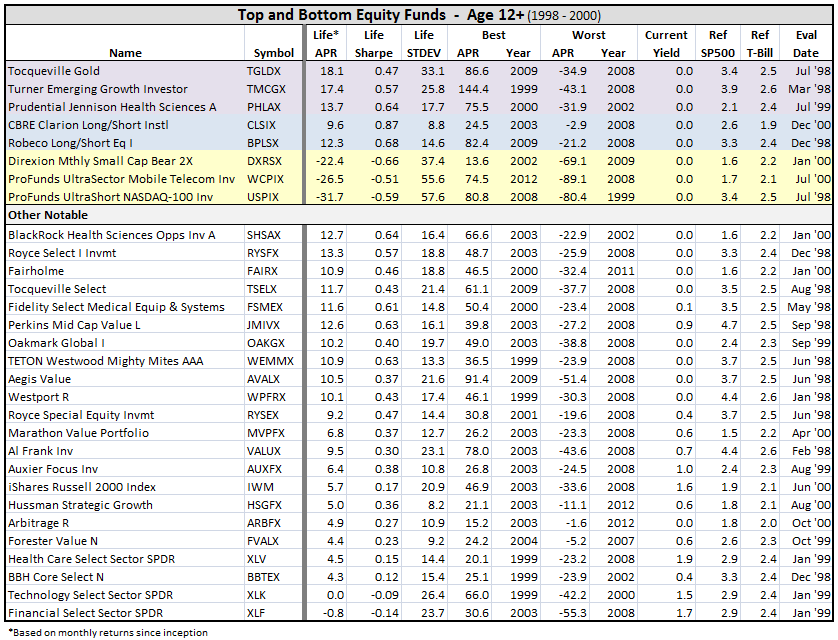
    Reply to @claimui: My view is that funds like Marketfield and the Robeco funds play a little more loose with the definition of long-short and are able to dial up/down risk in a much more flexible fashion than many long-short funds. Many funds I've looked at in the category emphasize being both long and short and seem inflexible in adjusting based on the environment. Long story short, the more dynamic nature of Marketfield and Robeco have lead to noticeable outperformance vs the category. Both are most likely going to loose more than other funds in the category if another 2008 occurred, but have the potential for considerable outperformance in up years.
    Having funds that offer a greater degree of flexibility (and I think flexibility and diversification will become increasingly important after a relatively smooth few years) - whether long/short or across multiple asset classes - and that may offer uncorrelated returns are (for some) a useful choice for part of a larger portfolio. I remain pleased with funds like Ivy Asset and Marketfield. Other people are welcome to invest differently, and that - I think - is one of the joys of investing. There is no one right answer for all people, and I often find other people's views who differ from my own fascinating or at the very least interesting.
    As for the category, a number of long-short funds simply aren't very good, some are too esoteric and will not likely attract enough assets even if they do okay (James Alpha Global Real Return, from the former Pimco Commodity RR manager), don't work in a mutual fund structure (I've said previously that I don't think the managed futures category really works in mutual fund form, but there are a number of highly successful managed futures hedge funds, which have far greater flexibility and less restrictions) or simply haven't chosen to be flexible to adjust to the environment they're facing (see Hussman.)
    However, more dynamic funds like the Robeco fund and Marketfield and the River Park fund show some promise of a second generation for the category. The Wasatch L/S fund - which has been around for a while - is another good choice.
    I don't think the public is looking for a "utopia" fund in the category as I don't think the public has any interest in the category as a whole, and I'd be curious to see the AUM of the category as a whole over the last few years versus AUM of the few standouts (Marketfield, for example.) I'd have to imagine the AUM of the category minus the few standouts is down, probably quite a bit - although flows out of stock funds in general keep continuing week after week after week.
    Equity funds had estimated outflows of $8.38 billion for the week, compared to estimated outflows of $1.84 billion in the previous week. Domestic equity funds had estimated outflows of $6.63 billion, while estimated outflows from world equity funds were $1.75 billion.
    http://www.ici.org/research/stats/flows/flows_11_21_12
    If anything, the general public would seem far more in love with fixed income. 2008 saw some people leave and not come back to the stock market, many seem to have piled into bonds. At some point, bonds will turn and I'll guess that a fair amount of those people who sought safety in bonds after they got out of stocks in 2008 and then will see bonds turn and will not want anything to do with investing at all, and that's unfortunate. It's doubtful that there will ever be a push to offer financial education at the high school level rather than home ec, despite the fact that greater financial knowledge will likely have a number of benefits for both the market and greater economy.
    If anything, the time period should be studied as a rather remarkable turn from the usual public chasing the rally - there have been few weeks in the last few years where there haven't been outflows out of stock funds and giant inflows into fixed income. Fidelity now has more AUM in bonds and money markets than stock funds.
    Whatever anyone's thoughts on Zerohedge, this chart of stock vs bond inflows from 2000 to now is a rather remarkable visual on money flow.
    http://www.zerohedge.com/sites/default/files/images/user5/imageroot/2012/09-2/js 5.png
    "Question: If interest rates rise, what will typically happen to bond prices? Only 21% of the 2009 FINRA National Financial Capability Study knew that the answer was “They will fall.” The same question to a group of active U.S. military got only a 30% correct response rate. In a 2010 Northwest Mutual survey, only 41% knew the relationship between interest rates and bond prices."
    http://www.zerohedge.com/news/investors-nostalgic-logical-markets-boycott-new-centrally-planned-normal
  • The New Safe Haven Durning Stock Market Sell-Offs
    One article I glimpsed recently favored investment grade corporates. The case: (1) valuations are not as "frothy" as for lower tier bonds. (2) they do well in an improving economy as rating agencies raise issuer's ratings in response to improving financial health. (Ie: an upgrade from BBB to A-B). Capital appreciation comes not from falling rates, but from improved fundamentals reflected in bond valuations. fwiw
  • Help with 401K
    I am 48 years old and I have $165,000 in my 401K. I am looking for feedback on allocation dollars or percentage. The plan is from John Hancock and here are my choices
    Large Cap Growth-
    Pru Jennison 20/20 Focus Fund
    The Growth Fund of America
    Fidelity Contrafund
    Large Cap Blend-
    T. Rowe Price Equity
    Washington Mutual Investors
    Mid Cap Value-
    JPM MidCap Value
    Mid Cap Growth-
    Wellington Mid Cap
    Pru Jennison Mid Cap
    Small Cap Value-
    Wellington Small Call
    T. Rowe Small Company Value
    Small Cap Groth
    Vanguard Small Cap Growth Index
    Vanguard Explorer
    International
    DFA Emerging Market Value
    Templeton International Value
    Oppenheimer Int. Growth Fund
    Balanced-
    Pax World Balanced Fund
    American Balanced Fund
    BlackRock Global Allocation
    Index-
    John Hancock Mid Cap Index
    John Hancoxk 500 Index
    Sector-
    Deutsche Asset Real Estate Securities
    T. Rowe Price Sci & Tech
    Davis Financial Services Fund
    T. Rowe Price Health Science
    MFS Utilities
    Intermediate Fixed Income-
    Pimco Total Return
    Pimco Real Return
  • Our Funds Boat, Week - .11%, YTD + 11.61%.....OK, I'll choose luck.....11-18-2012
    Reply to @Soupkitchen: Just to add to Catch's response - In early 2011 yields on munis spiked in response to Meredith Whitney's 60-minutes interview and other fears. Some financial advisors were actually recommending holding munis inside tax-sheltered accounts for their significant yield advantage. Some taxable bond funds dabbled in them as well for the same reason. Alas - no longer the case as the links I put up show. One mentions today's "rock-bottom" yields. Regards
  • Mairs Power growth fund & a couple of reads
    http://www.kiplinger.com/columns/fundwatch/archive/mairs-power-growth-fund-for-bbh-core-select.html
    the next bubble
    http://www.mauldineconomics.com/images/uploads/pdf/mwo111912.pdf
    what's next for muni market
    http://www.uptilt.com/content/6433/What Next for the Municipal Market11 12 2012.pdf
    rbc wealth management - weekly read
    RBC Wealth Management
    Michael D. Ruccio, AAMS
    Senior Vice President -Financial Advisor
    25 Hanover Road
    Florham Park, NJ 07932-1407
    (p) (866) 248-0096
    (f) (973) 966-0309
    [email protected]
    michaelruccio.com
    Market Week: November 19, 2012
    The Markets
    Equities around the globe continued to slide, suffering four straight down days as both the United States and Europe grappled with fiscal cliffhangers. Despite some optimism at week's end, the Dow saw its fourth straight negative week. Meanwhile, the Nasdaq and small-cap Russell 2000 entered correction territory with declines of more than 10% since their September highs.
    Market/Index 2011 Close Prior Week As of 11/16 Week Change YTD Change
    DJIA 12217.56 12815.39 12588.31 -1.77% 3.03%
    Nasdaq 2605.15 2904.87 2853.13 -1.78% 9.52%
    S&P 500 1257.60 1379.85 1359.88 -1.45% 8.13%
    Russell 2000 740.92 795.02 776.28 -2.36% 4.77%
    Global Dow 1801.60 1881.43 1848.57 -1.75% 2.61%
    Fed. Funds .25% .25% .25% 0 bps 0 bps
    10-year Treasuries 1.89% 1.61% 1.58% -3 bps -31 bps
    Equities data reflect price changes, not total return.
    Last Week's Headlines
    Double dip: A second quarter of economic contraction pushed Europe back into recession for the second time in four years. The European Union's official statistics agency said gross domestic product fell 0.1% during Q3 after a 0.2% contraction in the previous quarter. The pace of contraction in Spain and Italy slowed and France's GDP rose for the first time since Q3 2011, while Germany's economic growth was more sluggish than in Q2.
    Greece fire: In the wake of Greece's narrow approval of new austerity measures, eurozone finance ministers and the International Monetary Fund clashed over whether to give the country a two-year extension (until 2022) to reduce its debt to the level required by its most recent bailout agreement. The extension is estimated to add €32.6 billion to Greece's tab with the IMF, the EU, and the European Central Bank.
    President Obama and congressional leaders opened discussions on a deal to avert the fiscal cliff. Both sides indicated they might pursue a two-phase approach by adopting small deficit reduction measures before January 1 while trying to develop guidelines for a more comprehensive agreement next year.
    The Chinese Communist Party rejected reform-minded candidates to lead its Politburo Standing Committee, considered the country's highest decision-making body, over the next decade in favor of more conservative candidates. Xi Jinping will replace Hu Jintao as party chief and China's de facto leader.
    The biggest jump in housing costs since March 2008, along with higher costs for clothing and airfare, helped push up the Consumer Price Index in October, according to the Bureau of Labor Statistics. The 0.1% increase put overall consumer inflation at 2.2% for the last 12 months. Meanwhile, despite a 0.4% increase in foods, lower energy costs helped cut wholesale prices 0.2% for the month, leaving inflation at the wholesale level for the past year at 2.3%.
    Despite a 3% increase in October, mortgage foreclosures were 19% lower than the same time last year, according to RealtyTrac.® Also, the Mortgage Bankers Association said the number of households that were behind on their mortgage payments in the third quarter was at its lowest level in almost four years, though the delinquency rate varied dramatically among states.
    Outages caused by Hurricane Sandy hurt manufacturing activity measured by the Federal Reserve's Empire State and Philadelphia Fed November indices. The Philly Fed index hit -10.7, while the Empire State measure was at -5.2. Sandy also affected October retail sales, though the Commerce Department said it couldn't quantify how much of the 0.3% decline could be attributed to the storm. Sales were up 3.8% from a year ago.
    The Fed is considering using economic indicators, such as a target unemployment or inflation rate, rather than a calendar date to determine when to begin raising interest rates. Minutes of the Federal Open Market Committee's most recent meeting showed that most members also favored extending "Operation Twist" bond purchases past the program's scheduled December expiration date.
    British Petroleum will plead guilty to felony charges and pay $4.5 billion in penalties in connection with the 2010 Deepwater Horizon oil spill as part of an agreement with the U.S. Justice Department. And a House subcommittee investigating MF Global Holdings' bankruptcy said that regulatory agencies had failed to share information that might have helped prevent the eighth largest bankruptcy in U.S. history.
    New technologies are expected not only to make the United States a net exporter of natural gas by 2020 but also to transform North America into a net oil exporter by 2035, according to the International Energy Agency. The agency's annual World Energy Outlook also said renewable energy sources could become the second largest global source of power generation by 2015 if development subsidies are continued. Finally, the IEA projects that as global energy demands increase by more than a third by 2035, Iraq would replace Russia as the world's second largest oil exporter and 90% of Middle East oil supplies would go to Asia.
    Eye on the Week Ahead
    European finance ministers will meet Tuesday to discuss whether to release €31.5 billion needed to make upcoming payments on Greek debt, and whether to disregard the IMF's concerns about relaxing the bailout agreement's terms. The Thanksgiving holiday could keep trading volumes light.
    Key dates and data releases: home resales (11/19); housing starts, meeting of EU finance ministers (11/20); leading economic indicators (11/21).
    Data sources: Includes data provided by Brounes & Associates. All information is based on sources deemed reliable, but no warranty or guarantee is made as to its accuracy or completeness. Neither the information nor any opinion expressed herein constitutes a solicitation for the purchase or sale of any securities, and should not be relied on as financial advice. Past performance is no guarantee of future results.
    The Dow Jones Industrial Average (DJIA) is a price-weighted index composed of 30 widely traded blue-chip U.S. common stocks. The S&P 500 is a market-cap weighted index composed of the common stocks of 500 leading companies in leading industries of the U.S. economy. The NASDAQ Composite Index is a market-value weighted index of all common stocks listed on the NASDAQ stock exchange. The Russell 2000 is a market-cap weighted index composed of 2000 U.S. small-cap common stocks. The Global Dow is an equally weighted index of 150 widely traded blue-chip common stocks worldwide. Market indexes listed are unmanaged and are not available for direct investment.
  • Time to do some buying? A Poll...
    Reply to @Mark: Hi Mark- As discussed in an article posted by Ted the other day, one of the attributes of American Funds is that they don't have any "superstars", but rather they use panels of analysts at Capitol Group.
    Well, MFO is, in it's own right, a groups of analysts with a whole lot of experience garnered over a long period of time. And diversity? A groups such as this has come from all walks of life, with immense experience in survival, both financial and personal. I'm thinking that a poll of this board is bound to produce insights and perspectives that have value, simply based on the type of folks who post here. I may at times agree or not with some of you, but I would never think that any of you are stupid, and I thank you all for contributing to this board.
  • Cost Control
    Reply to @Old_Joe:
    Hi Old Joe,
    I’m sure you did well with American Funds; I hired them in the early 1990s and they did deliver positive Alpha for me for good parts of a decade. I’ve adopted a more passive oriented approach more recently.
    The Capital organization emphasized deep research in all their products and developed their talent internally. Given Charles Ellis’s penchant for passive investing, I was amazed at how fairly he detailed the Capital system in his book. He honestly believed that Capital managed to identify, develop, and maintain an exceptional cohort of researchers and money managers to successfully execute the challenging active management task.
    He concluded that the firm achieved low turnover rates because of a carefully crafted financial incentive program, and an industry admired corporate culture whereby innovative thinking was encouraged and rewarded.
    Ellis writing kind words about an active fund management operation sort of unbalanced me. My cognitive equilibrium was perturbed, like seeing one of M. C. Escher’s staircase drawings. Here is a great Link that presents some of Escher’s more famous physics defying drawings:
    http://www.google.com/images?q=escher+waterfall&hl=en&gbv=2&gs_l=heirloom-hp.3..0l10.1636.9414.0.15474.12.6.0.6.6.0.228.916.0j5j1.6.0...0.0...1c.1.rpA423tePJc&oq=escher+waterfall
    I particularly like the Escher waterfall picture at:
    http://www.google.com/imgres?imgurl=http://homepage.ntlworld.com/andrew.lipson/escher/lego_waterfall_1600.jpg&amp;imgrefurl=http://www.andrewlipson.com/escher/waterfall.html&amp;usg=__62R1IQmU2_39xJal9W2IRSjn1E0=&amp;h=1600&amp;w=1394&amp;sz=539&amp;hl=en&amp;start=3&amp;zoom=1&amp;tbnid=-MMhbr3uuv3fvM:&amp;tbnh=150&amp;tbnw=131&amp;ei=b-mhUJLDI4Hs2QXMuIC4DQ&amp;prev=/images?q=escher+waterfall&hl=en&gbv=2&tbm=isch&amp;itbs=1
    Enjoy and thanks for your comments. Escher’s work wows me.
    Best Wishes.
  • Cost Control
    Reply to @bee:
    Hi Bee,
    I too was fascinated by Charles Ellis’s assessment of mutual fund management fees. I didn’t think it was possible, but Ellis out-Bogled cost containment master John Bogle himself with respect to cost analysis.
    John Bogle forever cautioned that cost matters should be judged against prospective annual returns. A 1 % management fee is less onerous when a 10 % annual return is expected and delivered than when a 5 % yearly return is realized.
    Charles Ellis proposes a more challenging demand since you already own your portfolio, and are entrusting it to your fund manager's protection against the vicissitudes of general market uncertainty. He suggests that the fee schedule should be coupled to returns measured against a relevant benchmark. Little chance of that ever happening.
    Ellis has long been a staunch ally and advocate of passive Index investing. I was shocked when he wrote a book, “Capital” , in 2004 that chronicled the history of The Capitol Group Companies, financial and investment advisors for the American Funds family. I found it unlikely that Ellis would elect to do this task, and even more unlikely that Capital would enthusiastically participate in this company biography, given Ellis’s preference bias and passion for passive fund management. Strange bedfellows indeed.
    Yet Ellis produced a book that extolled the virtues of the long term investment outlook, the team management concept, the shunning of investment superstars, and publicity that characterizes Capital and American Funds long, and mostly distinguished, record. Given a long enough time horizon, bad outcomes damage all investors: private, professional, and institutional alike. Recently, American Funds suffered that regression to the mean.
    I love analogies. They help in the understanding of a complex landscape and provide stories that facilitate memory. Your toll booth analogy serves both those desirable purposes. It is excellent. I will certainly remember it, and might use it. Congratulations.
    Thanks for your contribution, especially for your perceptive analogy.
    Best Wishes.
  • AQR Risk Parity HV/MV now available
    Reply to @BannedfromBogleheads:
    To state that aversion to volatility equates to stupidity is fatuous.
    The dictionary defines "risk" as, among other things, "the possibility of financial loss". Simply because your personal definition of "risk" does not happen to agree with that of the dictionary does not confer upon you the right to determine the appropriateness or acceptability of another persons determination in this area.
    I suggest that your supercilious commentary is out of place here at MFO- perhaps you should try for a return to the Bogleheads forum.
  • Tactical: Anyone buying funds here on this dip, or maybe waiting to see "cliffhanger"?
    Didn't realize that "Bummer" was a financial term, but it sure makes the point, yes? Thanks for the charts.
  • Tactical: Anyone buying funds here on this dip, or maybe waiting to see "cliffhanger"?
    Reply to @Old_Joe: Old Joe, I am strictly a low volatility momentum/relative strength trader/investor. My preference are bond funds that are hanging right at or making new highs and without a lot of drama (volatility) I've had SUBFX on a short leash because I knew with its portfolio of financial bonds and its outsized 2012 performance it would get hit harder in a correction than something like PONDX. PONDX has hit new 52 week highs the past three trading days and new highs in ABTYX, while MWCRX is right at highs and (adjusting for payout last month) PPSIX is but a penny off highs. Can't say the same anymore for SUBFX.