Howdy, Stranger!

It looks like you're new here. If you want to get involved, click one of these buttons!

Here's a statement of the obvious: The opinions expressed here are those of the participants, not those of the Mutual Fund Observer. We cannot vouch for the accuracy or appropriateness of any of it, though we do encourage civility and good humor.
  • Investors Stampede Into These Funds As Stocks Hit All-Time Highs
    Punch Bowl More than Half Full ?
    Net flows into ETFs totaled $52.6B in July, according to FactSet, with just about every asset class seeing fresh money, particularly U.S. equities, which drew in $30.1B.
    U.S. fixed-income saw a robust $11.6B of inflows - a possible source of concern for some analysts, noting high demand for both "risk-on" and "risk-off" assets. It wasn't just Treasurys though, as the data shows plenty of demand last month for investment-grade corporate paper, emerging-market bonds, and high-yield debt.
    http://seekingalpha.com/news/3198724-etf-inflows-soar-july
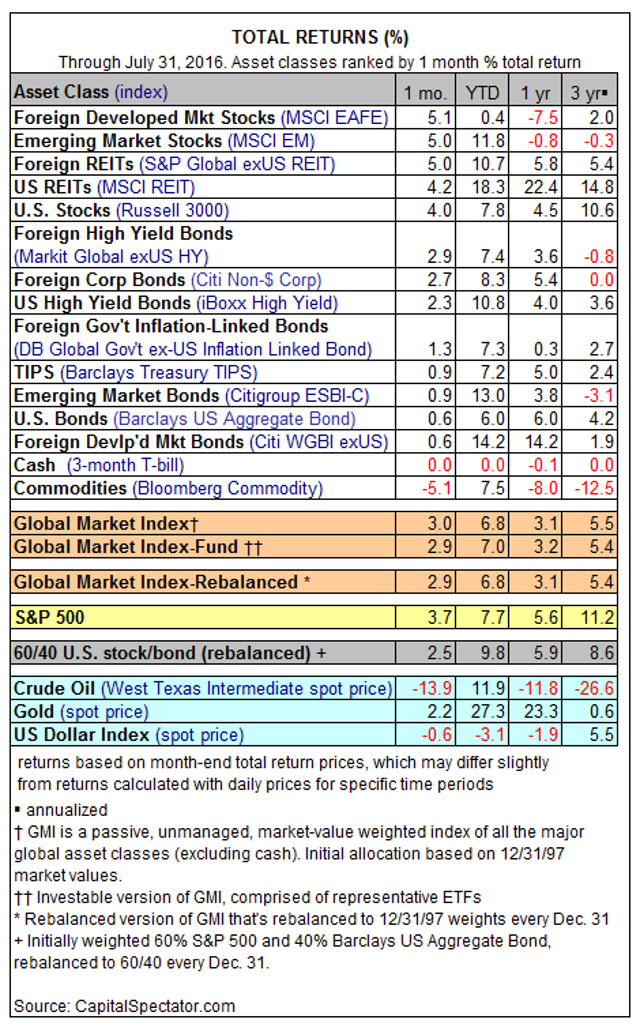
    Graphics from @Ted's original article from MarketWatch
    image
    image image
    http://seekingalpha.com/article/3994368-major-asset-classes-july-2016-performance-review
    BEIJING (Reuters) - A raft of global risks that could adversely affect the United States remains on the horizon and requires close monitoring, Dallas Federal Reserve Bank President Robert Kaplan said on Tuesday.
    Kaplan, along with several other Fed policymakers, has urged renewed caution in trying to lift rates again...
    "I am closely monitoring how slowing growth, high levels of overcapacity and high levels of debt to GDP in major economies outside the U.S. might be impacting economic conditions in the U.S.," Kaplan said at an event in Beijing.
    In his second appearance within a week, Kaplan, a centrist at the U.S. central bank, repeated that he continues to back tightening monetary policy in a gradual and patient manner.
    Chief among his concerns is sluggish U.S. growth exacerbated by a changing world in which economies are more globally interconnected.
    "It's going to take many years and maybe decades for China to manage through overcapacity and high levels of debt to GDP," Kaplan added. "I think sudden jarring traumas ... may make that adjustment more challenging."
    On Monday New York Fed President William Dudley, a permanent voter on the Fed's rate-setting committee, said that while it was "premature" to rule out a rate increase this year, negative economic shocks were more likely than positive ones.
    https://www.yahoo.com/news/feds-kaplan-urges-patience-raising-rates-points-global-115047772--business.html?ref=gs
    A Brief Note From G M O's Ben Inkster in their 2nd Quater Newsletter
    "So what can we do to protect portfolios ..."
    "a deeper analysis of what led returns to be disappointing for
    the asset classes that have lagged may help investors avoid the error of abandoning decent assets just when their time may be about to come."

    This is the nature of the discount-rate-driven gains for asset classes such as equities, bonds, and real
    estate. Beyond the discount rate change, it is still true that US equities have done surprisingly well,
    emerging equities surprisingly badly, and so on. But even if those “surprises” are permanent (and
    our guess is that for the most part they are not) the fact that the valuation of US equities has risen
    guarantees that the future returns to US equities from here will be lower than they would have been
    otherwise, and the same is true for all of the long-duration assets whose discount rates have fallen
    over the period.
    The most shocking hole that will be blown through people’s portfolios is if discount rates rise again
    fairly quickly. Even if the circumstance is one in which the global economy is doing well, the impact
    of a 1.5% increase in the discount rate on equities from here is a fall of over 30%, which would
    almost certainly be enough to swamp the earnings impact of the decent growth. For bonds, of course,
    there would be no possible counter to the discount rate effect. For a portfolio that is fully invested in
    long-duration assets (i.e., consists of a combination of stocks, bonds, real estate, and private equity),
    the possible performance implication is on the order of the falls experienced in the financial crisis –
    perhaps a 20-33% fall depending on the weightings – despite the fact that the global economy was doing just fine.
    So what can we do to protect portfolios against this possibility? One answer would be to hold cash, which, as a zero-duration asset, would be a beneficiary of rising discount rates. The trouble with cash, of course, is that if the discount rates do not rise, it is doomed to deliver little or nothing. What
    we would ideally like is to hold a short-duration risk asset – one where if nothing changes we are getting paid a decent return but where a rising discount rate will not destroy multiple years’ worth of
    returns. We believe alternatives fit the bill pretty well. If things hold together, we should expect to
    make money from activities such as merger arbitrage or exploiting carry trades or global macro. If the
    world does surprisingly well and causes investors to raise their expectations for discount rates, these
    strategies should be largely unaffected and could still make money. If we head into a severe recession
    or financial crisis, they will presumably lose money, as we saw in 2008, but that is no different from
    other risk assets. To be clear, I’m not arguing that the returns to alternatives are likely to be a lot
    higher than we have seen since 2009-10. Alternatives have been mildly disappointing since 2009, doing almost 1% worse than one might have expected. The more sobering truth is that the 4.2% return they have achieved since then simply looks pretty good given the other choices on offer, and
    their lack of vulnerability to rising discount rates is a comfort in a world where almost everything in
    a traditional portfolio is acutely vulnerable to discount rate rises should they happen.
    Today does not look like a great opportunity to reach for risk, despite the temptation in the face of unprecedentedly unattractive yields on government debt.....
    The charm of alternatives today is that we believe they should perform similarly in either the
    temporary or permanent shift scenario, and there are almost no other assets with expected returns
    above cash for which that is the case. The problem with alternatives is that they are more complicated
    to manage than traditional assets, generally have higher fees associated with them, and require more
    oversight. Normally, those problems are enough to make them less appealing than traditional risk
    assets such as equities and credit. Today, however, they seem well worth the extra effort. Their
    generally disappointing performance over recent years, rather than a sign to dump them once and for
    all, should probably be recognized as a signal of their potential utility in the market environment we face in the coming years.
    There is no panacea for the low returns implied by asset valuations today. Anyone suggesting
    differently is either fooling themselves or trying to fool you. But piling into the assets that have been the biggest help to portfolios over the past several years, as tempting as it may be, is probably an even worse idea than it usually is. And a deeper analysis of what led returns to be disappointing for
    the asset classes that have lagged may help investors avoid the error of abandoning decent assets just when their time may be about to come.
    https://www.gmo.com/docs/default-source/public-commentary/gmo-quarterly-letter.pdf?sfvrsn=30
    A Q R funds
    http://quicktake.morningstar.com/fundfamily/aqr-funds/0C000021ZL/fund-list.aspx
    Arbitrage funds
    http://quicktake.morningstar.com/fundfamily/arbitrage-fund/0C00001YYL/snapshot.aspx
    Long-Short Equity: Total Returns
    http://news.morningstar.com/fund-category-returns/long-short-equity/$FOCA$LO.aspx
    Multialternative: Total Returns
    http://news.morningstar.com/fund-category-returns/multialternative/$FOCA$GY.aspx

  • Investors Stampede Into These Funds As Stocks Hit All-Time Highs
    FYI: Forget Brexit, lackluster economic data and a contentious U.S. presidential election campaign, investors jumped into exchange-traded funds with both feet in July, with more than $50 billion flowing into every asset class, according to data provider FactSet.
    Regards,
    Ted
    http://www.marketwatch.com/story/investors-stampede-into-these-funds-as-stocks-hit-all-time-highs-2016-08-02/print
  • High Yield Closed End Bond Funds question for the learned
    My concern would be I don't think my trading skills are sufficient to double my money over a 20 year time frame every 4-5 years like my $7 cost basis provides me. Not many opportunities present themselves in the stock market to do that. My theory centers around long term compounding versus trading in and out. Dividend cuts etc would change my mind but since 2008 this one hasn't cut.
  • V.G. target date funds ?
    I received 2/nd Qt. 401-k statement & noted their target date returns for one year & ytd had fallen below their benchmark. 3, 5, & 10 year returns were above benchmark.
    Was this slip age due to V.G.'s reallocation from 30% to 40% in international equities, plus increase from 20% to 30% in fixed international income exposure during 2/2015 ?
    Thanks for any replies.
    Derf
  • High Yield Closed End Bond Funds question for the learned
    You're getting lost in the weeds.
    Here's a simple math problem to illustrate: Two trains are 100 miles apart, each traveling at 50 MPH. A bee, flying at 100 MPH starts at the first train, flies to the second train, reverses direction until getting back to the first, and so on, until it is squashed between the trains. How far does the bee fly?
    One could calculate the sum of the infinite series of flights that the bee makes from one train to another, or one could simply observe that the trains meet in an hour, in which time the 100MPH bee will have traveled 100 miles.
    Same idea here. You could calculate how much you'd make with what investments with what trades at what times, or you could simply ask: with the $70K you have now (7000 @ $10), what is the better investment - the fund you're in or a different fund? You could be holding the wrong fund at the wrong time whether that's the fund you currently own or a different fund.
    Your numbers do help with this decision. Consider: if your fund is currently yielding 14% ($10K/year on $70K market value), and the alternative funds are currently yielding 8%-10%, what is the market telling you?
  • High Yield Closed End Bond Funds question for the learned
    lets put some bad math to it. Bought 7000 shares at $7 in 2008. Rose to$17 in 2013. Roughly $70k profit plus $10k/yr in dividends (@20% yield) = $120k. The fund is choppy up and down since $17 peak but lowest it goes is $10. So at $10/sh I got $21K cap gain plus $50k dividends (not reinvested)= $71k plus $10k/yr for the foreseeable future. I get 20% yield at a $7 cost basis that will be tough to create a cap loss, while others get 8-10% yield reinvested in a new fund plus the chance of buying the wrong fund at the wrong time at a loss. At what point (timeframe) do I overtake the people who wanted to sell at $17 and attempted to reinvest? By now all you math majors are cringing at my mistakes, but you get my point. 401k so no taxes. You would be able to buy more shares of the new funds with the $120k profit if you sold. This would be a good website calculator ....assuming a constant share price and yield of the new fund purchased for the sake of answering the timeframe question.
  • 'Sell Everything,' DoubleLine's Gundlach Says
    “The artist Christopher Wool has a word painting, 'Sell the house, sell the car, sell the kids.' That’s exactly how I feel – sell everything. Nothing here looks good,” Gundlach said in a telephone interview. "The stock markets should be down massively but investors seem to have been hypnotized that nothing can go wrong."
    Just who is Gundlach addressing here?
    (A) 30-year old workers socking away money in a 401k or buying their first home?
    (B) 85-year old widows living on social security and pension?
    No to the first group and Yes/Maybe to the second.
    I'm always suspicious of these everything or nothing approaches. You're really exposing your *** big-time if you bet wrong.
  • The decline in interest continues to amaze me.

    @DanHardy I'm keeping inflation on the stove (on a "side burner") if only to keep myself honest. Is it starting, or is this only a meandering, to and fro? I don't think it's wise to bet too much on trend-following here. If the bond vigilantes become convinced that inflationary pressures are building up and here to stay, there won't be much the Fed will be able to do about it (and if they were to decide to try, I suspect it would have to be in a way that would be a "naked tell" they have been playing favorites all along). Get caught leaning, and there could be some hell to pay.
    May you live in interesting times. :)
    Well the work that comes to mind is stagflation - but not the '70s flavor - History may not repeat but it rhymes.
    There are key differences from the '70s.
    Now with have weak growth & that will continue
    image
    Now we have pass through of energy, food and service industries but not in other areas. "Free Trade" will help to keep imported goods prices down and keep US workers worried.
    image
    Now the worker does not have pricing power. They will have to suck up any price increases.
    image
    http://economistsview.typepad.com/economistsview/2008/03/frbsf-the-econo.html
    Bottom line - while we have inflation you have to look where it is coming from - e.g. health care and health insurance is much larger part of the US economy then it was in the '70s.
    So while we have inflation returning from the dead it is weak, we do not have the other aspects to make it a concern to bond prices. There is a lot of liquidity sloshing around the world looking for a return.
  • 'Sell Everything,' DoubleLine's Gundlach Says
    In one of his webcast in 2011, he told audience he had sold all his stock holding around 1150. I don't think his forecast for equity is good. He also has to close a doubline equity fund after poor performance.
  • The decline in interest continues to amaze me.
    How come we never hear from anyone who purchased lots of longterm T-bills 1988-1990? They are coming up pretty soon. Is this a case of 'investor returns'?
    G-fund since April Fool's '87 to last xmas was ~5.3% annually on average; SP500 was ~7.1% and with very different taxation, right? Who woulda thunk.
  • High Yield Closed End Bond Funds question for the learned
    "...(at a 20% cost basis yield) you would double your money ever 5 years..." At a 20% return per year, you would more than double your money every 4 years (1.2 raised to the 4th power equals 2.07+).
  • Oakmark reopens three funds to all investors
    I believe Snowball has written extensively about their virtues.
    He's featured ICMAX (April, 2016) and ICMUX (Mar. 2014), also adding a piece this month about ICMAX.
    The firm is doing a conference call Aug. 4. You can submit questions in advance.
    The fund purchases companies with at least a 20% discount to FV, holds 15-50 securities (currently 30), and, like the other funds at Intrepid, emphasizes absolute return and will hold cash when it cannot find suitable investments.
    I spoke with Ben Franklin, PM of ICMIX, earlier this month about how the fund is presently constituted and about some of the portfolio holdings. While the product is an all-cap one, the market cap is currently <400m with 95% in small and micro cap international companies because those areas offer the best value, he says. Currently, 46% of the holding are in Europe. He's reduced cash from around 23% at the end of Q1 to 13% at the end of 2Q and apparently found some enduring values somewhere! (my opinion) especially when the domestic "EV/EBITDA multiple on the Russell 2000 Index is 20X, while it was closer to 12x at the prior two market peaks (March 2000 and July 2007," according to Jayme Wiggins at Intrepid.
    Despite its all cap mandate, he expects that the fund will continue to emphasize international small cap value --the area he says that he came to prefer as a PM since joining Intrepid.
    The fund complements other micro/small cap but dissimilar, distinctive funds that I own, e.g., GPMCX.
  • City National Rochdale Multi-Asset Fund to liquidate
    Okay, that last remark got me curious, so I checked. In its category (the one I'm guessing Ted used - M* 30%-50% allocation), there were two funds that had worse 5 year records.
    One has continued its bottom 2% performance except in the past few months - PRADX (NTF at various brokers). M* rates it a bronze, ostensibly because it is a real return fund. (Sometimes M* tacitly acknowledges the limitations of its classification system.)
    The other is a familiar fund - PRPFX. For a fund that is supposed to offer stability (by investing in a broad mix of asset classes: gold/silver, Swiss francs, natural resources, growth, and US bonds), it has certainly gotten led around by gold. 98th percentile over 5 years, but top 1% over the past year.
  • High Yield Closed End Bond Funds question for the learned
    msf, agreed. Another thought...even if a bear market emerged and your NAV dropped to $55 from $100, (at a 20% cost basis yield) you would double your money ever 5 years perhaps negating the risk of holding through the $45/share loss. IOW's would this be approached differently if an investor never believed his $40 cost basis would ever be breached? I am looking at my old research notes from the depth of 2008. HYV was yielding 22.9% DHF 21.3% SBW 16% HYT 22.1%. Incredible. I am not recommending the funds. No need to comment on the funds...simply examples of yields during that brief period of time. The one caveat is cuts in dividend thru economic cycles.
  • Oakmark reopens three funds to all investors
    As an investor in Oakmark funds for the past 20 years or so, specifically the international funds, I am not happy to hear this. Both OAKIX and OAKEX performance has suffered recently and I am fairly certain that asset bloat with OAKIX at 23.5 billion AUM and OAKEX at 2.4 billion AUM has been a factor on this poor performance. OAKEX in particular hasn't beaten it arrivals for last 1 yr, 3 yr, 5yr , or 10 yr periods. But I believed in the management and stuck with them all the years albeit cutting back on my exposure to OAKEX to about 25% of my original investment. But I think this may finally bring me to sell the remaining holdings in the fund. I originally invested in OAKEX to get small cap international value/blend exposure which was not offered in my 401K selections which only had foreign LC and Emerging Market as investment options. But now I believe their are several better options in the SC International arena. Funds such as ICMIX, ISMRX, and SBSHX all appear to be more compelling options in the international SC area with ICMIX probably being the standout option IMHO. So while I am glad that Oakmark believes that have some many good investment options, I am saying good bye to at least to OAKEX. So be warned since I am planning on selling OAKEX next year they probably return to stellar performance against their peers - just my luck. Disclosure I currently own 4 Oakmark funds - OAKLX, OAKWX, OAKIX, and OAKEX.
    I'm not that familiar with Intrepid... What is it that you like so much about them, other than performance?
  • VDIGX: closed
    Meh. Not seeing what size has to do with it, pro or con.
    "Investors have poured $3 billion into the fund over the past six months and its assets have nearly doubled in the past three years"
    Don Kilbride runs a concentrated portfolio of around 45 high quality stocks. Theoretically, by closing the fund, he can continue to beat the index by investing in his best ideas at a price point that he finds acceptable. Kilbride either believes that he can not effectively employ more assets at this time or he believes that he is bringing home enough income.
    Of course, the management team of PRBLX seems to feel differently by keeping their fund open, but the fund is also 1/3rd the size of VDIGX.
    Mona
  • The decline in interest continues to amaze me.
    The US 10 year below 1.5%
    I took a look at HYG and the trend in its dividend pay out down 21.4% in 4 years from Aug '12 to June '16
    https://finance.yahoo.com/quote/HYG/history?period1=1343620800&amp;period2=1469851200&amp;interval=div|split&amp;filter=div&amp;frequency=1d
    I don't see that trend changing. The implications are not good for all the new retirees looking for income.
    Where people are searching for yield?
    http://www.marketwatch.com/story/emerging-market-debt-funds-just-had-a-record-4-week-buying-boom-2016-07-29
  • Oakmark reopens three funds to all investors
    They also announced that Rob Taylor will be ... retiring? I wonder what's up with that; he can't be more than 45.
  • Gundlach Bond Fund Trails Rivals As Mortgage Focus Pinches
    FYI: (Click On Article Title At Top Of Google Search)
    Star bond investor Jeffrey Gundlach’s flagship fund has been slowed by a rally in the types of bonds it has avoided, putting its performance this year behind most comparable funds.
    The $61.1 billion intermediate-term DoubleLine Total Return Bond Fund has gained 3.5% this year through July 28, while the Barclays U.S. Aggregate Bond Index has shot up 5.7% and the average intermediate-term fund has risen 5.6%, according to Morningstar Inc
    Regards,
    Ted
    https://www.google.com/#q=Gundlach+Bond+Fund+Trails+Rivals+as+Mortgage+Focus+Pinches+WSJ