Howdy, Stranger!

It looks like you're new here. If you want to get involved, click one of these buttons!

Here's a statement of the obvious: The opinions expressed here are those of the participants, not those of the Mutual Fund Observer. We cannot vouch for the accuracy or appropriateness of any of it, though we do encourage civility and good humor.
  • Could Mutual Fund Sneakiness Be Costing You 4% Per Year?
    Hi Guys,
    It is no shock that mutual fund organizations work very hard to embellish their funds annual returns. One only wishes that these funds work equally hard at actually delivering superior returns to their loyal investor base. Hope springs eternal!
    The referenced article identifies a handful of tricks and gimmicks that fund managers can deploy to nudge the returns needle in the slightly more positive direction. Yes, these devices do make an impact, but only at the margins. Additionally it is a futile effort because a simple performance measurement and a comparison standard are easily accessible to all investors: these are the annual returns and an appropriate benchmark. These two values integrate all the investment wisdom and investment decisions into simple numbers.
    Most investors are most influenced by these two obvious metrics. I really don’t commit much precious time in identifying a funds specific portfolio holdings or their individual buy/sell records. That extra effort defeats one main reason for investing in mutual funds; allowing the fund manager to really manage his fund.
    Mutual fund buyers are slowly recognizing the futility of active fund managers. Money is flowing away from active funds towards passive fund products and ETFs.
    I doubt that active fund managers are robbing investors of 4% in returns because of unethical tactics. Yes, some tactics add to the cost structure, but insightful stock selections ameliorate their impact. The reference paper emphasizes the minor bushes and not the tall trees that dominate the forest. The referenced article is gilding the lilly.
    Active funds annually underperform their passive benchmarks on average, sometimes by rather large margins. Here is a Link to a nice Morningstar paper that addresses this issue:
    http://corporate.morningstar.com/US/documents/ResearchPapers/MorningstarActive-PassiveBarometerJune2015.pdf
    The paper certainly doesn’t make the case for the active mutual fund community. But exceptions do exist, and these exceptions have benefited their customers for long investment periods. Good for them, better for their clients. Indeed, hope springs eternal!
    Best Wishes.
  • Someone Made A Big Bet On Small ETF That Treasuries Rally On
    FYI: Less than two hours before U.S. Federal Reserve Chair Janet Yellen took center stage last week, an obscure exchange-traded fund managed by Pacific Investment Management Co. was the site of aggressive speculation on the rally in Treasuries.
    Regards,
    Ted
    http://www.fa-mag.com/news/someone-made-a-big-bet-on-small-etf-that-treasuries-rally-on--1-27567.html?print
  • Pathway Advisors Aggressive Growth and Conservative Funds to liquidate
    https://www.sec.gov/Archives/edgar/data/915802/000091580216000166/stickerpathwayfundsliquidati.htm
    497 1 stickerpathwayfundsliquidati.htm
    FINANCIAL INVESTORS TRUST
    PATHWAY ADVISORS AGGRESSIVE GROWTH FUND
    PATHWAY ADVISORS CONSERVATIVE FUND
    Supplement dated June 20, 2016
    to the
    Prospectus and Statement of Additional Information, each dated August 31, 2015,
    for the Pathway Advisors Aggressive Growth Fund and Pathway Advisors Conservative Fund,
    each a series of Financial Investors Trust (the “Trust”)
    The Board of Trustees (the “Board”) of the Trust, based upon the recommendation of Hanson McClain, Inc. (the “Adviser”), the investment adviser to the Pathway Advisors Aggressive Growth Fund and Pathway Advisors Conservative Fund (the “Funds”), each a series of the Trust, has determined to close and liquidate the Funds. The Board concluded that it would be in the best interests of each Fund and its shareholders that such Fund be closed and liquidated as series of the Trust effective as of the close of business on July 15, 2016.
    The Board approved a Plan of Termination, Dissolution and Liquidation (the “Plan”) that determines the manner in which each Fund will be liquidated. Pursuant to the Plan and in anticipation of each Fund’s liquidation, each Fund will be closed to new shareholder purchases effective as of the close of business on June 30, 2016 and closed to all existing shareholder purchases on July 5, 2016. However, any distributions declared to shareholders of a Fund after June 30, 2016, and until the close of trading on the New York Stock Exchange on July 15, 2016 will be automatically reinvested in additional shares of the Fund unless a shareholder specifically requests that such distributions be paid in cash. Although each Fund will be closed to any new purchases as of July 5, 2016, you may continue to redeem your shares of a Fund after July 5, 2016, as provided in the Prospectus. Please note, however, that each Fund will be liquidating its assets as of the close of business on July 15, 2016.
    Pursuant to the Plan, if a Fund has not received your redemption request or other instruction prior to the close of business on July 15, 2016, the effective time of the liquidation, your shares will be redeemed, and you will receive proceeds representing your proportionate interest in the net assets of the Fund as of July 15, 2016, subject to any required withholdings. As is the case with any redemption of fund shares, these liquidation proceeds will generally be subject to federal and, as applicable, state and local income taxes if the redeemed shares are held in a taxable account and the liquidation proceeds exceed your adjusted basis in the shares redeemed. If the redeemed shares are held in a qualified retirement account such as an IRA, the liquidation proceeds may not be subject to current income taxation under certain conditions. You should consult with your tax adviser for further information regarding the federal, state and/or local income tax consequences of this liquidation that are relevant to your specific situation.
    All expenses incurred in connection with the transactions contemplated by the Plan, other than the brokerage commissions associated with the sale of portfolio securities, will be paid by the Adviser.
    Please retain this supplement with your Prospectus and Statement of Additional Information.

  • :Historical Returns Versus Investor Returns
    Hi Guys,
    The referenced article that presents the shortfalls of investor returns relative to market rewards in the 1950s doesn't adequately document this highly persistent pattern. The individual investor shortfall is a reality across all decades. It is surely not restricted to that decade alone.
    DALBAR has reported this wealth limiting private investor handicap for many years now. In any given year, individual investors recover only 30% to 50% of equity market returns. We historically do not score well, and very often don't recognize our poor performance.
    I suppose we are frequently overconfident of our capabilities in this challenging arena. Even most fund managers underperform. Our hubris limits our ability to properly score ourselves. We don't beat the odds.
    Study after study demonstrates that as investors we suck wind big time. I mostly gave up this losing fight a number of years ago. I spend far less time worrying the marketplace and specific investment decisions these days. I'm heavily into Index products. Life is much easier now!
    EDIT: It would likely be a good practice to check our Egos before making an investment decision. That's easy to say but is a high hurdle for many of us. Fortunately I was never the smartest person in any and all rooms.
    Best Wishes.
  • 3rd quarter q3 portfolio -mf newsletter t. madell
    Hi @johnN,
    I enjoy reading Dr. Madell's monthly newsletter and this month was no exception.
    This month I averaged all the model portfolio's recommened asset allocations for cash, bonds and stocks. With this, for his three models, stocks averaged 45%, bonds 40% and cash 15%. Not sure if this has any great meaning but it is something I have been doing for the past couple of years in an attempt to follow the true shift in his asset weightings between stocks, bonds and cash.
    When I detect a shift in his averages I then check my allocation to see where I stand in relation to his averages. Currently, we are the same for stocks at 45%, he is heavier in bonds at 40% and I am at 25%; and, I am also heavier in cash than he is. But wait, his model allocations are for the buy and hold investor and my weighting allows for some near term movement by using an adpative allocation model and strategy. In general, when stocks are expensive I hold less of them and when they are cheap I hold more of them thus rebalancing my equity allocation downward as stocks, in general, become more and more expensive.
    My allocation model and investment sleeve system also allows for a seasonal strategy and its positioning along with taking advantage of market pullbacks and the associated swing. However, since bonds are not currently providing much yield and might soon face a rising interest rate environment I have chossen to carry a heavier cash allocation than normal this year thus foregoing my usual shift into bond funds from equity funds throuh nav exchanges. Since, I parked the cash proceeds from the sale of equity funds in the respective fund family's money market fund I can buy their funds again at nav without paying another commission or transaction fee. In addition, I pay no wrap fee on my accounts. With this, what some state and consider to be a high cost due to the frontend sales load, on the first purchase, actually turns out to be a low cost way to invest for an active investor, like myself, that likes to reconfigure their portfolio from time-to-time due to market movement and seasonal trends.
    And, so it goes.
  • :Historical Returns Versus Investor Returns
    FYI: The 1950s were a great time to be an investor. It was the only decade where stocks began at the lows and finished right near the highs. Furthermore, the total return on the S&P 500 was 486%, the strongest of any decade ever.
    Regards,
    Ted
    http://theirrelevantinvestor.com/2016/06/15/historical-returns-versus-investor-returns/
  • 'GLD' YTD Inflows Top $10 Billion, 'HYG' Loses Big
    A Little History
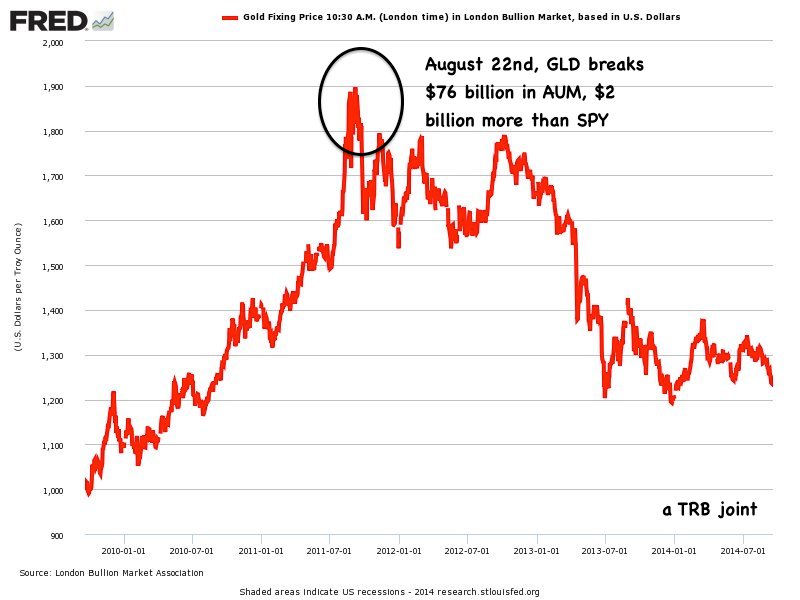
    ...a moment in time at the end of the summer of 2011 during which the investor class had temporarily lost its collective mind.
    Investors, you see, had pushed the assets under management in State Street’s GLD Etf to a higher level than the assets held in its S&P 500 Etf (SPY). In other words – investors had decided, in the aggregate, that securitized rocks were worth more than the entirety of American capitalism and free enterprise.
    The combined productive fruits of American business and labor were, for a moment, worth less to investors than a paper precious metal proxy.
    August 22nd 2011
    image
    http://thereformedbroker.com/2014/09/18/that-time-three-years-ago-when-investors-temporarily-lost-their-minds/
    Today
    image
    SPY
    As of 06/16/2016
    Price $208.38
    Shares Outstanding 876.68 M
    Total Net Assets $182,685.64 M
    GLD Last Sale
    US $123.97
    Gold spot price
    Bid
    US $1,298.45
    Ask
    US $1,298.85
    Total gold in trust
    Tonnes
    907.88
    Ounces
    29,189,217.78
    Value US$
    37,667,845,243.64

    I recently trimmed my precious metal holdings @ a ( long waited ) profit. Now < 5% of investable assets, mostly TGLDX and PSAU
  • 'GLD' YTD Inflows Top $10 Billion, 'HYG' Loses Big
    FYI: On the whole, investors continued to pour money into U.S.-listed exchange-traded funds this week. About $5 billion entered ETFs as a whole, with most of the money going into U.S. equity products, according to FactSet data. On the other hand, fixed-income ETFs saw a sizable outflow—$960 million—but that was all due to one product in particular.
    Regards,
    Ted
    http://www.etf.com/sections/weekly-etf-flows/weekly-etf-flows-2016-06-16-2016-06-10
  • Consuelo Mack WealthTrack Preview: Guest Francois Trahan, Co-Founder, Cornerstone Macro
    FYI:
    Regards,
    Ted
    June 16, 2016
    Dear WEALTHTRACK Subscriber,
    This week’s guest is telling clients to forget everything they’ve learned about investing, that the old rules are about to fail them and that we are in a new era.
    Interested? I am! So I invited Francois Trahan to join us for an exclusive WEALTHTRACK interview.
    Financial Thought leader Trahan is Co-Founder and Head of the Investment Strategy team at Cornerstone Macro, an independent macro research and strategy firm he and his partners launched in 2013. Trahan was ranked the #1 Portfolio Strategist by Institutional Investor magazine in 2015 for the fourth year in a row, as he has been for nine out of the last twelve years. As one institutional investor, who voted for Trahan told the magazine: “Francois is not afraid to make a bold call or to change his position when the data indicate that it is right to do so”.
    Among his recent bold calls was turning bullish on the stock market late last year, predicting a “global recovery, weaker dollar and higher oil prices” would drive stock markets higher when the exact opposite was happening. Needless to say he turned out to be right as the S&P 500 hit new highs last week.
    By far his boldest thesis is a macro one, which he characterizes as the most important in his career. According to Cornerstone Macro’s research, the economy has moved from the era known as the Great Moderation, also known as the “Goldilocks” period during the 1980s, 1990s and until the financial crisis, when inflation was tamed, interest rates declined and household debt increased, to the current era marked by deflation concerns, still declining interest rates and falling household debt.
    The Great Moderation also resulted in declining crisis risk - by one measure to the lowest level in 100 years - which totally reversed during the financial crisis, to the current era of elevated crisis risk.
    I asked Trahan what these changes mean for the markets and why they require a new investment approach.
    In my EXTRA interview with Trahan, available exclusively on our website, he will explain why he is watching for signs of inflation when everyone else is focusing on the risk of deflation. If you’d like to watch the show before the weekend it’s available to our PREMIUM viewers right now. You can also find the One Investment picks of our guests and my Action Points there.
    Thank you so much for watching. Have a happy Father’s Day this weekend! Make the week ahead a profitable and a productive one.
    Best Regards,
    Consuelo
  • DoubleLine's Gundlach: 'Rate-Hike Cycle Has Left The Building'
    @Old_Joe I think maybe that bottom guy has sent me and others to "the wood shed" several times ?
    Mr Gundlach has made the point several times about the Fed moving the goal posts.
    Lisa Abramowicz is a Bloomberg Gadfly columnist covering the debt markets.6/14 2016
    OPEN MARKET
    The One Thing the Fed Should Say, But Doesn't
    The Fed says its time for the U.S. to have higher rates, yet foreign money keeps flooding into the country as investors seek reprieve from negative-rate policies in Japan and Europe. This has kept American borrowing costs low despite rising U.S. inflation and Fed chatter about lifting benchmarks.
    FED FUTURE
    ...in talking about global risks in their formal statements, although those always seem to be changing. Is China the problem? Is it Brazil? Or is it the concern that Britain may exit the European Union?
    This backdrop paints a picture different from any other in the Fed’s history and calls for a new approach. The U.S. needs to communicate directly to traders and economists how it evaluates global risks and plans to cooperate with other top central bankers, who are engaged in stimulus efforts. It needs to acknowledge that it can’t meaningfully raise rates without some explicit coordination with other central banks around the world.If the Fed tries to go it alone, it risks spurring market turmoil that could derail both the U.S. and global economies. It can't afford to do that right now.
    http://www.bloomberg.com/gadfly/columnists/AQJIVP98p_c/lisa-abramowicz/articles/2016-06-14/the-one-thing-the-federal-reserve-should-say-but-doesn-t
    Mr Gundlach showed a slide in yesterday's presentation concerning rising home safe sales in Japan. How do you say "home safe" in German ?
    image
  • DoubleLine's Gundlach: 'Rate-Hike Cycle Has Left The Building'
    @Ted Nice pic. Crusty Chicago guy that you are ,I thought you might resemble Da Coach !
    image image
  • Ten Simple Rules for Investors
    Hi Guys,
    I almost always prefer and select simple over complex. Too, too much can go South with complex investment strategies. A ton of financial experts agree with that investment philosophy.
    There is the danger of oversimplification. However, here is a list of Ten Simple Rules for Investors advocated by one such famous expert. I won’t name that expert just yet, but if you have any doubts, those doubts will be completely eliminated by Rule number 10. Here is the list:
    1. Remember Reversion to the Mean
    2. Time Is Your Friend, Impulse Is Your Enemy
    3. Buy Right and Hold Tight
    4. Have Realistic Expectations
    5. Forget the Needle, Buy the Haystack
    6. Minimize the Croupier’s Take
    7. There’s No Escaping Risk
    8. Beware of Fighting the Last War
    9. The Hedgehog Bests the Fox
    10. Stay the Course!
    Yes, these are rules generated by Jack Bogle. Simple enough to understand, but sometimes extremely difficult to execute.
    Here is the Link to Bogle’s Chapter 9 of “The Clash of Cultures” book that contains his rules of the road:
    http://johncbogle.com/wordpress/wp-content/uploads/2013/05/c09.pdf
    Enjoy. Bogle is forever a stimulating read with solid investment advice. If there is one constant in the investment universe, that constant is Jack Bogle. He is a rock. Take care everyone.
    Best Regards.
  • DoubleLine's Gundlach Says 'Central Banks Are Losing Control'
    Mr Gundlach started with this slide.Her artwork makes him dizzy. As does I guess the world's central bankers
    Bridget Riley was born in London in 1931. She became best known in the mid-1960s for her dazzling black and white abstract art pieces, exploiting contrast, tension and optical illusions. Her style became known as “op art” for that reason. She featured repeating geometric shapes, inter-locking, developing, vibrating, and tricking the eye into a sense of movement beyond anything seen before in a painting.
    image image
    Central Banks:Get back to reality,not theory.
    Negative rates are by definition deflationary and part of the problem.
    Back to the 1800's .Banks will be bled to be cured.Absolutely impossible for banks to be profitable in a negative interest environment.
    Negative interest rates may go down as the "plague"
    of the 21st century.
    "Junk' not expensive ,but sees defaults rising and bankruptcy recovery rates declining.
    Mr Trump will be elected president.Questioned about the polls and 3-1 chances of that happening". He was 500-1 a year ago,the trend is his friend !"
    Buying opportunity in risk assets as market fears digest Trumps ascendancy late this summer.
    @FundStudent said Is gold appreciation solely due to lost faith in central banks?
    Gundlach paraphrased::Gold rises with a no confidence vote of central bankers and falls if central bankers are seen as stewards of economic growth and stability without constantly moving the goalposts for interest rate movement. Still forecasts gold to touch $1400 this year.
    Reiterated long term belief in India.
    Said Ronald Reagan's slogan in the '80's was "Let's make America great again" and once elected,exploded G'ment spending. Sees this happening with Mr Trump.Helicopter money will be coming !
    Wouldn't Mr Gundlach look quite snappy wearing this to Mr Trump's inaugural !
    image
    https://www.levinehat.com/collections/bailey-hats/products/bailey-milo-103210
  • It's possibly time to up your GASFX allocation
    Nat Gas Notables
    Western Colorado has 40x more natural gas than previously thought, potentially making it the second-largest formation in the U.S., according to a new estimate from the U.S. Geological Survey.
    Current prices of ~$2/MMBtu are considered too low for companies to begin drilling to any large extent; companies likely would begin drilling if prices reached $3.50/MMBtu, says David Ludlam of the West Slope Colorado Oil and Gas Association.
    Among Colorado's top current oil and gas producers: APC, NBL, ECA, XOM, CVX, OXY, WLL, BBG, SYRG, PDCE, BCEI, CRZO
    http://seekingalpha.com/news/3188430-colorado-40x-natural-gas-previous-estimates-usgs-says
    From Bloomberg
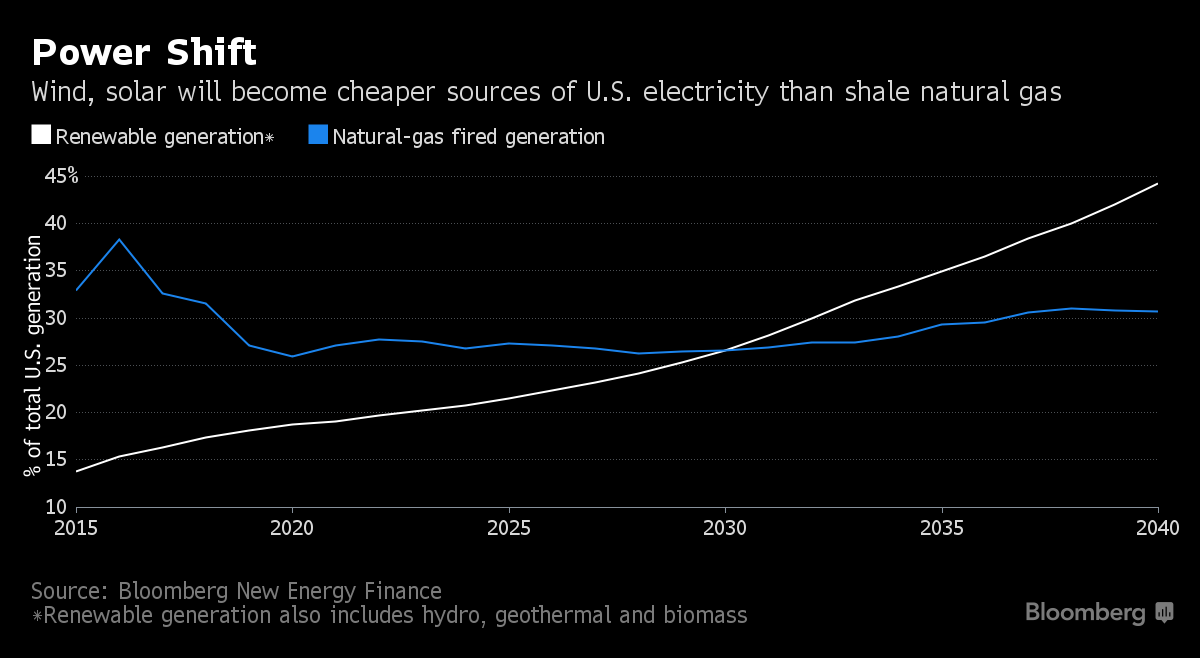
    Renewables Will Replace Gas as Top U.S. Power Source in 2031
    a Bloomberg New Energy Finance analysis showed. (Green and left leaning source ? )
    Naureen Malik .bloomberg.com
    By 2040, renewables will account for 44 percent of U.S. power generation from 14 percent in 2014. Gas generation will slip from 33 percent to about 30 percent in the period. Coal’s share will drop by almost two-thirds to just 12 percent.
    image
    Over or under the wall ?
    Spectra, TransCanada to build $3.6B natural gas pipeline into Mexico
    The projects will feed cheap shale gas from Texas to Mexico to help meet the country’s growing electric generation needs. Mexico is building more gas-fired power plants.
    The Sur de Texas pipeline will be a joint venture between TransCanada and a Mexican subsidiary of San Diego-based Sempra Energy.
    “We are extremely pleased to further our growth plans in Mexico with one of the most important natural gas infrastructure projects for that country’s future,” said Russ Girling, TransCanada’s president and CEO.
    http://fuelfix.com/blog/2016/06/13/spectra-transcanada-to-build-3-6b-natural-gas-pipeline-into-mexico/
    I own TEP in this space. The only M L P I've had any success with (so far ) Assets in gas transmission including Western CO.
  • Vanguard Group Employee Dividend Rises 12 Percent
    USAA paid well also from January 26, 2016 article:
    http://www.mysanantonio.com/business/article/San-Antonio-based-USAA-announces-annual-6785116.php
    Excerpt:
    "...Workers will receive a bonus equal to 17 percent of their annual base pay for 2015, snapping a string of six straight years that the award has been 18.4 percent or higher. The bonus was 18.7 percent in 2014."
    Must be all of those commercials during televised sporting events.
  • Vanguard Group Employee Dividend Rises 12 Percent
    FYI: Top mutual fund provider Vanguard Group raised the value of a profit-sharing dividend paid to employees by 12 percent for 2015 as investors poured in assets, the editor of a newsletter following the Pennsylvania company said on Thursday.
    Regards,
    Ted
    http://wealthmanagement.com/print/industry/vanguard-group-employee-dividend-rises-12-percent-newsletter
  • John Waggoner: Mutual Fund Born During Great Depression Proves The Value Of Buy-And-Hold
    I like the idea of LEXCX (and owned it at one time) but a M*-reported 0.53 ER for an unmanaged fund is outrageous.
  • John Waggoner: Mutual Fund Born During Great Depression Proves The Value Of Buy-And-Hold
    I'm likely the only one who cares about this, but LEXCX is not a mutual fund. It is a unit investment trust (albeit organized under the 1940 Investment Company Act, like mutual funds). IMHO it is much closer to a HOLDR than to a mutual fund (in the sense of portfolio construction, not legal structure).
    Here's a column discussing the different structures of investments (in the context of ETFs):
    https://www.merrilledge.com/article/is-etf-really-a-fund-maybe-not
    LEXCX is unmanaged. That is an attribute of a UIT, in contrast to a mutual fund (even an index fund). The Sponsor (currently Voya Investments) has the responsibility of complying with the rules of the trust (e.g. dealing with mergers and spinoffs). The Trust is set to terminate on Nov. 30, 2100, or when its last portfolio security goes poof!
    There is no table of expenses, no SAI. (The trust agreement provides that the sponsor be paid 0.40% of AUM for doing no management, just caretaking. Not even holding the securities - a separate Trustee gets a separate fee for that.)
    I'm not saying this vehicle hasn't done well. Just that it isn't a mutual fund, and like HOLDRs will gradually become more and more concentrated. (It started with 30 companies, and is down to 22).