Howdy, Stranger!

It looks like you're new here. If you want to get involved, click one of these buttons!

Here's a statement of the obvious: The opinions expressed here are those of the participants, not those of the Mutual Fund Observer. We cannot vouch for the accuracy or appropriateness of any of it, though we do encourage civility and good humor.
  • Pimco Dethroned As Emerging-Market Bond King
    FYI: Pacific Investment Management Co. has lost its title as manager of the world’s largest emerging-market bond fund, battered by ill-timed bets that fueled an investor exodus.
    Regards,
    Ted
    http://www.bloomberg.com/news/articles/2015-11-17/pimco-loses-emerging-market-bond-king-crown-as-assets-drop-62-
    M* Snapshot PAEMX: http://www.morningstar.com/funds/XNAS/PAEMX/quote.html
  • Schwab Slashes Minimums On OneSource NTF Mutual Funds
    At least Schwab now charges the fee only on the front end. If you wanted to take some profits, rebalance, etc. the $49.95 they used to charge on the redemption end (for any amount) was steep.
    And I don't like plunking down $100k all at once for any fund...not a good market timer.
    But Schwab charges a ridiculous $75.95 for purchasing TF funds whereas Fido charges $49.95, also with no fee for redemptions.
  • Schwab Slashes Minimums On OneSource NTF Mutual Funds
    At least Schwab now charges the fee only on the front end. If you wanted to take some profits, rebalance, etc. the $49.95 they used to charge on the redemption end (for any amount) was steep.
    And I don't like plunking down $100k all at once for any fund...not a good market timer.
  • Schwab Slashes Minimums On OneSource NTF Mutual Funds
    Many investors look at that $50 fee and think "why should I pay this, when I can get the same fund for 'free' (NTF)?"
    If they're looking at investing $5K in a TF fund, they may be right. $50/$5K is 1% and typically buys an ER reduction of 0.25%. That's four years to break even. For a true long term investor, four years is nothing, but I suspect most investors look at that as "forever" , i.e. too long.
    If anything, it seems that the minimums on institutional funds at brokerages seems to be going up (as contrasted with the increasing availability of load-waived retail funds). That could be due to the pricing structure imposed on TF funds. They pay fees, too.
    0.10% of AUM or $20/account/year is what Schwab charges TF funds. The same sort of calculation as above applies to the what these funds pay. For high min funds, $20/year is peanuts. Drop the min below $20K, and the funds might as well just pay Schwab 0.10%/year to sell institutional shares. That's a big bump in expenses for this share class.
    http://www.schwab.com/public/schwab/nn/legal_compliance/compensation_advice_disclosures/schwab_compensation.html#transaction_fee_funds
  • The Fairholme Allocation Fund reopening to new investors
    The minimum is 25K, so any advantage if it is exists is meaningless to me. I'm only in FAIRX because I was able to get in cheaper and I have never invested distributions back.
  • Valeant Takes Bite Out Of More Funds
    FYI: Amid the steep declines in the stock price of Valeant Pharmaceuticals International Inc., losses suffered by its largest shareholder, Sequoia Fund Inc., and by activist investor William Ackman have been well documented. But there are plenty of other funds that have likely been hit by the drop in the company’s shares.
    Regards,
    Ted
    http://blogs.wsj.com/moneybeat/2015/11/17/valeant-takes-bite-out-of-more-funds/tab/print/
    VRX: Major Owners
    http://investors.morningstar.com/ownership/shareholders-major.html?t=VRX&region=usa&culture=en-US&ownerCountry=USA
  • Schwab Slashes Minimums On OneSource NTF Mutual Funds
    Don't think so. Most investors have difficulty paying $50 transaction fee (at least at Fidelity) to buy institutional mutual funds with higher $ minimum than $2,500. And there are additional fees for subsequent purchases.
  • AQR Style Premia Alternative II Fund in registration
    What is the difference with the new fund? Perhaps they are planning to close the existing fund and put new investors in this one instead?
    QSPIX has done very well since it opened. Even more so for the related QMNIX. These were on my watchlist, but recently AQR seems to have made it more difficult to access them for less than the $1m/$5m minimums. See the discussion here: https://www.bogleheads.org/forum/viewtopic.php?t=175359
    Seems like Scottrade is one of the few available options right now.
  • Checking In On The Robo Advisors With Year-to-Date Results -- Frank Zorrilla's Blogspot
    I invested a third of my IRA in the Schwab intelligent portfolio at about a 60/40 mix. I invested in June of this year. I input the portfolio into M*. As of today the Schwab portfolio YTD is down -2.85%. Not sure when the data you show is from, likely end of 3rd quarter.
    Looking at the data Zorilla included in the table at the link I posted, it appears that data runs through 11/13. But, in checking Zorilla's data, it indicates -- as an example -- that the share price change for BNDX is at -0.32% through closing on 11/13. But, in checking at M*, that site indicates the total return on BNDX is at 0.88% through 11/13. So, there is a difference of 1.20% related to reinvesting the dividends for BNDX. Zorilla's returns appear to only reflect changes in share prices. So, they understate the total returns through 11/13 (assuming dividends are reinvested in the same ETFs with no rebalancing).
  • Checking In On The Robo Advisors With Year-to-Date Results -- Frank Zorrilla's Blogspot
    I invested a third of my IRA in the Schwab intelligent portfolio at about a 60/40 mix. I invested in June of this year. I input the portfolio into M*. As of today the Schwab portfolio YTD is down -2.85%. Not sure when the data you show is from, likely end of 3rd quarter.
    The big losers were, large company EM equity -15%, EM bonds -13%, diversified EM equity -12% and gold -10%. Those 4 investments represent 5%, 5%, 3% and 5% of the total respectively.
  • The Fairholme Allocation Fund reopening to new investors
    http://www.sec.gov/Archives/edgar/data/1096344/000091957415008282/d6136779_497.htm
    497 1 d6136779_497.htm
    FAIRHOLME FUNDS, INC.
    The Fairholme Fund
    The Fairholme Focused Income Fund
    The Fairholme Allocation Fund
    Supplement dated November 17, 2015 to the Prospectus of The Fairholme Fund dated March 27, 2015, the Prospectus of The Fairholme Focused Income Fund dated March 27, 2015, and the Prospectus of The Fairholme Allocation Fund dated March 27, 2015 and the Summary Prospectus of The Fairholme Allocation Fund dated March 27, 2015.
    The Board of Directors of Fairholme Funds, Inc. has approved the re-opening of The Fairholme Allocation Fund (NASDAQ: FAAFX) ("The Allocation Fund") to new investors. Effective November 18, 2015, The Allocation Fund will offer its shares to new investors and begin accepting orders for the purchase of Fund shares from new investors.
    The first four paragraphs under "Purchase and Sale of The Allocation Fund Shares" in the summary section of the Prospectus and Summary Prospectus of The Allocation Fund are deleted in their entirety and replaced with the following paragraph:
    Purchases of shares of The Allocation Fund are subject to the following minimum investment amounts (which may be waived by the Manager in its discretion):
    The following paragraph is added as the second to last paragraph under "Purchase and Sale of The Allocation Fund Shares" in the summary section of the Prospectus and Summary Prospectus of The Allocation Fund:
    The Allocation Fund reserves the right to limit the sale of shares to new investors and existing shareholders at any time. The Allocation Fund may reject any order to purchase shares, and may withdraw the offering of shares at any time to any or all investors.
    * * *
    The first five paragraphs under "HOW TO BUY SHARES OF THE FUNDS" in the Prospectus of The Fairholme Fund, the Prospectus of The Fairholme Focused Income Fund and the Prospectus of The Allocation Fund are deleted in their entirety and replaced with the following paragraph:
    Shares of each Fund are available for purchase by both new investors and existing shareholders. Each Fund may reject any order to purchase shares, and may withdraw the offering of its shares at any time to any or all investors.
    * * *
    YOU SHOULD RETAIN THIS SUPPLEMENT WITH YOUR PROSPECTUS AND SUMMARY PROSPECTUS FOR FUTURE REFERENCE.
  • Checking In On The Robo Advisors With Year-to-Date Results -- Frank Zorrilla's Blogspot
    @davfor Thanks! I was wondering how the Schwab robo-advisor was doing.
    You're welcome. I was wondering about that too......
  • Checking In On The Robo Advisors With Year-to-Date Results -- Frank Zorrilla's Blogspot
    "We all know how miserable it's been recently for some hedge funds, now it's time to look at some Robo Advisors. These portfolios vary depending on the needs and risk tolerance of the investor, but you can get a feel for what the returns might look like for a conservative or moderate investor. I'm using the allocation of a recent Wall Street Journal article."
    image
    The year-to-date results for the first three of these are:
    "Schwab Intelligent Portfolios.... this particular mix is down 5.16%.
    Betterment's mix is....down 3.66%.
    Wealthfront ...this particular mix is down 5.15% year to date."
    See: Frank Zorilla and WSJ
  • How to Invest in a Slowing China World -- GaveKal Capital
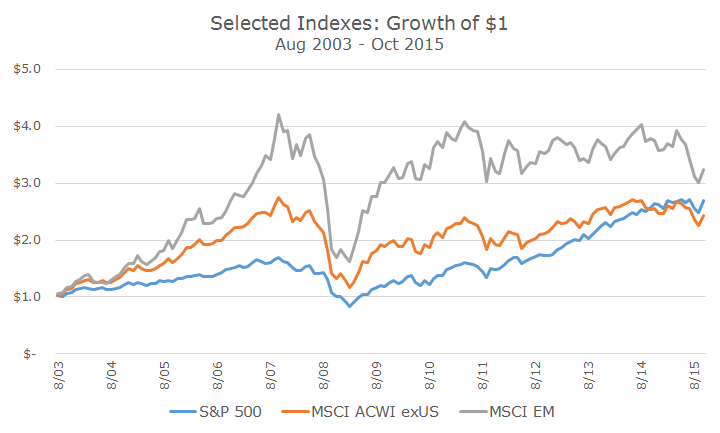
    A Big Bet on Emerging Markets
    Posted on November 17, 2015 by David Ott Acropolis Daily Insights
    Schwab’s IMPACT conference
    This year featured more academics than usual, which I found particularly engaging. One of the sessions was actually a debate between academic Roger Ibbotson (who also manages some money) and Rob Arnott, a practitioner with some academic credentials as the former editor of the Journal of Portfolio Management and the author of a number of papers.
    The debate was good, although the real highlight for me was during the audience Q&A when someone asked Rob Arnott how much of his personal net worth was invested in emerging markets stocks.
    First, Arnott has been saying that emerging markets are a great value for a while now and they keep heading lower. With the double digit decline this year, he said at the conference that he is now pounding the table that emerging markets are a screaming buy if you’ve got a 10-year time horizon (which, in theory, we all should).
    Second, the question is good because it asks the question the right way. In the last issue of Portfolio Insights, I included a quote that Chris found from finance author Nissim Taleb who said, ‘Never ask anyone for their opinion, forecast or recommendation. Just ask them what they have or don’t have in their portfolio.’
    Arnott responded by saying that he now has one-third of his net worth in emerging markets stocks, which is a big time wager. Emerging markets stocks account for about 15 percent of the world’s market capitalization, so Arnott has a huge relative bet on them. I would never make that kind of bet, but I admire that he’s put his money where his mouth is.
    image
    http://acrinv.com/a-big-bet-on-emerging-markets/
  • Schwab Slashes Minimums On OneSource NTF Mutual Funds
    In the past, Fidelity's minimum investment on NTF platform was $500. When the asset went up, they gradually let it rises to $2,500.
    More importantly, the minimum on transaction-fee funds could be lowered to $5,000 - 10,000 instead of the $100K on institutional shares.
  • Harbor International Small Cap Fund in registration
    Interesting. Under fees and expenses, it lists a management fee of 0.85%, a (puke) 12b-1 fee for "distribution and/or service" of 0.25%, other fees etc. (left blank, as is the new typical), and then a total fee (after reimbursement, unstated) of 1.32%. OK, so far, par for the course, so to speak.
    Under "Choosing a Share Class", we find something added for Investor Class: a 12b-1 fee of up to 0.25% and a transfer agent fee of up to 0.18%. Hmmm, doesn't the former usually take care of the latter? Well, hell, while you're larding it on, Harbor, why don't you just toss in a utilities services charge--- water and sewer, heating, electric ('cause those lights don't stay on all by themselves, you know?)--- and maybe a portion of the long-term lease you carry for office space rental? Fair to share..... because "mutual."
  • Schwab Slashes Minimums On OneSource NTF Mutual Funds
    I think this is a brilliant move by Schwab and I hope it catches on with other brokerages. If I can start with $100 instead of $2500 or sometimes $10000, I a more likely to invest and invest sooner.
  • Chuck Jaffe: Some Sweet-Smelling Mutual Funds And ETFs Could Turn Out To Be Skunks
    FYI: Walking the exhibit hall at the Schwab IMPACT Conference in Boston last week was a bit like strolling through the perfume and cologne department at a big department store.
    Every few steps, it seemed like a representative from a firm selling exchange-traded funds was jumping out to spritz you with their wares.
    Some of the smells were pleasing and appealing, others muddled and a few were offensive and seemingly hard to scrub off, like they could leave a portfolio reeking for years.
    Regards,
    Ted
    http://www.marketwatch.com/story/some-sweet-smelling-mutual-funds-and-etfs-could-turn-out-to-be-skunks-2015-11-17/print
  • Schwab Slashes Minimums On OneSource NTF Mutual Funds
    FYI: Initial investments for most funds cut to $100 from $2,500; subsequent investments reduced to $1 minimums.
    Regards,
    Ted
    http://www.thinkadvisor.com/2015/11/16/schwab-slashes-minimums-on-onesource-ntf-mutual-fu?t=mutual-funds
  • Characteristics of active MFs indicative of future performance: might there be more?
    https://www.onefpa.org/journal/Pages/NOV15-Updated-Advice-on-Mutual-Fund-Selection.aspx
    "Over the past three years, academic research has revealed new characteristics to look for in an actively managed mutual fund. In 2012, I suggested that financial planners look for funds with a high level of fund manager ownership, board of director ownership, a short-term redemption fee, a high active share or low R-squared value, and that lack affiliation with an investment bank. Recent research shows that financial planners should also look for funds that manage their portfolios in-house, outsource the execution of their shareholder services, have managers with performance-linked bonuses, and have a key role in their fund family performed by someone with a Ph.D. Each of these characteristics are associated with outperformance. "
    I'd like to see a little math. It's early for these.