Howdy, Stranger!

It looks like you're new here. If you want to get involved, click one of these buttons!

Here's a statement of the obvious: The opinions expressed here are those of the participants, not those of the Mutual Fund Observer. We cannot vouch for the accuracy or appropriateness of any of it, though we do encourage civility and good humor.
  • Artisan International Fund to close; Global Value Fund to reopen to new investors
    I notice that the min balance at Artisan for getting into closed funds is being increased from $100K to $250K. The current prospectus reads:
    • you are a shareholder with combined balances of $100,000 in any of the Funds (in your own name or as beneficial owner of shares held in someone else’s name) (available for investments in each closed Fund except Artisan Global Value Fund);
  • Grandeur Peak Global Micro Cap Fund subscription offering info
    http://www.sec.gov/Archives/edgar/data/915802/000091580215000076/grandeurpeakglobalmicrocapsu.htm
    497 1 grandeurpeakglobalmicrocapsu.htm
    FINANCIAL INVESTORS TRUST
    Grandeur Peak Global Micro Cap Fund
    (the “Fund”)
    SUPPLEMENT DATED SEPTEMBER 21, 2015 TO THE FUND’S PROSPECTUS AND STATEMENT OF ADDITIONAL INFORMATION DATED JUNE 29, 2015
    The distributor of the Fund, ALPS Distributors, Inc., is soliciting subscriptions for the Fund’s Institutional Class shares during an initial offering period to begin on September 21, 2015 and end the close of business on October 19, 2015 (the “Subscription Period”). The subscription price will be the Fund’s initial net asset value of $10.00 per share. Only those potential investors who have been given a specific share allocation of the Fund’s Institutional Class shares by the Fund’s investment adviser, Grandeur Peak Global Advisors, prior to October 20, 2015 will be allowed to purchase Institutional Class shares of the Fund beginning on October 20, 2015 (the date the Fund intends to commence operations) through October 30, 2015. Checks or drafts to purchase the Fund’s Institutional Class shares that are received during the Subscription Period will be held uninvested until October 20, 2015. The Fund’s Investor Class shares will remain unavailable for purchase.
    Please contact Grandeur Peak at 1-855-377-PEAK(7325) for further information.
    PLEASE RETAIN THIS SUPPLEMENT FOR FUTURE REFERENCE. YOU MAY DISCARD THIS SUPPLEMENT ONCE SHARES OF THE FUNDS ARE OFFERED FOR SALE.
  • Artisan International Fund to close; Global Value Fund to reopen to new investors
    http://www.sec.gov/Archives/edgar/data/935015/000119312515323911/d21853d497.htm
    497 1 d21853d497.htm ARTISAN PARTNERS FUNDS, INC.
    ...ARTISAN PARTNERS FUNDS, INC.
    SUPPLEMENT DATED SEPTEMBER 21, 2015
    TO THE PROSPECTUS OF ARTISAN PARTNERS FUNDS, INC. (Investor and Institutional Shares)
    DATED FEBRUARY 1, 2015
    ARTISAN GLOBAL VALUE FUND
    Artisan Global Value Fund will open to new investors on October 1, 2015. All references to the closure of Artisan Global Value Fund in Artisan Partners Funds’ prospectus are removed effective October 1, 2015.
    --------------------------------------------------------------------------------
    ARTISAN INTERNATIONAL FUND
    Artisan International Fund (the “Fund”) will close to most new investors at the close of business on January 29, 2016. The Fund is expected to remain open to new employee benefit plans through September 30, 2016 and to other investors who meet Artisan Partners Funds’ eligibility criteria for investing in a closed Fund.
    Effective February 1, 2016, the following paragraph is added under the heading “Purchase and Sale of Fund Shares” on page 25 of Artisan Partners Funds’ prospectus:
    Artisan International Fund is closed to most new investors. See “Investing with Artisan Partners Funds – Who is Eligible to Invest in a Closed Fund?” in the Fund’s statutory prospectus for new account eligibility criteria.
    Effective February 1, 2016, the following will replace the text under the heading “Who Is Eligible to Invest in a Closed Fund?” on pages 71 and 72 in Artisan Partners Funds’ prospectus in its entirety.
    Artisan International Fund, Artisan International Small Cap Fund, Artisan International Value Fund, Artisan Mid Cap Fund, Artisan Mid Cap Value Fund, Artisan Small Cap Fund and Artisan Small Cap Value Fund are closed to most new investors. The Funds do not permit investors to pool their investments in order to meet the eligibility requirements, except as otherwise noted below.
    If you have been a shareholder in a Fund continuously since it closed, you may make additional investments in that Fund and reinvest your dividends and capital gain distributions in that Fund, even though the Fund has closed, unless Artisan Partners considers such additional purchases to be not in the best interests of the Fund and its other shareholders. An employee benefit plan that is a Fund shareholder may continue to buy shares in the ordinary course of the plan’s operations, even for new plan participants.
    You may open a new account in a closed Fund only if that account meets the Fund’s other criteria (for example, minimum initial investment) and:
    •you beneficially own shares of the closed Fund at the time of your application;
    • you beneficially own shares in any of the Funds with combined balances of $250,000;
    •you receive shares of the closed Fund as a gift from an existing shareholder of the Fund (additional investments generally are not permitted unless you are otherwise eligible to open an account under one of the other criteria listed);
    •you are transferring or “rolling over” into a Fund IRA account from an employee benefit plan through which you held shares of the Fund (if your plan doesn’t qualify for rollovers you may still open a new account with all or part of the proceeds of a distribution from the plan);
    •you are purchasing Fund shares through a sponsored fee-based program and shares of the Fund are made available to that program pursuant to an agreement with the Funds or Artisan Partners Distributors LLC and the Funds or Artisan Partners Distributors LLC has notified the sponsor of that program in writing that shares may be offered through such program and has not withdrawn that notification;
    • you are an employee benefit plan (only available for investments in Artisan International Fund through September 30, 2016);
    •you are an employee benefit plan and the Funds or Artisan Partners Distributors LLC has notified the plan in writing that the plan may invest in the Fund and has not withdrawn that notification;
    • you are an employee benefit plan or other type of corporate, charitable or governmental account sponsored by or affiliated with an organization that also sponsors or is affiliated with (or is related to an organization that sponsors or is affiliated with) another employee benefit plan or corporate, charitable or governmental account that is a shareholder of the Fund at the time of application;
    • you are a client of an institutional consultant or financial intermediary and the Funds or Artisan Partners Distributors LLC has notified that consultant or financial intermediary in writing that you may invest in the Fund and has not withdrawn that notification;
    • you are a client of a financial advisor or a financial planner, or an affiliate of a financial advisor or financial planner, who has at least $2,500,000 of client assets invested with the Fund or at least $5,000,000 of client assets invested with the Funds or under Artisan Partners’ management at the time of your application;
    • you are a client of Artisan Partners or are an investor in a product managed by Artisan Partners, or you have an existing business relationship with Artisan Partners, and in the judgment of Artisan Partners, your investment in a closed Fund would not adversely affect Artisan Partners’ ability to manage the Fund effectively; or
    • you are a director or officer of the Funds, or a partner or employee of Artisan Partners or its affiliates, or a member of the immediate family of any of those persons.
    A Fund may ask you to verify that you meet one of the guidelines above prior to permitting you to open a new account in a closed Fund. A Fund may permit you to open a new account if the Fund reasonably believes that you are eligible. A Fund also may decline to permit you to open a new account if the Fund believes that doing so would be in the best interests of the Fund and its shareholders, even if you would be eligible to open a new account under these guidelines.
    The Funds’ ability to impose the guidelines above with respect to accounts held by financial intermediaries may vary depending on the systems capabilities of those intermediaries, applicable contractual and legal restrictions and cooperation of those intermediaries.
    Call us at 800.344.1770 if you have questions about your ability to invest in a closed Fund.
    Please Retain This Supplement for Future Reference

  • Exit fees In Times Of Market Stress: A Solution In Search Of A Problem
    People here have raised some of the same questions, some of which I've addressed. Appearing together in one article makes them look like potshots at something Investment News doesn't like, as opposed to a coherent position.
    Two rationales for the fee - stabilize markets, and have people pay for the costs they create.
    The editorial suggests that "Exit penalties might increase, not decrease, volatility." If that's true, what one wants is opacity - something that achieves the second objective (charging people for the costs they create) without people knowing on the day of the trade whether they'll get hit with a fee. That way, they wouldn't "simply sell earlier, which could then trigger more selling". So the editorial simultaneously complains about volatility that transparency would create and bemoans a lack of transparency that would avoid increasing volatility.
    I wrote about both issues, selling early and lack of transparency, in my prior post. With a mutual fund, one can't "sell early", since a sale takes place at the end of the day, regardless of when the order is placed. Transparency can be achieved by triggering redemption fees based on market conditions rather than on fund conditions (which might not even be known until end of day).
    The editorial's objection to redemption fees is even more specious. First, because it fails to call on funds to end their current practice of charging short term redemption fees. "An argument could be made that those funds should be able to pass those costs onto the very investors who are selling. But isn't that really a cost of doing business?"
    Second, because while the quote above appears to address the issue of investors increasing costs, it really sidesteps it. If some shareholders cost the fund more, why is it unreasonable that they should be charged more? Why should the other shareholders subsidize them? It's not as though this is a cost of doing business that's being shared equally by all investors.
    Isn't that why Vanguard has Investor and Admiral shares? Or why large trucks pay higher tolls on bridges than do automobiles? Where is the outrage, the railing at the unfairness of it all?
  • Chuck Jaffe: Why Most Investors Should Ignore Janet Yellen, Donald Trump And The Dow
    @ducrow - Thanks for the question. Following is my Buy & Hold group. Many are of the balanced and allocation variety. A lot of this evolved over the years by placing square pegs (funds already owned) into round holes (different sleeves within the plan) ... so it makes sense to me, but wouldn't be a model I'd recommend to anyone else,
    Multi-Income - RPSIX 18-22%
    Balanced - RPGAX and DODBX 18-22% combined
    Hybrids - OAKBX, PRPFX, and TRRIX 12-15% each
    Hard Assets - (currently 3 funds) about 10% combined
    Global Income - (currently 2 funds) about 10% combined
    Above represents approximately 75% of retirement assets. Rebalancing is minimal.
    More to your specific question
    Balanced funds: DODBX and RPGAX
    Allocation funds: RPSIX and TRRIX
    OAKBX is sometimes called balanced. I consider it "moderate allocation - equity."
    PRPFX is sometimes called allocation. I'd call it a "specialty" fund.
    Outside Buy & Hold, I own PRWCX. It is sometimes called balanced. I'd call it "moderate allocation-equity".
  • What Are The Hottest Mutual Funds This Year ?
    @VintageFreak didn't do the actual math...I don't live in Cancun...just wanted to emphasize that I own a VERY small position in MCXAX, so unless you want ulcers, don't put a lot of pesos in it!
    Hey, you were the one who said 0.00001% not me :P
  • It’s Not Easy Being A Cash Investor
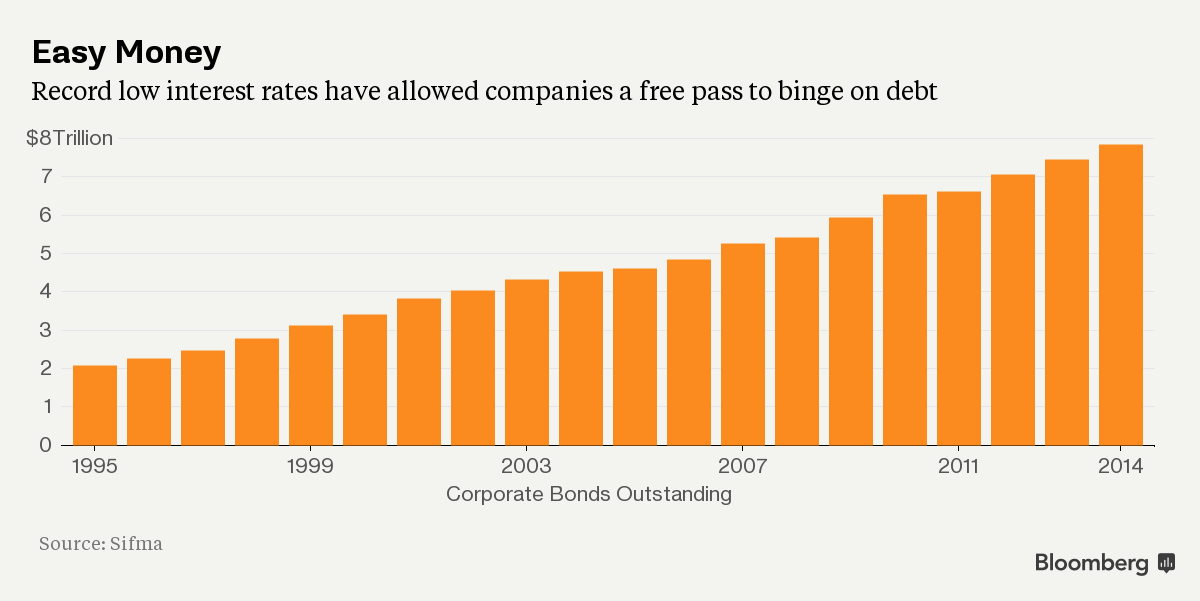
    well, if it isn't easy being a cash investor, then maybe it would be easier being a cash borrower--- make like you're a corporation.
    image
    Party on, corporate dudes!
  • It’s Not Easy Being A Cash Investor
    FYI: PIMCO's Jerome Schneider says even after the Fed raises rates, successful money market funds may not give the net yield.
    Regards,
    Ted
    http://www.thinkadvisor.com/2015/09/18/its-not-easy-being-a-cash-investor?t=fixed-income&page_all=1
  • Exit fees In Times Of Market Stress: A Solution In Search Of A Problem
    FYI: (This is a follow-up article)
    Allowing mutual funds to flip a switch and turn on exit fees on a moment's notice seems reactionary and short-sighted.
    Regards,
    Ted
    http://www.investmentnews.com/article/20150920/FREE/150919899?template=printart
  • What Are The Hottest Mutual Funds This Year ?
    Wait a second. $2500 minimum. Multiply by 100,000. Oh....
    Are your retired in Cancun? No? WTF not?
  • What Are The Hottest Mutual Funds This Year ?
    @VintageFreak yes, as I've stated, it's not for the faint-hearted. And some days, it's up over 5%. The challenge is knowing when to put in more money. I have a small position in it...probably .00001% of my portfolio. It keeps things interesting! Always a surprise to see how it's done on any given day!
  • Chuck Jaffe: Why Most Investors Should Ignore Janet Yellen, Donald Trump And The Dow
    I think we're increasingly seeing hot money chase trends, driving sectors to unsustainable highs and lows. However, these trends persist for very long periods. Riding the trends if you're a smart (or lucky) momentum investor is very rewarding.
    My biggest problem in the past has been bailing when something gets hot, believing that locking in a 10-20% gain was to my advantage. Of course, in a market where hot funds and sectors can tack-on 15-20% gains year after year, that's a self-defeating practice.
    I'm increasingly moving to a buy and hold strategy focused mostly on good balanced and allocation funds. Some rebalancing, but less than in the past. 75% is so allocated to that strategy now and I'll likely raise it to 80% by year's end.
  • Chuck Jaffe: Why Most Investors Should Ignore Janet Yellen, Donald Trump And The Dow
    Howdy @rforno
    Agree............rebalance one's own portfolio as needed; not just at 12:30pm on some day into the future, for a given year.
    Regards,
    Catch
  • Aperio Group: What Would Yale Do If It Were Taxable?
    Pages 20 to 21 of the Yale 2014 Endowment Report contain review of actual performance and lists both their active and passive benchmarks.
    http://investments.yale.edu/images/documents/Yale_Endowment_14.pdf
  • Big Divergence in Fund Performance YTD - TRP Fund Performances
    http://www3.troweprice.com/fb2/mfpathways/pathways.otc?facets=domesticStock,intStock
    (Page has a "see all funds" link in upper right corner)
    I can't recall a year when there's been such a huge divergence in sectors. I've seen geographic areas rise and fall in the past, but this year the divergence among sectors seems more widespread. A 16-point performance difference between TRBUX (Blue Chip Growth) and PRFDX (Equity and Income).
    A few YTD winners: Health Sciences +18%, Global Technology +9%, Japan & Blue Chip about +6% each
    Some double-digit losers: Equity and Income, Latin America, EM stock, EM bond-local currency, Africa & Mid East, Natural Resources
  • Aperio Group: What Would Yale Do If It Were Taxable?
    From the bogleheads.org website...
    Aperio Group: What Would Yale Do If It Were Taxable?
    The phenomenal success of Yale's endowment has been an inspiration to many investors. However, if Yale’s endowment had to pay the same taxes as individual investors, its portfolio would be constructed very differently.
    The referenced paper presents a simple model for incorporating tax considerations into a pre-tax asset allocation such as Yale's.
    With illustrative examples, it demonstrates the profound impact that taxes can have on optimal portfolio weights as well as the interplay between taxes and risk.
    Once taxes are included the model tends to lower allocations to tax-inefficient asset classes such as hedge funds and increase allocations to tax-efficient strategies. However, with optimal tax management, hedge fund allocation can still be preserved so long as their returns are uncorrelated with those of equity.

    NOTE: Larry Swedroe's post at ETF.com (see below) is most approachable summary.
    WHAT WOULD YALE DO IF IT WERE TAXABLE?
    P Geddes, L Goldberg & S Bianchi, Aperio Group LLC
    FULL PAPER, PUBLISHED BY APERIO, 2014
    http://www.fwp.partners/wp-content/uploads/2015/04/What-Would-Yale-Do1.pdf
    FULL PAPER, PUBLISHED BY FAJ FROM APERIO, JUL/AUG 2015
    https://www.aperiogroup.com/resource/154/node/download
    COMMENTARY, PRESTON D MCSWAIN @ FWP, MAY 2015
    http://www.fwp.partners/ideas/what-would-yale-do-if-it-was-taxable/
    COMMENTARY, LARRY SWEDROE @ ETF.COM, SEP 2015
    http://www.etf.com/sections/index-investor-corner/swedroe-taxing-yale-model
    (Thanks to Larry Swedroe's ETF.com commentary - cited above, which caught my eye, and Vegomatic's post at bogleheads.org website. I have re-arranged the post to conform to the conventions of the MFO board.)
  • WealthTrack: Guest: Charles Dreifus, Royce Funds
    Market has not spared even Charlie. 3 and 1 star...