
Howdy, Stranger!

It looks like you're new here. If you want to get involved, click one of these buttons!

Here's a statement of the obvious: The opinions expressed here are those of the participants, not those of the Mutual Fund Observer. We cannot vouch for the accuracy or appropriateness of any of it, though we do encourage civility and good humor.
  • 10-Year Closing in on 1.5% (OP) - Blows Right Past - Near 5% (30 months later) - Whee!
    @WABAC, you may want to review River Park Short Term High Yield, RPHYX. David has provided a detail analysis of the fund.
    https://mutualfundobserver.com/2017/05/riverpark-short-term-high-yield-fund-rphyxrphix/
    YTD return is +0.3% while vast majority of bond funds are in red for the year.
  • Buffett says 'never bet against America' in letter noting company's U.S. assets
    There is a lot more information in Buffett's interview with respect to bonds in general.
    “Bonds are not the place to be these days,” Buffett said. “Fixed-income investors worldwide – whether pension funds, insurance companies or retirees – face a bleak future.”
    Buffett noted that the benchmark 10-year Treasury yield had fallen drastically to 0.93% at the end of 2020 from 15.8% in September 1981. Meanwhile, investors earn a negative return on trillions of dollars of sovereign debt in Germany and Japan, he added.
    If US investment opportunties are so great, why is he buying back $9 billion worth of Berkshire Hathaway stock? The answer is that he have had hard time buying them within his metrics and this is consistent with his investment pattern for a number of years. Recent purchase in drug and telecommunication stocks is a reflection of his forward looking view in post-pandemic scenario.
    In addition, Buffet also made many mistakes just like other investors or fund managers. His value investment approach exposes him to the value-trap stocks. At least he owed up to his mistakes and moved on.
    https://reuters.com/article/us-berkshire-buffett-precisioncastparts/warren-buffetts-10-billion-mistake-precision-castparts-idUSKCN2AR0MZ
  • Buffett says 'never bet against America' in letter noting company's U.S. assets
    Don't bet against him/market
    Keep buying brk.b & dji sp500 Nasdaq
    Also contribute 25-30% overseas eu
    You maybe laughing your ways to bank 10 20 yrs from today.
  • Wealthtrack - Weekly Investment Show - with Consuelo Mack

    Weird. Here in DC I got a re-run from last summer with Jim Rosenblatt of Gotham Securities. ;/
    Feb 26th Episode:

    Free Issues (Grant's Interest Rate Observer):
    https://grantspub.com/subscribe/index.cfm#freeBlock
  • 10-Year Closing in on 1.5% (OP) - Blows Right Past - Near 5% (30 months later) - Whee!
    “Whoa. A lot to unpack there” - Not really. It’s just one of a half-dozen different market takes Barron’s typically presents from a variety of different sources in a small section of the magazine each week. More, I think, to give a flavor of the kinds of questions advisors are batting around (to borrow your spring training metaphor) than to provide any definitive or accurate point of view.
    “But I hear the GOP wants to position itself ... ” - OK
    Oh, I get that.
    Among other things I was thinking about putting Reagan and Volker in the same basket after packing the 50's and 60's into the same bear market as the 70's. And that whole four decade bull was pretty much treading water for 13-14 years after the dot com bust. At some point the market became Friedman's, and now seems to be a wholly owned subsidiary of the Fed.
    Took my brain a while to boil it down to a paragraph.
    Rest assured that my opinions are neither definitive nor accurate. ;-)
    Spring training game today. First Moderna shot on Monday morning.
  • IQDAX- If it's opaque, just maybe there's a reason?
    I have learned from past mistakes and would never buy a new unproven fund like IQDAX. And I might add I would not buy the TMSRX fund either. For a low risk fund for my portfolio I would prefer a funds like bampx, wbalx, hblix. I own all of them. they usually hold 50% bonds 50% stocks.
    I have no interest at all in IQDAX.
    I have been DCA'ing into TMSRX. FWIW, it has easily been outperforming those three AA funds since its inception with only ~28% stocks.
    In the 30%-50% cat, I own CFIAX and FMSDX (the latter which I regard as Best in Class). If I were to add another, it would be AZNAX. After that, I'd consider adding BAMPX and likely stop there.
  • IQDAX- If it's opaque, just maybe there's a reason?
    I have learned from past mistakes and would never buy a new unproven fund like IQDAX. And I might add I would not buy the TMSRX fund either. For a low risk fund for my portfolio I would prefer a funds like bampx, wbalx, hblix. I own all of them. they usually hold 50% bonds 50% stocks.
  • 10-Year Closing in on 1.5% (OP) - Blows Right Past - Near 5% (30 months later) - Whee!
    If inflation remain less than the 2% target, what is the value of holding gold as a hedge against inflation?
    @Sven - Also noticed the reference to gold in the cited passage. I have no idea what gold might do or whether one should own it. I’ve concluded that gold fits the definition of manic-depressive - being prone to extreme mood swings with little apparent reason.
    Likely the article cited was penned several days prior to being published. Over those few days gold’s price stumbled from around $1800 (start of week) to $1730 at yesterday’s close. The miners fell about 5% Thursday and another 3-4% Friday.
    IMHO - It’s too erratic to serve as a reliable inflation hedge. Those who promote buying gold seem to be of the belief that the Fed’s stimulative measures along with massive government spending will eventually lead to a cataclysmic fall in the dollar’s value.
  • 10-Year Closing in on 1.5% (OP) - Blows Right Past - Near 5% (30 months later) - Whee!
    @hank
    We expect that the clamor for bigger government will contribute to a secular bear market that could rival the one that persisted from the 1950s to the 1980s.
    Are they talking about a bear market in bonds? Or what?
  • 10-Year Closing in on 1.5% (OP) - Blows Right Past - Near 5% (30 months later) - Whee!
    Just one view ...
    By Daily Insight Research - BCA Research (excerpt from Barron’s March 1, 2021 issue)
    “We recommend that multi-asset investors underweight bonds, especially Treasuries. We expect that the clamor for bigger government will contribute to a secular bear market that could rival the one that persisted from the 1950s to the 1980s. Within Treasury portfolios, we would maintain below-benchmark duration and favor Treasury inflation-protected securities over nominal bonds, at least until the Fed signals that its campaign to re-anchor inflation expectations higher has achieved its goal. Gold and/or other precious metals merit a place in portfolios as a hedge against rising inflation, and other real assets, from land to buildings to other resources, are worthy of consideration, as well.”
    (No link. I’m a Barron’s subscriber.)
  • 10-Year Closing in on 1.5% (OP) - Blows Right Past - Near 5% (30 months later) - Whee!
    Government Bond Yields Have Surged, but Real Yields Are at Zero:
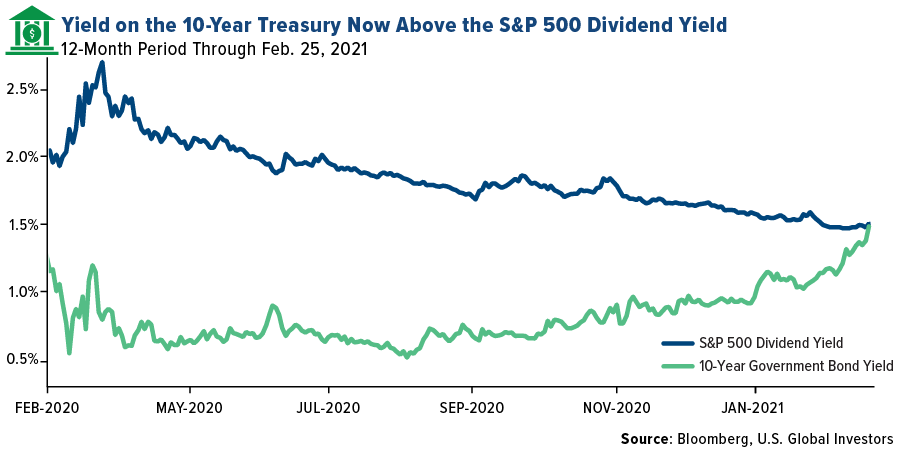
    Government bond yields have been rising steadily for the past three months, but they went parabolic in February. The yield on the 10-year Treasury touched 1.6% yesterday, up from 0.9% just a couple of months ago. That’s more than a two standard deviation move, suggesting the bond selloff may be overdone. Remember, bond yields rise as prices fall.
    Yields have jumped so much, in fact, that they’re giving stocks a serious run for their money. The 10-year yield is now higher than the S&P 500 dividend yield, which may have added to the selling pressure that cost stocks close to 2.5% yesterday.
    image
    Link:
    government-bond-yields-have-surged-but-real-yields-are-at-zero
  • 10-Year Closing in on 1.5% (OP) - Blows Right Past - Near 5% (30 months later) - Whee!
    A $50 Billion Unwind Fueled Treasuries’ Rout. It Has Room to Run
    (Bloomberg) -- A chaotic selloff in the Treasuries market was spurred by a massive exodus from popular trades, heightened by liquidity concerns that could inflict more pain in coming days.
    The exodus happened at a time when traders were already worried about the imminent disappearance of a support beam for the market -- a regulatory exemption that has allowed banks to accumulate more U.S. bonds.
    Treasury futures open interest across a range of maturities sank by a huge amount Thursday: the equivalent of $50 billion of 10-year notes. It didn’t help that this coincided with the Treasury Department selling $62 billion of seven-year notes, an auction that proved to be a disaster.
    The month ahead could be rocky, too. Back in April, the Federal Reserve tweaked its rules to exempt Treasuries from banks’ supplementary leverage ratios -- allowing them to expand their balance sheets with U.S. debt. But that relief ends March 31 and what happens next is something of a mystery.
    “It wasn’t an orderly selloff and certainly didn’t appear to be driven by any obvious fundamental continuation or extension of the reflation thesis,” wrote NatWest Markets strategist Blake Gwinn in a note to clients. A number of more technical factors were in the mix, against a backdrop of a good-old-fashioned buyers strike, he said.

    Article:
    chaotic-treasury-selloff
  • American Century Mid-Cap Value Fund to re-open thru all channels
    Here we go again. It never closed to new investors categorically. It only closed to new investors through some (but not all) channels.
    As of November 1, 2013, the fund is generally closed to new investors other than those who ... invest directly with American Century....
    Summary prospectus, Aug 1, 2020
  • S.E.C. suspends trading in 15 securities (social media hypes)
    If you are curious about such events. I presume one may assume this is a form of warning about other future actions as deemed legal and/or valid by the SEC.
    Other reasons for the suspensions are noted in the SEC document.
    Public press news release "short".
    SEC document list
    Time for a movie night unwind from this week.
    Take care,
    Catch
  • IQDAX- If it's opaque, just maybe there's a reason?
    @Baseball_Fan
    I want to know what the young man who was running the fund was exactly doing? Was there malfeasance? Or did he really believe the 3rd party model was incorrect and there was a "tweaking" for good reason? He's obviously lawyered up. Who else knew and who challenged him on his actions? Wasn't there a compliance/risk officer? What was he doing/not doing/getting paid for?
    Good questions. To those I would add what was it that finally did bring this to the SEC's attention?
    Regarding the audit question, I was referring to the annual reports.
    This is from their August 2020 annual report:
    REPORT OF INDEPENDENT REGISTERED PUBLIC ACCOUNTING FIRM
    To the Board of Trustees of Trust for Advised Portfolios and the
    Shareholders of Infinity Q Diversified Alpha Fund
    Opinion on the Financial Statements
    We have audited the accompanying consolidated statement of assets and liabilities of Infinity Q Diversified Alpha Fund, a series of shares of beneficial interest in Trust for Advised Portfolios, and Subsidiary (the "Fund"), including the consolidated schedule of investments as of August 31, 2020, and the related consolidated statement of operations for the year then ended, the statements of changes in net assets for each of the years in the two-year period then ended, the statement of cash flows for the year then ended, and the financial highlights for each of the years in the three-year period then ended, and the related notes (collectively referred to as the "financial statements"). The consolidated financial highlights for the years ended August 31, 2017 and August 31, 2016 were audited by another independent registered public accounting firm whose report, dated February 1, 2018, expressed an unqualified opinion on those consolidated financial highlights. In our opinion, the financial statements present fairly, in all material respects, the consolidated financial position of the Fund as of August 31, 2020, the consolidated results of their operations for the year then ended, their cash flows for the year then ended, the changes in their net assets for each of the years in the two-year period then ended, and financial highlights for each of the years in the three-year period then ended, in conformity with accounting principles generally accepted in the United States of America.
    Basis for Opinion
    These financial statements are the responsibility of the Fund's management. Our responsibility is to express an opinion on the Fund's financial statements based on our audits. We are a public accounting firm registered with the Public Company Accounting Oversight Board (United States) ("PCAOB") and are required to be independent with respect to the Fund in accordance with the U.S. federal securities laws and the applicable rules and regulations of the Securities and Exchange Commission and the PCAOB.
    We conducted our audits in accordance with the standards of the PCAOB. Those standards require that we plan and perform the audit to obtain reasonable assurance about whether the financial statements are free of material misstatement, whether due to error or fraud. The Fund is not required to have, nor were we engaged to perform, an audit of its internal control over financial reporting. As part of our audits, we are required to obtain an understanding of internal control over financial reporting but not for the purpose of expressing an opinion on the effectiveness of the Fund's internal control over financial reporting. Accordingly, we express no such opinion.
    Our audits included performing procedures to assess the risks of material misstatement of the financial statements, whether due to error or fraud, and performing procedures that respond to those risks. Such procedures included examining, on a test basis, evidence regarding the amounts and disclosures in the financial statements. Our procedures included confirmation of securities owned as of August 31, 2020, by correspondence with the custodian, prime broker and third-party counterparties. Our audits also included evaluating the accounting principles used and significant estimates made by management, as well as evaluating the overall presentation of the financial statements. We believe that our audits provide a reasonable basis for our opinion.
    Bold emphasis my own.
    To answer my own question. My interpretation is that the audit just makes sure that there are no irregularities in the numbers or accounting in the financial reports but not an assessment of the validity of how the asset values are obtained or the actual pricing of the assets themselves. But I'm no expert on financial reports.
    I also think the comparison of Infinity Q and T. Rowe Price is like comparing apples & oranges, even concerning TMSRX. Especially as Infinity Q was essentially a one man operation. Anything is possible & I definitely understand the concern.
    @Sma3
    Regarding IOFIX, my impression was they were not disclosing to shareholders the risks involved with some of their holdings- their method of buying & valuing odd lots not widely traded which during times of stress (ie last March) might become difficult to unload.
    @Derf
    I have no idea what a "reasonable" amount would be but for me, in general, I tend to limit any one holding to no more than 5-7%. TMSRX is currently around 6.5%. The main exception to that is PRWCX which I started investing in back in the 1990s. It sits around 16%.
  • 10-Year Closing in on 1.5% (OP) - Blows Right Past - Near 5% (30 months later) - Whee!
    @Derf - you are absolutely right. It was stale info. Fidelity was not updated when I looked. I was down 1.75% for the day. FDGRX, MESGX and MSSMX were my biggest movers in the wrong direction. Still long, though. Thanks for the correction.
  • Vanguard Equity Income Fund's James P. Stetler to retire
    https://www.sec.gov/Archives/edgar/data/826473/000168386321001104/f8199d1.htm
    497 1 f8199d1.htm EQUITY INCOME FUND
    Vanguard Equity Income Fund
    Supplement Dated February 26, 2021, to the Prospectus and Summary Prospectus Dated January 31, 2021
    Important Changes to Vanguard Equity Income Fund
    Effective immediately, Sharon Hill will be added as a co-portfolio manager of Vanguard's portion of Vanguard Equity Income Fund (the Fund). James P. Stetler will retire from Vanguard in July 2021 and will no longer serve as a co-portfolio manager for Vanguard's portion of the Fund. The Fund's investment objective, strategies, and policies remain unchanged.
    Prospectus and Summary Prospectus Text Changes
    The following is added under the heading "Investment Advisors" in the Fund Summary section:
    Sharon Hill, Ph.D., Senior Portfolio Manager and head of the Alpha Equity Global and Income Investment team within Vanguard's Quantitative Equity Group. She has co-managed a portion of the Fund since February 2021.
    Prospectus Text Changes
    The following is added under the heading "Investment Advisors" in the More on the Fund section:
    Sharon Hill, Ph.D., Senior Portfolio Manager and head of the Alpha Equity Global and Income Investment team within Vanguard's Quantitative Equity Group. She has been with Vanguard since August 2019, has worked in investment management since 2000, has managed investment portfolios since 2009, and has co-managed a portion of the Fund since February 2021. Education: B.S., City University of New York at Brooklyn College; M.S. and Ph.D., University
    of Connecticut.
    https://advisors.vanguard.com/pub/Pdf/p065.pdf
  • IQDAX- If it's opaque, just maybe there's a reason?
    TMSRX What would be a reasonable amount , per cent, to own in a retirement account of say 500 K ? Just wondering. Possible in the 4 - 5 % range .
    Stay safe, Derf