Howdy, Stranger!

It looks like you're new here. If you want to get involved, click one of these buttons!

Here's a statement of the obvious: The opinions expressed here are those of the participants, not those of the Mutual Fund Observer. We cannot vouch for the accuracy or appropriateness of any of it, though we do encourage civility and good humor.
  • Why Vanguard Is About To Engulf The Financial Planning Industry
    FYI: Bill McNabb, CEO of Vanguard Group, gave a keynote speech at the 2016 Inside ETFs conference in Florida declaring the importance of advisers in delivering alpha to clients. But a bit more interesting to me was the incredible growth the firm is experiencing in its centralized advice offering.
    Regards,
    Ted
    http://www.investmentnews.com/article/20160212/BLOG16/160219961/why-vanguard-is-about-to-engulf-the-financial-planning-industry
  • Was yesterday it?
    Dead Cat Bounce?
    Depends which cat you mean.
    - Oil's been dragging bottom for over a year. Suspect we're plumming the bottom somewhere in the $25+ area.
    - I'm not convinced re stocks. And the move today doesn't look that convincing to me. Could rally for a few days than fall back.
    - Gold's unpredictable. Might as well go to Vegas and throw your money on the craps tables. I'll agree, however, with those who believe financial chaos and a weaker dollar tend to bolster its attractiveness. Having a bit of exposure has helped me in recent months.
    Disclaimer: I'm not an expert. My forecasts over the years have a 50-50 success/failure ratio. I am not a market timer and do not normally attempt to time markets nor have I ever been affiliated with any market timers or market timing strategies.
  • Bill Miller's A Hedge-Fund Guy Now With A Funky Model To Try Out
    Sold to you.
    I cannot run away fast enough from any financial product with Bill Miller's name on it.
  • Lipper: The Month In Closed-End Funds: January 2016
    FYI: For the third consecutive month equity CEFs and fixed income CEFs on average suffered
    downside performance on a NAV basis (-5.86% and -0.03%, respectively) for January,
    while for the second month in a row equity CEFs posted a negative return on a market
    basis (-6.69%) and fixed income CEFs (+0.15%) posted a plus-side market-based return.
    Regards,
    Ted
    http://lipperalpha.financial.thomsonreuters.com/wp-content/uploads/2016/02/FMIR-US-CE-M-20160131-TR-JT.pdf
  • This can't be another 2008 - right?
    vkt:
    I will simplify what you have written a bit. Selecting the preferred presidential candidate from amongst the Republican and Democratic nominating races is as easy as "ABC":
    ABC = Anyone But Cruz
    All of the candidates in both parties certainly have their warts and their detractors but a Ted Cruz presidency would be an unmitigated disaster. He represents the lunatic fringe of the Republican Party, an evangelical nutcase without any understanding of or respect for the constitutional separation of church and state - one of the most important foundations of this country. He is also the meanest, nastiest, and most destructive person to serve in the Senate in the past 30 years, and that is truly saying something. His entire senatorial career has been to obstruct and destroy - he is an anarchist. Fortunately, he is as hated in the mainstream Republican Party as he is outside of it and I doubt his nomination would attract significant support or money from mainstream Republican sources. Unfortunately, the misanthrope Koch brothers would gladly pick up the financial slack but that is probably where his support would end.
  • This can't be another 2008 - right?

    Off topic: I'll probably be voted off the island for writing this, but I think Sanders is a refreshing breath of fresh air to the national political debate. And, I'm a registered Republican that campaigned for Reagan at the Infinite Corridor in 1980 ... although a bit embarrassed to admit that given those in office and running recently ... Sarah Palin, Donald Trump, Ted Cruz, etc. Fear the party as I/we once knew it is on verge of collapse.
    You won't be voted off the island unless you bash every one equally. But I hear you. Here is my problem:
    1. Bernie Sanders - Nice guy, has a good heart. Beat up Wall Street isn't going to grow economy. Will be too distracted with too many things to carry out his agenda against Wall Street and pro consumer things (not that these are necessarily bad things), to do the highest priority things needed. Has no clue of the future technology and how to accommodate/leverage it.
    2. Hilary Clinton - Able to do what is needed to win but will be long on rhetoric short on action if elected. Too much politicking, not enough eye on the ball.
    3. Donald Trump - Shrewd businessman but every deal he has made has only benefited himself and has crumbled soon after for others. Is the political equivalent of the financial engineering CEO. Not a team player. Ego can't share the stage with anybody so his team including the VP will be some airhead yes-men/women with him micromanaging. Most likely to send US into cultural or economic bankruptcy after window-dressing deals.
    4. Ted Cruz - Is going to look like fish out of water when he realizes he has to deliver and can't just blame somebody or tear down things to get support. Will likely find polarizing things to rant against and distract people from his own inability to deliver. Immigrants, almost every other foreign country will be fair game.
    Ugh. How did we get here on the greatest country on earth?
  • This can't be another 2008 - right?

    Bottom line: We have a long way to go to the downside before the true nature of this deja vu financial crisis is fully understood and market valuations adjust appropriately. The only sane financial commentator that fully understands this is Joe LaVorgna, the Managing Director and Chief U.S. Economist for Deutsche Bank Securities.
    Depending upon what analysis you look at -technical, fundamental, micro or macro economics - you will come up with different reasons; which will be wrong.
    My way of thinking is what I have posted in the past we are in a sea change that people are not talking about - free trade, population growth, robotics, AI, free movement of money and movement of mfg to lower cost areas causing deflation and hardship for worker.
    So, I'm expecting a slow grind - years.
    The EU can show us what to expect a VAT to deal with the debt (for awhile) and social programs, a smaller fragile middle class etc.
  • This can't be another 2008 - right?
    The talking heads, economists, CNBC, etc., are greatly underestimating the financial crisis occurring amongst the major European banks, e.g., Deutsche Bank, Credit Suisse, UBS, etc., and their balance sheets are a mess. Several of these banks are (theoretically) reaching the point of insolvency and will need bailouts from their central governments to stay afloat, imho. This will, inevitably, spill over into our markets and, frankly, I think OUR major banks and global financial companies are facing their own liquidity crises - which everyone is conveniently ignoring or underestimating.
    Bottom line: We have a long way to go to the downside before the true nature of this deja vu financial crisis is fully understood and market valuations adjust appropriately. The only sane financial commentator that fully understands this is Joe LaVorgna, the Managing Director and Chief U.S. Economist for Deutsche Bank Securities.
  • This can't be another 2008 - right?
    @Joe, you keep saying that and you say you are an insider. Any specifics? You said oil companies will collapse earlier. Which companies outside frackers and why? If just fracking industry, why would it be such a big deal outside of a few states in the US? I asked this question earlier.
    You say countries will default because of it. Which countries? Nigeria? Venezuela? Russia?
    Commodity producing countries aren't running deficits with debtors financing it like Greece was to default on that would pose systemic risks through the financial system. Saudis aren't going to collapse any time even if they won't be able to spend as much. Countries that are printing money without oil revenues instead will face inflation but won't put debtors in jeopardy.
    Any black swan event would have some spreading systemic risk. Not that they don't necessarily exist. But without evidence for or against, I find it hard to take such a definitive stance that it is going to be really bad or it is going to be all OK. There is a third alternative that we just don't know and won't know until it happens or doesn't.
  • Unconstrained Bond Funds Finally Face A Challenge To Prove Their Stuff
    FYI: The unconstrained bond fund strategy wasn't born from the 2008 financial crisis, but the crisis and the unprecedented Federal Reserve policy that followed did play a major role in drawing attention to unconstrained bond funds.
    Regards,
    Ted
    http://www.investmentnews.com/article/20160207/FREE/302079991?template=printart
    M*: Unconstrained Bond Fund Returns:
    http://news.morningstar.com/fund-category-returns/nontraditional-bond/$FOCA$NT.aspx
  • Larrry Swedroe: Small Caps Still Outperforming
    FYI: As the director of research for The BAM Alliance—a community of about 140 like-minded RIA firms who believe in providing a fiduciary standard of care using an evidence-based investment strategy—I often get requests from other advisors for my help in answering questions from clients about articles they’ve read in the financial media.
    Regards,
    Ted
    http://www.etf.com/sections/index-investor-corner/swedroe-small-caps-still-outperforming?nopaging=1
  • Top Mutual Fund Families
    FYI: (Scroll & Click On Article Title Google Search) "Top Mutual Fund Families"
    The top firms in 2015 Barron’s/Lipper Fund Family Ranking avoided the pitfalls of last year. Two leaders: Thrivent Financial and Eaton Vance.
    Regards,
    Ted
    https://www.google.com/#q=top+mutual+fund+families+Barron's
    Graphic Look:
    http://online.wsj.com/public/resources/documents/BestFundFamiliesOf2015.pdf
    5 & 10 Year Ranking:
    http://online.wsj.com/public/resources/documents/BestFundFamilies5-YearAnd10-YearRankings.pdf
  • COP down 7%
    Junkster said:
    The moral is be you a trader or investor is always have an exit point. So much thought goes into when to buy yet so little on when to sell.
    To whom do you think he is addressing this advice?

    This was just an observation on money management, nothing more, nothing less. COP was a fave on this board here in the 60s. I don't know how many are still holding tight since then, especially those that touted its purchase based on its fundamentals/dividends. A simple money management strategy based on price would have had you out long before the current fiasco. Unlike so many, I have no pension and only a meager SS of $1019 monthly. Before that I had little to no income outside of the markets. So it is only natural I would be so obsessed with managing losers. I don't have the luxury of other income to ride out the storms in the financial markets.
  • COP down 7%
    little5bee - I can only hope that insider selling would be too easy to spot albeit not until later. If so I expect those caught will be dealt with the same firm handslaps handed out to the financial manipulators of the housing/mortgage meltdown
  • Bill Gross's Investment Outlook For February: Increasingly Addled
    Walkin the walk M*s top performing L/S fund in 2015-16
    Update From the Jan 31 OTCRX Fact Sheet
    ..We continue to be focused on credit domestically and globally as the change in credit conditions is being underappreciated by investors from our perspective.
    Credit market stress continues to percolate in various sectors with stress now going beyond commodities..
    the decline in equity markets has made valuations slightly
    more attractive; however, overall valuations in both the equity and bond markets are not compelling on an absolute basis considering the growth outlook. We
    estimate the S&P 500 is trading around 15x-16x consensus 2016 earnings, this is near its historical average. Based on our conversations, it appears that in the
    near term there will continue to be selling pressure in the market driven by asset liquidations among Sovereign Wealth ( funds )..
    As we enter February, we have approximately 20% of the Fund in cash. We anticipate equity and bond markets will remain volatile as the market goes through a
    painful digestion period driven by a less accommodative Federal Reserve, slowing global growth, tighter financial conditions, and the risk of a currency war.
    Ultimately, asset prices will have to adjust to reflect a higher risk premium
    Copyright © 2015 :::: Otter Creek Adviosors, LLC
    http://www.ottercreekfunds.com/media/pdfs/OCL_Factsheet.pdf
    OTCRX Y T D +4.09 1 YR +13.89 A U M $225 mil
    JANUARY 20,2016 Webcast Combine the two links for the full presentation.About 45 minutes.
    http://www.ottercreekfunds.com/media/pdfs/OCL_Call_Presentation_4Q2015.pdf
    http://www.ottercreekfunds.com/media/pdfs/Q42015_CC.mp3
    Or
    http://www.ottercreekfunds.com/index_webcasts012016.html
    Also
    http://performance.morningstar.com/fund/performance-return.action?t=OTCRX&region=usa&culture=en_US
    Synopsis /Outline
    THE OTTER CREEK INVESTMENT PROCESS
    US MACRO: THE AGE OF GOVERNMENT AUSTERITY IS OVER
    Government spending is estimated to add around 40 70bps to GDP growth in 2016 according to various Street economists
    US MACRO: OVERALL THE US ECONOMY HAS SLOWED
    US MACRO: MIXED SIGNALS
    Global trade volume growth has turned negative
    One potential upside factor to growth is lower oil prices eventually boosting GDP
    CENTRAL BANKS: THE POLICY CONUNDRUM
    TAILRISK: EXPECT THE UNEXPECTED IN 2016
    Large increases in global debt, zero bound rates, slowing growth
    ...we are expecting heightened levels of volatility to continue
    (and they're busy boys on those days)
    MARKET FUNDAMENTALS: EARNINGS GROWTH and PROFIT MARGINS
    S&P 500 earnings growth excluding energy has moderated, but it is still growing
    Margins gains have slowed
    CHEAP DEBT & LOW RATES: REAP WHAT YOU SOW
    Zero bound rates have created meaningful distortions in how capital is allocated...it started with energy production
    Auto subprime financing at all time highs
    THE MACRO and MARKET ENVIRONMENT: CONCLUSIONS
    PORTFOLIO POSITIONING IN TODAY’S ENVIRONMENT
    Long Portfolio
    Short Portfolio
    INVESTMENT THEMES
    DRAWDOWN ANALYSIS
    CONCLUSION
    Seek to achieve:
    •Absolute risk-adjusted returns

    Capital preservation
    in periods of dislocation

    Low
    correlation
    relative to the market indices

    Below average volatility
    relative to the S&P 500 Index
  • Why The Best Junk Fund Manager Since '11 Is Betting On A Rebound
    @vkt
    OMG.........nah, they can't be "just" banks. They would get run out of town by the credit unions, eh? They've (the banks) got the need, the fix and the backing.
    The Pusher Man (The Fed) has their backside.
    Hell, the banks can still get .5% on cash reserves and "excess" cash reserves, as of December, with the rate hike.
    The financial market place is so perverted.
    Regards,
    Catch
  • Why The Best Junk Fund Manager Since '11 Is Betting On A Rebound
    Junk bond stress posts biggest jump since financial crisis
    Feb 2 2016, 14:28 ET | By: Stephen Alpher, SA News Editor [Contact this editor with comments or a news tip]
    Moody's Liquidity Stress Index jumped to 7.9% in January from 6.8% previously - the largest one-month move since March 2009. The gauge measures the number of companies carrying the agency's lowest liquidity rating of S G L-4.
    Stripping energy out, the index rose to 4.5% in January - the highest level since November 2010. In fact, six of the ten downgrades to S G L-4 this month were for companies outside the energy sector, though two of those are suppliers to commodity companies.
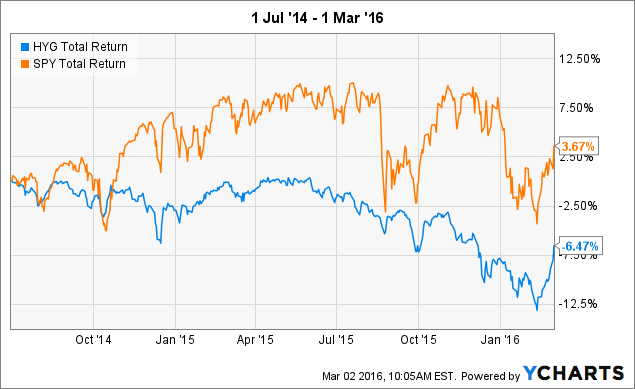
    Junk prices are having another rough session today, with HYG down 0.6% and JNK off 0.9% as Treasury prices post big rallies..
    http://seekingalpha.com/news/3074426-junk-bond-stress-posts-biggest-jump-since-financial-crisis
    Original Source
    Junk bond stress is spreading beyond energy, says Moody’s
    By Ciara Linnane Corporate news editor Published: Feb 2, 2016 11:43 a.m. ET marketwatch.com
    Oil and gas issuers have been pummeled in the last year by the collapse in oil prices, which has hurt the many shale players that emerged during the fracking boom. Many of those companies need an oil price of at least $60 a barrel to be profitable, according to energy consulting firm Rystad Energy.
    In December, Moody’s warned that companies in the sector are facing a spike in defaults and downgrades, while investors in their debt are looking at major losses. Companies in the oil and gas and mining sectors have issued nearly $2 trillion in bonds globally since 2010, many of them in the junk category.
    http://www.marketwatch.com/story/junk-bond-stress-is-spreading-beyond-energy-says-moodys-2016-02-02
  • PTIAX portfolio followup
    We had an earlier discussion on PTIAX, where I said I'd contact the fund and get back on some of the details about the portfolio. I was finally able to speak at some length with one of the analysts, so here's the Cliff Notes version.
    * Credit quality: The munis are basically A, with only a few BBBs and nothing below investment grade. For the mostly non-agency mortgages, it's the same thing Gundlach always says: credit ratings alone aren't very helpful for evaluating older, higher-yielding mortgages, since there haven't been any revisions since the typical downgrades of the financial crisis era. PTIAX invests only in prime and Alt-A, no subprime, so the credit quality of their holdings is comparatively good for the asset class.
    * Duration: The munis fall in ~ the 7-8y range, and the mortgages (on paper, by the usual calculation) are ~ 4-5. (But see the 'graf below on their take on using duration as a metric.)
    * Strategy: As is pretty obvious by the holdings, it's a strategy that attempts to balance risks. On the rate-sensitive side of the scale, as tax-exempt munis have moved into historical fair value range (based on the spread to Treasuries), they've moved some of that part of the portfolio to taxable munis, which they regard as still a decent value. They've also added a single-digit stake in IG corporates, but are going slow in that department and still regard IG corps as peripheral to the strategy.
    * Duration and their process: they regard duration as interesting but not definitive, not in their top tier of evaluation metrics. For example, the mortgages they use in the portfolio, on paper ~ a duration of 4-5, typically don't move much if any when there's a rate bump. Their process, "Shape Management," starts with rate and credit-based analysis, but the critical piece is "a forward projection of a fixed-income security’s total return characteristics over a variety of interest rate scenarios, yield curve shifts, and time horizons." (The "shape" is the shape of returns under different scenarios.)
    Thus endeth the dissertation. These guys are still very helpful; the delay in responding was apparently due to the ramping-up of the operation that's going on now.
    Best, AJ
    Edit to add: To clarify on the non-agency mortgages, they're what show on, say, the M* portfolio page as the below-IG part of the portfolio, based on the ratings of years ago, which the PTIAX folks think aren't very accurate today.
  • Is Ted Sleeping while the important news is happening??????????????????????? BOJ - negative

    If I think the world is going full NIRP (which it would not surprise me if it did, despite the fact that that will likely end very, very badly) then I do not want to be in cash, I want to be in assets. Hence, unsurprising futures ramp.
    If we go back to ZIRP (or better yet, NIRP), watch REITs and other productive assets that yield.
    Honestly, if we are eventually heading in the NIRP direction in this country, lets just do it now and get the spectacular failure out of the way rather than dragging this out. After what NIRP will cause if we go that route, perhaps we can start anew and try to, I don't know, try to figure out how to rebuild a sustainable economy based around producing things (aside from Facebook posts, although apparently that economy is doing exceedingly well) and not based around financial engineering.
    Also, would not surprise me if countries start to move towards electronic transactions and doing away with physical cash.
    Some discussion:
    http://www.businessinsider.com/how-negative-interest-rates-would-work-japan-switzerland-2015-11

    I agree.
    Workers will be taking the brunt of the hurt in that situation. Stagnating wages while their basics go up - health care, food and maybe energy.
    Pretty much.
    "But the punchline is the actual message, in which Janet Yellen tells those mired in debt to build more assets.
    In other words, the Fed Chairman has some words of encouragement for the tens of millions of Americans who live at or below the poverty level, including that threatened with extinction class, affectionately known as "the middle."
    Her message? It is important to build assets, or said otherwise... get rich." (http://www.zerohedge.com/news/2014-09-16/janet-yellen-trolls-americas-poor-tells-them-it-important-get-rich)
    Should tell one much of what they need to know in terms of what the Fed's priority is. It should be no surprise that the wealth disparity in this country has increased massively and will only continue to.
    "In 2015, 62 billionaires had more wealth than half the world’s population – compared to 388 in 2010."
    I mean hey, that's the world we live in. Invest accordingly.
    As for Japan, "They have an aging population"
    Adult diapers outsell baby diapers in Japan. I'm sure that their elderly population is going to be just thrilled going down a NIRP path that Japan will probably never voluntarily get off of.
  • Is Ted Sleeping while the important news is happening??????????????????????? BOJ - negative

    If I think the world is going full NIRP (which it would not surprise me if it did, despite the fact that that will likely end very, very badly) then I do not want to be in cash, I want to be in assets. Hence, unsurprising futures ramp.
    If we go back to ZIRP (or better yet, NIRP), watch REITs and other productive assets that yield.
    Honestly, if we are eventually heading in the NIRP direction in this country, lets just do it now and get the spectacular failure out of the way rather than dragging this out. After what NIRP will cause if we go that route, perhaps we can start anew and try to, I don't know, try to figure out how to rebuild a sustainable economy based around producing things (aside from Facebook posts, although apparently that economy is doing exceedingly well) and not based around financial engineering.
    Also, would not surprise me if countries start to move towards electronic transactions and doing away with physical cash.
    Some discussion:
    http://www.businessinsider.com/how-negative-interest-rates-would-work-japan-switzerland-2015-11
    I agree.
    Workers will be taking the brunt of the hurt in that situation. Stagnating wages while their basics go up - health care, food and maybe energy.