Howdy, Stranger!

It looks like you're new here. If you want to get involved, click one of these buttons!

Here's a statement of the obvious: The opinions expressed here are those of the participants, not those of the Mutual Fund Observer. We cannot vouch for the accuracy or appropriateness of any of it, though we do encourage civility and good humor.
  • Your Home is Not an Investment
    Thanks for the rundown @bee. I’ve rented and owned. Prefer the latter - but not by a whole lot. One reason: If I decide to pound a nail in the wall to hang a photo (or rip a wall out for that matter) there’s no nasty landlord to deal with.
    I don’t doubt your numbers. Of course, you’ve been able to borrow against the home at very low interest rates for many years now, investing that $$ for higher return. Might alter the equation a bit. A lot of our affinity for houses as investments probably stems from the 70s and 80’s when high inflation was driving prices. For some, houses seemed like gold mines. Not so much the case today.
    Somebody defined a boat as “a hole in the water you pour money into.” A house ain’t that bad, But the upkeep is expensive and ongoing. The more you can do yourself (repairs, wiring, painting, etc.) the lower the overall cost. But, as I’m learning, the more one advances in age the less likely he / she is to do such work. So, owning a home is becoming more expensive with age.
  • Ready For a Melt UP? Bears, It's Checkmate!
    BS or not, I have been using T/A successfully for about 20 years. T/A is only one part of my system. I never held a losing fund too long and since retirement in 2018 I didn't lose more than 1% from any last top. T/A just help me to be a better consistent discipline trader.
  • Your Home is Not an Investment
    I am in the final stages of selling a home that I have lived in for almost 35 years. Purchase price was $67K. Hoping to close at $277K, but those numbers are not the whole story.
    Home improvements (landscaping, additions, remodels, and replacement of original components have cost close to $100K plus interest over those years. Recent costs (getting the home ready for sale) were close to $25K. Property taxes collected by my town over 35 years were close to $150K. Insurance costs close to $30K. Mortgage interest (financed and refinance the property) costs totaled $100K.
    Had I rented instead of owned, my housing costs (average $1.2K / month over 35 years) would have been about $500K. So maybe...just maybe... "owning" (the bank owed the home most of the 35 years) my property was a break even proposition financially.
    Had I put $10K into VFINX 35 years ago (a portion of the 20% down payment on the $67K sale price I had to come up with) that investment would be worth $436K. If I had invested in the entire 20% ($14,400) it would have grown to $628K.
    https://portfoliovisualizer.com/backtest-portfolio#analysisResults
    Interesting.
    Here's a conversation on the topic (at the 5 minute mark):
    For most people, your house is your biggest asset and also your biggest liability. So it’s understandable to think about the financial implications of the most significant purchase you’re ever going to make. But a home is about more than what you buy it for and what you think it will be worth in ten years.


  • Ready For a Melt UP? Bears, It's Checkmate!
    @Old_Joe
    Give the man credit- right or wrong he's not pussyfooting around with "ifs, ands, or buts". I've got to respect that.
    Why is blind fanaticism to be respected? Belief without rational cause is interesting from a psychological perspective, like watching a man in a padded cell who’s sure he’s Jesus, but not a good guide for running one’s life. All this author has causally is it happened yesterday. Yesterday it rained. Therefore it must rain today. Every April the stock market went up for the last hundred years. Therefore it must go up every April for the next hundred. No reason. Just because.
    He is not into "blind fanaticism". If you have followed his bond posts he is very careful investing in those. No reason to think otherwise with equities. If it goes south he is out fast. Nice to see some positive presented.
  • Ready For a Melt UP? Bears, It's Checkmate!
    @LewisBraham- I see that I mistook Tom Bowly (whoever he might be) for FD. Yes, I understand that your observation is equally applicable no matter who might be making the "prediction", but for me there's a difference between someone who is supposedly a published "expert", and one of the "regular folks" here on MFO. Yes, I know, indefensible "logic", but then I hardly ever claim to be completely sane anymore. If we're subjected to another four years of this administration I'll be a write-off ready for the home anyway.
  • Observation - A tale of two markets (no links)
    Wouldn't VFINX or SPY be classified as a blend of Large Cap Value and Growth? Just own a blended fund and wait. A Russell 1000 index would cover an even larger number of both growth and value.
    Over the last 20 years QQQ (Growth) has played catched up to blended funds like SPY and VTI. The catch up has really happened over the last 10 years.
  • Ready For a Melt UP? Bears, It's Checkmate!
    @Old_Joe
    Give the man credit- right or wrong he's not pussyfooting around with "ifs, ands, or buts". I've got to respect that.
    Why is blind fanaticism to be respected? Belief without rational cause is interesting from a psychological perspective, like watching a man in a padded cell who’s sure he’s Jesus, but not a good guide for running one’s life. All this author has causally is it happened yesterday. Yesterday it rained. Therefore it must rain today. Every April the stock market went up for the last hundred years. Therefore it must go up every April for the next hundred. No reason. Just because.
  • MMIN ETF insured muni fund
    I admit to being skeptical of monoline muni bond insurers after their 2008 collapse. Keep that in mind when reading my comments.
    The basic function of insurance is to spread risk. So long as one can expect defaults to be isolated cases and not the result of some systemic problem, insurance works well. (Insurers are financially stressed when there are a lot of hurricanes, fires, or a market implosion.)
    To protect against the, say, 1 in 100 chance that a bond defaults, each bond shaves a little off its yield to pay for insurance to cover that 1 bond in 100. Diversification does something similar. If you own 100 uninsured bonds, and one fails, you'll have lost 1%, just as if each uninsured bond had paid 1% to the insurer to be covered.
    The ability of a fund to diversify away individual bond risk seems to reduce the value of insurance to a fund holder, as contrasted with its value to an underdiversified individual bond investor.
    I also wonder about the low penetration (around 6%) of insurance in the muni bond market. Before 2008, penetration was well over half. Funds that are not required to buy insured munis are still free to do so. Yet they typically buy A/BBB bonds. Either because they don't find enough investors like you looking for that extra protection, or because they don't feel the reduced risk is worth the cost of the insurance.
    Since you're interested in high quality (AA) bonds, you might also consider TEPFX. Over virtually the life of MMIN (since Oct 23, 2017), it has returned a cumulative 7.21% vs. 7.93% for MMIN (using M*'s new performance graphs, not linkable).
    But it has done so with lower volatility, e.g. TEPFX had a drawdown of 6.4% vs. MMIN drawdown of 13.9% from March 9 through March 20). Figures computed from Yahoo Finance tables. That's due in part to TEPFX's shorter effective duration of 3.14 years vs. MMIN's 6.19 years (both per M*).
    TEPFX's portfolio has a weighted average credit rating of AA, the same as MMIN. It's got around 40% AAA rated and 40% AA rated. In contrast, MMIN has virtually no AAA rated bonds (muni insurers are only rated AA and it wouldn't make sense for a natural AAA bond to buy lower grade insurance). Though a huge 90% of MMIN's bonds are rated AA (since they're almost all insured).
    Finally, despite the shorter duration, TEPFX's SEC yield is higher, 1.39% vs. 1.22%, both figures as of Sept. 30th. I haven't yet looked into how TEPFX manages that trick.
  • Observation - A tale of two markets (no links)
    It’s amazing how wide the gap is this year between value and growth. Once upon a time Price’s Equity Income fund PRFDX was their flagship equity offering. It’s one of their oldest funds. For many years it was headed by the very capable Brian Rogers, something of a media celebrity in his day. The fund holds a lot of income producing companies and tilts toward value. It’s off a whopping 12.4% YTD. and has stumbled badly for years now. By contrast, Vanguard’s S&P index fund, VFINX is ahead YTD by 9.11% YTD. That’s a gap of about 21% YTD between the two funds. Even crazier, Price’s Blue Chip TRBCX is up 29.3% this year for a YTD difference of more than 40% between the two funds. Absolutely amazing.
    I think this all means something important for us to consider, but I’m not sure what. Smarter people than me can chime in. I got my numbers from Lipper and believe them to be accurate. If you own Price’s diversified income fund, RPSIX, and are wondering why it’s only ahead by 1% YTD, look no further than PRFDX which it holds at generally around a 12% weighting (but it varies).
    Disclaimer - I do not own any of the 3 mentioned equity funds and haven’t for at least 5 years. I do, however, own RPSIX.
  • Ready For a Melt UP? Bears, It's Checkmate!
    Thirty years ago I would have asked for some of what he's smoking.
  • PIMCO sees low-return environment likely for next 3-5 years
    Unfortunately most retirees I know including myself don't want to increase volatility and/or use cash + alternatives. The only choice most have are bond funds.
    I have looked for alternative for years and couldn't find any that proved to be a good consistent one for years.
    In my case as a trader, I'm at over 99% in bonds most times but trades riskier stuff for hours-days several times annually. The results are much better than my specific goals (making 6% annually, never lose 3% from any last top, SD < 3).
    For someone who is not a trader and still want to have bond funds, they may look beyond "simple" bond funds. PIMIX used to be a great one and it's still OK but other funds may be PTIAX,TSIIX(both multi) + MNCPX(Non Trad) + HY Munis(VWALX).
    Another good choice is a fund like PRWCX where the manager have been using flexible approach.
    I prefer VCORX or BIV over BSV, a bit more volatility but much better returns (chart)
    VCOR is not a near cash vehicle. BSV is, and also is inversely correlated to the market, making it a good choice to combine with near cash positions that do better but are correlated to the market (a bit) like GILPX and THIIX. In a balanced basket there is a very low probability of losing significant dollars, and they should materially outperform something like a high yield on line savings account (in the .70%-.80 range these days).
  • U.S. Wind and Solar Installations Are Smashing Records, but the Trend May Not Last
    Perhaps worthwhile for those interested in renewables...
    The United States is on pace to install record amounts of wind and solar this year, underscoring America's capacity to build renewables at a level once considered impossible.
    In the big picture, the amount of wind and solar deployed this year will need to be replicated in coming years.
    This year's renewable energy expansion is driven in part by the expiration of the wind production tax credit and a decrease in the investment tax credit available to solar projects.
    The potential for a renewable energy drop-off points to the need for a national clean electricity standard or some other policy to drive green investments
    (Also) Much of the wind and solar development occurring this year is taking place in regions with large amounts of renewables already. Greening America's collection of regional electric grids will not only require an expansion of renewables into new regions, but more transmission to carry it to the areas where power is consumed.
    https://scientificamerican.com/article/u-s-wind-and-solar-installation-are-smashing-records-but-the-trend-may-not-last/
  • Ready For a Melt UP? Bears, It's Checkmate!
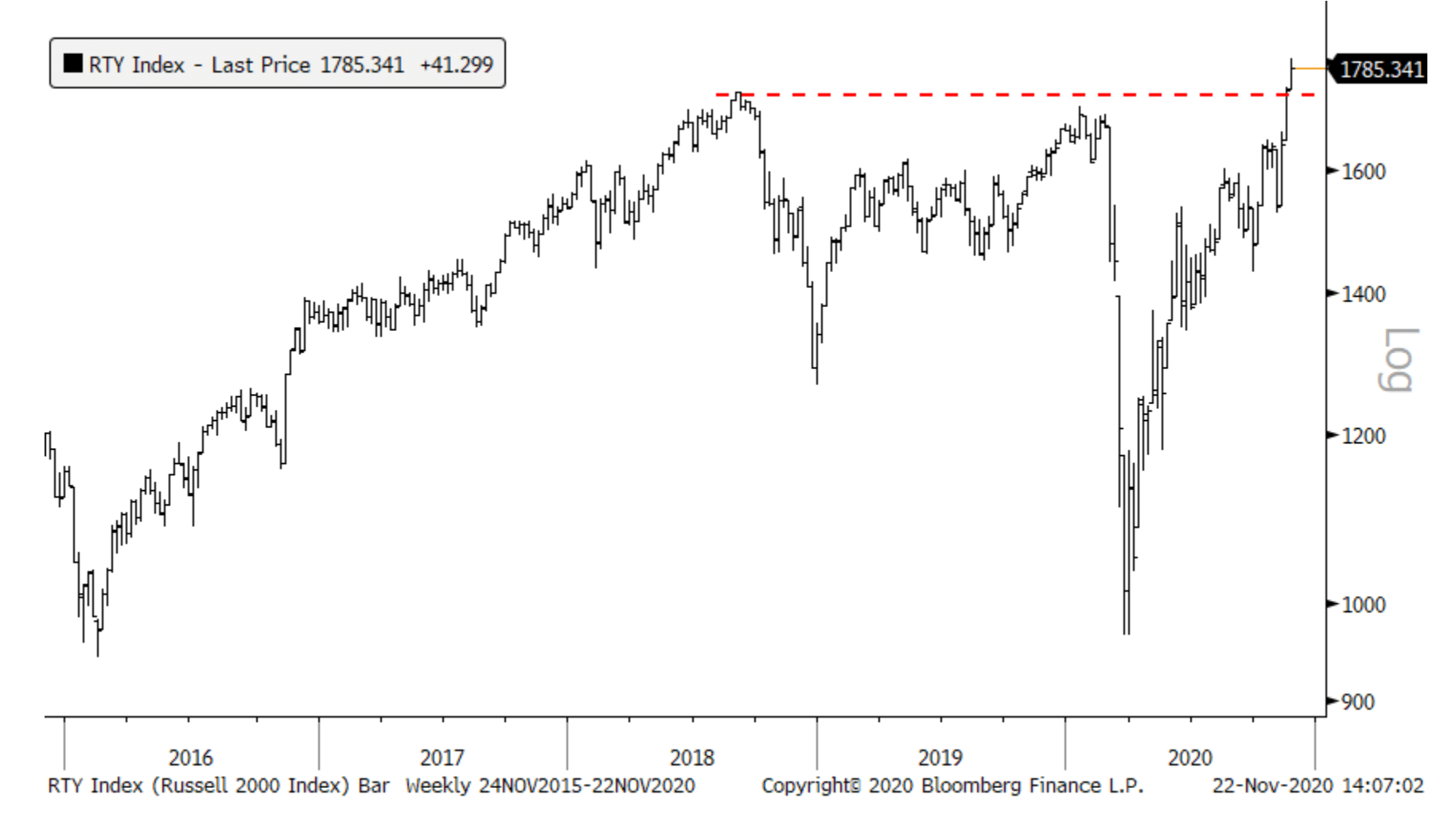
    (link) Tom Bowley is one of my favorite technicians.
    I remain firmly in the secular bull market theory camp. We're going higher. Forget about politics, civil unrest, the virus, the deficit, the economy, blah, blah, blah. Money flow, the Fed and historically-low interest rates will fuel higher prices. While each of those is extremely important in the performance of U.S. equities, here are the 3 really big reasons why I believe stocks are heading higher.
    ...
    We're in a different market environment. I've been writing about it all year. Stop fighting this bull market. I'm not talking about an advance that lasts the rest of this year....or for 2021. I'm talking about a secular bull market that will last another 10-12 years, into the 2030s.
  • PIMCO sees low-return environment likely for next 3-5 years
    Unfortunately most retirees I know including myself don't want to increase volatility and/or use cash + alternatives. The only choice most have are bond funds.
    I have looked for alternative for years and couldn't find any that proved to be a good consistent one for years.
    In my case as a trader, I'm at over 99% in bonds most times but trades riskier stuff for hours-days several times annually. The results are much better than my specific goals (making 6% annually, never lose 3% from any last top, SD < 3).
    For someone who is not a trader and still want to have bond funds, they may look beyond "simple" bond funds. PIMIX used to be a great one and it's still OK but other funds may be PTIAX,TSIIX(both multi) + MNCPX(Non Trad) + HY Munis(VWALX).
    Another good choice is a fund like PRWCX where the manager have been using flexible approach.
  • PIMCO sees low-return environment likely for next 3-5 years
    In the current interest rate environment, I would require "near cash" to:
    (a) be only slightly volatile - the more volatile a fund is, the longer one might have to wait to cash out even accepting a modest loss;
    (b) have relatively small max drawdowns - it could take "forever" to recover from a significant drop
    Bonds are more predictable than stocks in the sense that one can say, given a particular condition, how a particular bond will behave. If one bond with basic attributes (maturity, duration, credit quality) similar to another pays more, there's a reason.
    Even (and perhaps especially) if a fund has never exhibited a risk, if it is yielding more, there's a risk there somewhere. The rule of thumb I follow is that the less obvious the risk and the less likely it is to happen, the more catastrophic it will be if the risk is realized.
    I think one objective for "near cash" is to reduce the likelihood, however small, of such a catastrophic event. "Near cash" is not an investment one is planning to hold for many years. It does not have the time to prove its long term mettle.
    VCORX has 2½ times the volatility of BSV (3.67% vs 1.51% over three years). It has a duration of 6.4 years (per Vanguard). No wonder it (and BIV) took off since March 20th. But do you really expect interest rates to drop again just as much? That would be a drop to 0.0%. (Between March 18th and October 8th, 7 year treasury rates dropped from 1.08% to 0.54%; another 0.54% drop would take them down to 0.0%.)
    Regarding BSV, this still carries some interest rate risk, some volatility, some credit risk. Its 30 day SEC yield is 0.34%. These don't compare favorably with no-penalty CDs from Ally Bank (11 month, 0.60% - 0.65%), and Marcus Bank (7 month, 0.55%). Though the ETF does have the advantage of finer granularity (you don't have to cash out everything) and ETFs can be easier to invest in than CDs with an IRA.
    As to bonds in general, I substantially agree with one of the quotes in the Barron's article that @hank cited in another thread: "Rieder recommends more stocks and, in the bond portfolio, only half in traditional fixed income, with the other half split between alternatives and cash."
    Personally, I'm not into alternatives, but increasing equity and using cash rather than bonds to protect against sequence of return risk makes sense to me. Especially since one doesn't do much better with bonds these days than with cash unless one is taking outsized risks.
  • The US debt is now projected to be larger than the US economy
    And, it will undoubtedly go up more from here....for better or worse...
    The Treasury Department won't put out final numbers for fiscal year 2020 until later this month. But if the CBO's estimates are on the mark, the country's total debt owed to investors -- which is essentially the sum of annual deficits that have accrued over the years -- will have outpaced the size of the economy, coming in at nearly 102% of GDP, according to calculations from the Committee for a Responsible Federal Budget.
    The debt hasn't been that high since 1946, when the federal debt was 106.1% of GDP.
    https://cnn.com/2020/10/08/economy/deficit-debt-pandemic-cbo/index.html
  • PIMCO sees low-return environment likely for next 3-5 years
    BSV, so simple yet so good. Also like in the "near cash" space VNLA, GILPX,, THIIX, SNGVX, BBBMX (misstep in Q1 this year, but basically first one in last 20 years, not a single down year).
  • Long-Term S&P 500 Returns, Election Event Risk....
    Yes it is, Mark. But, at my age, I lived through much of the timeline (too young to remember life under Truman) and I couldn't help thinking that sometimes, though, the devils in the details. And "we the people" have had more than one considers to do with those details. When did we loose so much of our "forward", "continuous improvement" attitude as a society? Have we too much to entertain our time away?
    When? When we embraced the social Darwinian idea that the market was the only fair arbiter of the worth of anything, and the sole driver of worthwhile change. Creative destruction. Survival of the fittest. Etc.
    A friend of mine tells the story that seventy years ago his father supported his family (rather well) as a projectionist at a movie theatre. These days people snicker at the idea of such people earning a wage that allows them to think of sending their children to college. Wages like that destroy shareholder value.
  • TD Ameri-Schwab
    Almost 50 years ago, two upstart companies pioneered a new model in the financial services industry—one entirely devoted to individual investors. Following this week's close of the acquisition, TD Ameritrade and Schwab are now part of one company with the same shared goal: helping people realize their dreams through the power of investing.
    mail.tdameritrade.com/H/2/v600000175091d3956a25213f4bbe5cfc0/b21ddfaa-76df-4f58-b1b4-0239b10f8915/HTML
  • PIMCO sees low-return environment likely for next 3-5 years
    Just put several years of cash equally into BND, BSV, and LDUR, so we shall see how it goes (lots overlap of course) compared w near-zero MMF.