
Howdy, Stranger!

It looks like you're new here. If you want to get involved, click one of these buttons!

Here's a statement of the obvious: The opinions expressed here are those of the participants, not those of the Mutual Fund Observer. We cannot vouch for the accuracy or appropriateness of any of it, though we do encourage civility and good humor.
  • M* US MultiSector Bond Category
    Here's a BrandywineGlobal paper from 1½ years ago discussing convexity and securitized debt, along with market conditions at the time and risks involved in four types of securitized debt.
    Riding the Convexity Wave in Securitized Credit
    Thank you for the link. Yet another reason I try to minimize exposure to securitized debt is because I don't understand things like the following from the link cited:
    Risks: If the job market worsens significantly along with a hard landing, subprime auto ABS bond defaults may increase sharply. However, we believe the potential credit losses should be absorbed by the cushion provided by credit enhancements and the fast deleveraging of the deal structure.
    "Fast deleveraging of the deal structure" sounds like Repo Man II: The Action Movie to me. But I know I don't know what I'm talking about. :).
  • M* US MultiSector Bond Category
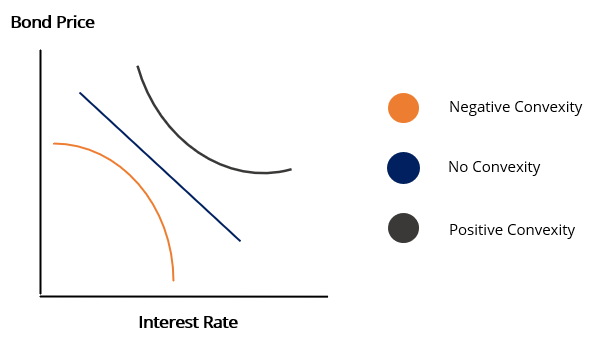
    With securitized debt borrowers typically have some control over payment schedules. See "prepayment risk" and "extension risk" in prospectuses. The bottom line is that this affects convexity, often leading to negative convexity (especially for longer term debt) that can make bonds behave badly at the worst times.
    image
    With normal bonds (positive convexity) as interest rates increase, prices decrease but at a decelerating rate (tempers bad effect of rising rates). And when rates decrease, prices increase at an accelerating rate. But bonds having negative convexity exhibit the opposite behavior. As interest rates increase, prices decline at an accelerating rate. And as interest rates decrease, bonds usually still appreciate but at slower and slower rates.
    This negative convexity is one reason why securitized debt tends to yield a bit more than other forms of debt. And like investing in general, risk tends to be rewarded over time if you wait long enough. But in the interim, one can take severe hits. That's what makes me nervous. So I'll consider multisector bonds where the manager has the flexibility to adjust allocations as seem appropriate, but I don't invest in securitized debt funds.
    Here's a BrandywineGlobal paper from 1½ years ago discussing convexity and securitized debt, along with market conditions at the time and risks involved in four types of securitized debt.
    Riding the Convexity Wave in Securitized Credit
  • M* US MultiSector Bond Category
    It would be a good idea to examine drawdown periods as @Obervant1 noted with various multi-sector funds and ETFs for their risk. Using MFO Premium, one can compare these funds for their MFO rating and Risk over 3 years and 5 years period. In general, MS funds carry higher risk than that of investment grade bonds. I have short term investment bonds to compliment my MS and high yield bonds.
  • “The one-fund Portfolio as a default suggestion”
    Thanks @msf for the update. Two years ago there were fewer Vanguard funds available. There must be additional agreement made to be on Fidelity shelf space.
  • “The one-fund Portfolio as a default suggestion”
    @Mark is correct with D&C at Fidelity’s mutual fund supermarket. Years ago they were listed.
    Vanguard is listed today, although it limited only to a handful of OEFs and not the entire lineup.
    We consolidated to Fidelity several years ago. Few Vanguard funds remained and others are their ETFs.
  • M* US MultiSector Bond Category
    Just be aware with securitized (MBS) funds.....SYFFX lost -31% in 1Q 2020, as many of these funds were crushed at the time. That's why I don't hold more HOSIX.
    It's not that history will repeat, but it can.
    Good observation. I normally don’t look further than 5 years (and place more emphasis on 3 year returns), and don’t look at individual quarters that far back. so I probably would have missed that. That is also something to consider.
  • M* US MultiSector Bond Category
    @Observant1, why did you sell River Canyon Total Return Bond Fund RCTIC?
    Not Observant, but I also used to own RCTIX. It underwent manager changes a few years ago, the performance started to suffer, and there seemed to be some uncertainty. So I sold it. It later improved and recovered. The fund is 55% securitized. When I was thinking about getting back into the fund, I saw that SYFFX, a securitized fund, was outperforming RCTIX. SYFFX outperforms RCTIX at every trailing period I look at. So if I when considering RCTIX, which has more than 50% exposure to the securitized sector (a sector I was underexposed to), I thought that I might as well go with a dedicated securitized fund that has performed better.
  • GMO Latest
    Grantham has been wrong for over 15 years.
    Hussman and Arnott have been wrong for as long.
    These people forgot that markets collapse many times based on special conditions/situations.
    2008-MBS
    2018-Fed raised rates 3-4 times within a year.
    2020-Covid
    2022-Inflation made the Fed raise rates very rapidly.
    Valuation models aren’t gospel. They’re frameworks, often rigid ones. Markets don’t “obey” a PE ratio, a CAPE model, or any single metric. They move based on flows, positioning, liquidity, sentiment, and risk appetite — none of which those “experts” fully capture.
    Articulation ≠ expertise. Some people build reputations on talking smoothly on CNBC or writing clever papers. But if you look under the hood, their track records are mediocre or not disclosed at all. A true expert has numbers behind them, not just words.
    Macro talk rarely drives short-term results. Tariffs, inflation debates, and political narratives — they sound convincing, but the link between those stories and stock prices in the next 1–12 months is weak. Liquidity and momentum can swamp those factors.
    The real experts are rare. They don’t talk much because they’re too busy managing money. They know the limits of prediction and don’t oversell their opinions.
    So, how can anyone listen or invest with these guys?
  • GMO Latest
    He was on a episode of the Compound with Josh Brown and Michael Batnick. I was super impressed with Grantham and his ability to speak intelligently about markets, the past, future estimates. But I still can't get around how poorly he's navigated the past 15 years.
  • This Day in Markets History
    From Markets A.M. newsletter by Aaron Back.
    On this day in 1787, John Fitch launched the first successful steamboat run
    in U.S. waters when his 45-foot boat smoked and boomed up the Delaware River.
    But he never got costs under control, so Robert Fulton—whose own steamboat launch
    came 20 years later—is instead remembered as the father of the steamboat.
  • Safe Withdrawal Rates - Bengen
    Bengen's definition of "safe" means that an investor can maintain a certain withdrawal rate
    over a 30-year timeframe regardless of market performance.
    In a worst-case scenario (very low probability), the portfolio would be depleted after 30 years.
    For those interested in leaving a legacy, they may wish to decrease the withdrawal rate accordingly.
  • GMO Latest
    Jeremy's next big prediction after getting the real estate fiasco correct was to begin heavily divesting from us markets and focusing on emerging markets. He has basically reiterated that stance for 15 years. since then, emerging markets have been 4X'ed by the US market. So eventually they'll be right. but to the normal investor who invests some in international, its going to take quite a correction to make up for 15 years of garbo returns in VWO.
    signed person who overweights EM in his international allocation and has for 7 years.
  • Safe Withdrawal Rates - Bengen
    It's worth noting that Bengen's "rule" assumes a 30-year time horizon and that the portfolio is emptied just as the investor takes her last breath. Most people don't want to cut things that close. They want a measure of safety in the event they last longer than 30 years, and most want to leave a legacy, perhaps a good-sized one. These additional factors militate in favor of a lower withdrawal rate (or a longer work life) and Bengen is up front about that.
  • The Stock Market Is Getting Scary. Here’s What You Should Do. By Burton G. Malkiel
    @PopTart- Yes, both parties gerrymander. That's why I voted for California's independent redistricting commission, which I believe has worked very fairly. And now our governor wants to "temporarily" shut down the commission for five years to offset Trump's work in Texas. "Nice guys" just can't win.
  • The Stock Market Is Getting Scary. Here’s What You Should Do. By Burton G. Malkiel
    [snip]
    According to an article in today's NYT, "The Democratic Party is hemorrhaging voters long before they even go to the polls.
    Of the 30 states that track voter registration by political party, Democrats lost ground to Republicans in every single one between the 2020 and 2024 elections — and often by a lot.
    That four-year swing toward the Republicans adds up to 4.5 million voters, a deep political hole that could take years for Democrats to climb out from. The stampede away from the Democratic Party is occurring in battleground states, the bluest states and the reddest states, too ..."
    The Financial Times recently published their Business Book of the Year 2025—the longlist.
    The following book was on the list.
    In Outclassed: How the Left Lost the Working Class and How to Win Them Back, Joan C Williams looks
    at the US left’s failure to challenge the rise of Trump, through the lens of workers and the working class.
    She aims to explain how that happened and how the Democratic elite might use economic and political tools
    to recover support.
  • This Day in Markets History
    From Markets A.M. newsletter by Aaron Back.
    On this day in 1982, the stock market finished a week of shattering records,
    with the Dow Jones Industrial Average up 10.3% in five days.
    Just days earlier, most investors had thought a bull market was still months, even years, away.
  • T. Rowe Price Small-Cap Stock Fund reopening to new investors
    I owned OTCFX, in taxable and tax-deferred, for a couple decades. I sold it a few years ago when it started to underperform. I am assuming that a lot of investors did same.
    Despite talk of a resurgence in small caps lately, the fund is only up 3% YTD. I did not buy it to diversify, rather to beat the S&P. Both 2023 & 2024 were underwhelming, as well. Though. by then I had sold.
  • The Stock Market Is Getting Scary. Here’s What You Should Do. By Burton G. Malkiel

    My personal belief is that those people were there all along, but until the communications revolution of the internet and streaming video they were relatively isolated, without the ability to easily communicate with others of similar beliefs, and they were essentially isolated into fairly small but unorganized groups.
    Now they've found each other, and all hell has broken loose.
    Maybe we are in fact simply merely becoming a lot more of what we always really were.

    You may have a point, Old Joe.
    According to an article in today's NYT, "The Democratic Party is hemorrhaging voters long before they even go to the polls.
    Of the 30 states that track voter registration by political party, Democrats lost ground to Republicans in every single one between the 2020 and 2024 elections — and often by a lot.
    That four-year swing toward the Republicans adds up to 4.5 million voters, a deep political hole that could take years for Democrats to climb out from. The stampede away from the Democratic Party is occurring in battleground states, the bluest states and the reddest states, too ..."
  • Do I need to see an occupational hypnotherapist
    Wondering if Housel is onto something with his book, Psychology of Money...also wondering if the most proficient wealth advisors are adept at managing and growing wealth but also the soft side of understanding the human mind and emotions...understanding how we are carrying around a "blueprint" from our upbringing...
    Recent convo with a health care provider friend who owns his own business...wealth advisor advised him to ladder CDs out for the next 5 years with half his monies and the other half in SP500 buffered ETN/ETF, with first 0% downside protection and upside capped at 10% annualy....maybe speaks to a balanced approach with a psychological safety net?
  • T. Rowe Price Small-Cap Stock Fund reopening to new investors
    The T. Rowe Price Small-Cap Stock Fund (OTCFX) closed to most new investors on January 2, 2014.
    At the time of the closure, the fund had experienced a significant increase in assets under management. As the fund becomes larger, it becomes more difficult for portfolio managers to invest in smaller companies without significantly impacting the stock prices of those companies.
    But Small Cap Value has been open for many years. Maybe assets weren’t growing so fast in the small cap value fund?
    It may have been closed to new investors in 2013-2016 time period.