
Howdy, Stranger!

It looks like you're new here. If you want to get involved, click one of these buttons!

Here's a statement of the obvious: The opinions expressed here are those of the participants, not those of the Mutual Fund Observer. We cannot vouch for the accuracy or appropriateness of any of it, though we do encourage civility and good humor.
  • The Best Taxable-Bond Funds -- M*
    Interest (I) = Principal (P) x Rate (R) x Time (T)
    I think that's a formula that everyone can agree is correct whether it is applied to a 0.01% checking account, a variable rate savings account, a fixed rate CD, an inflation-adjusted Series I savings bond, or any other interest bearing vehicle.
    It says that if R increases by 1%, then the interest you get in a year will increase by 1%. No exceptions.
    It doesn't matter what the Fed does. If the Fed raises interest rates by 25 basis points but your bank doesn't increase 'R', then you won't be getting any more interest. If you think otherwise, well, you're just looking at the wrong 'R'.
    Same with bond prices. Sure, the formula for bond prices is a little more complicated, but it's just as arithmetically sound as I = PRT.
    image
    Same with the formula for duration, which is essentially just the first derivative (rate of change, or "speed") of price as market interest rates (YTM) change.
    As with I = PRT, if you believe the formula doesn't always "work" because the price of your corporate bond may not change when the Fed changes its overnight rates or when the 10 year Treasury rate drops, well you're just looking at the wrong 'R' (YTM).
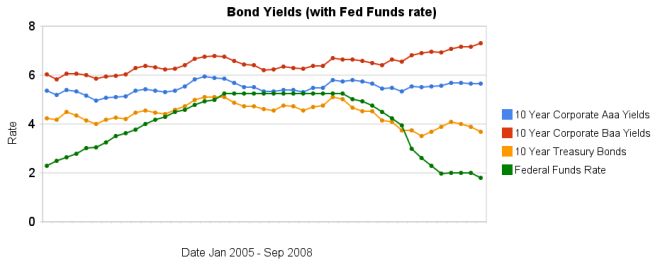
    Case in point. Between mid 2007 and September 2008, the market rate on 10 year Treasuries dropped from 5+% to around 3¾% while the rate on Aaa 10 year corporates barely moved. The formula worked fine; corporate bond prices didn't move because corporate interest rates didn't move. It's an oversimplification to talk about "rates" as though there's only one set of interest rates.
    image
  • The inventor of the ‘4% rule’ just changed it
    You can see that my assumptions end results are pretty close to yours.
    Remaining portfolio:...Mine=$876K...yours=$847K.
    From this point it may get much harder not easier. FBNDX(bonds) past performance since 1998 was 5% annually, it's going to be about 2% lower. This means that the same portfolio could make about 2% lower than the above and further erosion.
    My portfolio like many others must be able to pay for LTC too.
    I know, that's beyond the scope, but in my case I don't want my portfolio to lose purchasing power and the ability to handle unexpected health issues and why Bengen (and other) papers are just a starting point for me.
  • The inventor of the ‘4% rule’ just changed it
    The idea in using historical data is to use historical data. One doesn't input one's own hypotheticals. In particular, one uses actual inflation rates (which PV supports).
    Also, the idea is to reproduce Bengen's scheme, not introduce one of your own design. Bengen starts with a fixed amount (4.5% of the initial pot), and adjust that dollar amount annually by the actual rate of inflation. What you did instead was withdraw 7% of the portfolio value at the end of each year.
    From Bengen's original paper:
    The withdrawal dollar amount for the first year (calculated as the withdrawal percentage times the starting value of the portfolio) will be adjusted up or down for inflation every succeeding year. After the first year, the withdrawal rate is no longer used for computing the amount withdrawn; that will be computed instead from last year's withdrawal, plus an inflation factor.
    https://www.retailinvestor.org/pdf/Bengen1.pdf
    Here's Bengen's model in PV applied to the time frame you selected.
    At the end of the 22+ years, it shows a remaining portfolio value of $1.366M, or $847K in inflation adjusted dollars (check the inflation-adjusted box at the bottom of the graph). It's hard to see this investor's portfolio going down to zero in the next seven years, given that it's only dropped 15% in real value over the first 22 years.
    FWIW, the annualized inflation rate for the years 1998-2019 (based on the NYU/Stern figures I previously cited) is 2.16%, and the current year's inflation rate is even lower.
  • Should You Pay Off Your Mortgage?
    https://www.morningstar.com/articles/991262/should-you-pay-off-your-mortgage
    I found the discussion of this issue in the linked M* article pertinent to my situation. I realized I have been twisting my knickers every way to Friday trying to get some yield out of my cash holdings at Schwab, with little luck. I did put a chunk into TMSRX, but I do think it's time to stop paying Chase 3% on our mortgage and pay ourselves the savings.
  • The inventor of the ‘4% rule’ just changed it
    I like simplicity. We never had CAPE > 30 and interest rates so low which isn't a good start from here.
    For my portfolio sustainability I always add inflation. The last time CAPE was over 30 was in 01/1998. I'm trying to be fair and not start at much higher CAPE such as 01/2000.
    PV(link) shows that 4.5%(withdrawal)+ 2.5%(inflation) = 7% withdrawal in PV isn't good enough. I know, it's not 30 years but almost 23 years is still a good one.
    It's worse now because bonds future returns will be worse in the next 30 years.
  • an answer to the question of avoiding the big six
    It's the usual academic argument. One considers volatility not really because it is "risk" but because with leveraging (or deleveraging, i.e. underweighting) one can achieve virtually identical results using any investment having a given "risk adjusted" rate of return.
    I've previously quoted John Rekenthaler on this subject:
    [A]lthough academic theory states that performance should be risk-adjusted, investors tend to pay greater attention to unadjusted returns--not without reason. Academic theory assumes the use of leverage, but few mutual fund owners will ever borrow to purchase more shares. They therefore may be pardoned for favoring the bottom line...
    https://www.morningstar.com/articles/945008/be-thankful-that-you-dont-compete-against-vanguard
    My question for investors remains: if you're not thinking about leveraging, why do you care about the volatility of an investment you won't touch for a decade or more? Why does it matter to you the path it follows to the same end result?
    Jeff Ptak's take: "The saying is true: You really can't eat risk-adjusted returns. But it appears that higher risk-adjusted performers are easier for investors to use."
    https://www.morningstar.com/articles/873910/you-cant-eat-risk-adjusted-returns-but-they-still-might-nourish
    Buffett's take: "Charlie and I would much rather earn a lumpy 15% over time than a smooth 12%. (After all, our earnings swing wildly on a daily and weekly basis - why should we demand that smoothness accompany each orbit that the earth makes of the sun?)".
    https://www.berkshirehathaway.com/letters/1996.html
  • an answer to the question of avoiding the big six
    The last section, on risk, is fascinating to contemplate; want to see braham and msf weigh in --- is the arg really in favor of equal weighting, or just stick with the winner-bias approach?
    https://www.marketwatch.com/story/how-to-invest-in-the-sp-500-without-betting-on-faamg-stocks-2020-10-23
  • The inventor of the ‘4% rule’ just changed it
    >> I wonder if he still feels this way.'
    One's "feeling" about immutable historical numbers does not change. Though one can add more historical data as time passes. What I illustrated is that today, all the historical data, including the additional dozen data points since Kitces' piece, (probably) does not change the Kitces' result. Of course all the additional data since Bengen's original work does not change his conclusions, as he reiterated them (with refinements) in his current work.
    >>My curiosity, as I said, is about what the scenario might look like
    That's a different question. You're asking what they would speculate about future data. I addressed that in writing "Bengen doesn't make market predictions."
    The curiosity is understandable. The closest you're going to come to an answer is Bengen's observation: "Unfortunately, as Michael observed in his 2008 article, the “CAPE needle” has been jammed against the upper valuation stops for almost all of the last 25 years. As a result, almost the only choice for safe withdrawal rates has been the highest CAPE value in each table."
    That means that there are now a few 30 year spans that started with high CAPE ratios. Obviously not enough for Bengen to break out into a separate (higher CAPE) bucket, else he would have done so in his current paper. You can hope that he revisits his partitioning of CAPE ranges in a few years when he has more high CAPE data points to work with. Though as I've tried to show, the 4.5% withdrawal rate still works with the first few periods that have rolled in since Kitces' paper.
    I expect the 4.5% withdrawal rate to succeed with the next data point (1991-2020) as well. PV shows that after 29 years (1991-2019) one would be left with 4.2x one's starting value.. For the annual inflation-adjusted withdrawal at year end (Dec 31, 2020) to exhaust that portfolio would require an incredible market swoon in the last two months of the year.
  • The inventor of the ‘4% rule’ just changed it
    >> showing that 4.5% works for 1979-2008.
    of course; whoever has said otherwise?
    >> the mid 80s were a good time to start
    of course, the best ! Thank goodness.
    My curiosity, as I said, is about what the scenario might look like ...
    >> [4.5%] can be increased if the ratio at the start of retirement is under 20.
    ... when ratios are ~25%-50% and more above 20. So I will monitor PV going forward to get a sense. Are you thinking Kitces et alia would maintain their 4.5% SWR view starting now?
    Obviously anyone who thought otherwise in March has been shown the wisdom of staying the course and the foolishness of doing the opposite.
  • The inventor of the ‘4% rule’ just changed it
    The results are all historical. The latest current 30 year period is Jan 1990 - Dec 2019. The last 30 year period in 2008 was Jan 1978 - Dec 2007.
    No need to wonder. Just check whether any of the following additional periods would have failed with a 4.5% withdrawal rate, inflation adjusted:
    1979-2008, 1980-2009, 1981-2010, 1982-2011, 1983-2012, 1984-2013,
    1985-2014, 1986-2015, 1987-2016, 1988-2017, 1989-2018, 1990-2019.
    Portfolio Visualizer can give you a good sense on the second row (its data starts with 1985). I don't believe there was a bond index fund around then, but FBNDX can serve as a proxy.
    Here's 1985-2014 to start with. As you can see, the mid 80s were a good time to start, even with the 1987 crash.
    As far as the starting in one of the previous six years (1979-1984) is concerned, you can find the figures for those years here.
    For 1979, $5K stocks rise to $5,926. $5K in bonds, worst case (using the worst performing bonds in the table) fall to $4,899.50. Total is $10,826. WIthdraw $450, leaving $10,376. Rebalance into stocks and bonds: $5,188 each. Adjust next year's withdrawal for inflation: $500.63.
    For 1980, stocks rise to $6,834. Bonds, worst case, drop 3.32%, to $5,016. Total is $11,850. Withdraw $500, leaving $11,350. Rebalance into stocks and bonds: $5,675 each. Adjust next year's withdrawal for inflation: $568.47.
    For 1981, stocks fall to $5,408. Bonds, worst case, rise to $6,140. Total is $11,548. Withdraw $568, leaving $10,980. Rebalance into stocks and bonds: $5,490. Adjust next year's withdrawal for inflation: $627.19.
    For 1982, stocks rise to $6,611. Bonds, worst case (3 mo. T-bills), rise to $6,072. (T bonds and Baa bonds rose around 30%) Total is $12,683. Withdraw $627, leaving $12,056. Rebalance into stocks and bonds: $6,028. Adjust next year's withdrawal for inflation: $665.64.
    For 1983, stocks rise to $7,375. Bonds, worst case, rise to $6,221. Total is $13,596. WIthdraw $666, leaving $12,930. Rebalance into stocks and bonds: $6,465. Adjust next year's withdrawal for inflation: $687.01.
    For 1984, stocks rise to $6,863. Bonds worst case (3 mo T-bills), rise to $7,080 (T bonds and Baa bonds rose around 14%) Total is $13,943. Withdraw $687, leaving $13,260. Adjust next year's withdrawal for inflation: $716.55.
    At this point, we can use PV, with a starting balance of $13,260 and a starting withdrawal of $717. It goes from Jan 1985 through Dec 2008. The early 2000s are not good, and 2008 is not good, but by then the mountain of cash has risen so high that it hardly matters.
    That takes care of showing that 4.5% works for 1979-2008. The five other 30 year periods are left as an exercise for the reader. Also, make sure to check my arithmetic, I wasn't too diligent here.
  • The inventor of the ‘4% rule’ just changed it
    >> never less than 4.5%, and can be increased if the ratio at the start of retirement is under 20.
    I wonder if he still feels this way. I could check. The link is from spring of 2008, a wonderful time to be writing about anything financial, and the p/e he cites has not been <20 since like ~1993 except for that sharp 08-09 dip, and much if not most of the time it's been way >25 if not >30.
    So like most (esp those of us out of equities) I am hoping this time, meaning since the 1980s, it's different.
    https://www.multpl.com/shiller-pe
  • Fidelity Report on IRA, 401K & 403B Accounts by Age
    Just keeps getting better!!
    Fidelity® Q2 2020 Retirement Analysis: Steady Contributions Combined With Market Performance Lead to Double-Digit Rebound Across Retirement Account Balances
    Retirement account balances rebound in Q2. The average IRA balance was $111,500, a 13% increase from last quarter and slightly higher than the average balance of $110,400 a year ago. The average 401(k) balance increased to $104,400 in Q2, a 14% increase from Q1 but down 2% from a year ago. The average 403(b) account balance increased to $91,100, an increase of 17% from last quarter and up 3% from a year ago.
    https://www.businesswire.com/news/home/20200811005276/en/Fidelity®-Q2-2020-Retirement-Analysis-Steady-Contributions#:N^P]™\˜YÙILŒ™]\™[Y[LŒXØÛÝ[LŒ˜[[˜Ù\ÉLŒLŒLŒLŒ LÍÉLÍŒ LŒLŒLŒLLÍŒ LŒLŒLŒLÉLÌ LŒ
  • The inventor of the ‘4% rule’ just changed it
    Michael Kitces is my favorite writer: a better choice is to start with lower % in stocks in early retirement years and increase the % with age.
    As I've posted before, this work by Pfau and Kitces work breaks down when rates are low. Dr. Pfau acknowledged this, writing that
    It does indeed seem that retiring at times with particularly low bond yields, which can be expected to increase over time, may not favor rising equity glidepaths during retirement. It essentially causes the retiree to lock in low bond returns and even capital losses on a bond fund as bond yields gradually increase (on average) over time.
    Kitces, incorporating CAPE P/E 10 data, concluded that the safe withdrawal rate is never less than 4.5%, and can be increased if the ratio at the start of retirement is under 20.
    The only enhancement that Bengen made to Kitces' work was to incorporate inflation, i.e. part of what you are concerned about.
    Inflation directly affects the periodic withdrawals, as it is assumed that dollar withdrawals are increased annually by CPI. If inflation is high, it results in rapidly increasing withdrawals. ... the inflation trend hints at a reliable cause-and-effect relationship. As inflation (defined as the trailing 12-month Consumer Price Index at retirement) increases from top to bottom, SAFEMAX correspondingly declines.
    Now he says SP500 performance will be around 7%.
    You may have misread Marketwatch's writing: "Historically, he says, the average safe withdrawal rate has turned out to be about 7%." Bengen doesn't make market predictions.
    I should also issue the usual cheerful disclaimer that this research is based on the analysis of historical data, and its application to future situations involves risk, as the future may differ significantly from the past. The term “safe” is meaningful only in its historical context, and does not imply a guarantee of future applicability.
    Also on point regarding predictions, he writes: "if you have strong feelings that the inflation regime will change in the near future, you can choose another [presumably more conservative] chart".
    Thanks to @bee for having posted Bengen's article yesterday, so that one could read what he actually wrote.
    https://mutualfundobserver.com/discuss/discussion/57156/william-bengen-revisits-the-safe-withdrawal-rate-at-retirement
  • World's Largest Solar Farm to Be Built in Australia - But They Won't Get The Power
    Thanks to all for the discussion about HVDC transmission.
    The first major HVDC transmission line in the US has been sending renewable hydropower from Bonneville Dam to the Los Angeles area via an 846-mile long overhead line for about 50 years.
    image
    https://new.abb.com/news/detail/45972/abb-completes-upgrade-of-first-major-hvdc-link-in-us-transmission-history
  • The inventor of the ‘4% rule’ just changed it
    Bengen doesn't make sense and why the rule should definitely be under 4% and not 5%.
    From 1992 to 2005-6 inflation(link) was around 2.5-3%. In the last several years it's about 2%. When the long term performance of the SP500 was about 10%, Bengen used 4%. Now he says SP500 performance will be around 7% and inflation is lower (at 2%), the rule should be under 4%.
    In the past it was 10-3 = 7% performance(after inflation) and now it's lower 7 - 2 = only 5%. Lower performance means lower withdrawal rate.
    Our portfolio withdrawal rate would be under 2% long term. This will keep our current standard of living and our portfolio for the next 4-5 decades similar to today.
    Michael Kitces is my favorite writer: a better choice is to start with lower % in stocks in early retirement years and increase the % with age.
    BTW, The withdrawal rule has nothing to do with distributions. Higher distributions isn't a guarantee for better performance or volatility but it's being promoted for years as the best solution.
  • BlackRock’s bond king Rick Rieder: Market is going significantly higher
    (link)
    Nothing new but it makes sense. Stocks are the only game in town.
  • The Best Taxable-Bond Funds -- M*
    @bilperk
    1) Ballast - This is what most investors think
    That's the first site(link) I found at Google:
    Historically, when stock prices are rising and more people are buying to capitalize on that growth, bond prices have typically fallen on lower demand. Conversely, when stock prices are falling and investors want to turn to traditionally lower-risk, lower-return investments like bonds, their demand increases, and in turn, their prices.
    2) "Most of us don't have the time or desire to do the research and then jump in and out of lower-rated and often newer bonds fund." How about admitting it's not about time at all. Investing was always may passion, I do research regardless if I trade or not. When I do it specifically for trading it takes me maybe an hour per month. In the period of 2000-2010 when I traded less often it took me about an hour every several months. The bigger and more important question is...do you see better results?
    If I remember correctly you do change your asset allocation and funds according to market conditions which means you are not a buy and hold investor and it worked pretty well for you. I came to conclusion FOR ME that the only way to achieve my strict goals and rules and use mainly bond fund is what I do.
    BTW, sometimes I don't change for months-years. I held a huge % in PIMIX for several years but in the last 2-3 years it's getting harder and from this point a lot harder for high-rated bonds.
  • World's Largest Solar Farm to Be Built in Australia - But They Won't Get The Power
    I've found the subject of ultra-high voltage power transmission lines to be very interesting. In the early days, as Catch22 mentions, the DC voltages involved were quite low, so to increase the deliverable power the transmission lines had to be extremely thick, expensive, and heavy. Because AC voltage can be easily increased or decreased by transformers, it became the transmission method of choice.
    To greatly simplify, the effective power that can be delivered through a circuit is the product of the voltage x the amperage (current). So to deliver more power through the same set of transmission lines the voltage can be increased. If a resistive load such as an electric heater needs 1000 watts of power, that can be delivered by supplying 100 volts at 10 amps, or alternatively by 200 volts at 5 amps, etc. The 200 volt supply would be preferable from the standpoint of power transmission, as the power lines need only be 1/2 as thick, saving copper, weight, and therefore expense.
    However, as AC voltage is increased to extremely high values, other complex issues come into play, causing significant losses in power transmission. Because of advances in electronic switching apparatus, it is now also possible to transmit extremely high DC voltages.
    The voltage generated is still actually AC, and transformers are used to increase that voltage to extremely high values. That high voltage is then converted to DC, and sent over typically long transmission lines. At the receiving end, the DC is reconverted to AC for local distribution. The terminal equipment for the DC lines is expensive, but the transmission lines are much thinner, and the transmission losses are much smaller.
    As Davfor's post illustrates, this transmission mode is especially useful for long underwater transmission lines.
    If interested, good information on all of this is available at Wickipedia.
  • Fidelity Report on IRA, 401K & 403B Accounts by Age
    Average balances are 2-2.5 times higher than they were in Q1 2009 thru Q1 2019. Many own primarily Target Date Funds
    FIDELITY® Q1 2019 RETIREMENT ANALYSIS: ACCOUNT BALANCES REBOUND
  • The inventor of the ‘4% rule’ just changed it
    This isn't the change I would have expected....
    Bengen says based on the current environment he thinks a new retiree should be safe if they start with a withdrawal rate of…no more than 5%.
    “That’s what I use myself,” Bengen told me when we spoke by phone.
    ....retirees right now have one saving grace: Very low inflation.

    https://marketwatch.com/story/the-inventor-of-the-4-rule-just-changed-it-11603380557