Howdy, Stranger!

It looks like you're new here. If you want to get involved, click one of these buttons!

Here's a statement of the obvious: The opinions expressed here are those of the participants, not those of the Mutual Fund Observer. We cannot vouch for the accuracy or appropriateness of any of it, though we do encourage civility and good humor.
  • M* Fund Spy: How Risky Is Risky in World-Bond Funds?
    am glad that yields aren't NEGATIVE (yet.)
    Oh, ye of too much faith. A few days ago I was looking through funds a tad up the risk scale past "near cash", and found a few short term government funds with negative yields (at least negative 30 day SEC yields): GSSDX, FFXSX, FIGIX, BTTTX, TWUSX, and CGBAX.
    See here (for GSSDX) and here (for the others). I've listed from best (-0.05%) to worst (-0.65%) SEC yields.
    As you observed, "the value of our currency will be falling off a cliff", which makes it a good time to buy unhedged foreign securities.
  • MetWest Flexible Income Fund - MWFEX, MWFSX
    Cash is up to 53.7% as if 7/31. That’s kind of crazy.
    Assets have tripled since I started the thread, up to 31 million now.
  • GAEG - NYL Anchor
    Can anyone explain what exactly this fund is? I don't fully understand it.
    I invested 25% of in it a couple of years ago because I was told it was one of the safest funds in my companies 401k offerings. The only other relatively semi safe funds offered are FXNAX and MWTSX. I have 25% in the former and the remaining 50% in CDs in IRA's.
    I am still working at 68and will continue (knock on wood). I want to preserve what I have if possible.
    Is this fund as safe as CD's?
  • M* Fund Spy: How Risky Is Risky in World-Bond Funds?
    I'd rather be getting a decent yield, in the neighborhood of 5% or so. I'm settling for a lower yield, and am glad that yields aren't NEGATIVE (yet.) I have a third bond fund which assists in pulling up my yield PTIAX. ...Still, yields are coming DOWN while share prices are rising....I'm still receiving a decent share of the rise in stocks, too. My domestic and international stock funds = 35% of portfolio. Staying conservatively diversified.
    ...But the rules of the game have changed, it's true. We are 100% divorced from fundamentals. I don't even want to think about what it will be like when the world's Central Banks pull the plug on stimulus. In the meantime, the value of our currency will be falling off a cliff.
    Today:
    Canada: $1.33
    Yen: 105.5
    euro: $1.18 (18% lower than the euro.)
    pound sterling: $1.31 (Not long ago, we were at $1.25)
    Filipino peso: 49.09 down from 52, lately.
  • IOFIX Imposes 1% Redemption Fee
    Thanks Charles. IOFIX since the crisis bottom has been the bond trade of the decade along with its sisters BDKAX, SEMPX, and others in the beaten down mortgage space. The last such trade was junk corporates in 2009 and before that emerging markets debt in 1999. Back further was junk corporates in 1991. Notice the theme here? Black swan events in 2020 (Covid liquidity crisis) 2008 (housing crisis) 1997/1998 (Asian currency crisis) and 1990 (Drexel Lambert) And after each crisis everyone was too scared to venture back in thinking a repeat is right around the corner. I love the fund company has imposed this fee. It will make for a more stable asset base.
  • M* - How to Create Cash Flows in Retirement
    by Christine Benz
    Mentioned: T. Rowe Price Dividend Growth (PRDGX) , Vanguard Dividend Growth Inv (VDIGX) , Vanguard Dividend Appreciation Index Adm (VDADX) , Vanguard Dividend Appreciation ETF (VIG) , Vanguard High Dividend Yield ETF (VYM)
    "It’s something that even casual market observers know well: Yields on bonds and cash have been going down, largely unabated, for almost three decades. Just when it seemed they had reached their nadir, payouts have taken another leg down. The yield on the 10-year Treasury was just 0.51% on August 4, its lowest level since the equity-market panic back in March. Yields on lower-quality U.S. bonds spiked during the equity-market duress in the first quarter, but they too have drifted back down more recently."
    Article Here
  • The Fed is expected to make a major commitment to ramping up inflation soon
    >> The way it's currently done
    Posted inflation data are chronically 4y out of date? That seems the conclusion, but I wonder; you'd think that would be bruited everywhere all the time.
    I think what it's saying is that while the 2016 CPI is computed using 2016 prices, the weights in the 2016 basket are based on consumer surveys asking what people spent money on in 2013. (And 2017 CPI is based on 2014 weights.)
  • The Fed is expected to make a major commitment to ramping up inflation soon
    The cost of the residential natural gas itself has gone down from 29¢ per therm (July 2019) to 24¢ per therm (July 2020). Not a down a third, just down a sixth.
    Cost of gas to your home is a total cost. That depends on how much gas you use, which varies year by year, and also on the cost of the last mile transport to your home. The latter is around 4x-6x times the cost of the gas itself. So that's the real determinant of cost, and a pretty stable one. I would guess that it is not a cost factor incurred by commercial users.
    Still, looking at average total residential gas costs, they dropped by about 7% over the same one year period, from $24.03 to $22.32. (That's attributable almost entirely to slightly less use per household.)
    https://www.pge.com/tariffs/Residential.pdf
  • The Fed is expected to make a major commitment to ramping up inflation soon
    That's the issue I was alluding to in my apparently feeble attempt at a joke about buying up cheap airline tickets. How, and how quickly, the basket of goods should be adjusted for consumer purchase patterns is a good question.
    The way it's currently done: "The CPI market basket is developed from detailed expenditure information provided by families and individuals on what they actually bought. There is a time lag between the expenditure survey and its use in the CPI. For example, CPI data in 2016 and 2017 was based on data collected from the Consumer Expenditure Surveys for 2013 and 2014."
    https://www.bls.gov/cpi/questions-and-answers.htm#Question_2
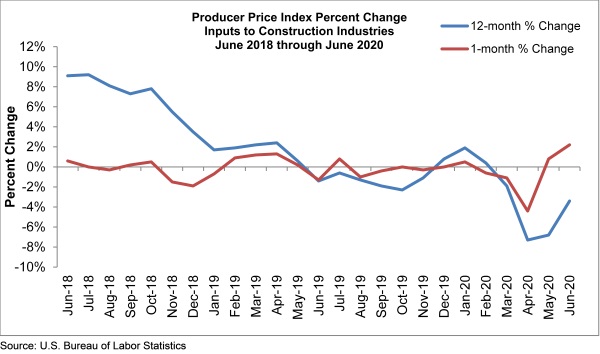
    The construction industry has its own problems with boom and bust cycles. On that basis alone it would seem to make more sense to smooth the prices of its materials over a full cycle rather than to project "boom" price increases to the present.
    Here's a graph with more current data:
    image
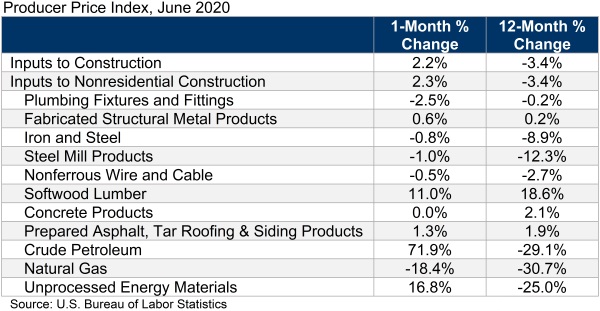
    And the current breakdown by component:
    image
    News release (Associated Builders and Contractors): https://abc.org/News-Media/News-Releases/entryid/17880/monthly-construction-input-prices-rise-in-june-says-abc
  • The Fed is expected to make a major commitment to ramping up inflation soon
    Tracking U.S. Lumber, Steel, Concrete, Gypsum, Glass, and Other Construction Material Costs
    Here
    @msf - please note the 3-year price increases from 2016-2019 (left side of chart). What’s more important? An airplane seat or a dry roof over one’s head?
  • The Fed is expected to make a major commitment to ramping up inflation soon
    "Do these people EVER walk into a grocery store ...?"
    Sounding like a broken record, I'll repeat that people tend to notice "pain" (rising prices, investment losses) more than they notice positive events (prices going down, investments gaining). Also that the CPI incorporates prices of everything, not just the ones going up. Perhaps we need an ulcer index for prices?
    It's likely you haven't noticed the deals one can get now on airplane trips. Wait, you mean you're not taking advantage of all these travel bargains? :-)
    WaPo: For the unemployed, rising grocery prices strain budgets even more
    Beef and veal prices rose 20.2 percent, and eggs rose 10.4 percent since February, according to data released Friday by the Bureau of Economic Analysis
    https://www.washingtonpost.com/business/2020/08/04/grocery-prices-unemployed/
    Overall inflation has not been a pressing concern since the recession touched down in February. Last week, Federal Reserve Chair Jerome H. Powell said consumer prices have been kept in check due to weak demand, especially in sectors such as travel and hospitality that have been most affected by the pandemic. But food prices are the exception.
  • M* Fund Spy: How Risky Is Risky in World-Bond Funds?
    Bonds at current world-wide rates are the nearest thing to poison (IMHO). Than again ... most financial assets appear overpriced. A sign of the times. Global bond funds (which include U.S. issues) and International bond funds (ex-U.S.), like other bond funds, are affected by credit quality, duration, maturity and the fund manager’s expertise at analyzing quality - particularly for “non-rated” bonds. Additionally, these funds also often employ derivatives - not easy for most investors to evaluate in terms of risk.
    Expenses are particularly important to bond funds. As a proportion of return, fees represent a higher % and therefore affect return on investment to a greater degree than for equity funds. Hedged or Unhedged? It’s a significant consideration. Unhedged funds tend to experience wider (also “wilder“) swings in value, but should protect better against a depreciating dollar. Most of these funds hedge in varying degree rather than being 100% hedged / 100% unhedged.
    As your prospectus should state, non-U.S. investments (including bonds) generally are subject to higher expenses and greater risk than U.S. domiciled holdings.
  • T. Rowe Price Institutional Core Plus Fund being reorganized into T. Rowe Price Total Return Fund
    https://www.sec.gov/Archives/edgar/data/1169187/000174177320002223/c497.htm
    497 1 c497.htm
    T. Rowe Price Institutional Core Plus Fund
    Supplement to Prospectus Dated October 1, 2019, as supplemented
    On July 31, 2020, the Board of Directors (“Board”) of the T. Rowe Price Institutional Core Plus Fund (“Fund”) approved restructuring the Fund’s fees and expenses, effective September 1, 2020. In addition, the Board approved a plan of reorganization pursuant to which the Fund will transfer substantially all of its assets and liabilities to the T. Rowe Price Total Return Fund (“Acquiring Fund”) in exchange for I Class shares of equal value of the Acquiring Fund on or about November 30, 2020 (“Reorganization”). Following the transfer, the I Class shares received in the exchange will be distributed to the Fund’s shareholders in complete liquidation of the Fund. The Reorganization does not require approval by the Fund’s shareholders.
    The Fund currently pays T. Rowe Price Associates, Inc. (“T. Rowe Price”) an all-inclusive management fee of 0.40% based on the Fund’s average daily net assets that includes investment management services and ordinary, recurring operating expenses (with certain limited exceptions). Effective September 1, 2020, the management fee will no longer include ordinary recurring operating expenses, and the Fund will incur its ordinary operating expenses directly. The management fee will consist of two components—an “individual fund fee,” and a “group fee” that declines as the combined assets of the T. Rowe Price Funds rise, so shareholders benefit from the overall growth in mutual fund assets. On September 1, 2020, the annual group fee rate was 0.29%. The individual fund fee, also applied to the fund’s average daily net assets, will be 0.08%, which, when combined with the group fee rate, will result in a combined management fee rate of 0.37% of average daily net assets. In order to ensure that Fund shareholders will not pay more under the new fee and expense structure, T. Rowe Price has agreed to indefinitely waive the Fund’s fees and/or bear any expenses (excluding interest; expenses related to borrowings, taxes, and brokerage and other transaction costs; or nonrecurring, extraordinary expenses, which are the expenses excluded under the Fund’s all-inclusive management fee) that would cause the Fund’s ratio of expenses to average daily net assets to exceed 0.40%...
  • The Fed is expected to make a major commitment to ramping up inflation soon
    Hi Derf - Yeah - I was one of the last ones to receive it, but I got the $1200 bonus check along with the signature. Thankfully, the USPS was still functional than.
    Today the President unveiled a new plan that surely should ignite inflation, especially if we keep spending like a drunken sailor. The Plan - Deceptively simple. “Spend more. Tax less.” Why didn’t somebody think of it before? Also has a nice ring to it. I’m thinking it might catch on with the public the way Miller Beer’s early slogan for Miller Lite caught on years ago. “Tastes Great!...Less Filling!"
  • Bond Yields Are Sending a Scary Signal on Stocks
    +1 Yes-maybe FD1000 should start his own hedge fund and reap the benefits of the 2/20 fee structure.
    It's documented in this thread(link)
    And thanks, I'm retired enjoying my free and happy time. I have given FREE advice to hundreds of posters who contacted me over the years.
    davidrmoran: with his reported performance, again and again, he has no need of 2/20
    Correct, my portfolio just passed 35 times our annual expense, and we didn't start taking our SS. The results in the last 3 years were beyond anything I anticipated.
  • The Fed is expected to make a major commitment to ramping up inflation soon
    @catch22 : ''As of a few days ago, the etf TIP is +8.5% YTD, and the etf LTPZ (long duration TIPs) is +24.1%. Neither of these etf's are reacting to inflation today, eh?"
    Did you say this tongue in cheek ?
    Seems to me the higher these go, etf's, the more inflation ?!
    Derf
  • David’s August MFO Commentary ....Here!
    Davids report on the coupling of QRSVX & FPPTX sent me to thinking this may not be a good deal for QRSVX fund holders. More money coming into a PRICEY market if FPPTX sells its holdings or if their stocks are off loaded to QRSVX doesn't sit well with me !
    If some one could fill in a couple of blanks it would be deeply appreciated.
    1. When will this coupling start ?
    2 Will holdings roll over or cash from FPPTX ?
    Thanks for your time, Derf
  • David’s August MFO Commentary ....Here!
    David and colleagues decided to publish an entire encyclopedia on investing this month. Packed full of graphs, charts and analysis with the ambitious goal of assessing relative risk / reward for many different approaches (emphasis on risk). Some “end of the world” investment ideas are suggested, playing off the global warming theme. Everybody seems to agree that oil as an investment is in its death-throes. (I’ll submit that sometimes the consensus is wrong.) Charles Lynn Bolin offers a fascinating look at the bucket approach, which he uses. Personally, I never met a pie-chart I didn’t like, which I believe ties-in nicely in planning a bucket approach. Bucketing should ring a bell with Ol’ Skeet and many others here who use it - perhaps under a different name (like sleeves).
    One fund David looks at is RPIEX - Price’s Global Dynamic Bond fund. Dang it. I thought about that one some time back, but it was in the dumpster than. I even posted on the board and we all (?) agreed it had the characteristics of a perennial loser. Guess what? The fund has come alive and posted some nice YTD returns. David also re-examines RPHYX as a cash alternative. There’s more market neutral and alternative type offerings detailed by David and team than you can shake a finger at. I once owned Calimos’ version. High fees and poor performance than.
    Sorry I haven’t digested much of the commentary. I will in time. Right now it’s time to crank up the mower and tackle some 8” tall grass. My everlasting gratitude to David and the team at mfo for these timely incisive monthly reports.
    Link to August 1, 2020 Commentary: https://www.mutualfundobserver.com/2020/08/august-1-2020/
  • The Fed is expected to make a major commitment to ramping up inflation soon
    Hi @Old_Joe and @hank ......et al
    Tangent considerations for this thread.
    The below calculator is based upon the government CPI; which many agree is a flawed gauge. I agree with this view. Aside from whatever one may conclude is an average of components within the official CPI affecting the country overall; inflation for some high value items (housing) is regional/local. Some other local costs that vary by location is the cost of services needed by regular folks; being hourly rates for electricians, mechanics, skilled carpenter, etc. Auto purchase prices, on the other hand; may not vary as much today, as decades ago.
    I've used the below calculator for studying whatever. An example: An electronics technician position I held in 1971 paid $12,000/year. Based solely upon the CPI index, this same position today would require an annual salary of $76,000 for a break even number.
    Simple
    inflation calculator

    As to TIPs bond sector investments. I don't know that this area will have a particular impact from real or perceived inflation. Today, IMHO; these bonds are impacted more as a safe haven for scared money; not unlike other AAA U.S. issues. As of a few days ago, the etf TIP is +8.5% YTD, and the etf LTPZ (long duration TIPs) is +24.1%. Neither of these etf's are reacting to inflation today, eh?
    I find no need to purchase TIP's from the Treasury. Purchase of a fund or etf is as simple as a click at your investment company site, yes? As stated previous, not all TIP funds are equal. Active funds may have 20% invested into corp. bonds. Review holdings before a purchase, if you want pure TIPs.
    TIPs, obviously; are just another sector of bondland. Not unlike the major equity sectors of the SP500.
    On the personal side: If one considers a purchase, IMHO, the percentage should have impact upon your portfolio. A 1% of a total portfolio value purchase wouldn't mean much. Your portfolio likely already contains some TIPs mixed into a fund. If you're serious about a purchase, the percentage should high enough for the reward. Yes, this increases the risk (be it bonds or equity). BUT, your money is already at risk as an active investor; or you would not have a need for this forum. You'd have your money parked in CD's (negative, inflation protected growth today, eh?).
    NOTE: from mid-July......The U.S. Treasury just completed its auction of $14 billion in a new 10-year Treasury Inflation-Protected Security, with a historic result: A real yield to maturity of -0.93%, the lowest in the 23-year history of TIPS auctions of this term.
    ALSO: The German 10 year bund remains around a -.5% yield, and yet safety purchases continue to push or hold the yield low; thus resulting in price appreciation. Folks are still making money with these crazy yields.
    Time to hush my view.
    Chores call.
    Take care,
    Catch