
It looks like you're new here. If you want to get involved, click one of these buttons!
Comment: Stupid, STUPID, STUPID !!!The Trump administration is planning to close a small, obscure laboratory whose work undergirds everything from microchip manufacturing to nuclear fusion.
The Atomic Spectroscopy Group at the National Institute of Standards and Technology (NIST) provides the definitive measurements of atomic spectra. Spectra are specific sets of colors emitted by different atomic elements. Those sets of colors act as atomic fingerprints that are used to characterize a wide variety of things — from the gases in far-off stars, to the blood in a person's finger.
The laboratory has been in continuous operation for more than 120 years, but in mid-April it will be forced to close, according to a letter sent by the lab's head, Yuri Ralchenko, to dozens of colleagues around the world.
"We were recently informed that unless there is a major change in the Federal Government reorganization plans, the whole Atomic Spectroscopy Group will be laid off in a few weeks," Ralchenko wrote in the letter, which was emailed on March 18 and seen by NPR. The letter was first reported by Wired. Ralchenko says in the letter that he was told "our work is not considered to be statutorily essential for the NIST mission."
But thousands of scientists and engineers disagree. A petition is now circulating to reverse the closure, and it had received close to 3,000 signatures as of Wednesday. Among the signatories is Nobel Prize-winning physicist Sheldon Glashow.
"I cannot believe that the government would be stupid enough" to slash this kind of work, Glashow said in a video statement. The overwhelming support exists because the group's spectral measurements get used in almost every field imaginable, according to Elizabeth Goldschmidt, a physicist at the University of Illinois, Urbana-Champaign. "You look at the very specific color of a star, it can tell you the makeup of the star. You look at the blood in someone's finger ... and that can tell you how much oxygen is in the blood," she says.
But to measure colors accurately, devices like telescopes and pulse oximeters must be correctly calibrated, and that's where the Atomic Spectroscopy Group comes in. The laboratory maintains a database of atomic spectra that are the standard reference used to ensure devices are functioning correctly. Every month, the database receives around 70,000 queries from around the world, according to a recent post about it on NIST's website — and it's cited in two research papers per day, according to a recent presentation by Ralchenko.
Among the researchers querying the database is Brett Morris, an astronomer at the Space Telescope Science Institute in Baltimore, Md. who works on NASA's James Webb Space Telescope. Morris is studying planets around distant stars. Sometimes he says, the light coming from those stars looks surprising. "The first thing you have to do is to figure out who's to blame — was it oxygen? Was it carbon? Was it neon?" he says. "And the resource for doing that is the database produced by the Atomic Spectroscopy Group."
In addition, the laboratory conducts precise measurements of ultraviolet atomic spectra that are critical to developing advanced microchips. Ultraviolet light is used to etch tiny circuits, and advances in the field require detailed knowledge of the atomic spectra of elements in the extreme ultraviolet. There are a handful of facilities that research ultraviolet spectra, and this group is one of them, Goldschmidt says. It also studies plasmas, which are ionized gases that enshroud nuclear fusion reactions. Researchers around the world are pursuing fusion as a clean and virtually limitless form of energy, and detailed knowledge of plasmas is essential to that development.
Neither NIST nor its parent agency, the Department of Commerce, responded to NPR's inquiries about the closure, but the savings from closing the lab would be minimal. NIST's annual budget is just $1.5 billion, less than 0.02% of the government's $7 trillion annual budget.
A silicon wafer with microchips etched into it. Microchips are etched using specific wavelengths of light. Better measurements of the wavelengths in ultraviolet light are required to advance chip manufacturing.
Within NIST, the atomic spectroscopy group is made up of seven full-time federal employees. The group's employees even pay out of pocket for coffee and sugar used in its coffee breaks and have been doing so since 1973, according to a video celebrating its anniversary last year. By contrast, if the spectroscopy group closes, the costs will be enormous, scientists say. Researchers around the world will waste hours on the internet hunting around for the best spectral measurements, says Evgeny Stambulchik, a physicist at the Weizmann Institute of Science in Israel.
What currently takes a couple of minutes might soon take "many hours, maybe many days," Stambulchik says. "Multiply that several hours by several thousands of scientists and you understand the waste of work time there would be without such a centralized database," he says.
But Goldschmidt says the real blow would be to industry. Having centralized and agreed-upon calibration and measurement standards "is what allows industries to innovate and make new products," she says. "Everyone wins when this happens at NIST because everyone can rely on what NIST does, and they don't have to invest their time and money in doing it themselves."
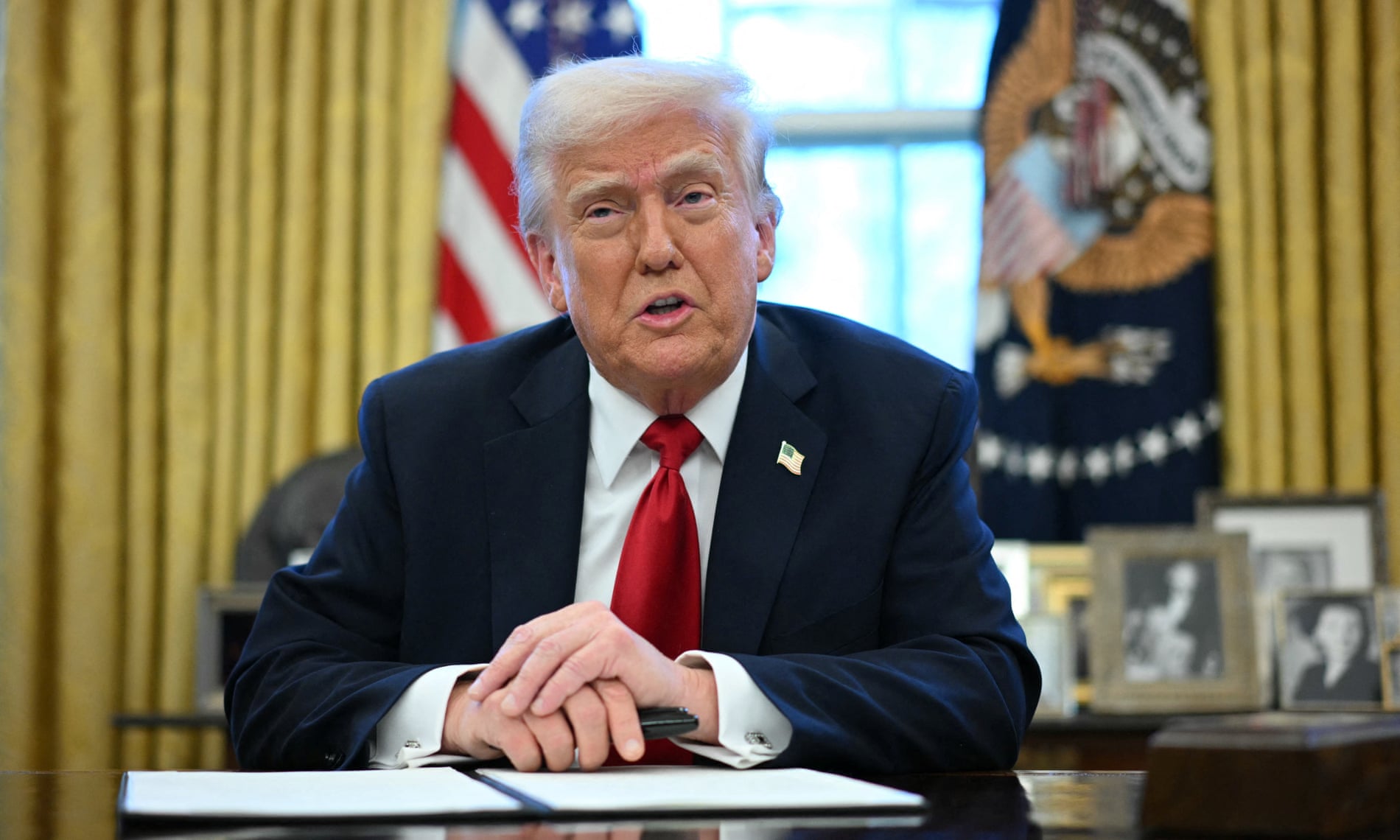
On Wednesday Donald Trump announced plans to impose sweeping 25% tariffs on cars not made in the United States, days before the US president is expected to announce wide-ranging levies on other goods from around the world: “What we’re going to be doing is a 25% tariff for all cars that are not made in the United States,” Trump said in the Oval Office. “We start off with a 2.5% base, which is what we’re at, and go to 25%.”
The tariffs will go into effect next week, on 2 April, the president claimed, and the US will start collecting them the following day. “This is very exciting,” he said, suggesting the move would spur economic growth. In February, Trump floated the idea of a 25% tariff on imported vehicles but had offered no other details. On Monday, the president hinted that the auto industry levies could come in “the very near future”.
On 2 April – a day Trump has dubbed “liberation day” – the president is expected to unveil a wide range of so-called reciprocal tariffs – levies on imported goods that the Trump administration argues are unfairly taxed by the US’s trading partners.
Trump has long argued that the US is being cheated by its trading partners and that tariffs are the best remedy. However, he has delayed or watered down his tariff plans on several occasions. His stance has worried investors, leading to sharp sell-offs in US stock markets, and has proved unpopular with both corporate America and consumers.
Many economists have expressed alarm, too, warning that the president’s tariff plan would risk increasing prices across the US. A study by Anderson Economic Group, an automotive consultant, for example, found that blanket tariffs on Canada and Mexico risked increasing US car prices by as much as $12,000.
Mexico, Japan, South Korea, Canada and Germany are among the top car exporters to the US. Will Scharf, a White House official, claimed the new car tariffs would result in more than $100bn in annual revenue to the US. “Have no fear, we will WIN everything!!!” Trump wrote on Truth Social earlier this month, claiming that tariffs were already “pouring money” into the country.
But a Harris poll conducted for the Guardian found that the majority of Americans were already worried about the impact tariffs will have on their finances. Ninety per cent of Democrats, 69% of independents and 57% of Republicans reported they were concerned about tariffs.
Industry groups sounded the alarm on Wednesday. “Throwing away tens of thousands of jobs on both sides of the border will mean giving up North America’s auto leadership role, instead encouraging companies to build and hire anywhere else but here,” said Candace Laing, president and CEO of the Canadian Chamber of Commerce. “This tax hike puts plants and workers at risk for generations, if not forever.”
https://cnn.com/2025/03/25/cars/china-byd-annual-sales-pass-tesla-intl-hnk/index.html
In 2024, BYD had a 32% share of China’s total market for new energy vehicle sales, which includes hybrids. Tesla claimed only 6.1% of the market, despite reaching a record high in terms of shipments, according to the China Passenger Car Association.
Tesla is struggling in Europe, too, where its sales fell in February for the second consecutive month: The company sold around 40% fewer vehicles on the continent compared with February 2024, according to the European Automobile Manufacturers’ Association.
Thanks Fred, I still maintain M* Watchlists and look at several bond oef categories. I have some interest in wading back into Muni funds, like NVHAX for my taxable account at Schwab, so I will maintain money in my MM funds with that in mind.I am a little older than you, dt, and also don't have much appetite for risk. However, I do want to beat inflation and aim to have my portfolio earn an annual total return of around 5-7%.
Currently, about 25% of my portfolio is invested in CDs from large national banks, and if they go under then the FDIC will not be of much help anyway. About 50% is in bond funds like CBLDX, ICMUX, RCTIX, etc., and the remaining 25% is in a MM fund for the time being.
Once the Trump tariff induced market turbulence subsides, my thoughts are to invest the MM funds in low SD alternative funds such as QDSNX, QQMNX, etc., and perhaps a balanced fund like PRCFX. But, for this segment of my portfolio I will always be dancing near the exit.
Good luck.
Yes, in one of my Schwab accounts, I put 2 CDs that matured, into SWVXX that pays 4.15%. In a different Schwab account, I put 1 CD that matured, into SNAXX that pays 4.30%. I can't find a nonCallable CD that pays more than that.I note SWVXX is down to 4.15% yield. Still attractive to me. I'm still adding in dribs and drabs. The savings account at the credit union is used simply as a sleeve to tuck money into for a particular purpose; it will be spent in a matter of months.
Sales of new Tesla cars slumped in Europe last month in the latest indication of a potential buyer backlash over Elon Musk’s high profile and controversial behaviour since becoming a leading figure in Donald Trump’s administration. The Texas-based electric carmaker sold less than 16,000 vehicles across Europe last month, down 44% on average across 25 countries in the EU, the UK, Norway and Switzerland, and Tesla’s market share fell to 9.6% last month, the lowest it has registered in February for five years. In January, its sales across Europe fell 45%, from 18,161 in 2024 to 9,945.
However, in the UK the Society of Motor Manufacturers and Traders reported an almost 21% rise in the number of new Tesla cars registered in February, with the Model 3 and Model Y proving the second and third most popular after the Mini Cooper.
Analysts have said that the volatile sales are also likely to have been affected by Tesla’s overhaul of the Model Y. A global analyst at Jato Dynamics, said: “Tesla is experiencing a period of immense change. In addition to Elon Musk’s increasingly active role in politics and the increased competition it is facing within the EV market, the brand is phasing out the existing version of the Model Y – its bestselling vehicle – before it rolls out the update. “Brands like Tesla, which have a relatively limited model lineup, are particularly vulnerable to registration declines when undertaking a model changeover.”
© 2015 Mutual Fund Observer. All rights reserved.
© 2015 Mutual Fund Observer. All rights reserved. Powered by Vanilla


