Howdy, Stranger!

It looks like you're new here. If you want to get involved, click one of these buttons!

Here's a statement of the obvious: The opinions expressed here are those of the participants, not those of the Mutual Fund Observer. We cannot vouch for the accuracy or appropriateness of any of it, though we do encourage civility and good humor.
  • Vanguard Wellington
    Welcome @carminusa
    You did not state whether you have access to broad range of moderate allocation funds; but if this is the case:
    You may also consider VILLX, FBALX or FPURX .
    Note that VILLX, for whatever reason had a nasty 2014; but appears to be back in the groove for 2015.
    This is a list of Morningstar Moderate Allocation funds. Click on the 5 year or any other column header to sort the list by return rate.
    Keep in mind that these so called MA funds may vary quite a lot with internal allocations and related. They are not twins and performance will vary, as indicated by the 5 year returns.
    Regards,
    Catch
  • Chuck Jaffe: 6 Bad Reasons To Make Changes To Your Portfolio
    ""1. ‘It can’t go up forever,’ or ‘We are overdue for a downturn or a correction.’"
    It cannot go up forever, but theoretically, it can go far further than anyone could expect. It really strongly appears to me that Central Banks are absolutely of the view that economic Winter has to be held back at all costs. I'm not saying that they will be successful, but they will push their theories until things get disorderly.
    QE (and as I've noted, market didn't even have to go down much and there was a Fed governor the other day talking about the potential for more asset purchases - I thought the market would have to drop 15-20% for that conversation to even start) and ZIRP will not in and of themselves result in a sustainable recovery or fix underlying problems that need to be addressed.
    This is not saying that stocks can go up forever, but there's a lot of variables and reflation or bust clearly seems to be the theme of central banks. Again, I'm not saying that stocks go to the moon, I'm simply saying that - for some reason - central banks this time around seem as if they are going to take this to the limit.
    If it doesn't work, they'll never admit it - problems are "transitory" and theories don't work because there "wasn't enough". With those views, things will - I think - be taken to the limit until they get disorderly. What that looks like we'll have to see, but I still think this period ends badly. I think in some ways with ZIRP and QE this is the ultimate bubble and it would not surprise me if the global economy looked very different on the other side."
    ======
    http://www.zerohedge.com/news/2015-04-26/boston-fed-admits-there-no-exit-suggests-qe-become-normal-monetary-policy
    "Boston Fed Admits There Is No Exit, Suggests QE Become "Normal Monetary Policy"
  • For you younger people hoping to retire comfortably - give up the dream.
    Hi Dex,
    I made a decision to take an early pension (defined benefit) at age 51 after 27 years of service. If anything will be different for those younger than you and I it will be that defined benefits will not be a common component of retirement.
    I will not qualify nor did I significantly contribute to SS. I needed to combine my "defined benefit" with a one time opportunity to buy and "extra annuity" to make my budget work. Budgeting, saving and thriftiness is what has allowed me to consider retirement at 51 and it will be that same attention to personal finances that will serve me well going forward.
    I moved to a no income tax state, bought a condo in 2012 for $35K that has tripled in value in three years. I drive multiple 20-25 year old cars...that's plural. I furnished my place mainly by finding good deals on Craigslist and the like.
    After 50 I started reminding my 50+ year old friends that:
    "Today is our last best day...and tomorrow will be our next last best day."
    In other words, If you have a desire to do something...do it today. There are no guarantees when it comes to tomorrows.
    Thanks for the thread.
  • Gundlach Buys $20 Million Of Junk-Rated Puerto Rico Bonds
    "Covenant-lite" corp junk and the impact of second-lien debt issuance. Be cautious; this asset class has a tendency to get crazy-stupid, just before it "gives it (overvaluation) up."
    http://www.businessinsider.com/martin-fridson-junk-bonds-are-in-extreme-overvaluation-2015-4
  • For you younger people hoping to retire comfortably - give up the dream.
    Here is '15's budget. Not very extravagant and I really just buy what I want. I'm not constricting myself in any way. The total is what is important - it is close in the end.
    Basic Living
    House
    1,981 RE Tax
    2,556 HOA - includes outside mtc - painting etc, water, trash, lawn care.
    489 Electric
    928 Insurance
    300 Misc Purchases
    133 Mail Box
    6,386 Subtotal House
    Car
    138 AAA
    744 Routine Mtc.
    1,164 Insurance
    147 Registration
    1,800 Gas
    3,993 Subtotal Car
    Personal Expenses
    327 Income Taxes
    1,200 Cash
    360 Medical
    340 Cell Phone
    3,300 Food
    600 Wine
    133 Mail Box
    396 Internet Access
    300 Dining Out/Entertainment
    4,230 Health Ins.
    300 Clothes
    - Driving Lic
    -
    11,485 Subtotal Personal Expenses
    21,865 Total Basic Living
    Incremental Living -1
    - Travel Trailer Reg
    492 Storage
    - Good Sam
    492
    Incremental Living - 2
    6,643 Travel/Education/Etc
    Misc Hobbies
    6,643
    7,135 Total Discretionary
    29,000 Total Basic + Incremental
  • For you younger people hoping to retire comfortably - give up the dream.
    First this is for the younger people. Not the first half of the baby boomers ('14-55) or those older.
    Give up the idea of retiring comfortably. You don't have a defined pension plan, little in 401K, social security will be pushed out further, a VAT will be instituted to help with the debt (and Obamacare).
    I own my home (no mortgage), truck and travel trailer, single (no debt). I retired in '07 at 51 and since then I averaged $27,000 in spending - that includes health ins and taxes. I'm estimating I will spend an average of $38,000 (includes $30,000 for a new truck) from '16-25.
    I did a line item budget for this period. After '25 I grow expenses at 4%
    Even with a small pension (13,000) and social security I estimate that only 6 years will be cash flow positive (from pension & SS I'm starting it at 63) starting in '19. I do use conservative estimates for capital growth 5%.
    Now the younger people will not have a defined pension and will have to take full SS later or early at a reduced rate. I doubt the workforce will have many 65 y.o. in int or even 62.
    The small pension and a good amount of savings that allowed the numbers to work.
    So, abandon all hope and enjoy life while you are young. It will suck when you 55+.
  • Active share measure is misleading
    My individual investments in actively managed mutual funds almost exclusively involve individual funds that focus on one market segment or one investment style. So, it makes sense that my comparisons of active share numbers between funds would be restricted to the group of funds that share the same benchmark or style.
    The AQR paper linked above includes a chart (Exhibit 1, page 6) that displays the fund data used by Petajisto. It displays the average active share percentage for the funds included in each of the benchmarks. It also looks more broadly at how average active share varies between the Large Cap, All Cap, Mid Cap, and Small Cap fund categories. It shows the average active share at about 75% for the funds included in the Large Cap benchmarks, 80% for the All Cap benchmarks, 88% for the Mid Cap benchmarks, and 92% for the Small Cap benchmarks. This supports the conclusion that sorting according to active share simultaneously sorts according to market cap.
    I leave it to other to determine whether the data supports the proposition that high active share increases the odds that a fund will have superior fund performance. My point is that the data does appear to indicate it is most useful to compare active shares numbers only between funds that share the same benchmark...or at least that share the same broad categories. Both Exhibit 1 of AQR's paper and the response Cremers and Petajisto made to that paper in the link @David_Snowball provided above appear to support this conslusion.
  • The Week Ahead: Healthcare Earnings
    FYI: Healthcare companies on a seven-year tear have been top performers so far in 2015, helping to push broad stock indexes to record levels, but traders are now looking to protect themselves from a selloff as they await major earnings reports in the sector.
    Companies reporting first-quarter earnings next week include Bristol-Meyers Squibb Co, Boston Scientific Corp , Merck & Co, Pfizer Inc, Gilead Sciences Inc and Celgene Corp.
    Regards,
    Ted
    http://www.reuters.com/article/2015/04/26/markets-stocks-usa-weekahead-idUSL1N0XL1U520150426
  • SEC's Stock Market Reform Club Locks Out Retail Brokers
    Soft Dollar Brokerage: At the “Sunshine Meeting” on July 12, 2006 statements made by the Chairman, Commissioners,and staff of the SEC left the public with the common impression that a proposal for a “second wing” of Commission Guidance on disclosure and transparency of all institutional brokerage commission arrangements would be forthcoming before the end of 2006. [SEC Proposed Guidance S7-22-08 Comment C
    http://www.scribd.com/doc/5578021/SEC-Proposed-Guidance-S7-22-08-Comment-C]
    The "second wing" of SEC guidance was never published. On May 27, 2007 SEC Chairman Christopher Cox sent letters to Senator Christopher Dodd and Congressman Barney Frank requesting that Section 28(e) be revised or repealed. [http://www.scribd.com/doc/13752510/Cox-Requests-Legislative-Action]
  • The History of the Stock Market Since 1957 in One Picture
    @davfor: When I grow up I want to be just like you. Nice link !
    Regards,
    Ted
    Most investors are terrible at trading — that is, they're not good at predicting short-term swings in the market.
    More often than not, investors find themselves buying high and selling low. And when the market starts selling off sharply, investors will panic, sell their own shares, and sit on the sidelines.
    Unfortunately, some of the biggest one-day upswings in the market occur during these volatile periods.
    http://www.businessinsider.com/cost-of-missing-10-best-days-in-sp-500-2014-3
  • The History of the Stock Market Since 1957 in One Picture
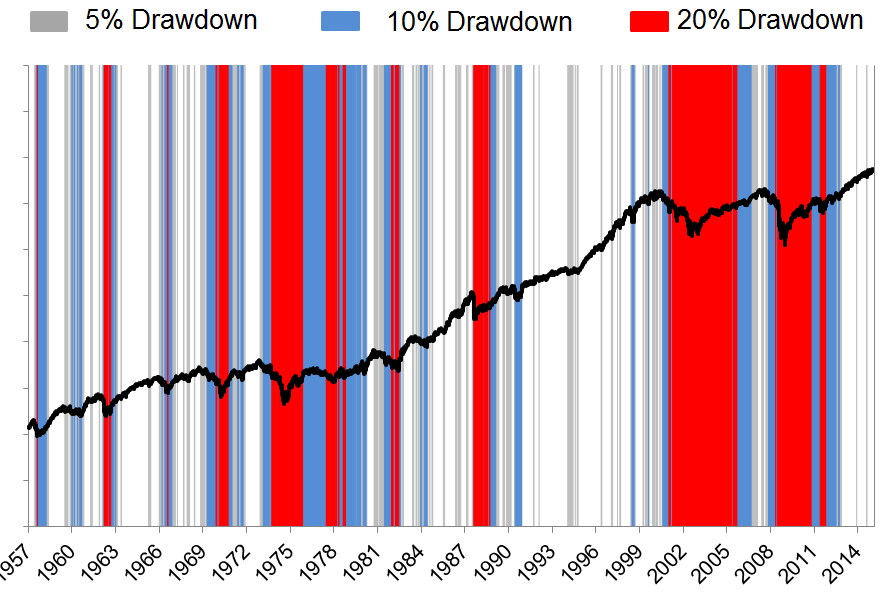
    Sometimes its useful to take a step back and look at the big picture.
    Joshu Brown writes: "In the chart below, I’m showing you how often the S&P 500 is in drawdowns of greater than 5, 10 and 20% from all-time highs. The white space is when the S&P 500 is at or within 5% of all-time highs (my god, look at the 1990’s!)." To his comment I would just add "My god, look at the 21st century!".
    Here is the chart:
    image
    Here is the post:
    thereformedbroker.com/2015/04/24/how-we-do-tactical/
  • SEC's Stock Market Reform Club Locks Out Retail Brokers
    FYI: The U.S. Securities and Exchange Commission is convening a group of financial industry veterans for the first time next month to consider stock market reforms, but one group will be conspicuously absent: retail brokerages.
    Regards,
    Ted
    http://www.reuters.com/article/2015/04/26/us-sec-markets-retailinvestors-analysis-idUSKBN0NH0D820150426
  • New Fund Offers Individuals Access To KKR Buyout Deals
    Scott - +1. The compositions of funds like these and similar always give me pause. As you noted, you get the A-list and the rest. Also, and I think I speak for both of us in this regard, when 'yield' may provide the greatest attraction these collections generally come up quite short to actually holding the cream of the crop or selecting a subset of own's own choosing. I see it in MLP funds as well as dividend or high-yield focused funds. I know selecting unique securities proves worrisome to many but I'm OK with it. To each their own.
  • Jason Zweig: Say ‘Yes’ To Funds That Know When To Say ‘No’
    The article should add...."close funds and then NOT start new ones". One of the reasons I quit Wasatch is because they didn't know when to stop? Then they gave birth to Grandeur Peak and IT does not know when to stop.
    I own one Wasatch Fund and one Grandeur Peak fund and I'm done.
    Here's another idea. Find funds that don't spend too much of their time and YOUR money marketing. They are unlikely to gather too many assets and have bloat issues. And you know your manager is even more sincere if you don't pay 12b1- fees.
  • Emerging Markets Are Hot
    FYI: After a horrid collapse late last year, emerging market stocks have come roaring back in 2015. Not without considerable basebuilding, however. Several emerging market exchange-traded funds spent the last six months churning in head-and-shoulder bottom formations.
    Regards,
    Ted
    http://wealthmanagement.com/print/etfs/emerging-markets-are-hot
  • Gundlach Buys $20 Million Of Junk-Rated Puerto Rico Bonds
    Yes, I have read and heard from at least a few different experts that EM debt in DOLLARS these days is a good place to be investing. I've been in PREMX since 2010. I'm really not sure where to find out just how much of the portf. is in dollar-denominated debt. Morningstar seems to give the impression that it is at least most of the portfolio.
  • NYSE Margin Debt Hits an All-Time High
    I am an amateur when it comes to investing, but no slouch about the study of history. Prior to the 1929 Crash, wasn't margin-debt at an all-time high? People borrowing to buy stocks? It's unnerving to read that.
  • substituting in IRA acct
    @catch22: Thanks for your input. Moving some of vtsax to poskx: is a good idea, the latter being from primecap family. My equity is purely US and at 90%, do not expect current income even after retirement in 2018(except capgains from the likes of prhsx, vhcox etc in the taxable accts). I use vanguard brokerage and essentially most funds are ntf.
  • Chuck Jaffe: 6 Bad Reasons To Make Changes To Your Portfolio
    "1. ‘It can’t go up forever,’ or ‘We are overdue for a downturn or a correction.’"
    It cannot go up forever, but theoretically, it can go far further than anyone could expect. It really strongly appears to me that Central Banks are absolutely of the view that economic Winter has to be held back at all costs. I'm not saying that they will be successful, but they will push their theories until things get disorderly.
    QE (and as I've noted, market didn't even have to go down much and there was a Fed governor the other day talking about the potential for more asset purchases - I thought the market would have to drop 15-20% for that conversation to even start) and ZIRP will not in and of themselves result in a sustainable recovery or fix underlying problems that need to be addressed.
    This is not saying that stocks can go up forever, but there's a lot of variables and reflation or bust clearly seems to be the theme of central banks. Again, I'm not saying that stocks go to the moon, I'm simply saying that - for some reason - central banks this time around seem as if they are going to take this to the limit.
    If it doesn't work, they'll never admit it - problems are "transitory" and theories don't work because there "wasn't enough". With those views, things will - I think - be taken to the limit until they get disorderly. What that looks like we'll have to see, but I still think this period ends badly. I think in some ways with ZIRP and QE this is the ultimate bubble and it would not surprise me if the global economy looked very different on the other side.
    2. ‘Because the bull run has been long, any decline is going to be big, too.’ - This is a patently false premise. Duration of a bull market is not the determining factor in the severity of corrections. Valuations and economic conditions are the primary drivers.
    Variables.
    3. ‘The Federal Reserve is serious about raising rates now, and that’s going to end the rally.’ - The first part of his statement is probably true. The second part does not necessarily follow.
    Who knows what the hell they want. You have different Fed governors saying different things every other day. The Fed can say that they want to raise rates, but they said that a couple of years ago, too. It gets to the point after several years where it looks bad that ZIRP is apparently still a need and does kind of go against their often overly optimistic economic projections. If that looks bad, imagine how it will look if they raise rates 50 basis points and then have to backtrack and lower rates again. That would be a clusterbleep of epic proportions.
    The Fed is ultimately "data dependent", but there is a real, strong element of "baffle them with BS" that is becoming more and more apparent with each passing year. As far as I'm concerned, this is a MOPE - management of perspective economy and the Fed is trying to manage the market's view of the economy for as long as they continue to have credibility. You should not be trading based upon what Yellen, Bullard or anyone else says on any given day because guess what? They could very well say something entirely different two days later. And all the discussion about the Fed raising rates might meet resistance with economic reality.
    4. ‘The government will screw this up.’ - This is a silly argument. Governments come and go depending on the outcome of elections.
    Of course they will. As far as I'm concerned, a lot of what government does these days is simply "hot potato" - hope they can buy time by financial engineering and other garbage in order to get to hand things off to the next person. Or, they hope they can throw enough money at problems that they don't have to actually go through the difficult task of having to solve them. And hey, it's a lot more popular to throw money at problems than to make difficult decisions - until things fall apart again.
    5. ‘The market is overpriced.’ - This is probably true in general. However, it's a straw-man so "all-inclusive" that it's easy to knock down.
    Meh. It depends on so many factors.
    6. ‘You can’t lose money in cash, so I will wait until the next downturn passes.’ -
    Well, you can if the government decides that ZIRP and QE aren't enough and decide to step it up to things like NIRP and devaluation.
  • New Fund Offers Individuals Access To KKR Buyout Deals
    About LPEFX, with a 5.5% front-end load and a 1.59% ER I personally don't find anything interesting about this fund at all. That'a a 7.09% deficit from the start that an investor w/o access to a load waiver has to jump over to even begin to make any return. Also, assuming M* (and this is one BIG assumption) has this dog placed in the appropriate category, the fund trails it's category badly. I'd pass and just hold a few of the entities outright but to each their own. Disclosure: I own BX & KKR.
    I think what concerns me about this fund is that - as you noted - you get everything, and that includes both the good (the A-list, like KKR, BX, OAK and a few others - including Brookfield and Danaher) along with some of the London traded PE funds, as well as some other entities, which are a mixed bag.
    Owning the individual entities has issues (K-1's, although not with all of them - BAM and Danaher, for example) but ultimately that's what I've gone with. The individual names often provide quarterly dividends, too, which is what I'm looking for and I suppose this is just such a tricky and volatile industry that there is something to going with the biggest and best versus the whole thing.
    Again though, just me.
    Long BX, DHR, OAK and BPY. I've pondered Onex and a few of the other things. However, I'm probably done after making BX a larger position than I'd initially imagined it being. Private equity investments are quite volatile and not for conservative investors.