MINT etf versus CD's versus MMK'Ts Taxes (in taxable accounts):
- short term (12 mo or less) zeros are taxed only at maturity, so a 9 month instrument purchased in May 2024 will not be taxed until the 202
5 tax year. This goes for T-bills and short term CDs that pay interest at maturity.
- if an ETF or fund (other than a MMF) pays interest periodically, one might choose not to reinvest divs. Otherwise, one could be facing an accounting nightmare when withdrawing cash. There's a significant risk of generating wash sales - sell shares at $10.02 that were purchased at $10.0
5 (a small loss); then the divs reinvested that month will "wash out" that loss.
- Treasury funds like USFR are (mostly) state tax-exempt.
Why multiple funds:
Floating rate and fixed rate markets (yields) don't move in sync and hard to predict. Likewise treasuries and commercial paper.
Personally I like RPHIX and FLRN, though FLOT is very close to FLRN. I agree with Yogi that Pimco seems to have higher expense funds. In the past JPST (another fund of this ilk) was more aggressive than ICSH and had done better. Not so since roughly the beginning of 2021 when volatilities were comparable and ICSH returned more.
Here's
Fidelity's comparison of RPHIX, USFR, FLRN, ICSH, and MINT. As conditions shift, the cumulative (e.g. three-year) figures could change significantly. IMHO that's the argument for using multiple types of these funds.
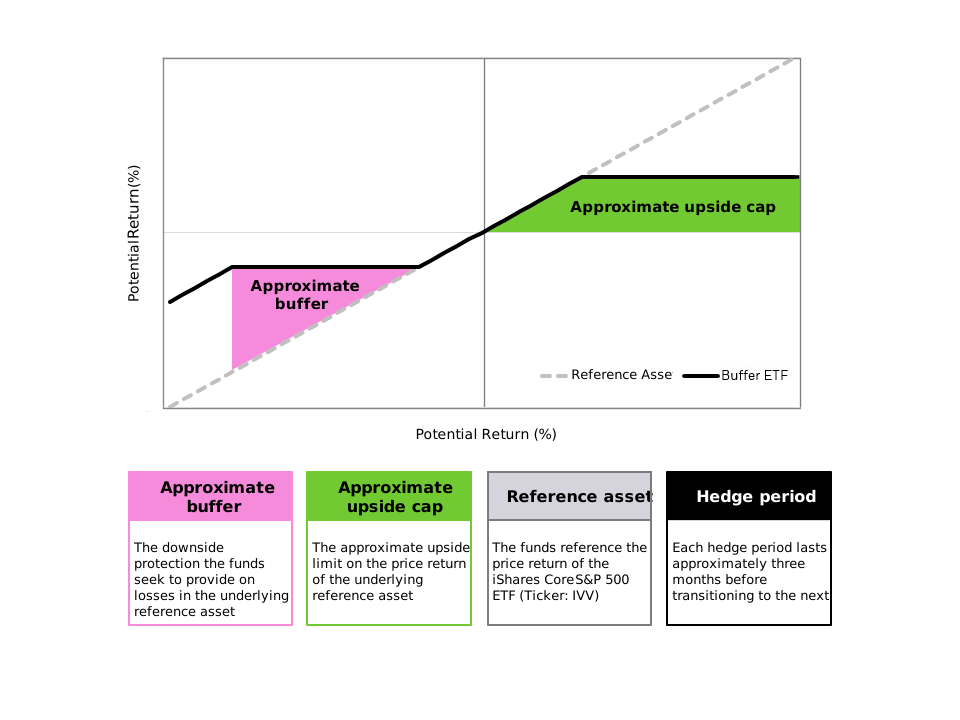
New Stock ETFs Offering ‘100%’ Downside Protection Are Coming "Calamos Investments filed Monday for so-called “structured-protection” exchange-traded funds that will track a portion of the returns of the S&P 500, Nasdaq 100 and Russell 2000 while hedging 100% of the downside via the options market, according to a Monday filing.
It's a gimmick I'd say.
I agree, if for a different reason.
In the world where you would get any benefit from 100% downside protection - if there is a world left by then - SP
500 would be down to '0' and, should they still be around to pay out, your money would be worthless anyway. (In fact, if they really wanted to get attention, they should offer a fund hedging in $'s up to, say, 9
5% downside and switching payout to 'chips' - my choice: potato - if the reference index drops any further.)
Historically, since 19
50, there has been one instance of >
50% DD on SP
500 and four in the 30-40%'s (if you believe
this link). So, when dabbling in hedged ETFs, I find ~ 1
5-20% downside protection more reasonable - which also allows for a higher upside.
Opportunistic Trader ETF (WZRD) will be liquidated @hank, there is also an annual fixed cost of about 2
50k to run an ETF why even well known firms liquidate ETFs if they do not accumulate assets after a year or two. The ETF business is not as lucrative as inventing an index or strategy that you could license to other ETF shops. Or come up with a hot thematic ETF like a Bitcoin ETF, cybersecurity ETF, etc. Anyway, good luck!
Opportunistic Trader ETF (WZRD) will be liquidated @hank,
Yes, I think it costs at least $
500K to start an ETF, especially for the first one.
I too think it is a great ticker. I think you can use it if it is not being used - check the SEC rules. If you are superstitious, you may avoid it no matter how brand value you might perceive.
If you want a ticker that is being used, you can buy it from the current user. META used to be a ticker for an ETF when FaceBook bought it. That ETF is now METV.
Grandeur Funds (GPGOX, GPIOX) I started a position in GPMCX around the time most everyone else did here back in 2015. After going great guns, and then recovering from Covid, since 2021 it has been all downhill. Fortunately I sold most of the position.
I have a hard time figuring out what they are doing wrong, but I am sticking with funds I am more comfortable with,
M* JR: Low-Risk (Claimed) = High Risk (Realized) If you are going to remain "overweight" in equities, the 1 phrase that sticks in my mind is:
"A rising tide lifts all boats" - JFK
....and the reverse is true as well. Defensive sectors (Utilities, Health, etc.) don't always hold up. So it would be nice to think that there are "low risk" strategies that could work. But they rarely do.
The M* article that YBB posted pointed out that both Low-volatility and Alternative investments have been hampered severely by extremely low interest rates (earned by Treasuries and Cash collateral) over the past 15 years.
The article finished with:
"But what feels good is not necessarily what is right. As a rule, competitive gains do not occur without accompanying pain.
That’s a message worth remembering when investment vendors respond to a stock downturn by selling safety. They always do."
M* JR: Low-Risk (Claimed) = High Risk (Realized) Nice
@msf I liken the “drag effect” of portfolio hedging to brakes on a car. A car would be much more
efficient and would travel
farther if you just left it rolling along.
PS -
@msf said “Shilling (attrib Keynes): The market can remain irrational longer than you can remain solvent.”
That’s scary if true. It suggests our perspective on markets based on most of our investing lifetimes may not reflect reality. My “hands-on” experience dates to 199
5, or about 30 years. Prior to that I paid little attention. Despite a few awful downturns (2000, 2008, 2020, 2022) U.S. equities have dramatically outpaced just about every other kind of investment. I dare say that holding bonds or other hedges over that 30 year span would have resulted in a lower overall return.
But, as I think Shilling / Keynes implies, that 30 year period may represent some type of
alternative universe rather then
reality.
FWIW / Fido’s analytics currently put me at
51% equities. Too high. Waiting for a good chance to reduce that.
M* JR: Low-Risk (Claimed) = High Risk (Realized) Volatility reduction tactics can improve long term performance. It depends on how long the term is. As you imply, in the withdrawal stage long term is decidedly shorter. Two quotes come to mind.
Keynes: In the long run we are all dead. Economists set themselves too easy, too useless a task if in tempestuous seasons they can only tell us that when the storm is long past the ocean is flat again.
Shilling (attrib Keynes): The market can remain irrational longer than you can remain solvent
https://www.goodreads.com/quotes/6757924-in-the-long-run-we-are-all-dead-economists-sethttps://quoteinvestigator.com/2011/08/09/remain-solvent/Still, I maintain significant exposure to vanilla equities. Though that is with what I feel is adequate ballast that can be drawn down as needed.
M* JR: Low-Risk (Claimed) = High Risk (Realized) ”This column should not be read as a criticism of low-risk investments. They aren’t required for younger investors, who need not worry about redeeming their funds at the wrong time (at least, if they are sensible), but they are critical for retirees who are withdrawing their assets. Ballast prevents them from entering a bear market spiral in which they spend ever-larger percentages of their portfolio to realize the same amount of money. Do that for long, and you are in real trouble.”
Do younger investors (ie ages 25-45) really pay much attention to portfolio construction / hedging? Sure, some do. And likely if they’re reading this board they pay greater attention than the average working stiff with a job, kids in school, a big mortgage and 25 + years to retirement.
Good article. Hopefully (as the author suggests) well considered portfolio specific hedging may reduce short term volatility for those already in the withdrawal stage. In no way, shape or form would I ever argue that hedging improves longer term performance. And … there’s always the option (hedge) of moving a big chunk into cash and / or CDs, as one well-heeled poster appears to have done recently. As a sometimes landscaper / gardener, I’m aware that hedges come in many different shapes and colors.
The Week in Charts | Charlie Bilello The Week in Charts (04/19/24)The most important charts and themes in markets, including...
00:00 Intro
00:14 Topics
00:46 When the Levee Breaks
07:21 The Other Side of Mania
12:01 The Large/Small Divide
1
5:19 Netflix Numbers
19:14 When Valuation Matters
22:12 Tesla Trimming
26:2
5 Housing Slump Continues
30:
51 Higher (Cash Yields) For Longer
VideoBlog
DJT in your portfolio - the first two funds reporting (edited)
Buy Sell Why: ad infinitum. BOT more shares of GOOGL while down slightly in pre-market trading to bring position to intended level. Avg share price just under $138 (a wee bit lower than the $140+ on our first BUY/SELL). Will either be another ST trade. if we get a bounce, or will ADD to position as LT HOLD. All yet TBD.
EDIT: Decided to dbl the position. BOT more shares during early market action as price kept falling. Snagged next batch at just under $136. Fun stuff!
EDIT_2: Closed out the position with some BUYs later in the day in the $135's, to end at an avg purchase price of $137, less than 1/2% below today's Close. Seems to be about where we were when we took the first ride on GOOGL. Lot of negativity towards it now but thinking we should be just about done with this round of punishment. We'll see!
SOLD full position in GOOGL on after hours POP at ~$177 for a ST Gain of ~29%. This trade took a LOT longer than expected to materialize but ended up being the best of my three ST plays on GOOGL, then NVDA, then GOOGL again.
CD
CD Sold 100k SUTXX MMKT (currently
5.17%) to extend income ladder-
50k treasuries, mature 2/26 @ 4.9698%, and 1/27 @ 4.806%
Note:
The Washington Post is reporting that "
the U.S. economy grew at 1.6 percent annual rate in first quarter 2024, a sharp slowdown".
Those of us currently building and maintaining income ladders should be alert that high current MMKT returns may drop significantly if the economy slows and the Fed
continues finally begins it's rate reductions, and consider moving at least some MMKT cash to long-term securities.