
Howdy, Stranger!

It looks like you're new here. If you want to get involved, click one of these buttons!

Here's a statement of the obvious: The opinions expressed here are those of the participants, not those of the Mutual Fund Observer. We cannot vouch for the accuracy or appropriateness of any of it, though we do encourage civility and good humor.
  • Silver Market
    Sounds like it's time for me to dig out my pre-1965 dimes, quarters and half dollars.
  • Silver Market
    Gold:Silver ratio peaked at 105 in 04/2025 (gold was hot) and is now 76 (silver has been shining for months). Recent low for the ratio was 73 in 11/2024.
    Edit/Add: Gold:Silver chart (E.O.D.) https://schrts.co/pNJHhiAh
  • Bond Market Retrospective
    " It is refreshing to have an established bond analyst to discuss the process of exploring various sectors of bonds and their inefficiencies."
    But I don't see why we need an "established bond analyst" when we already have FD1000.

    Well, if your toilet ain’t working, do you want a
    general therapist who claims to know a lot about everything from gutter repair to toasters? Or do you want a dedicated plumber with all the right tools?
    "great" post.
    Since retirement I have been in at least 95% bonds. In the last 3.5 years, I have been in 99+%.
    The images below, which I copied directly from Schwab, show I made 11.4% since 1-1-2018 and 11. 8% in the last 5 years.
    Go ahead and find a bond fund that beat the above performance and never lost more than 1% from any last top.
    https://ibb.co/yn39KpsC
    https://ibb.co/27w1XV1w
    My toilet is flushing pretty well.
  • Silver Market
    Howdy folks,
    Silver continues to shine relative to all else, particularly gold. YTD, gold is up ~55% while silver is up ~74%. Geez, silver was up almost 5% Wednesday and another 6% today. Silver is crushing due to a lack of supply in the face of enormous demand for physical bullion. This is putting pressure on both the COMEX and particularly LME (London). You see there are two distinct markets in precious metals - paper and physical. Silver has been in severe backwardation for quite a while now with demand for physical bullion outstripping the paper trade. Historically, most paper contracts are simply rolled over when due, but now folks are actually demanding the real metal. 'How dare you! ' December is a delivery month and there is a severe shortage of actual silver bullion available to fulfill the contracts.
    Some 70% of new silver comes as a byproduct of other mining such as lead, zinc and copper. This makes it very hard to scale up production in the short run. In addition, silver has enormous industrial demand - solar, EVs, circuitry, photography, medicine, reflective uses, etc. That puts a huge floor under the price.
    https://silverinstitute.org/silver-in-industry/
    On the demand side, you have the debasement trade and that's happening with the Central and Sovereign banks and folks that don't care for the smell of things.
    Rather than default, I suspect both exchanges are going to be willing to pay most any price for bullion. This should manifest itself over the next few weeks. We'll see.
    I'm just a old momentum investor who has been stacking silver for going on 70 years. This is my 3rd bull market and I'm right now I'm in a constant state of multiple orgasms. Hell, I can't even stand up in mixed company.
    For paper metals, I trust Sprott and do NOT trust the basic bullion ETFs such as SLV. Nope, nope, nope. While physical possession is ideal, most of us augment that with paper bullion and miners.
    Right now I'm riding SLVR, SGDJ, PSLV, CEF, SILJ. Note that most of these are miners. I particularly like the juniors and penny stocks. Nose bleed stuff for sure . . . but WTF we only live once.
    and so it goes,
    peace,
    rono
  • The Week in Charts | Charlie Bilello
    The Week in Charts (11/26/25)
    10 Things to Be Thankful For
    Video
    Blog
  • Fund Allocations (Cumulative), 10/31/25
    Fund Allocations (Cumulative), 10/31/25
    No significant changes overall. The changes for OEFs + ETFs were based on a total AUM of about $43.43 trillion in the previous month, so +/- 1% change was about +/- $434.3 billion. Also note that these changes were from both fund inflows/outflows & price changes. #ICI #Funds #OEFs #ETFs
    OEFs & ETFs: Stocks 61.75%, Hybrids 4.05%, Bonds 17.29%, M-Mkt 16.90%
    (New high for stock % since 10/2024)
    https://ybbpersonalfinance.proboards.com/post/2319/thread
  • Sentiment & market Indicators, 11/19/25
    Hey, @hank.
    Productive thoughts. Of course, capitalism is the only game in town, and its basis is not the intention to do good. Capitalism has no intention. My point is that capitalism can be bent by humans to benefit already-uber-wealthy-oligarchs, or it can serve the general public. Why is it that, generally speaking, things are more egalitarian in Europe?
    I recall a line from an episode in that wonderful tv series, "Thirtysomething." (Mel Harris! SO gorgeous!) So, a prospective employer was almost scolding Michael, saying: "We're not in the business of doing good; the good we might do happens in the course of doing business." A-ha!
    I invest to grow my wealth, too. But if there is something I might choose or not choose to invest in, even remotely, which may line-up with my personal convictions, I'd rather follow that course of action than to blindly and obliviously get rich while forsaking what I believe in. And what I believe in might or might not be consistent with the broad arc or direction which the country's and the world's leaders want to take us.
    If we do this stuff without at least a tacit ethical filter, we are not worthy of ourselves. And diversification, touted as so very necessary, will always serve to mitigate whatever good and ethical stuff we might attempt. You and I can both disagree about where the Ship of State is being steered, or we might approve. Either way, I guess what it boils down to for me is that we never can invest in a vacuum, even if were were to try.
    Honolulu, Th'ving Day, 2025, 2:30 p.m.: sunny, 83 F. (Real-feel = 87F.) Simply spectacular. I'm getting ready to eat some dead bird parts. Yum.
  • Crypto market crash hits Trump family, wiping out $1 billion of their fortune
    Expect increased chatter about a national crypto reserve in the coming weeks. Managed by Orange Julius Corp of course!
    Could the National Guard stop the bleeding? Maybe put 500 on Crypto detail?
  • Vanguard lowers fee expense ratios and other changes on Primecap funds
    Performance fees in mutual funds are called fulcrum fees. The adjustments must be symmetric (same magnitude for under- and over-performance), like a seesaw and a fulcrum. And like a seesaw (that can't drop below the ground), the maximum adjustment is limited.
    Many Fidelity funds have used fulcrum fees for the past decade. As noted in the column below from 2017, they sound better in theory than in reality.
    https://www.wealthmanagement.com/mutual-funds/fidelity-s-fee-fix-for-active-funds-comes-up-short-2017-10-19-1-
    Morningstar calculates that performance-fee funds have generated an average alpha -- or risk-adjusted outperformance relative to the appropriate broad market index -- of 0.22 percent annually over the last 15 years through September [2017]. By comparison, active funds that charge a flat fee generated an average alpha of 0.29 percent.
    ...
    fulcrum fees leave lots of opportunities for misalignment. They create incentives for managers to take more risk when they’re losing to the benchmark and less risk when they’re winning, regardless of whether those changes are best for investors. [Rest of paragraph contains complaints about how fulcrum fees might be abused, e.g. by picking the wrong benchmark - something neither Fidelity nor Vanguard does.]
    I'm troubled by Vanguard omitting the fee adjustment formula from the SAI. Three numbers are needed: (1) the base rate; (2) the maximum fee adjustment; and (3) the rate of adjustment (how many basis points added to management fee for how many percent outperformance).
    This is from FLPSX's current SAI:
    For Fidelity® Dividend Growth Fund, Fidelity® Low-Priced Stock Fund, Fidelity® OTC Portfolio, and Fidelity® Value Discovery Fund, each percentage point of difference, calculated to the nearest 0.01% (up to a maximum difference of ±10.00), is multiplied by a performance adjustment rate of 0.02% [item (3) above]. The maximum annualized performance adjustment rate [item (2) above] is ±0.20% of a fund's average net assets over the performance period.
    The FLPSX prospectus says that its base rate is not more than 0.67% [item (1) above]
    The supplements to the Vanguard prospectuses don't provide any of this information. For all we know, the current ER change for VPMAX from 0.29% to 0.27% is due not to a reduction in the base rate, but from a negative performance adjustment (underperforming the S&P 500 for the past three years).
    That is, 0.27% could equal 0.29% (base) - 0.02% (performance penalty).
    Or the base rate might actually have been reduced to 0.27% with a performance penalty of less than 1 basis point. Who knows?
    IMHO - the new Vanguard performance adjustments are publicity, little more. How many people were even aware of Fidelity's adjustments? And of those who were, how many really cared? The adjustment is usually noise.
    One exception: BRAGX. Unlike performance adjustments for most funds that are capped at small amounts, Bridgeway allows large adjustments, both positive and negative.
    From Kiplinger, Jan 31, 2011
    The fund’s record is now [YE 2010] so bad that it is paying customers to invest. This isn’t a joke. The expense structure of Aggressive Investors 1, as well as other Bridgeway funds, calls for higher management fees when the fund beats its benchmark and lower fees when it trails. Based on the formula, Bridgeway’s sponsor is now paying into Aggressive Investors 1 at an annual rate of 0.51% of assets.
  • Bond Market Retrospective
    Eric JACOBSEN is VERY INFLUENTIAL at Morningstar.
    Those familiar with history may remember that after a leak/tip to him about 2009 about Jeffrey Gundlach firing from TCW, he forced a REVOTE of 2009 Bond Manager of the Year and the result was changed from initial GUNDLACH to FUSS.
    Jacobson then covered the new DoubleLine funds and rated some as unratable for years. I see that DLTNX / DBLTX (AUM $31 billion), for example, now shows Brian MORIARTY as the analyst. M* Analyst Archives don't go beyond 12/2022 and don't even show the analyst names. But the history lives in the Internet.
    DoubleLine (AUM $50.57 billion) is what it is today due to Gundlach's determination and Howard MARK's initial funding and support for DoubleLine (of course, he got paid handsomely for his equity stake).
  • Sentiment & Market Indicators, 11/26/25
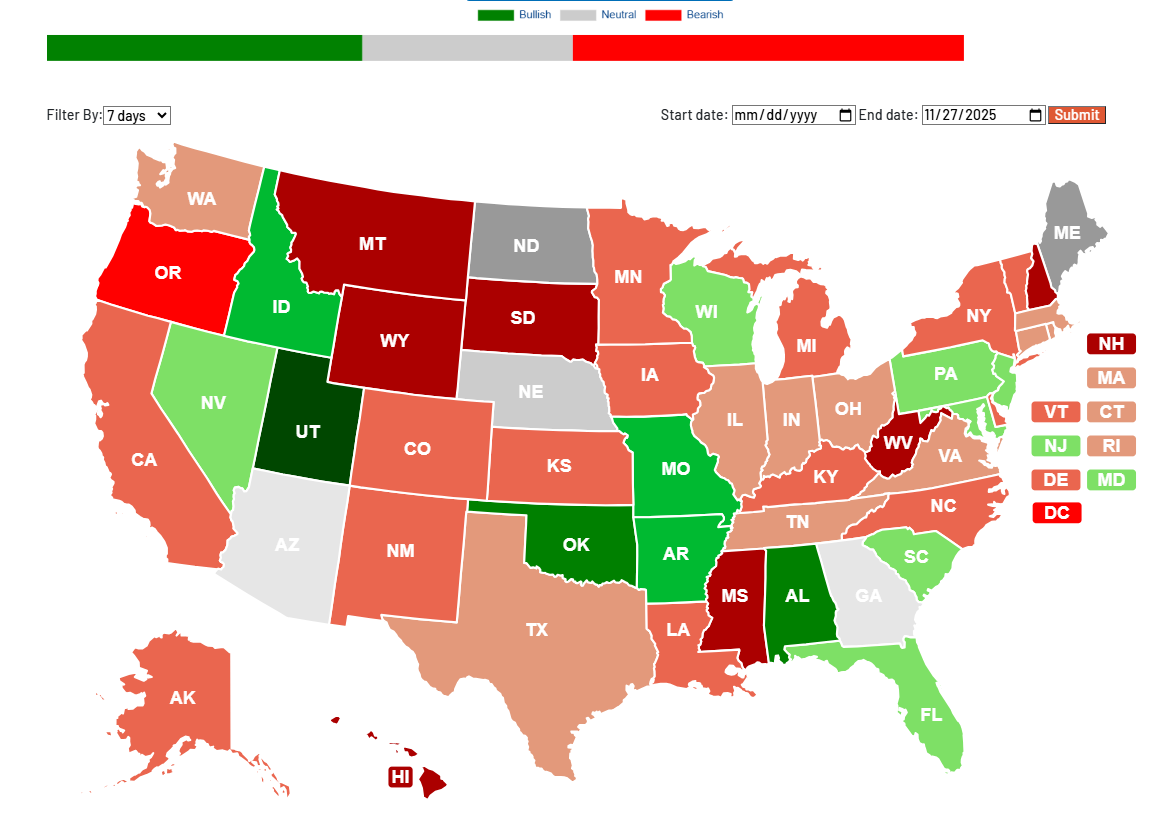
    AAII website also shows the distribution of sentiments by states (Bullish/ Neutral/ Bearish),
    image
  • Sentiment & Market Indicators, 11/26/25
    SENTIMENT & MARKET INDICATORS, 11/26/25
    AAII Bull-Bear Spread -10.7% (below average)
    CNN Fear & Greed Index 18 (extreme fear)
    NYSE %Above 50-dMA 53.71% (positive)
    SP500 %Above 50-dMA 56.60% (positive)
    These are contrarian indicators.
    INVESTOR CONCERNS: Budget, debt, tariffs, inflation, jobs, Fed, dollar, recession, geopolitical, Russia-Ukraine (195+ weeks), Israel-Hamas (67+27 weeks; fragile peace).
    For the Survey week (Th-Wed), stocks up, bonds up, oil down, gold up, dollar down.
    Speculative assets have sold off. Cryptos are in bear territory. Several AI & tech stocks are down sharply. Broad indexes aren’t showing major damage yet. Another round of talks to end Russia-Ukraine war are going on.
    #AAII #CNN #Sentiment
    https://ybbpersonalfinance.proboards.com/post/2318/thread
  • The ‘S&P 493’ reveals a very different U.S. economy
    Maybe time to consider an ETF like RSP (S&P 500 Equal Weight)?
    The S&P 500 without its top ten companies would have likely delivered lower returns in recent years but has historically demonstrated strong, and often superior, long-term performance compared to the highly concentrated, market-cap-weighted index.
    Article:
    more-equal-than-others-20-years-of-the-sp-500-equal-weight-index.pdf
    In a slightly different direction...
    This looked like a delicious side dish of information (link below) to bring to this S&P 500 discussion table:
    https://visualcapitalist.com/sp-500-annual-returns-since-1874/
  • Bond Market Retrospective
    Eric Jacobson joined Morningstar in 1995 as a closed-end fund analyst and is now a senior principal
    for fixed-income strategies on Morningstar’s Manager Research team.
    Mr. Jacobson discusses changes in the fixed income market over his career on The Long View podcast.
    It's an interesting and informative conversation.
    https://www.morningstar.com/podcasts/the-long-view/7d5bc753-3550-4e1c-b421-ce960be652b4
  • Crypto market crash hits Trump family, wiping out $1 billion of their fortune
    Following are excerpts from a current report in El Pais USA:
    Their wealth has fallen from $7.7 billion at the beginning of September to the current $6.7 billion, according to Bloomberg. The memecoin linked to the president has plunged 85%, while Trump Media’s shares have tumbled 70%
    In just over a month, the crypto market has lost $1.2 trillion in value. The steady declines since mid-October have erased much of the gains received by both small and large investors. Among the latter is a very well-known figure: U.S. President Donald Trump, who is also partly responsible for the euphoria the sector experienced until October.
    But the Trump effect has completely vanished, with digital assets falling back to levels seen before his term. His direct support of the sector and entry into crypto businesses fueled short-term excitement, but investors have forgotten about that now. Today, the focus of the debate is the potential AI bubble and interest-rate cuts. And the Trump business empire has felt the shock of reality: since September, it has lost at least $1 billion of its fortune (dropping from $7.7 billion at the beginning of September to the current $6.7 billion), according to the Bloomberg Billionaires Index, a decline largely due to the Trump family’s growing ties to crypto projects.
    The Trump family went all-in on digital assets: they launched tokens, created companies, invested in the industry, pardoned convicted crypto tycoon Changpeng Zhao, and legislated in favor of the sector, pushing major cryptocurrencies to historic highs. But in this market — marked by extreme volatility and speculation — no one is spared, not even the president. A good example of this was the launch, a few days before Trump’s inauguration, of the memecoin $TRUMP, a token with no backing whatsoever beyond being linked to the tycoon’s image. Minutes after its release, euphoria broke out and the token reached a value of more than $15 billion. But like every speculative wave, the excitement was short-lived, and its price plunged by up to 76% within a few hours.
    In these past months, $TRUMP has gone through ups and downs, but since mid-August its declines have intensified, and it has lost around 40% of its value; since its launch, it is down 85%. As of today, the size of the Trump family’s stake in the project is unclear; according to Bloomberg estimates, those close to him hold around 40% of all outstanding tokens. At current prices, that stake is worth about $310 million, implying a loss of $117 million since the end of August.
    But this is only the tip of the iceberg when it comes to the Trump family’s crypto empire. With their flagship project, the crypto platform World Liberty Financial, they issued the WLFI token, which has plunged 38% since early September: those close to the president hold an amount of tokens that reached an accounting value of roughly $6 billion at its peak, but which today are worth half that — about $3.15 billion — according to Bloomberg data. These assets, however, are not included in the agency’s calculations, as they are not traded on organized markets.
  • The ‘S&P 493’ reveals a very different U.S. economy
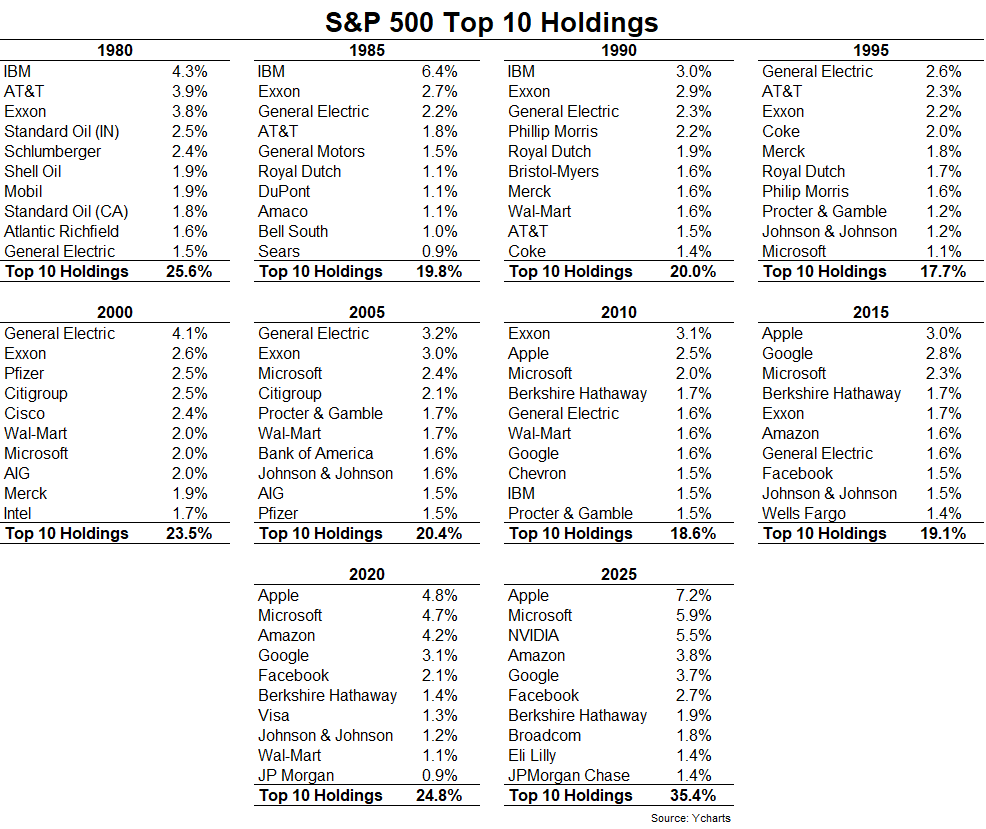
    Ben Carlson included the following table in a blog post.
    image
    "There are companies that can stay in the top 10 for a very long time.
    IBM was in there until 1990.
    They were at the top of the heap all the way back in the 1960s.
    Exxon was in the top 10 from 1980 to 2015 before finally dropping out."
    "The other pattern is there is plenty of turnover at the top.
    This table covers the top 10 every 5 years going back to 1980 so that’s 100 slots.
    I count 42 different companies in total.
    So on average there are roughly four new companies that enter the top 10 every 5 years."
  • Stable-Value (SV) Rates, 12/1/25
    Stable-Value (SV) Rates, 12/1/25
    TIAA Traditional Annuity (Accumulation) Rates
    EARLY release! 25 bps increases, except no change for IRA.
    Restricted RC 5.00%, RA 4.75%
    Flexible RCP 4.25%, SRA 4.00%, IRA-101110+ 3.75%
    TSP G Fund pending (previous 4.125%).
    Options outside of workplace retirement plans include m-mkt funds, bank m-mkt accounts (FDIC insured), T-Bills, short-term brokered CDs.
    #StableValue #401k #403b #TIAA #TSP
    https://ybbpersonalfinance.proboards.com/post/2317/thread
  • Vanguard lowers fee expense ratios and other changes on Primecap funds
    "For roughly 40 years, PRIMECAP was paid a simple, asset-based fee: a set percentage of each fund’s assets, billed quarterly. In the six months ending in March 2025—the most recent data available—
    Vanguard paid PRIMECAP Management nearly $113 million to run PRIMECAP (VPMCX),
    PRIMECAP Core (VPCCX) and Capital Opportunity (VHCOX).
    Annualized, that’s roughly $225 million in fees."
    "Big numbers, yes—but on a base of roughly $110 billion in assets, it works out to about 0.20%—
    a reasonable price for access to one of the industry’s most successful stock-picking teams."
    "From now on, though, PRIMECAP will be paid differently: a base fee plus or minus a performance adjustment.
    In English, PRIMECAP will earn more when it beats its benchmark and less when it lags it."
    https://www.independentvanguardadviser.com/weekly-brief-perspective-precision-and-primecap/?ref=the-independent-vanguard-adviser-newsletter
    Edit: PRIMECAP fund ticker corrected.