Howdy, Stranger!

It looks like you're new here. If you want to get involved, click one of these buttons!

Here's a statement of the obvious: The opinions expressed here are those of the participants, not those of the Mutual Fund Observer. We cannot vouch for the accuracy or appropriateness of any of it, though we do encourage civility and good humor.
  • How can you find out a fund's historical AUM?
    Fidelity lists AUM for the fund class - for 10 years or so to the best of my knowledge - under the "Performance and Risk" tab on the fund's page.
  • WealthTrack: Q&A With Jason Trennent
    Good bond funds in my mind are there for good managers to navigate the market better than I could. Over the last 5-7 years I identified the best managers for me. So I own MWTRX, PIMIX, TGEIX, and TGBAX. That's where my bond money is.
  • safe haven?
    Couldn't read the article. It says not available. But I'm sitting here at about 90% in cash for the last couple weeks, all because I'm in the middle of a 401k to IRA roll-over. Perfect time for me if the market decides to correct. I've been conservative at about 40-50% equities the last couple years.
    I have my new fund portfolio set up on paper and I plan to invest again with an aim of 50-60% equities by October with a tilt towards balance/allocation fund managers and large caps. I'll sprinkle in maybe end-of- (bull market) cycle sectors like technology and energy for alpha.
  • Morgan Stanley On The Markets: Transition Time
    Interesting article. The conservative asset allocation profiles have a lot of cash which is a losing proposition and has been for years. Personally I would not hold that much in cash these days.
  • John Waggoner: These Junk Funds Got Trashed Last Week
    I've been a shareholder of Eaton Vance Bond (EVBAX) since Gaffney left Loomis a couple years ago. The fund's cash position has risen to 20% with an additional 20% in equities. She typically chooses dividend generating stocks for the equity allocation. That had given the fund some upside since inception, but has been a drag on performance over the last month or so. In particular, the Arkema investment has been dismal - now down ~40% YTD.
    Overall though no complaints. For those interested, you can buy shares load waived at Fidelity.
  • assume most saw this (passive vs active, yet again)
    @MikeM After some years of purchasing mutual funds during periods that a manager is outperforming his benchmarks then being indecisive during the often inevitable underperfomance, I've decided that, rather than worry about whether my fund will deliver downside protection just because it did last time, I'll just settle for the mean (more and more ETFs).
    In another thread, I saw a lot of familiar places; I'm off route 250
  • Just thinking.....
    You invested in a infrastructure fund because you felt this area was going to be big in the years to come. It's a very specific sector for a fund to be in and so it will be volatile. In the long haul the country has to invest more in infrastructure. The current one is in bad shape.
    There is lots of talk here in what are called strategic income funds. Since you brought up some interest in fixed income funds I would direct you to the excellent resources on this website to search for funds. The threads are full of fund symbols if what posters have bought recently.
    I'm a dog lover too. I'm away from home at the present but a Doberman and a dingo are waiting for my return.
  • Just thinking.....
    I don't often agree with Cramer, but he talked the other day about how people come up to him on the street and ask him constantly about stock xyz and rather than telling them what to do he tells them to tell him why they bought it in the first place. He said that often they don't know what the company even does - they heard about it somewhere, heard it was hot, etc. I'm not saying that's the case here at all but I agree with him to a large degree. Why did you buy infrastructure funds? What has changed about infrastructure?
    I bought Brookfield Infrastructure (BIP), to use an example, because I wanted an investment that can be a pure play on vital infrastructure with ability to be nimble - the portfolio of projects it has now may look very different a few years down the line. In the meantime, I get a nice dividend. It went down this week. Nothing has changed with the reasoning - I enjoy owning vital infrastructure, hard/strategic assets. Agricultural infrastructure and rail are other examples. These are things that I can see owning for years.
    I'll also continue to own INF and happily just reinvest the nice dividend every month. I guess what the question becomes is why did you buy infrastructure funds? If there wasn't a core reason and you're going to try to move on because its cooled off in the very recent short-term I just think that style of investing - trying to move in and out of what's hot RIGHT NOW quickly becomes tedious for most people, not to mention the iffy longer-term record of most who try to sit and time the market day in/day out.
  • David Snowball's Commentary For August
    Bagels, Pizza, Bakeries - hard to find good ones these days.
    NYC is the magic word. I lived for 2 years in Manhattan. I'm ruined for pizza and bagels.
  • Research Paper: Determining The Optimal Fixed Annuity For Retirees: Immediate Versus Deferred
    All these fancy schmancy annuities. I still think if you go that route nothing beats an immediate fixed annuity. I mean it sounds crazy (at least to me as a 67 year old male) for a 65 year old male to buy something that doesn't kick in until they turn 85 in 20 years. I don't know many 85 year old males. Albeit one guy in my Asheville hiking group is 84 and still goes on 10+ mile hikes several times during the week.
  • Rising Rates Not Always Emerging Markets Poison
    As I mentioned in another thread listed below:
    Be aware that other Central Banks (Bank of Japan for one) are ready to open up their own liquidity spigot as the Fed tightens down their own. Prepare for burps, air bubbles and more burps as markets react to these changes.
    If the US stock market's performance is correlated in anyway with five years of Fed support I can imagine the Japanese stock market and stocks closely tied to Japan being the next benificiary of BofJ's new round of money printing.
    Ted's link to a most recent Wealth Track interview with Jason Trennent mentions Japan as a market to consider investing in as the Fed hands over the printing press to the B of J.
    Here's the Interview link:
    mutualfundobserver.com/discuss/discussion/14835/wealthtrack-q-a-with-jason-trennent#latest
    Finally, an interesting chart compares HJPNX (Hennessey Japan Fund) to the performance of the S&P 500 (SPY) going back to the beginning of the Fed's support. I give Hennessey's managers a lot of credit for keeping this fund's performance up while other Japanese-centric funds have lagged miserably.
    image
  • WealthTrack: Q&A With Jason Trennent
    My take from the interview:
    Japan.
    Be aware that other Central Banks (Bank of Japan for one) are ready to open up their own liquidity spigot as the Fed tightens down their own. Prepare for burps, air bubbles and more burps as markets react to these changes.
    If the US stock market's performance is correlated in anyway with five years of Fed support I can imagine the Japanese stock market and stocks closely tied to Japan being the next benificiary of BofJ's new round of money printing.
    Finally, an interesting chart compares HJPNX (Hennessey Japan Fund) to the performance of the S&P 500 (SPY) going back to the beginning of the Fed's support. I give Hennessey's managers a lot of credit for keeping this fund's performance up while other Japanese-centric funds have lagged miserably.
    image
  • assume most saw this (passive vs active, yet again)
    Hi Blitzer. I guess my point is I don't care about an obligatory index comparison.
    So, you go out and search for a fund that has beaten an index for the last 3 years. You find the perfect fund. Will that index beating performance continue? Maybe, but probably not. More likely that great fund you just bought will under perform, revert back to the mean. That's the way it works. The Yacktman funds are a good example of that.
    What I've noticed is that most fund mangers either excel in hot bull markets and that manager gets noticed as that fund you need to be in, or lose less during pull backs and now that is the fund people want. There may be a slim few that can do both. If you find one you are very lucky. My own personal preference is that guy who focuses on principle protection. I don't care if he beats the S&P500. I don't want to be invested in the S&P500.
    I'm comfortable with a fund manager who explains his or her process and sticks with it. If you understand and are comfortable with that manager, stick with him. Maybe the perfect example of that guy, for me, is Romick and FPACX. Is it the best performing balanced/allocation fund out there? No, but I like and understand the process and his conservatism.
    Damn the manager who's sole purpose is to beat and index. Give me the mix of funds that will get me to my goals with the least amount of turbulence.
    (sorry I got to rambling, and I know my opinion doesn't fit all.)
  • Checking Up On Fidelity's New ETFs
    FYI: Copy & Paste 8/2/14: Lewis Braham: Barron's
    Regards,
    Ted
    If ETFs are like the Protestant Reformation to the fund industry, Fidelity is the Catholic Church. The House that Peter Lynch built is famous for its active management. That's why to fund insiders it was as astonishing as Vatican II when the $2 trillion money manager launched 10 sector index ETFs of its own last October. Prior to that it had opened only one other ETF, Fidelity Nasdaq Composite Index (ticker: ONEQ), which it let languish for more than a decade.
    No one can dispute the new ETFs have been a success. In less than a year, they've gathered $1.2 billion in assets. That's one of the most successful launches since Pimco opened an ETF version of Bill Gross's Pimco Total Return fund (BOND) in 2012, says Dave Nadig, chief investment officer of ETF.com. Yet the ETF evangelist argues that Fidelity did this out of desperation. "Fidelity is trying to stem the tide of outflows," Nadig says. "Over the last five years, there's been nearly $750 billion of inflows into ETFs and net outflows from mutual funds. To not do something like this is to cede the field to ETFs."
    The truth is more nuanced. Fidelity's foray into the ETF world wasn't capricious; its index-based sector ETFs are an outgrowth of the actively managed sector funds it's been running for more than 30 years. Moreover, despite the generally bleak outlook for mutual funds, Fidelity's 39 "Select" sector funds experienced $7.1 billion in inflows in the last five years, according to Morningstar, and the firm has seen overall inflows in that period -- there's no tide of outflows. And given the challenges of active management, it's impressive that 22 of those 39 funds have beaten more than 70% of their peers over the past decade.
    Anthony Rochte, who oversees Fidelity's sector-fund division, sees the new ETFs as more of a complement to the mutual funds, meant for a different kind of investor, rather than a substitute for the shop's existing products. "We realized that ETFs are critical to investors who might want to be more tactical," he says. "Mutual funds may not be the perfect fit for a financial advisor or individual investor who wants to trade intraday." Of the $600 billion invested in sector-based portfolios industrywide, more than 40% is invested in such aggressive ETF trading strategies, Rochte says.
    CERTAINLY, THE NEW ETFS have many features that will appeal to sector rotators -- especially those who are already Fidelity customers. If you buy shares at Fidelity, there are no transaction fees, although like other brokers who offer such free trades, Fidelity will impose a $7.95 short-term penalty if you hold your shares less than 30 days. Longer-term investors will also appreciate the ETFs' 0.12% expense ratios, the lowest for their sectors. The ETFs also represent their sectors better than competitors by holding more small companies. Fidelity MSCI Health Care Index ETF (FHLC), for instance, has 311 holdings, including many small, rapidly growing biotech companies, compared with the 55, mostly blue-chip stocks in the better-known Health Care Select Sector SPDR (XLV).
    That said, volumes in the 10 ETFs have only ranged between 36,000 and 93,000 shares a day over the past three months -- good enough for individual investors but not large institutions. "Those volumes are nowhere near enough for a hedge fund to make major allocations," says Nadig. "But that will come with time." He thinks the ETFs will be successful because Fidelity has a "captive audience" at its brokerage. The firm has more than 15 million retail brokerage accounts and 10,000 financial advisors trading on its platform.
    FOR LARGE INVESTORS there is also a workaround to buying shares in bulk. David Haviland, who runs $1.1 billion in ETF strategies at Beaumont Capital Management, bought $162 million of Fidelity ETFs in one day earlier this year when trading volumes were much lower than now. Instead of buying the ETF shares via the exchange, his traders contacted market-maker Knight Capital Group, which creates baskets of stocks underlying the ETFs. If you're willing to buy enough shares -- 40,000 in Fidelity's case -- KCG or another market-maker, like Goldman Sachs, will essentially purchase the underlying stocks and create a new batch of ETFs. Dealing directly with a market-maker like this ensures big purchases won't affect the share price on the open market.
    Because Haviland employs an aggressive, momentum-based strategy, Fidelity's actively managed mutual funds never held any interest for him. He needs to exit on a dime when an ETF loses momentum to protect clients' capital. So in his case there really is no question of Fidelity ETFs appealing to a different kind of customer, one that is cannibalizing Fidelity's core business.
    Other experts believe that whether you substitute Select funds for ETFs depends on which sector you're invested in. Jim Lowell, editor of the Fidelity Sector Investor newsletter, thinks investors might be better off in Fidelity's energy ETF than its active funds because the sector is so volatile and driven by rapidly shifting commodity prices. "You want to be nimble and quick with an energy ETF because you'll more likely be trading out of your position quickly," he says. "The benefits of an active manager aren't there in that space from my perspective."
    Still, Lowell favors Fidelity's Select funds overall. "It will be very difficult for any sector ETF that's using a passive index to outperform Fidelity's active managed sector funds over any meaningful investment timeline," he says. While the academic research suggests indexing wins in general, choosing between active funds and passive ETFs at Fidelity remains a matter of belief.
  • Interesting fund commentaries to share
    Grandeur Peak:
    "Regarding our Global and International Opportunities funds, coming off of a couple of great years of performance, we’d normally be feeling OK about having a few average quarters. But as we dig into the reasons for the average type of results we’re disappointed in our performance and ourselves and we want to be open about this."
    Two pages of single spaced, equity by equity exposition follows.
  • assume most saw this (passive vs active, yet again)
    @ MikeM I agree that YAFFX would be a good candidate to provide consistent returns with downside protection. However,
    YAFFX has underperformed (using my arbitrary S&P 500 benchmark) over the past few years. Assuming newer shareholders haven't bailed yet, will YAFFX make up "lost ground" during the next downturn? YAFFX did well during the last downturn...will that happen again next time? (ie will the Yacktmans call it correctly?)
    Personally, I bailed on YAFFX and purchased VTI...only time will tell if I made the correct move.
    @ MJG I enjoy your commentary, Would you consider posting your portfolio in detail? Obviously, not dollar amounts, but I am interested to see how your commentary translates into actual holdings. I understand that each person's needs are different, past performance does not guarantee future results and that nobody should "copy" your actions.
  • Can You Afford To Retire Early ? Are You Saving Enough ?
    FYI: The Five-Year Rally in Stocks Has Bolstered Workers' Nest Eggs. But Consider These Six Issues First.
    Regards,
    Ted
    http://online.wsj.com/articles/can-you-afford-to-retire-early-1406912729#printMode
    Are You Saving Enough For Retirement ? Copy & Paste 7/31/14: Walter Updegrave: WSJ
    Fueled by surging stock prices, average 401(k) balances have come back from the beating they took in the financial crisis and now stand at or near record highs.
    But hold the confetti.
    The tailwind of stocks' nearly 18% of annualized gains of the past five years—almost double the stock market's long-term average—clearly isn't sustainable for the long term. Indeed, given today's low interest rates and high stock prices relative to earnings, average annual stock returns over the next decade or so could come in at well below half the pace of recent years.
    Which means if you want to accumulate enough savings during your career to sustain you in retirement, you will have to do it the old-fashioned way: by saving diligently.
    On that front, the news isn't quite so upbeat. A survey of 144 large 401(k) plans covering some 3.5 million employees released in July by benefits consulting firm Aon Hewitt found that the annual contribution for employees and employer matching funds combined averaged just under 11% of salary last year, down a tad from the year before.
    And although the survey also showed that the average employee-plus-employer contribution rises with age—starting at 7.6% of salary for participants in their 20s and climbing to 10.1%, 11%, 12.7% and 13.4% for participants in their 30s, 40s, 50s and 60s, respectively—not a single age group averaged the 15% a year that retirement experts generally recommend if you want to maintain your preretirement lifestyle after calling it a career.
    Fortunately, it doesn't take a heroic savings effort to appreciably boost the eventual size of your nest egg and enhance your retirement prospects.
    Let's assume you are 25 years old, earn $50,000 a year and receive 2% annual raises, and that you make an "average" effort to fund a retirement account such as your 401(k). That is, throughout your career the total of your contributions plus employer matching funds mirrors the age-group averages in the Aon Hewitt survey.
    If you invest your savings in a diversified portfolio of stocks and bonds that earns a reasonable rate of return—say, 6% a year after fees—your 401(k) balance would total roughly $1.1 million at age 65.
    That is a tidy sum, to be sure. But it probably isn't enough to replace enough of your income over at least 30 years of retirement.
    Generally, advisers say personal savings should generate 50% to 60% of your preretirement income, so that withdrawals from savings plus another 20% to 25% from Social Security and other sources (part-time work, a pension) replace at least 75% to 80% your preretirement income—a level experts generally consider the benchmark for maintaining your preretirement standard of living after you retire.
    Increasing the amount you save by even a relatively small amount can significantly improve your chances of reaching that level.
    For example, if instead of saving at that average level, reported by Aon Hewitt, you set aside just an extra 1% of salary each year, your 401(k) account's value would climb to just under $1.2 million at age 65. Assuming a 4% initial withdrawal of $48,000, your savings would now be able to replace nearly 45% of pre-retirement income from savings alone. Boost your savings rate another 1% each year, and your account's projected value rises to almost $1.3 million, which allows for a withdrawal of $52,000, bringing you just within reach of replacing 50% of your preretirement income from savings.
    And if you manage to stash away the 15% a year that advisers recommend, you would have a nest egg at age 65 valued at almost $1.6 million, providing for an initial withdrawal of $64,000, or about 60% of preretirement income. Throw in an additional 20% to 25% from Social Security and other sources, and your retirement income now meets or exceeds that 75% to 80% benchmark.
    Aside from the obvious benefit of a larger nest egg generating more income in retirement, saving at a higher rate during your career also makes your retirement strategy less vulnerable to setbacks from financial shocks.
    For example, the hypothetical 25-year-old in the scenarios above saved like a machine each and every year over four decades. In the real world, job losses, health problems, unexpected expenses and all manner of other unanticipated events can prevent even the most diligent saver from sticking to a savings regimen uninterrupted over an entire career. By making the effort to save at a higher rate when things are going well, however, you effectively will build a cushion that will help you better absorb any financial setbacks and get your retirement planning back on track.
    Such a cushion can come in especially handy late in your career. For example, if you are on the verge of retiring and the stock market takes a dive, having $1.6 million in savings instead of $1.1 million could mean the difference between scaling back your lifestyle a bit but still going ahead with your retirement plans versus having to postpone your employment exit and spend extra years on the job.
    The single best way to maximize your savings effort is to sign up for your company's 401(k) or similar plan. Aside from the benefit that your contributions and investment earnings in a 401(k) account go untaxed until withdrawal, the fact that money is automatically deducted from your paycheck makes it more convenient to save, and more likely you actually will do so.
    That said, some features in 401(k) plans that were designed to spur savings can sometimes have the opposite effect. For example, the lure of "free money" in the form of company matching contributions clearly creates an incentive to save. But the Aon Hewitt survey shows that nearly a third of 401(k) participants contribute just enough to get the full company match.
    While doing that may seem smart, in that you get the largest company match while you shell out as little as possible, it also can leave you short of the savings rate required to assure a secure retirement.
    Keep in mind, though, that while 15% is generally a reasonable goal, the actual amount you should be setting aside can vary considerably depending on your salary, how much you already have stashed away and the number of years until you retire.
    There are many online retirement planning tools that can help you home in on the right annual savings target for you. Whether you use a basic calculator or a more comprehensive one that allows you to vary such assumptions as how you invest your savings and your planned retirement date, you will want to reassess every year or so to see whether your current savings rate is adequate.
    As exciting as it may be to watch the value of your nest egg swell as stock prices soar, over the long run it is how much you save that will determine how well you can live in retirement.
  • assume most saw this (passive vs active, yet again)
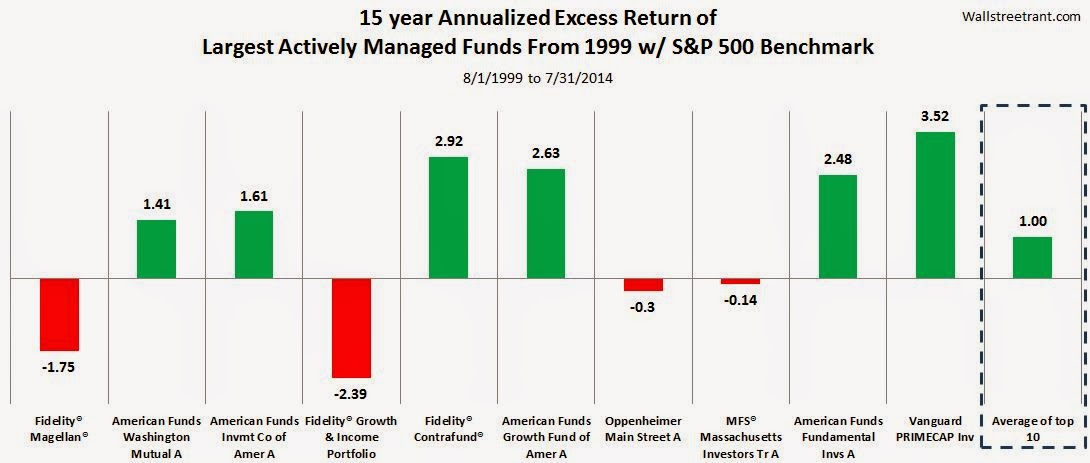
    ". In the US world, only 14% of the actively managed funds outperformed an Index in both excess returns and in reduced risk. Another 21% also generated excess returns above Index returns, but at a higher risk level. So 65% of the active portfolios delivered less than their Indices."
    To me this doesn't sound too bad. I've got a strong stomach and was able to add to my high beta funds during 2008 and 2011. I'm willing to take higher risk if I get long-term outperformance, and this quote seems to indicate that about 35% of funds do that. Then again I expect not to retire for at least another 20 years. If I were retired already or planning to retire in the next fews, it would be a different story.
  • 3 Market Warning Signs Predict 20% Stock Tumble
    Hulbert will quote anyone to spin out yet another "article". The three indicators are subjective anyway. I for one do not consider the overall market to be overvalued. Plenty of blue chip dividend stocks have p/es in the low teens. My mutual fund has a p/e of 15. And according to M* the Russell 2000 p/e is under 20. So where are these lofty valuations?
    Also it should be mentioned that the US energy picture is the brightest that it has been for many years. Which is a boost for the economy and markets.
  • Safety in Numbers – Not Necessarily
    I thought I’d comment on a few things. They follow.
    Item 1) In reviewing IRNIX which was presented by the Vintage Freak although it is a fund of funds it does carry a four star M* rating and has a duration on 3.35 years. So with this it appears good performance can be had form a fund of funds just as good performance can be had form my sleeve system that holds a number of funds … usually three to six. I expect this fund to continue to perform well and if one or even a few of the funds that it holds falters then there are the others that can still propel the fund. Its turnover ratio is 43% so it appears some active trading and positioning occurs. In 2008 it lost about one half of what its category lost.
    Item 2) Some say I have way too many funds … perhaps so, perhaps not! In comparing my portfolio’s performance to Morningstars Moderate Target Risk as a benchmark … well I have handily bettered the benchmark. The results follow listed by period with the portfolio being listed first within the results and then the benchmark for a market close of August 1, 2014 in its current configuration.
    1 Week) Portfolio -1.8%, benchmark -1.8% … 1 Month) -2.1%, -2.0% … 3 Month) 1.5%, 1.4% … YTD) 5.0%, 3.7% … 1 Year) 11.9%, 9.6% … 3 Year) 10.7%, 9.4% … 5 Year) 12.5%, 10.9% … 10 Year) 8.4%, 6.6%.
    Closing comment: With this, there seems to be some added value by using the sleeve system along with selecting only quality funds and when one of them does falter replacing it with another. Seems this is what IRNIX might be doing and it seems to be doing it just fine as it only lost about one half of what the average strategic income fund lost in 2008.
    I think one needs to ask themselves this question ... Does your portfolio meet your needs? And, if it does, from my thoughts, then the rest really does not matter if you are happy.
    Have a good day … and, most of all I wish all … “Good Investing.”
    Old_Skeet