
Howdy, Stranger!

It looks like you're new here. If you want to get involved, click one of these buttons!
Here's a statement of the obvious: The opinions expressed here are those of the participants, not those of the Mutual Fund Observer. We cannot vouch for the accuracy or appropriateness of any of it, though we do encourage civility and good humor.
  • Why rising rates isn't that bad for bonds
    Actually, I have a lot more problems with the original OP than the way he said it. First, he cites FED funds rate, but his examples are all over the board intermediate bonds. Did these funds see a 2.5% rise in their yields? I don't think so. Second, three years seems to be FD's go-to for making points. Anything can happen with bond funds (or stock funds) over a three year period. Third, "bonds are doomed" does not express my feelings nor have I even heard it before. I hear a lot about bonds being a poor investment at low rates but no so much at higher rates.
    I think a good deal of the problem is that the OP is a trader, while most of us hold bond funds for stability and over longer periods than 3 years.
    But, hey, don't get me wrong; I love that my bonds are doing well despite low yields. I just don't believe it can continue for long.
  • How I Use A Barbell Investing Strategy To Avoid Financial Ruin
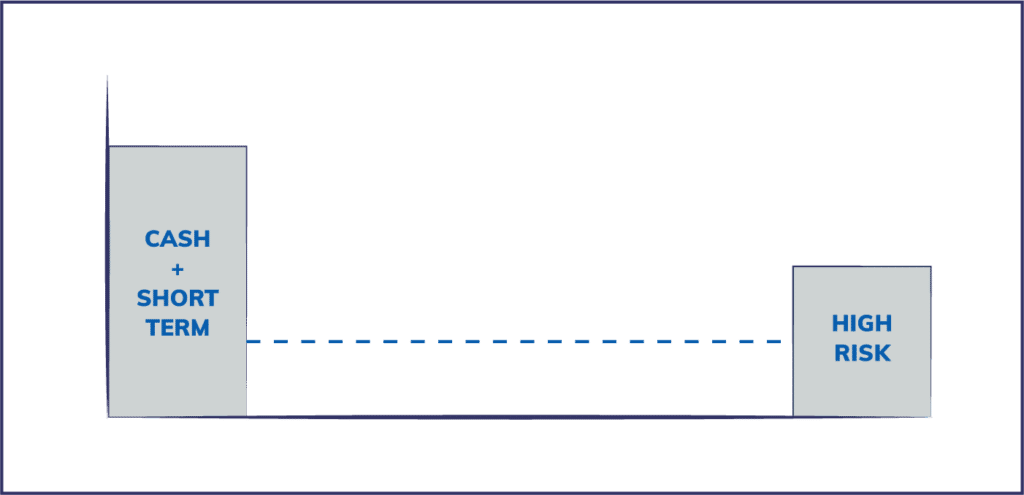
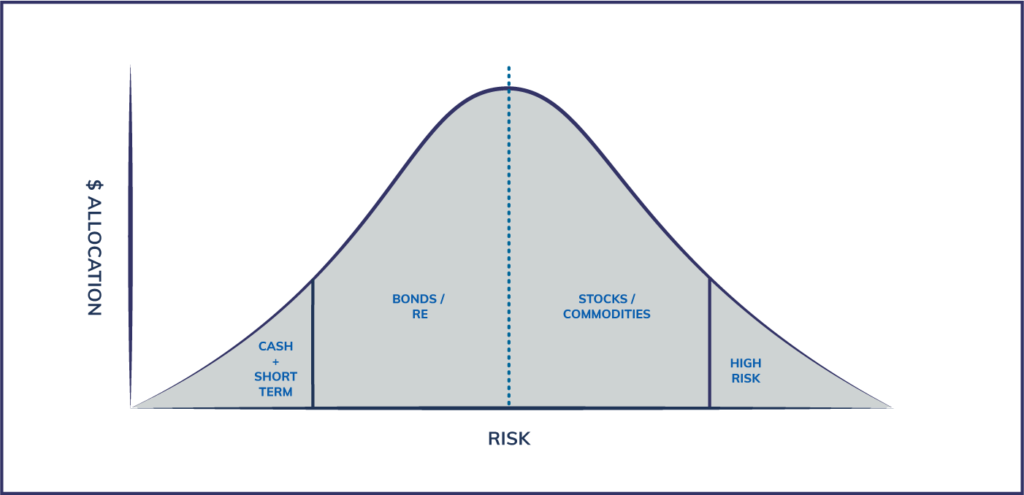
    Now you're on a slippery slope toward a traditional portfolio asset distribution and away from a barbell (zero risk and high risk, nothing in the middle). Once you add bonds, you're proposing a different allocation regimen with likely higher risk as you noted (whether of negative rates or loss of principal from rising rates).
    His barbell strategy:
    image
    A traditional strategy (note that the leftmost category excludes bonds):
    image
  • How I Use A Barbell Investing Strategy To Avoid Financial Ruin
    Whoa --100K assets = 80 K X .5% ( Bondo's )+ 20K @7% so $400 + 1.4K += $1.8K On the other hand ,what if negative rates come into play !! ??
    Some bed time thoughts, Derf
    P.S. I stand corrected.
  • Markets Without Havens - VMVFX
    The equity profiles are quite similar, .....
    Important to note significant differences between the two funds in equity holdings: VWINX 36% with HBLYX holding 44%.
    True the equity/bond asset allocations are a bit different. Still, the equity profiles are similar:
    VWINX vs. HBLYX:
    LCV: 69% vs. 73%
    LCBl: 21% vs. 15%
    LCG: 2% vs. 3%
    MCV: 5% vs. 6%
    MCBl: 0% vs. 1%
    Others: 0%
    VWINX: 9.5% of equity is foreign (1.47% Canada, 1.48% UK, 6.59% Europe developed)
    HBLYX: 9.4% of equity is foreign (1.69% Canada, 1.34% UK, 6.35% Europe developed)
    Even in terms of equity allocation, the historical differences tend not to be quite so large. Closer to 5% than to 8%. Again from M*, VWINX vs. HBLYX:
    2020: 36.46% vs. 41.46%
    2019: 38.11% vs. 42.87%
    2018: 36.90% vs. 40.15%
    2017: 38.56% vs. 43.25%
    2016: 38.30% vs. 41.27%
  • BlackRock Supports Fewer Shareholder Requests for Climate Risk Disclosures
    "In the past, both BlackRock and Vanguard have expressed a preference for such 'direct engagement'".
    We've discussed the problems with this before. At least currently, Vanguard is the largest shareholder in WFC, and Blackrock is number 2. Either they've been asleep at the wheel, or "direct engagement" (at least with Wells Fargo) has left something to be desired.
    "Meanwhile, the report broke out Fidelity's index funds run by subsidiary Geode from its active ones."
    A quibble then a real question. Geode was spun off from Fidelity in 2003.
    https://www.wsj.com/articles/SB106003396490241400
    More to the point, the M* report broke out proxy votes for Fidelity's main (sole?) subadvisor. Did it do a similar breakout for Vanguard? The reason for this question is that Vanguard said it would start delegating proxy voting authority to its subadvisors. You write that Vanguard's votes on providing climate risk disclosures improved somewhat this year. A breakdown would help to see whether the improvement was due in part to the delegation of voting, or whether the delegation and the vote improvements were merely coincidental.
  • How I Use A Barbell Investing Strategy To Avoid Financial Ruin
    A barbell approach to asset allocation can work. It's one of several approaches to dealing with sequence of return risk. I've posted more than once about this. It's also what Buffett was suggesting with his recommendation of 10% short term Treasuries (effectively cash) and 90% S&P 500 index.
    While I might suggest something closer to 20/80 (cash/equity) than 10/90, and I might suggest a bit more diversification on the equity side, I don't have problems with the general idea.
    What do have problems with is what hank described as "a little nuts" - going 80/20 rather than 20/80.
    If we assume inflation of around 1.4% (COLA for SS in 2021 is 1.3%) and a 7% rate of return on equity for the foreseeable future (a decade), an 80/20 mix may not even match inflation: 80% x 0% (cash) + 20% x 7% (equity) = 1.4%. And that's before taxes.
  • The Best Taxable-Bond Funds -- M*
    I'm less concerned than some others with the modest increase in duration of DODIX. To explain why, I'm going to have to go into why I feel that MBS durations understate risk. Negative convexity. Bear with me here.
    I'll try explaining this by analogizing to a vehicle in motion. Duration can be thought of as a measure of speed. A duration of five years means that you're "driving" at 5% per 1% rate change. That is, for every 1% increase in interest rates, you lose 5% in value. That's your "speed".
    If you were "driving" at a constant speed, you'd lose 5% for each 1% increase in interest rates, like driving a steady 5MPH down a road. The way vanilla bonds work, it's as though you were tapping the brakes. (A gentle tapping, nothing more, with apologies to Edgar Allen Poe.) So at the first instant, you're losing money at 5% per 1% rate change. But as soon as you start losing principal, you slow down. That's good, you don't lose money so quickly. You lose less than 5% as rates drop 1%.
    With negative convexity, instead of decelerating (positive convexity), you're accelerating. You're not gradually dropping from 5MPH to 4MPH, but you're stepping on the gas, and speeding up, say to 6MPH. Instead of losing 5% as rates drop 1%, you're losing more than 5% as your losses accelerate.
    One way of looking at this is that an MBS with a 5 year duration will lose more value than a vanilla bond with a 5 year duration. (So duration understates MBS interest rate risk.) Another way of looking at this is that an MBS with a shorter duration will lose just as much as a vanilla bond with that 5 year duration.
    What DODIX did was shift from somewhat shorter duration MBSs to somewhat longer duration vanilla (corporate) bonds. So even though the duration looks longer than before, the expected loss if rates increase should still be comparable.
    In the first six months of 2020, we established new positions in over a dozen corporate issuers at what we believe were exceptionally attractive valuations. These purchases, along with many additions to existing corporate issuers, increased the Fund’s Corporate sector weighting by 11 percentage points to 45%.
    To fund these purchases, we sold certain Agency MBS and U.S. Treasuries, which now make up 31% and 8% of the Fund, respectively. We lengthened the Fund’s duration modestly through the aforementioned corporate bond purchases, though we remain defensively positioned with respect to interest rate risk.
    https://dodgeandcox.com/pdf/shareholder_reports/dc_income_semi_annual_report.pdf
  • How I Use A Barbell Investing Strategy To Avoid Financial Ruin
    Interesting ideas and definitely unique but I don't agree with this article and here is why:
    1) Most investors should just use a simple formula and be invested at all times according to their goals. It's easy and makes sense
    The writer is so much off main stream investing style.
    2) 80% cash? + 10-15% in startups and a decent size cryptocurrency?
    Ridiculous ideas
    No need to go further :-)
  • FT Cboe Vest U.S. Equity Deep Buffer ETF - October (DOCT)

    2 new ETFs from First Trust claim to help limit downside in equities if the market declines. Not sure if these products would interest anybody here. Also not certain if they will "work", but I will probably track them (DOCT and FOCT) for now. DOCT has lower limits than FOCT. I remain skeptical until I see how they perform.
    FT Cboe Vest U.S. Equity Deep Buffer ETF - October (DOCT)
    Investment Objective/Strategy - The investment objective of the FT Cboe Vest U.S. Equity Deep Buffer ETF - October (the "Fund") is to seek to provide investors with returns (before fees, expenses and taxes) that match the price return of the SPDR® S&P 500® ETF Trust (the "Underlying ETF"), up to a predetermined upside cap of 9.34% (before fees, expenses and taxes) and 8.49% (after fees and expenses, excluding brokerage commissions, trading fees, taxes and extraordinary expenses not included in the Fund's management fee), while providing a buffer against Underlying ETF losses between -5% and -30% (before fees, expenses and taxes) over the period from October 19, 2020 to October 15, 2021. Under normal market conditions, the Fund will invest substantially all of its assets in FLexible EXchange® Options ("FLEX Options") that reference the performance of the SPDR® S&P 500® ETF Trust.
  • Markets Without Havens - VMVFX
    Why not split the difference 50-50 ? Would that equal 11 % more in equity instead of 22% ?
    What was I think ? 8% or 4% =50 - 50. Stay Safe, Derf
  • Markets Without Havens - VMVFX
    In New 60/40 Portfolio, Riskier Hedges Are Displacing U.S. Debt
    Many investors have no choice but to stick with Treasuries because of fund mandates, or they do so since they’re unconvinced it’s worth taking a chance on something else. Yet others are exploring riskier assets -- from options to currencies -- to supplement or fill the role of portfolio protection that U.S. government debt played for decades, a trend that highlights the dangers that the Fed’s rates policy can create.
    and,
    Options Hedge
    Swan is a longtime skeptic of Modern Portfolio Theory, which was made famous by economist Harry Markowitz in the 1950s and is the thinking upon which the 60/40 mix is based. Two decades ago, Swan created a strategy of using long-term put options plus buy-and-hold positions in the S&P 500 to limit huge losses during economic downturns.
    That approach has since been expanded to include positions in exchange-traded funds indexed to small cap stocks, and developed and emerging markets. It relies on constant allocations of 90% to equities and 10% to put options purchased on the underlying ETF portfolio.
    Are riskier-hedges-are-displacing-u-s-debt
  • The Best Taxable-Bond Funds -- M*
    Great discussion. Correct me if wrong, but I think that large houses like TRP and DC with considerable expertise / resources in analyzing bond fundamentals (ie credit-worthiness)) should be able to identify pockets of value in mid and lower rated bonds. Let’s hope that’s what you’re paying a management fee for. So, I wouldn’t get too excited about DODIX ‘s BBB bond rating (technically considered “investment grade” - if only marginally).
    If duration on DODIX is 5 years (as stated by @WABC), I would find that concerning as well as “odd”, since it’s no secret D&C has for many years now been erring on the side of caution - expecting interest rates to rise. That’s one thing that has dinged their equity performance. So a 5 year duration is hard to explain. One guess: They have been known to short a few longer Treasury bonds as a hedge on rising rates. That might be what allows for the longer duration on their long bond positions. Yep - I wouldn’t use a fund with a 5 year duration as a cash substitute.
    I bailed on DODIX back in March after the Fed drove interest rates to near 0. I had been using it as a cash substitute for many years and felt the risk / reward had shifted. Turns out I was wrong (or perhaps just early). It’s had a great run this year. I guess it was the (yet unannounced ) Fed dalliance with the corporate bond sector that provided the added impetus.
    I’ve long wondered how DODIX can turn out such splendid returns with so little volatility. I’d say that puzzles me about as much as the enduring success of PRWCX. Some things are simply beyond my comprehension.
  • Rethinking Retirement
    @little5bee- We haven't done that in many years, but it sure was a lot of fun! When we did it there was no internet and they hadn't invented cellphones yet, so just heading somewhere with no idea what might be available for lodging was sometimes quite exciting. Things are different when you're young. :)
  • A lot of red today
    Maybe this from The Financial Times via Axios?
    The Fed is starting to question its own policies
    Several officials at the Fed are beginning to worry about asset bubbles and excessive risk-taking as a result of their extraordinary policy interventions, James Politi writes for the Financial Times, citing interviews with multiple Fed presidents and members of the Board of Governors.
    Details: Some are now pushing for "tougher financial regulation" as concerns grow that monetary policy is "encouraging behavior detrimental to economic recovery and creating pressure for additional bailouts."
    What they're saying: “I don’t know what the best policy solution is, but I know we can’t just keep doing what we’ve been doing,” Minneapolis Fed president Neel Kashkari told the FT.
    “As soon as there’s a risk that hits, everybody flees and the Federal Reserve has to step in and bail out that market, and that’s crazy. And we need to take a hard look at that.”
    Boston Fed president Eric Rosengren called for a “rethink” of “financial stability” issues in the U.S., and Fed governor Lael Brainard said in a speech last month that expectations of extended low-interest rates were boosting “imbalances” in the U.S. financial system, Politi reported.
    Why it matters: Economists, strategists and fund managers on Wall Street have said for months that the Fed has effectively killed price discovery by "nationalizing" the bond market with its actions and is artificially holding up the price of financial assets.
    That has elevated U.S. economic inequality, and while market participants have cheered, the Fed's popularity has sunk among most Americans.
    Much of the U.S. economy, including jobs and spending at small businesses and firms not dedicated to e-commerce, continues to be weak.
    The big picture: The latest comments from Brainard, Rosengren, Kashkari and others suggest that influential members of the Fed's policy-setting committee may be pushing back against the so-called Fed put — a belief among investors that if stock prices fall enough, the Fed will bail them out by lowering interest rates or by pushing trillions of dollars in liquidity into financial markets through quantitative easing.
  • A lot of red today
    The issue in the trials was safety of the vaccine generally. One of the purposes of phase 3 clinical trials is to test the safety of pharmaceuticals in a broad population sample. Each trial was paused to allow the companies to determine whether an illness was due to effects of the vaccine.
    https://www.statnews.com/2020/10/13/covid-19-clinical-trials-pauses-at-jj-and-eli-lilly-could-be-bumps-on-a-hard-road-or-mere-blips/
    Since these pauses occurred almost a week ago, I doubt that they were a reason for today's declines, especially since the markets opened on the upside and didn't go negative until 10:30 or so.
    Mass manufacturing and distribution has its own set of issues. Followup data from post- trial inoculations will be needed to show that manufacturing was safe and that over time a vaccine remains effective. See, e.g. the Cutter Incident.
    https://www.cdc.gov/vaccinesafety/concerns/concerns-history.html
    Monday's market:
    https://www.usatoday.com/story/money/markets/2020/10/19/dow-stocks-fall-hopes-new-covid-19-stimulus-fade/5984119002/
  • Maximal Drawdowns
    Also, MAXDD is for specific evaluation period specified. So, 1-, 3-, 5-year MAXDD for same March 2009 drawdown can all be different.
  • Maximal Drawdowns
    MAXDD is a monthly number and why VCOBX is only at -0.8%. Use 03/01-04/1. See this (link).
  • Markets Without Havens - VMVFX
    FWIW, I just checked with Fidelity (phone) and VWINX is eligible for Fidelity's Automatic Investment Program. As with other funds, a $250 min for each addition.