
Howdy, Stranger!

It looks like you're new here. If you want to get involved, click one of these buttons!
Here's a statement of the obvious: The opinions expressed here are those of the participants, not those of the Mutual Fund Observer. We cannot vouch for the accuracy or appropriateness of any of it, though we do encourage civility and good humor.
  • The Best Bond Funds for Uncertain Times - Barrons, October 2
    “The drastic changes in the fixed-income market in recent months—largely driven by the Federal Reserve’s signaling that interest rates will stay near zero until 2023, plus the central bank’s aggressive bond-buying—necessitates a reassessment of bond portfolios.”
    Good read. The problem with bonds isn’t anything most of us don’t already know. Several money managers are cited, including Dan Fuss. I found it curious that Price’s Spectrum Income (RPSIX) made the top 10. Sure hasn’t impressed me lately (but still own a little). Dan Fuss’s income fund is allowed to hold up to 20% equities, and he seems to favor equities over bonds right now. Also discusses the the barbell approach to portfolio construction.
    No guarantee you can get through the paywall. But here’s the link. https://www.barrons.com/articles/the-best-bond-funds-for-uncertain-times-51601679748
  • The Presidential Election Correction Continues
    @FD1000: The context, since it seems to have eluded you, is kings53man's claim that Trump's Covid-19 infection is "fake news" .
    We're supposed to let kings53man say whatever he wants and just sit here meekly and let him yammer, right? Interesting that you didn't object to his post. Speaking of that post, it's difficult to discern the line between willful ignorance and plain everyday stupidity.
  • CNBC Gets Kinky About the Markets
    +1.
    The media and especially CNBC has been making constant bombastic headlines about investing/markets to keep viewers/readers watching/reading.
  • "Off-Topic" previously "Off Limits"... now "back in service".
    Average incubation period 5 days. 97% of people symptomatic in 11 days
  • CNBC Gets Kinky About the Markets
    Headline: "The stock market appears to be coiling for a tension release" https://cnbc.com/2020/10/04/the-stock-market-appears-to-be-coiling-for-a-tension-release-.html
    This weird fetishization of stocks in the U.S. has reached the creepy stage. Another Freudian slip in the article: "The stock market has been vibrating within a tight range for a month...."
  • "Off-Topic" previously "Off Limits"... now "back in service".
    The incubation period is 7 days and this week the symptoms will show if they have been infected. Biden tested twice last week and both are negative. Wallace has showed symptoms and not been tested.
    What we are seeing the numerous infections in the WH is the disbelieve of science and danger of the coronavirus. It does not discriminate the politically leaning but only to those who present themselves the opportunity of being infected. No one wish the infection to anyone, but it did so widely last week. The fall season is here and the combination of flu and COVID-19 is simply scary.
  • The Pandemic Depression Is Over. The Pandemic Recession Has Just Begun.
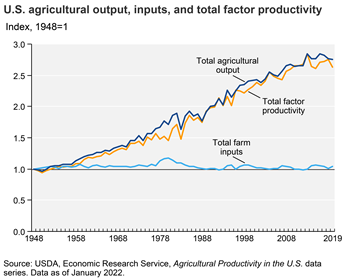
    Economic growth can come in many ways. From more workers (and requisite capital to sustain productivity/worker). From longer hours, e.g. converting part time jobs to full time jobs. From increased worker productivity, e.g. from better training, reduced turnover, better tools, or simply improved working conditions/worker satisfaction. From replacing workers with machines.
    Farming illustrates the potential for increased output from improvements in technology and increased automation even as labor decreases sharply:
    image
    https://www.ers.usda.gov/data-products/ag-and-food-statistics-charting-the-essentials/farming-and-farm-income/
    Regarding the employed/population ratio (56.6%). One calculates this by multiplying together:
    employment rate, i.e. 1 - unemployment rate, and
    "participation rate", i.e. percentage of people employed or actively looking for jobs.
    (1 - 7.9%) x 61.4% = 56.6%
    This is one reason why the official unemployment figure can be misleading. If a lot of people get discouraged and drop out of the workforce, then they are not counted as unemployed. This shows up as a lower participation rate rather than a higher unemployment rate.
    The participation rate, 61.4% is almost two percent lower than it was a year ago (63.2%). However, that participation rate from a year ago was itself lower than it was "at any point in the Great Recession." So at least some of the decline in the percentage of the population working likely has little to do with the pandemic, but rather reflects a generally declining participation rate. It's difficult to disentangle multiple causes.
    (Seasonally adjusted, from the end of 2007 to the end of 2010, the participation rate dropped around 1½% , continuing to decline slowly for another 3-4 years. It stabilized and began rising slightly only in the second half of 2019.)
    Please consider providing links to sources, especially ones quoted. Statistics also.
    https://www.nytimes.com/2020/10/02/upshot/2020-terrible-job-market.html (quoted text)
    https://www.bls.gov/news.release/empsit.nr0.htm (Current BLS employment report, generally released first Friday of each month)
    https://www.bls.gov/news.release/empsit.a.htm (BLS total employment, unemployment data)
    https://www.bls.gov/webapps/legacy/cpsatab1.htm (Employment, unemployment historical data)
    https://www.bls.gov/news.release/empsit.t17.htm (BLS nonfarm data, incl. mfg detail)
    https://www.bls.gov/webapps/legacy/cesbtab1.htm (Nonfarm historical data)
  • PIMCO Emerging Markets Currency and Short-Term Investments Fund is not liquidating
    https://www.sec.gov/Archives/edgar/data/810893/000119312520263401/d96445d497.htm
    (see link above for other changes)
    497 1 d96445d497.htm 497
    PIMCO Funds
    Supplement dated October 5, 2020 to the International Bond Funds Prospectus
    dated July 31, 2020, as supplemented from time to time; and to the Statement of Additional Information dated July 31, 2020, as supplemented from time to time
    Disclosure Related to the PIMCO Emerging Markets Currency and Short-Term Investments Fund (the “Fund)
    This supplement supersedes and replaces the supplement filed for the Fund on August 21, 2020.
    Pursuant to a recommendation by the Fund’s investment adviser, Pacific Investment Management Company LLC (“PIMCO”), the Board of Trustees (the “Board”) of PIMCO Funds (the “Trust”) previously approved a Plan of Liquidation for the Fund pursuant to which the Fund was scheduled to suspend sales on November 20, 2020 and to be liquidated on or about January 7, 2021. PIMCO subsequently reconsidered its recommendation, particularly in light of its desire to offer a diverse range of funds for different possible market scenarios given unique market conditions, and determined that it would recommend that the Fund continue its operations. Accordingly, PIMCO proposed that the Board withdraw the Plan of Liquidation. Following a determination that withdrawing the Plan of Liquidation is advisable and in the best interests of the Fund and its shareholders, the Board approved PIMCO’s proposal to withdraw the Plan of Liquidation.
    Accordingly, the Fund will continue operations past January 7, 2021 and will not be liquidated. The Fund will continue to offer shares to new investors and existing shareholders, including exchanges into the Fund from other funds of the Trust or funds of PIMCO Equity Series. In addition, effective November 20, 2020, purchases of Class A shares of the Fund will be subject to initial sales charges, as applicable, and redemptions of Class A shares of the Fund purchased on or after November 20, 2020 will be subject to contingent deferred sales charges, as applicable, as if the Fund had not previously announced the prior approval of the Plan of Liquidation.
    If you have any questions regarding this supplement, please contact the Trust at 1-888-877-4626.
    Investors Should Retain This Supplement For Future Reference...
  • What's going on at the Matthews funds?
    M* calibrates the outflows on a fund family basis. In 2017 Matthews managed $29.6B and in 2020 assets are down to $20.5B while the number of funds during that time period did not change. The people leaving may not constitute an “exodus,” but the AUM decline is enough to shake my confidence. Investors who remain in funds that are losing assets often get stuck with a nasty tax bill year end.
  • The Pandemic Depression Is Over. The Pandemic Recession Has Just Begun.
    Thx for posting!
    From another article:
    “ The level of economic activity is miserable. Seven months into the pandemic, most sectors of the economy are producing below — and in some cases far below — normal levels. The number of jobs on employers’ payrolls was 7 percent below February levels in September, a worse shortfall than at any point in the Great Recession. The share of the population working is only 56.6 percent, down from 61 percent a year ago and lower than it ever got during that downturn and its aftermath.”
    I track BLS employment, they report 141.8 million Non-farm jobs currently, down from a high of 153 million& slightly less than Was hit in May 2015. Also the country currently has only 12.2 million manufacturing jobs, down from 12.8 mil. The current level was reached in August 2014. I throw these out there because it seems to me that economic growth requires job growth.
  • The Presidential Election Correction Continues
    Fake news - Trump infected with Covid-19, it was just a flu. You will see it in few days.
  • What's going on at the Matthews funds?
    To David's point, in my experience only about 1/3 of headlines journalists write are actually kept in the published article, including I would add in this "Exodus" case. Headlines are re-written for SEO or search engine optimization. Clicks are vitally important for pubs to survive, and sensational headlines with the best SEO words get the most clicks. Such is life in a post-Google era.
  • Capital Migrates To Best Fund Families In September 2020 MFO Ratings Update
    All fund risk and return metrics, ratings, and analytics were uploaded to MFO Premium on this past Sunday, 4 October, reflecting performance through September 2020 or 3rd Quarter.


    The MFO Fund Family Scorecard reveals 31 families (like Winning Points, Huber, Saratoga) where every fund has underperformed since launch by an average of -3.2% per year. Combined they represent $15B in assets under management (AUM), carrying an annual expense of $173M per year nominally for the privilege of owning them. Can you believe that?


    Fortunately, most assets gravitate to best performing families. Let's break the families down by AUM: first, the largest families with greater than $1T; second, next tier with AUM greater than $500B, and finally those greater than $100B.
    Read more here.
  • the 200 year history of US interest rates
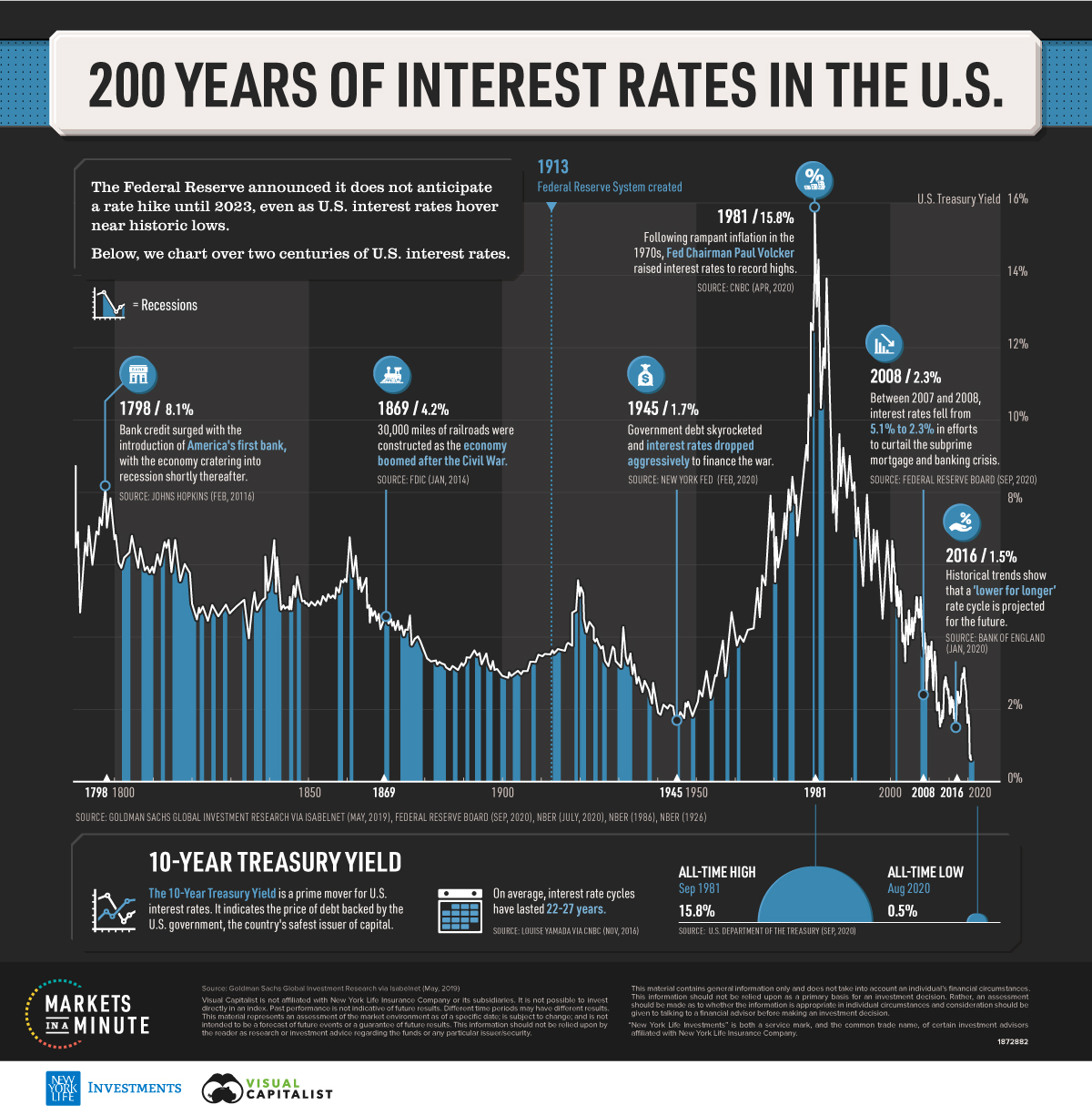
    Interesting. Except for that jump to the 1981 peak there has been a fairly persistent long term down trend since 1798. But, we are close to a floor now unless the Fed changes its mind about negative rates. Maybe we do just bump along zero for a while unless excessive deficit spending juices things up.
  • the 200 year history of US interest rates
    image
    One description: interest rates declined steadily for 150 years as the US economy matured and we weren't universally seen as an issuer of junk bonds, soared for 40 years during the "rise to global hegemony" phase and have now fallen for 40 years.
    It's never safe to read too much into history, but an appreciation of how long "the long-term" can last might provide a useful frame for other discussions.
    Just pondering, David
  • The Pandemic Depression Is Over. The Pandemic Recession Has Just Begun.
    The article discusses why the time it takes for the economy to fully recover from the pandemic may well be measured in years.
    ....what makes a recession a recession is that the initial economic pain, whatever its source, transmits broadly to affect nearly every industry and drive millions of people not into newer and fast-growing sectors but onto the rolls of the unemployed.
    The origins of the recession of 2020 may be different from those of the previous two downturns. But so far, the way it is spreading from company to company, and industry to industry, looks awfully similar.
    https://nytimes.com/2020/10/03/upshot/pandemic-economy-recession.html
  • What's going on at the Matthews funds?
    Yes, I was intrigued at the inception of MEGMX about Matthews’ chances with a diversified EM fund with new management. I decided to take a position in it and at the same time commit to ARTYX, in hopes that EMs would recover. Both positions made great moves up, with the Artisan fund doing better. The turmoil at Matthews and the apparent success of Artisan in attracting new talent led me to sell MEGMX but keep my EM allocation by increasing my position in ARTYX. I’m impressed that Artisan poached Lewis Kaufman (2015) and Reno Kanovich (2018) and got people from Matthews to come back. David Snowball’s commentary this month suggests that Artisan has concrete plans for future expansion.
    Asset managers as businesses may face rocky roads ahead. In fact, from its IPO in 2013 until the present, Artisan Partners stock hasn’t seen any appreciation. While it’s hard to draw conclusions from the last 12 months or so, Schwab’s stock has disappointed at a time when the company has expanded its asset base. Personally, I am drawn to small MF firms for my actively managed holdings. Therefore, I own funds at Artisan, DF Dent, Brown Capital, Brown Advisory, and Grandeur Peak. With the exception of GP, I use Schwab for our Roths and taxable MF accounts. I just recently decided to part ways with the Bruce Fund, in part for the purpose of consolidating accounts. The redemption check arrived quickly enough via the USPS, but BOA has placed a 10-day hold on my deposit. Shades of “Hotel California.” Needless to say, investing in a boutique MF company that has no presence in the fund supermarkets has its drawbacks.
  • Perpetual Buy/Sell/Why Thread
    @Derf,
    My initial (2020) purchase of PRLAX occurred on 2 successive days, April 2 and April 3. Was off close to 50% YTD at that time. Sold a couple small chunks (about 20%) late April / early June as it had risen quite a bit. As of yesterday, fund was still off 31% YTD. My 6-month gain’s probably going to be close to 15%. Beats 0.07% in a T-Bond money market fund. Been eying DODFX for a couple months. Should be a smoother ride. But doesn’t have the same upside potential.
    Otherwise, you might be referring to roughly 4-5 years ago when I also played PRLAX for a quick gain. If that’s it, you have a damned good memory! They had an exit fee back than if the fund was held for fewer than 90 days. Actually sold it and paid the fee, since it had done so well.
    “A bird in the hand is worth two in the bush.” - B/F