Howdy, Stranger!

It looks like you're new here. If you want to get involved, click one of these buttons!

Here's a statement of the obvious: The opinions expressed here are those of the participants, not those of the Mutual Fund Observer. We cannot vouch for the accuracy or appropriateness of any of it, though we do encourage civility and good humor.
  • A Top Fund Makes The Value Case For Verizon
    $300 a month is insane but I’m sure there are plenty of people out there who may be paying close to that.
    Every time my Internet/Cable package is up for renewal with Comcrap, I negotiate a new deal. Don’t know if this is an option for @VintageFreak with FiOS - there are also 3rd party services that will negotiate for you for a fee of 50% of the savings.
  • American Funds F1 shares can be purchased no-load.
    "While I wouldn't pay a wrap fee, one presumably isn't tied to one (possibly bloated) fund family, so a lucky adviser might earn his 1% by skilled diversification."
    @STB65 - an excellent point, more so now than in the past. In days of yore, it was not uncommon for load families to waive their loads for exchanges from other load families. FINRA still has a page on this, it's called Net Asset Value Transfers:
    http://www.finra.org/investors/alerts/net-asset-value-transfers-look-you-leap-another-mutual-fund
    For conspiracy theorists, it may be that the fund families started dropping this en masse when wrap accounts became popular. Wrap accounts offered a similar feature ("free" transfers between families), but bigger fees (in the long term) for advisors.
    These days, I'd expect a good advisor (who is using load funds) to use families with a broad range of funds so that keeping money within a family would not be a problem. To the extent that AF funds are bloated, that seems to be a family-wide characteristic. So if this is viewed as a problem, one would not likely be attracted to the family at all. And if not, then AF has a good set of funds to move between.
    @Alban - As Rekenthaler states in his column (see link above) a small wrap account isn't going to get serviced well. Quite possibly larger accounts as well, as Kitces discusses in his recent (August) column: "Why Reverse Churning Is About To Become A Big Advisor Problem" (i.e. advisors kicking back and letting the fees roll in - the opposite of traditional churning).
    https://www.kitces.com/blog/reverse-churning-in-advisory-accounts-problems-for-fiduciary-advisors/
    IMHO the only way to resolve conflicts of interest that will arise regardless of the method of compensation is to require the client's interest to come first. Period, end of story. Being somewhat less cynical than VF (though growing more so year by year), I still choose to believe that most people (including advisors) are decent and honorable and will do the right thing.
  • American Funds F1 shares can be purchased no-load.
    I'm never going to purchase a fund and say it is forever. I will evaluate the fund performance, manager, ER, etc. together and decide to buy and how many times to buy.
    So it does not matter to me if ER of NL shares is higher. I will NEVER buy a load fund. It is just ridculous to have 5.5 shaved off the top
  • Lewis Braham: Should Vanguard's ETFs Be Even Cheaper?
    FYI: (Click On Article Title At Top Of Google Search)
    To an outside observer, it may seem ironic that the exchange-traded-fund manager most beloved by profit-seeking investors is built like a nonprofit organization. The Vanguard Group manages $3.5 trillion in assets, yet because it is shareholder-owned, there’s no pressure from Wall Street or private stakeholders to drive profits—it operates at cost. That, plus its tremendous scale and efficiency, allows it to offer its products and services for less than its for-profit competitors.
    Regards,
    Ted
    https://www.google.com/#q=Should+Vanguard’s+ETFs+Be+Even+Cheaper?+Barron's
  • American Funds F1 shares can be purchased no-load.
    My experience with the American Funds choices (no load, presumably) which my university 403b plan forced me into in place of the former TRP options hasn't been a success, although I'm sure the B-school professors meant well with their choices.
    While I wouldn't pay a wrap fee, one presumably isn't tied to one (possibly bloated) fund family, so a lucky adviser might earn his 1% by skilled diversification. OTOH, I admit I have grudgingly (never "gladly") paid the 0.25% for a fund manager unavailable otherwise. If I've got my country school math right, the 0.25% fee might take 10 yr or longer to balance the 5% load, assuming some of my current (American fund) returns.
    As I gradually drift toward Vanguard, individual stocks or ETFs, or index funds, this is an irrelevant point.
  • REITs . . .
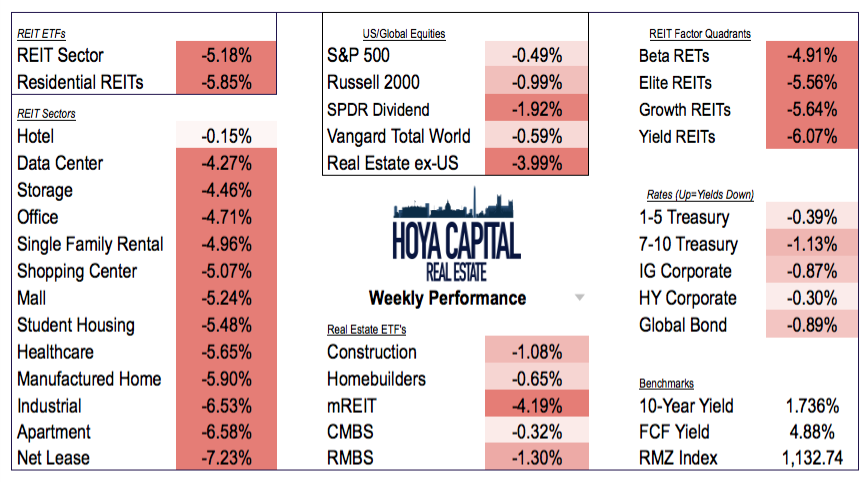
    Real Estate Weekly Review: REITs See Biggest Weekly Decline In 2 Years
    Oct. 7, 2016 6:51 PM ET
    Hoya Capital Real Estate
    Summary
    The REIT Index retreated by 5% this week following 2% decline last week. All sectors were lower. REITs are now up only 3% YTD, down 13% from its recent highs.
    image
    With graphics and charts
    http://seekingalpha.com/article/4010922-real-estate-weekly-review-reits-see-biggest-weekly-decline-2-years
    Article featuring Cohen and Steers ,the company. Bloomberg.com Charles Stein
    September 12, 2016
    Cohen & Steers Inc., this year’s top-performing money manager, has prospered by satisfying the appetites of investors who crave higher yields.
    Assets at the company, which specializes in real estate investment trusts and preferred securities, rose 17 percent to $61.5 billion in the first seven months of the year, driven by market appreciation and more than $4.5 billion in net customer deposits.
    The company’s oldest mutual fund, the $6 billion Cohen & Steers Realty Shares, returned more than 12 percent annualized over the past 25 years, compared with 9.2 percent for the S&P 500 Index. The fund, up 12 percent this year, has a dividend yield of 2.5 percent, superior to the payouts on the 10-year Treasury note or the S&P 500. Its performance is similar to the Vanguard REIT Index Fund over the past three and five years.
    “Higher-yielding REITs are attractive in a low-yield environment,” said Alec Lucas, a Morningstar analyst who follows the real estate fund.
    The attraction extends beyond the U.S. With bond yields depressed throughout the developed world, Cohen & Steers’s president and chief investment officer, Joseph Harvey, told analysts on a July conference call that investors “are scrambling for yield and we believe our strategies will continue to benefit.”
    The firm pulled in $840 million during the second quarter from its subadvisory business in Japan through a partnership with Daiwa Asset Management. Most of the money went into U.S. REITs, which are popular in Japan.
    The $6.8 billion Cohen & Steers Preferred Securities and Income Fund, which has a dividend yield of 5.3 percent, gathered $1.4 billion in deposits in the first seven months of 2016, data from Morningstar show. Preferred shares, considered a stock-debt hybrid, tend to appeal to income-oriented investors.
    http://www.bloomberg.com/news/articles/2016-09-12/year-s-top-money-manager-gets-boost-from-yield-starved-investors

  • American Funds F1 shares can be purchased no-load.
    The F-1 (or F) share class has existed since 2002. The only thing changing is that you can now purchase the existing F-1 share class without going through an advisor. So if you were working with an advisor nothing has changed on the fund side.
    The advisor may now have to be more honest, but American Funds is not changing what the advisor can sell you or the cost of those shares.
    IMHO people aren't wising up. Just the opposite. They gladly pay 1%/year in wrap fees forever rather than pay a one time 5% fee of the purchase amount (with free exchanges within the family).
    Wrap fees have supplanted loads as a way for advisors to make their fees palatable while extracting more money from their clients. Wrap fees function like C shares, but advisors can advertise that you won't pay a load.
    Likewise, noload investors gladly pay 0.25% in perpetuity rather than a one time fee of a few bucks per purchase.
  • American Funds F1 shares can be purchased no-load.
    This basically means they are acknowledging active management is worthless. Loads which are wrong in first place add insult to injury.
    I'm sure ER is jacked up on those F1 class shares.
    That's all a tad cynical, don't you think?
    If opening up sales channels is an acknowledgment that active management is worthless, then is closing some sales channels (e.g. converting from a no load family to a load family) is a declaration that active management is great? Perhaps it is simply a way of optimizing business, taking into consideration effects on sales force (brokers/advisors), cash flows, AUM, performance, etc.?
    American Funds has for many years sold its funds in both load and no load share classes. If, say, Fidelity, did that, would they also be wrong? Oh wait, they do, e.g. FFRHX & FFRAX. As do PIMCO, American Century, and various other fund houses.
    American Funds has been selling F shares since 2002 (they became F-1 in 2008 when AF launched F-2 w/o the 12b-1 fee).
    I checked the 2003 EuroPacific Fund prospectus. The F shares were indeed slightly more expensive when they started out: They had a 12b-1 fee of 0.25%, while the A shares had a 12b-1 fee of just 0.14%. So the F shares were11 basis points more expensive.
    But by 2008 when F-2 launched, both A and F-1 shares had a 0.25% 12b-1 fee, and virtually ERs. It looks like they jacked up the load share class fee, not the other way around.
  • American Funds F1 shares can be purchased no-load.
    Typically F-2 shares carry transaction fees, even when purchased through an advisor. For example, here are Scottrade's pages for EuroPacific Growth F-1 (AEGFX) and F-2 (AEPFX). At Scottrade both are sold only through advisors. The F-1 class is listed as NTF, the F-2 as TF.
    If you had direct access (i.e. no advisor required) under the same terms, would you pay the transaction fees for F-2? I would, but I invest long term and look at total cost. I believe some people here have written to the effect that they would not pay a fee to purchase a fund. The point is that access to cheaper institutional shares doesn't come for free.
    Sometimes it isn't even a matter of higher mins for the institutional (lower ER) share class. It may be strictly a matter of TF. For example, at Fidelity, in an IRA, you can purchase the I (institutional) and N (retail, 0.25% 12b-1 fee) share classes of AQR large cap funds with the same $2500 min. AUEIX & AUENX, AMOMX & AMONX, QCELX & QCENX.
  • American Funds F1 shares can be purchased no-load.
    If I recall correctly, somewhere in the 1990s or early 2000s, American Funds F shares (before they split into F-1 and F-2) were available through some second tier brokerages. That is, not Fidelity or Schwab, but some of the more obscure brokerages of the time.
    Regarding loads and advice. Over at M*, John Rekenthaler wrote a column a few years ago (that I cannot seem to find) detailing why loads can actually work better (read: cost less) than other forms of compensation for small investors.
    What I could find was a more recent paragraph by him summarizing his position (with which I concur):
    While most financial writers--and many if not most of this column's readers--believe that commission-based advice is inherently worse than advice that is purchased by ongoing fees (mostly asset-based, sometimes flat), I do not. A front-end load fund that is bought and held for the long term is a relatively cheap investment and often a relatively good one at that. What matters is not the payment structure for the advice, but if it is offered solely in the client's best interest and comes at a fair cost.
    Emphasis added.
    He goes on to sketch figures comparing access and costs of wrap accounts vs. loads, though in the broader context of discussing the new DOL fiduciary rule.
    http://ibd.morningstar.com/article/article.asp?id=718083&CN=brf295,http://ibd.morningstar.com/archive/archive.asp?inputs=days=14;frmtId=12, brf295
    Since I don't seek advice (heck, I actively run away from anyone pushing advice at me), this "back to the future" sales channel of American Funds is attractive to me, as it may be for many people here. But it won't work for everyone.
  • Seafarer

    Yeah I got in last week, too. Plan to add a few more $5K chunks to it over time.
  • Bloomberg BRIEF: Record Inflows For Municipal Bonds Funds: Audio Presentation
    Interesting that Inflation protected bonds have returned over 6-7% YTD.
    image
  • Bloomberg BRIEF: Record Inflows For Municipal Bonds Funds: Audio Presentation
    FYI: Bob Moon spoke to Taylor Riggs, Contributor to the Bloomberg Brief on Municipal Bonds, on First Word. The municipal bond market recorded a 52nd straight week of inflows into mutual funds, marking a full year of demand into the asset class and the longest stretch since at least 2010.
    Regards,
    Ted
    http://www.bloomberg.com/news/audio/2016-10-06/bloomberg-brief-record-inflows-for-municipal-bonds-audio
  • REITs . . .
    Real estate can be a very good "alternative" investment, and has always been a good diversifier. We would allocate no more than 5-7.5% to this asset class, since many index and actively-managed funds will own real estate, too. I would consider CSRSX or ICF, depending on they type of account you have. That company has the longest track record in the sector. Understand there will be periods of losses, just like any other stock fund.
  • Big Bets Come Back To haunt Franklin Templeton's Global Bond Fund
    On the contrary, the fund is exactly what most advisors expect. Those who saw Mr. Hasenstab's unique style and were early to the fund have done well for their investors. Virtually every manager will have a period of 2-3 year span of underperformance. Just as the hot money flowed into TGBAX after it's returns were great, 2005-2010, the same performance-chasing money is now moving out. Nothing has changed from a strategy or philosophy standpoint, but the bets the last couple of years have not paid out. They may do so yet. Contrary to M* comments, advisors and investors who actually take the time to know this fund have never expected it to be tame and run for capital preservation. It is a different vehicle that happens to own bonds, like it or not. It has been a big diversifier for portfolios over its long history with Hasenstab at the helm. We captured some long-term gains late last year and early this year, moving dollars to VTABX, thereby splitting international bonds into two very different pots.
  • Big Bets Come Back To haunt Franklin Templeton's Global Bond Fund
    FYI: The $44 billion Templeton Global Bond Fund (TGBAX) is probably not what most financial advisers would expect from a strategy in such a bland and stoic category as world bond funds.
    But, based on the pace of money flowing out of the fund over the past few years, advisers and investors are catching on that this is far from a plain vanilla global fixed-income portfolio.
    Regards,
    Ted
    http://www.investmentnews.com/article/20161005/BLOG12/161009971?template=printart
    M* Snapshot:TPINX:
    http://www.morningstar.com/funds/XNAS/TPINX/quote.html
    Lipper Snapshot:TPINX:
    http://www.marketwatch.com/investing/Fund/TPINX
    TPINX Ranks #44 In The (WB) Fund Category By U.S. News & World Report:
    http://money.usnews.com/funds/mutual-funds/world-bond/templeton-global-bond-fund/tpinx
  • RiverNorth, DoubleLine Launch Closed End Fund
    FYI: RiverNorth Capital Management announced the launch of its closed end RiverNorth/DoubleLine Strategic Opportunity Fund (OPP) Wednesday, for which it serves as advisor and DoubleLine Capital serves as sub-advisor.
    The fund started trading on the NYSE on September 28. RiverNorth said that the fund will opportunistically invest in fixed income securities and tactically invests in closed-end funds.
    Regards,
    Ted
    http://blogs.barrons.com/focusonfunds/2016/10/05/rivernorth-doubleline-launch-closed-end-fund/tab/print/
  • Question for the board for investing inherited money for daughter
    Unless your daughter wishes to make/upgrade a housing purchase in the next 5 years,growth is the word !
    T. Rowe Price Global Technology Fund PRGTX ( 10% )
    https://www.google.com/finance?q=MUTF:PRGTX&ei=48r1V-CDHtXLjAH27bDQDw
    T. Rowe Price Health Sciences PRHSX ( 10% )
    https://www.google.com/finance?q=MUTF:PRHSX&ei=vcr1V8DGJ8T2jAGTt67QDg
    iShares S&P SmallCap 600 Growth (Etf)(NYSEARCA :IJT (36% )
    https://www.google.com/finance?q=NYSEARCA:IJT&ei=Zcr1V_jyIIKK2AbS2IW4Bg
    SPDR S&P 500 Etf Trust(NYSEARCA: SPY (30%)
    https://www.google.com/finance?q=NYSEARCA:SPY&ei=Fsr1V5CXPMWr2Abc5bqwAQ
    iShares Barclays Aggregate Bond Fund(NYSEARCA: AGG (10 %)
    https://www.google.com/finance?q=NYSEARCA:AGG&ei=EMn1V5C-L8Gs2AaYraygCg
    100 shares @ $21.00 :ROIC (4%) One of @Scott's mentions a while back.
    Retail Opportunity Investments Corp(NASDAQ :ROIC
    ..specializes in the acquisition, ownership and management of necessity-based community and neighborhood shopping centers on the west coast
    https://www.google.com/finance?q=NASDAQ:ROIC&ei=98j1V6GGMszEjAGq-YLIAg
    Millennials
    Here's some info on the Millennial Generation .The two Etf's mentioned do not have enough assets or volume to be viable at this time,but bear watching.
    Which Millennial-Focused ETF Deserves Your Investment Dollars?
    investing in this segment’s needs and preferences should be intriguing.
    As this group has the prospect of comprising 75% of the workforce by 2025, it surely emerges as a long-term bet. As per research by Global X, millennials now earn about $2 trillion, with income projected to grow to $8 trillion by 2025.
    Probably this is why issuers got busy in launching millennials’ focused ETFs. First Global X and then Principal Exchange-Traded Funds brought about two such products, namely Global X Millennials Thematic ETF (NYSE:MILN) and Principal Millennials Index ETF (NASDAQ:GENY).
    http://etfdailynews.com/2016/08/28/which-millennial-focused-etf-deserves-your-investment-dollars/
  • How A More Balanced S&P 500 Can Lead To Richer Returns
    Well, of course --- if you're gonna go VTI instead of SPY, then sure, the delta w RSP (RPG, RPV) is not much worth spending time on.
    The suggestions were not just to go SP500 alone, that's all.