
It looks like you're new here. If you want to get involved, click one of these buttons!
https://www.fidelity.com/direct-indexing/customized-investing/faqsWhen don’t dividends reinvest into my basket?
Only dividends generated from shares held in a basket prior to the ex-dividend date will be allocated to the basket. Dividends from shares held outside of the basket, or in a basket on or after the ex-dividend date, will be allocated to the account. All subsequent dividends will be proportionately allocated based on these rules.
Florida has been working for years to crack down on employers that hire undocumented immigrants. But that presented a problem for businesses in the state that are desperate for workers to fill low-wage and often undesirable jobs.
Florida’s Republican Gov. Ron DeSantis and the state legislature have a potential solution: children. The state’s legislature on Tuesday advanced a bill that would loosen child labor laws, allowing children as young as 14 years old to work overnight shifts. If the new law is passed, teenagers would be able to work overnight jobs on school days. They are currently prevented from working earlier than 6:30 am or later than 11 pm per state law.
The bill passed through the Florida Senate’s Commerce and Tourism committee on Tuesday with five votes in favor of the loosened child labor restrictions and four against them. The bill will pass through two other relevant committees before being put to a vote with the full Florida Senate. DeSantis is supportive of the law and has been vocal of cracking down on immigration, echoing President Donald Trump’s rhetoric. However, economists have warned that could backfire, sparking further inflation and labor shortages.
“Why do we say we need to import foreigners, even import them illegally, when you know, teenagers used to work at these resorts, college students should be able to do this stuff,” DeSantis said last week at a panel discussion with border czar Tom Homan, as first reported by the Tampa Bay Times.
The state has been easing up on child labor protections for years. Last year, the legislature passed a law allowing home-schooled 16- and 17-year old teens to work any hour of the day.
The state’s Republican-led legislature on Tuesday will debate the new law, which also includes a number of changes including eliminating working time restrictions on teenagers aged 14 and 15 if they are home-schooled and ending guaranteed meal breaks for 16 and 17 year olds.
The number of child labor violations in Florida has nearly tripled in recent years, according to US Department of Labor statistics.
ECONOMISTS ARE WARY
Economists cautioned against changes to the current national accounts structure as it would make GDP very volatile and difficult to get a clear view of the economy's health, creating more uncertainty.
"I don't think the stock market, the financial markets would like that," said Sung Won Sohn, Finance and Economics professor at Loyola Marymount University.
It would also be impossible to compare the U.S. economy's performance against its global peers.
Looking at the private sector alone would not give the full picture on growth, Sohn said.
"Economic growth over time would become a lot more volatile. The reason is, when the economy slows or, when we are in a recession, for example, the government spends a lot of money," he said.
Removing government spending from GDP would distort the figure as government productivity is assumed to be zero whatever the production is in the computation of GDP.
"It's imperative that we keep the current system because, we need to make comparisons, and it's important to know how well we are doing compared to a year ago, five years ago, 10 years ago, and we can learn from our mistakes," Sohn said.
Comment: Elections do indeed have consequences. Welcome to Trump World.President Trump said on Wednesday that he would impose a 25 percent tariff on cars and car parts that were imported into the United States, a move that could encourage U.S. auto production over the longer run but is likely to throw global supply chains into disarray and raise prices for Americans who buy an automobile.
The tariffs will go into effect on April 3 and apply both to finished cars and trucks that are shipped into the United States and to imported parts that are included in cars assembled at American auto plants. Those tariffs will hit foreign brands as well as American ones, like Ford Motor and General Motors, which assemble some automobiles outside the country, including in Canada or Mexico.
Nearly half of all vehicles sold in the United States are imported, as well as nearly 60 percent of the parts in vehicles assembled in the United States. That means the tariffs could push up car prices significantly when inflation has already made cars and trucks more expensive for American consumers.
Cox Automotive, a market research firm, estimated that a 25 percent tariff on goods from Mexico and Canada would add $3,000 even to the cost of a car built in the United States. Tariffs would add $6,000 on average to the prices of cars made in Mexico or Canada, a category that includes vehicles like the Toyota Tacoma pickup, gasoline and electric versions of the Chevrolet Equinox, and several models of Ram pickups, according to Cox estimates.
Stock markets fell on news that the auto tariffs would be imposed. Shares of major carmakers tumbled further in after-hours trading, after the White House clarified that the tariffs would also cover imported auto parts. General Motors was down nearly 7 percent and Ford and Stellantis were more than 4 percent lower after the markets closed. Tesla’s stock fell 1 percent in extended trading.
With all the Trump stuff going on, it is virtually impossible for me to predict what changes will occur, and what will not. About the only category of Munis I would be "interested" in, are HY Munis, probably with some seasonal momentum investing. Any adverse Trump decisions would of course be important to me, but once you get away from personnel cuts, downsizing, etc. it will be more complicated with more changes having to go through a legislative process. I have my doubts that the public would be supportive of eliminating tax exempt status for Munis, but I guess anything is possible.FYI from Barron's: "Heads up, municipal bond investors: Amid all the Trump 2.0 policy proposals, there is one you should be aware of: The potential for munis to lose their tax-exempt status. “Eliminate Exclusion of Interest on State and Local Bonds” is listed on page 9 of a 50-page House Budget Committee document prepared in January that lists some 200 ways the government could raise extra funds to offset the impact of extending the 2017 Trump tax cuts."
Comment: Stupid, STUPID, STUPID !!!The Trump administration is planning to close a small, obscure laboratory whose work undergirds everything from microchip manufacturing to nuclear fusion.
The Atomic Spectroscopy Group at the National Institute of Standards and Technology (NIST) provides the definitive measurements of atomic spectra. Spectra are specific sets of colors emitted by different atomic elements. Those sets of colors act as atomic fingerprints that are used to characterize a wide variety of things — from the gases in far-off stars, to the blood in a person's finger.
The laboratory has been in continuous operation for more than 120 years, but in mid-April it will be forced to close, according to a letter sent by the lab's head, Yuri Ralchenko, to dozens of colleagues around the world.
"We were recently informed that unless there is a major change in the Federal Government reorganization plans, the whole Atomic Spectroscopy Group will be laid off in a few weeks," Ralchenko wrote in the letter, which was emailed on March 18 and seen by NPR. The letter was first reported by Wired. Ralchenko says in the letter that he was told "our work is not considered to be statutorily essential for the NIST mission."
But thousands of scientists and engineers disagree. A petition is now circulating to reverse the closure, and it had received close to 3,000 signatures as of Wednesday. Among the signatories is Nobel Prize-winning physicist Sheldon Glashow.
"I cannot believe that the government would be stupid enough" to slash this kind of work, Glashow said in a video statement. The overwhelming support exists because the group's spectral measurements get used in almost every field imaginable, according to Elizabeth Goldschmidt, a physicist at the University of Illinois, Urbana-Champaign. "You look at the very specific color of a star, it can tell you the makeup of the star. You look at the blood in someone's finger ... and that can tell you how much oxygen is in the blood," she says.
But to measure colors accurately, devices like telescopes and pulse oximeters must be correctly calibrated, and that's where the Atomic Spectroscopy Group comes in. The laboratory maintains a database of atomic spectra that are the standard reference used to ensure devices are functioning correctly. Every month, the database receives around 70,000 queries from around the world, according to a recent post about it on NIST's website — and it's cited in two research papers per day, according to a recent presentation by Ralchenko.
Among the researchers querying the database is Brett Morris, an astronomer at the Space Telescope Science Institute in Baltimore, Md. who works on NASA's James Webb Space Telescope. Morris is studying planets around distant stars. Sometimes he says, the light coming from those stars looks surprising. "The first thing you have to do is to figure out who's to blame — was it oxygen? Was it carbon? Was it neon?" he says. "And the resource for doing that is the database produced by the Atomic Spectroscopy Group."
In addition, the laboratory conducts precise measurements of ultraviolet atomic spectra that are critical to developing advanced microchips. Ultraviolet light is used to etch tiny circuits, and advances in the field require detailed knowledge of the atomic spectra of elements in the extreme ultraviolet. There are a handful of facilities that research ultraviolet spectra, and this group is one of them, Goldschmidt says. It also studies plasmas, which are ionized gases that enshroud nuclear fusion reactions. Researchers around the world are pursuing fusion as a clean and virtually limitless form of energy, and detailed knowledge of plasmas is essential to that development.
Neither NIST nor its parent agency, the Department of Commerce, responded to NPR's inquiries about the closure, but the savings from closing the lab would be minimal. NIST's annual budget is just $1.5 billion, less than 0.02% of the government's $7 trillion annual budget.
A silicon wafer with microchips etched into it. Microchips are etched using specific wavelengths of light. Better measurements of the wavelengths in ultraviolet light are required to advance chip manufacturing.
Within NIST, the atomic spectroscopy group is made up of seven full-time federal employees. The group's employees even pay out of pocket for coffee and sugar used in its coffee breaks and have been doing so since 1973, according to a video celebrating its anniversary last year. By contrast, if the spectroscopy group closes, the costs will be enormous, scientists say. Researchers around the world will waste hours on the internet hunting around for the best spectral measurements, says Evgeny Stambulchik, a physicist at the Weizmann Institute of Science in Israel.
What currently takes a couple of minutes might soon take "many hours, maybe many days," Stambulchik says. "Multiply that several hours by several thousands of scientists and you understand the waste of work time there would be without such a centralized database," he says.
But Goldschmidt says the real blow would be to industry. Having centralized and agreed-upon calibration and measurement standards "is what allows industries to innovate and make new products," she says. "Everyone wins when this happens at NIST because everyone can rely on what NIST does, and they don't have to invest their time and money in doing it themselves."
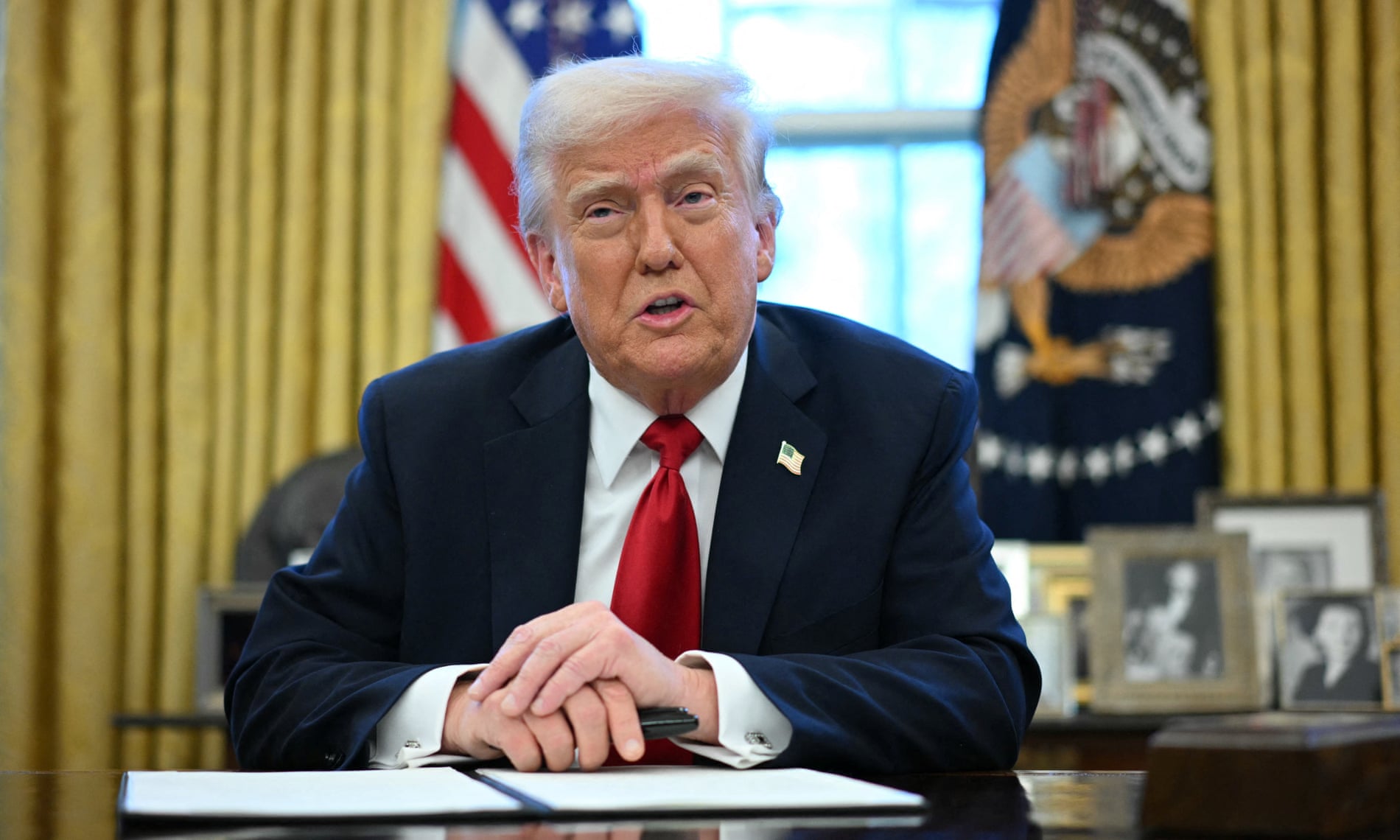
On Wednesday Donald Trump announced plans to impose sweeping 25% tariffs on cars not made in the United States, days before the US president is expected to announce wide-ranging levies on other goods from around the world: “What we’re going to be doing is a 25% tariff for all cars that are not made in the United States,” Trump said in the Oval Office. “We start off with a 2.5% base, which is what we’re at, and go to 25%.”
The tariffs will go into effect next week, on 2 April, the president claimed, and the US will start collecting them the following day. “This is very exciting,” he said, suggesting the move would spur economic growth. In February, Trump floated the idea of a 25% tariff on imported vehicles but had offered no other details. On Monday, the president hinted that the auto industry levies could come in “the very near future”.
On 2 April – a day Trump has dubbed “liberation day” – the president is expected to unveil a wide range of so-called reciprocal tariffs – levies on imported goods that the Trump administration argues are unfairly taxed by the US’s trading partners.
Trump has long argued that the US is being cheated by its trading partners and that tariffs are the best remedy. However, he has delayed or watered down his tariff plans on several occasions. His stance has worried investors, leading to sharp sell-offs in US stock markets, and has proved unpopular with both corporate America and consumers.
Many economists have expressed alarm, too, warning that the president’s tariff plan would risk increasing prices across the US. A study by Anderson Economic Group, an automotive consultant, for example, found that blanket tariffs on Canada and Mexico risked increasing US car prices by as much as $12,000.
Mexico, Japan, South Korea, Canada and Germany are among the top car exporters to the US. Will Scharf, a White House official, claimed the new car tariffs would result in more than $100bn in annual revenue to the US. “Have no fear, we will WIN everything!!!” Trump wrote on Truth Social earlier this month, claiming that tariffs were already “pouring money” into the country.
But a Harris poll conducted for the Guardian found that the majority of Americans were already worried about the impact tariffs will have on their finances. Ninety per cent of Democrats, 69% of independents and 57% of Republicans reported they were concerned about tariffs.
Industry groups sounded the alarm on Wednesday. “Throwing away tens of thousands of jobs on both sides of the border will mean giving up North America’s auto leadership role, instead encouraging companies to build and hire anywhere else but here,” said Candace Laing, president and CEO of the Canadian Chamber of Commerce. “This tax hike puts plants and workers at risk for generations, if not forever.”
© 2015 Mutual Fund Observer. All rights reserved.
© 2015 Mutual Fund Observer. All rights reserved. Powered by Vanilla


