Howdy, Stranger!

It looks like you're new here. If you want to get involved, click one of these buttons!

Here's a statement of the obvious: The opinions expressed here are those of the participants, not those of the Mutual Fund Observer. We cannot vouch for the accuracy or appropriateness of any of it, though we do encourage civility and good humor.
  • Re-investing RMDs
    So if one was interested on VTCLX, with it's "
    VTCLX has 65% in unrealized gains", more for a tax advantage account ?
  • Re-investing RMDs
    If VTCLX floats your boat, there are a couple of ETFs tracking the R1K. VONE (Vanguard) and IWB (iShares). VTCLX also tracks the R1K though more loosely for better tax efficiency.
    The ETFs have slightly higher tax cost ratios than VTCLX (0.41% and 0.40% respectively vs. 0.31%). Over the past 1 and 3 years they have slightly outperformed VTCLX pre-tax (with Vanguard's ETF being the best), though VTCLX has done slightly better over five years.
    Here's Portfolio Visualizer's comparison of these funds over 10 years.
    VTCLX has 65% in unrealized gains while the ETFs have lower exposure (likely due to their ETF structure): 17% for IWB and 35% for VONE.
    Again, when it comes to tracking market cap weighted indexes, you can often find "regular" funds that are comparable to ones focused on tax efficiency. This tool may help finding comparable ETFs:
    https://etfdb.com/tool/mutual-fund-to-etf/
  • Re-investing RMDs
    The only competitor for VTMFX that I'm aware of is TAIFX. It is also 5*, also M* silver-rated (FWIW), but performance is slightly less.
    Index funds are naturally somewhat tax efficient. So with a fund like VTMSX you might look at "regular" index funds. For example, VIOO (Vanguard's "regular" S&P 600 index ETF) has a tax cost ratio of 0.40% and unrealized gains of virtually zero vs. VTMSX's 0.41% and 24% in unrealized gains.
    When it comes to bonds (not exactly what you were asking about), tax-efficient (munis) funds may not produce the best after-tax returns. I haven't been looking at bond funds lately, but when it comes to MMFs, Treasury or Treasury only funds have been doing better than muni MMFs after tax.
    Finally, perhaps the most tax-efficient way to deal with unneeded RMDs is to make qualified charitable contributions. You're not left with any earnings or principal, but it's certainly tax-efficient and might leave you with a warm fuzzy feeling.
  • Re-investing RMDs
    We have not paid FIT/SIT since 2012 and won't take RMDs until Age 73, so no direct experience (yet) with your question. That said, it will be a very important question for us in a few years.
    We will start our analysis at that time with a comparison of all other options versus ITOT, VOO and the like. We expect there will be plenty of better tax-efficient options than the VG (or other) tax-managed mutual fund options. But that's a job for us for another day a few years from now.
    Here's a primer for your current analysis:
    https://russellinvestments.com/us/blog/understanding-tax-managed-funds-and-strategies
    https://www.fidelity.com/learning-center/investment-products/etf/etfs-tax-efficiency
    https://www.morningstar.com/funds/25-top-picks-tax-efficient-etfs-mutual-funds
    https://www.bogleheads.org/wiki/Tax-managed_fund_comparison
  • Undiscovered Managers Behavioral Value Fund soft closing
    https://www.sec.gov/Archives/edgar/data/1047712/000119312525030708/d835373d497.htm
    497 1 d835373d497.htm UNDISCOVERED MANAGERS FUNDS
    UNDISCOVERED MANAGERS FUNDS
    Undiscovered Managers Behavioral Value Fund
    (the “Fund”)
    (All Share Classes)
    Supplement dated February 20, 2025
    to the Current Prospectuses, Summary Prospectuses and Statements of Additional
    Information, as supplemented
    Effective as of the close of business on April 1, 2025 (the “Closing Date”), the Fund is offered on a limited basis and investors are not eligible to purchase shares of the Fund, except as described below. In addition, both before and after the Closing Date, the Fund may from time to time, in its sole discretion based on the Fund’s net asset levels and other factors, limit new purchases into the Fund or otherwise modify the closure policy at any time on a case-by-case basis.
    The following groups will be permitted to continue to purchase Fund shares. Except as otherwise described below, shareholders of record are permitted to continue to purchase shares; if the shareholder of record is an omnibus account, beneficial owners in that account as of the applicable closing date are permitted to continue to purchase:
    •Shareholders of record of the Fund as of the Closing Date are able to continue to purchase additional shares in their existing Fund accounts and may continue to reinvest dividends or capital gains distributions from shares owned in the Fund;
    •Shareholders of record of the Fund as of the Closing Date are able to add to their existing Fund accounts through exchanges from other J.P. Morgan Funds;
    •Group Retirement Plans (as defined in the glossary) (and their successor, related and affiliated plans), which have the Fund available to participants on or before the Closing Date may continue to open accounts for new participants and can purchase additional shares in existing participant accounts. A new Group Retirement Plan may establish a new account with the Fund only if the Group Retirement Plan has been accepted for investment by the Fund and its distributor by May 1, 2025 and the plan’s account with the Fund must be either funded by the plan or available to participant directed investments by October 31, 2025. The funding date for plans approved by May 1st may be extended with approval by the Fund and its distributor;
    •Fully discretionary fee-based advisory programs, where investment discretion (fund and investment allocations) solely reside with the Financial Intermediary’s home office and where the Financial Intermediary’s home office has full authority to make investment changes without approval from the shareholder, may continue to utilize the Fund for new and existing program accounts. This includes affiliated platforms that have approval from the Fund and its distributor. These programs must be accepted for continued investment by the Fund and its distributor by the Closing Date. Additionally, after the Closing Date, new fully discretionary fee-based advisory programs may utilize the Fund for program accounts only with the approval by the Fund and its distributor;
    •Registered Investment Advisory firms who have included the Fund in their discretionary models by the closing date and utilize an approved clearing platform may continue to make Fund shares available to new and existing accounts. These particular firms must be accepted for continued investment by the Fund and its distributor on or before the Closing Date;
    •Other fee-based advisory programs (including Rep as Advisor and Portfolio Manager programs) may continue to utilize the Fund for existing program accounts, but will not be able to open new program accounts after the Closing Date;
    •Model portfolios directed by J.P. Morgan Investment Management Inc. (“JPMIM”), and J.P. Morgan Funds that are permitted to invest in other J.P. Morgan Funds, may purchase shares of the Fund; and
    •Named investment professionals listed in the Fund’s prospectus may utilize the Fund for both new accounts and existing Fund accounts.
    INVESTORS SHOULD RETAIN THIS SUPPLEMENT WITH THE
    PROSPECTUSES, SUMMARY PROSPECTUSES AND
    STATEMENTS OF ADDITIONAL INFORMATION FOR FUTURE REFERENCE
  • Buy Sell Why: ad infinitum.
    The whole "climbing the wall of worry" nonsense gets old, but we know it can drag on for a while longer. Have your BUY list (and cash) ready to go.
    Added more NRDCX today in case I am wrong about a pullback in equities. Would still hope to make some money this year with certain bond funds regardless.
    Supposedly, odds of a US recession are under 30% for 2025. Feels much higher.
  • Buy Sell Why: ad infinitum.
    I talked with a smart old friend today and told him I had a month ago gone totally to MM cash at 4.25% (currently). Missing the ongoing runup. He said, 'Really? So you think the SP500 will not be higher at the end of the year?' It made me pause and gulp a little, and I answered, 'Yeah, no, I do not think so. Not 4% higher anyway.' I did describe JQUA. The starkness of the exchange made me think to put a notation on my calendar ....
  • Protect Your Brokerage Accounts From ACATS Transfer Fraud
    @Mona, thank you for the article. We have placed lockdown on all our Fidelity accounts. While it was easier to transfer assets, but it poses vulnerability within the system for bad actors from exploiting it.
    Edit: for Fidelity customers, lockdown setting is under the Security Setting where one can select which accounts one can lockdown. We transfer funds to our external checking account and get notified immediately via text messaging and email the $ amount is being transfer. Additionally, the receiving account notifies us within 5 minutes. As such, I can track the full cycle of money flow in our accounts.
  • ★ The most important economic overview that I have read in many years ★
    OJ - Likewise I agree with your points.
    My concern is that painting with broad brushstrokes, conflating the messengers with the messages, inculcates distrust in government research and analysis. And in doing so, enables "Donald Trump and his cohort of propagandists".
    Courts are sowing the same distrust. In overturning Chevron, the Supreme Court said that they understand complex issues better than subject experts.
    https://www.nrdc.org/stories/what-happens-if-supreme-court-ends-chevron-deference
    Here's a recent NPR report on the 'crumbling infrastructure' of federal data.
    The statistical agencies are also faced with a crisis facing the broader survey and polling industry — a shrinking rate of people willing to answer questions.
    https://www.npr.org/2025/01/24/nx-s1-5250264/unemployment-rate-cpi-inflation-census-bureau-labor-statistics
    Distrust extends well beyond answering surveys. Vaccinations, for example. I hear that the results aren't in yet. That's not what government and government-sponsored research data say. Rather it's how politicians (and one in particular) are presenting that data.
    We are in violent agreement. I'm just trying not to throw out the baby (data) with the bathwater (misinterpretation, whether deliberate or simply the result of misunderstanding).
  • Buy Sell Why: ad infinitum.
    Last week I added lightly to QLENX, my lone purchase since Halloween. Still don't trust this market one bit but that dang fund just keeps marching.
    Halloween is as good a time to adjust holdings as any other I suppose. I’ve targeted the 2 solstices and 2 equinoxes as the points for potential quarterly rebalancing myself.
    With you @Mark in that I haven’t changed holdings much since last fall. Did bump cash up from 10% to near 12.5% a few weeks back. But that had as much to do with anticipated yearly distributions as anything else. As a conservative old F*** I stick to lower volatility holdings with a value & international tilt. Very little exposure to the big heavyweights like the Mag 7.
    PS - Why use the solar cycle for rebalance dates? That’s one thing Trump can’t change. :)
  • AAII Sentiment Survey, 2/19/25
    Investor concerns: Jobs, budget, debt, inflation, the Fed, dollar, geopolitical, Russia-Ukraine (156+ weeks), Israel-Hamas (67+ weeks; cease fire). For the Survey week (Th-Wed), stocks up, bonds up, oil up, gold up, dollar down. NYSE %Above 50-dMA 57.10% (positive). Only SP500 made new highs
    Been thinking along that along that since late last year.
  • AAII Sentiment Survey, 2/19/25
    AAII Sentiment Survey, 2/19/25
    BEARISH remained the top sentiment (40.5%, high) & bullish became the bottom sentiment (29.2%, below average); neutral became the middle sentiment (30.3%, below average); Bull-Bear Spread was -11.3% (low). Investor concerns: Jobs, budget, debt, inflation, the Fed, dollar, geopolitical, Russia-Ukraine (156+ weeks), Israel-Hamas (67+ weeks; cease fire). For the Survey week (Th-Wed), stocks up, bonds up, oil up, gold up, dollar down. NYSE %Above 50-dMA 57.10% (positive). Only SP500 made new highs. #AAII #Sentiment #Markets
    https://ybbpersonalfinance.proboards.com/post/1884/thread
  • ★ The most important economic overview that I have read in many years ★
    that the government was telling the voters that all was OK
    The government (read Bureau of Labor Statistics) produced accurate data, though with misleading headlines. It was politicians and some reporters (who knew better or were ignorant) who told voters that the numbers meant "that all was OK".
    In a similar vein, was it the government or Democratic politicians saying that Biden was in great shape?
    Old joke: how can you tell when a politician is lying?
    https://www.thecut.com/2015/11/here-is-one-way-to-tell-if-a-politician-is-lying.html
    This matters for two reasons at least:
    1. Understanding data: If one doesn't understand what data represents (definitions, methodology) then one can be led astray or be confused. Hence questions about how Morningstar analysts could possibly praise 1 star funds (e.g. gold-rated OAKIX).
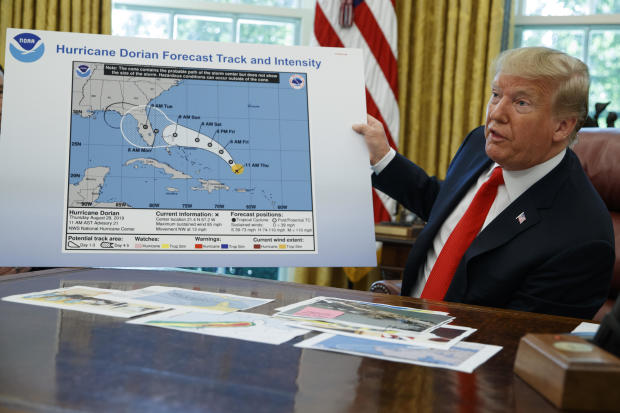
    2. Accuracy of government data: Traditionally the data produced by government departments has been accurate and apolitical. Tradition is being upset as we speak. My realtor told me this afternoon that when she looked up flood maps on FEMA, the first thing she saw was:
    FEMA.gov is being updated to comply with President Trump's Executive Orders. Thank you for your patience and understanding.
    image
    https://www.cbsnews.com/news/former-top-noaa-scientist-craig-mclean-trump-sharpie-gate-warning/
  • ★ The most important economic overview that I have read in many years ★
    @davidrmoran: thanks for your views. Have you already consulted the books I cited?
    I read Campbell summaries when their work came out, with reviews pointing out that along with wise advice it is cherry-picked, half-baked, lacking protein, to coin a phrase:
    https://sciencebasedmedicine.org/385/
    (just one)
    Similarly Greger (sp), who along with wise advice also just sounds simpleminded and black-white, not to say misleading:
    https://www.healthline.com/nutrition/how-not-to-die-review
    (Kind of like someone who would flatly assert:
    >> chicken eggs are terrible for human health )
  • ★ The most important economic overview that I have read in many years ★
    Its funny what we consider "employment" and what we consider important "statistics".
    I stopped my "full time career employment" at age 51. I spent the next 7 years caring for my elderly mom. I went from a well paying 8 hour job to a non-paying 24 hour job. Since this new job paid nothing and provided no resources it required many long nights of research to identify resources and funds for my mom's care. Over these eight years, I managed both my mom's diminishing health and her dwindling net worth.
    Most of my other seven siblings were too busy with their employed lives to help much when it came to this non-paying family care position. As alone as I was, I am not the only one who has taken on this type of non-paying work.
    From young Moms and Dads who stay at home to care for their children to middle aged adults taking care of their elderly parents, many working age Americans choose to work outside of the workforce, often for their entire working life.
    My mom raised 8 Kids; never took a day off in her life, but also never had an "employment record". When my dad passed, at age 54, she received nothing more than a survivor's benefit. At age 88, adjusted for inflation, her survivor benefit was a meager $800/month.
    For me, working until 65 would have made a huge difference in my retirement savings, but I am not sure I could have lived with that decision. I chose to care for my mom because she chose to care for the eight of us.
    These articles focus on workplace employment statistics, yet ignore the very important non-paying and non-workplace work many of us chose to do for our loved ones and how these hard choices impact the workplace.
  • ★ The most important economic overview that I have read in many years ★
    His point, as I take it, is that the numbers, though accurate are misunderstood. So things are worse than people get from the numbers reading them simplistically. True enough. But then he goes and does the same thing by simplistically presenting some reasons why the numbers don't say what people think they say.
    For example, he says that U-3 (full time employment) disregards "does not take into account many Americans who have been so discouraged that they are no longer trying to get a job". Something well known to anyone in Washington who relies on this datum for policy decisions as opposed to making political points.
    More importantly, this is a petty distortion. The U-4 figure, which includes these out-of-the-labor-force people, is 4.3% (Jan 2025), as opposed to 4.0% for U-3. And since U-4 is always higher than U-3, this "distortion" cannot have grown much if any over the past two decades.
    Here's my source:
    https://fred.stlouisfed.org/release/tables?rid=50&eid=4773
    He gives a figure for unemployed that includes not only those employed part time and those discouraged from seeking employment (U-6, 7.5% in table cited above), but those earning less than poverty wage. His figure adds 16.2% to the U-6 number.
    The latest (2022) BLS figures on the working poor (over age 16, working at least 27 weeks) is 4.0% of the labor force.
    https://www.bls.gov/opub/reports/working-poor/2022/home.htm
    Delving deeper (Table 6 in the report), it gives the total number of people working at all (1 week or more) over age 16 as 172M. The number of those working who are below the poverty level is 8.6M. That's 5% of people who worked at all. This is not precisely comparable to his 16.2% figure because definition of poverty may be different, but it does give one pause.
    Bottom line: I agree with his broad thesis that headline numbers don't present an accurate picture and that politicians take advantage of this. But at the same time, ISTM he's playing a similar game with figures.
    As someone here already said, a pox on all you guys.
  • JPMorgan Sustainable Infrastructure ETF will be liquidated
    https://www.sec.gov/Archives/edgar/data/1485894/000119312525028586/d898508d497.htm
    97 1 d898508d497.htm J.P. MORGAN EXCHANGE-TRADED FUND TRUST
    J.P. MORGAN EXCHANGE-TRADED FUNDS
    JPMorgan Sustainable Infrastructure ETF
    (the “Fund”)
    (a series of J.P. Morgan Exchange-Traded Fund Trust)
    Supplement dated February 18, 2025
    to the current Summary Prospectus, Prospectus and Statement of Additional Information
    dated March 1, 2024, as supplemented
    NOTICE OF LIQUIDATION OF THE JPMORGAN SUSTAINABLE INFRASTRUCTURE ETF. The Board of Trustees (the “Board”) of the Fund has approved the liquidation and dissolution of the Fund on or about March 28, 2025 (the “Liquidation Date”). Effective immediately, in connection with the liquidation and dissolution, the Fund may depart from its stated investment objective and strategies as it increases its cash holdings in preparation for its liquidation. On the Liquidation Date (for settlement the date after the Liquidation Date), the Fund shall distribute pro rata to its shareholders of record all of the assets of the Fund in complete cancellation and redemption of all of the outstanding shares of beneficial interest, cash, bank deposits or cash equivalents in an estimated amount necessary to (i) discharge any unpaid liabilities and obligations of the Fund on the Fund’s books on the Liquidation Date, including, but not limited to, income dividends and capital gains distributions, if any, payable through the Liquidation Date, and (ii) pay such contingent liabilities as the officers of the Fund deem appropriate subject to ratification by the Board. Income dividends and capital gain distributions, if any, may be paid on or prior to the Liquidation Date.
    After the close of business on Friday, March 21, 2025, the Fund will no longer accept creation orders. This is also expected to be the last day of trading of shares of the Fund on The Nasdaq Stock Market® LLC (“Nasdaq”). Shareholders should be aware that after the close of business on Tuesday, February 18, 2025, the Fund will no longer engage in any business activities except for the purposes of selling and converting into cash all of the assets of the Fund, paying its liabilities, and distributing its remaining proceeds or assets to shareholders (the “Liquidating Distribution”). Furthermore, during the time between market close on Friday, March 21, 2025 and the Liquidation Date, shareholders will be unable to dispose of their shares on Nasdaq.
    Shareholders may sell their holdings of the Fund, incurring typical transaction fees from their broker-dealer, on Nasdaq until market close on Friday, March 21, 2025, at which point the Fund’s shares will no longer trade on Nasdaq and the shares will be subsequently delisted. Shareholders who continue to hold shares of the Fund on the Liquidation Date will receive a Liquidating Distribution (if any) with a value equal to their proportionate ownership interest in the Fund on that date. Such Liquidating Distribution received by a shareholder, if any, may be in an amount that is greater or less than the amount a shareholder might receive if they dispose of their shares on Nasdaq prior to market close on Friday, March 21, 2025. The Fund’s liquidation and payment of the Liquidating Distribution may occur prior to or later than the dates listed above.
    Shareholders who receive a Liquidating Distribution generally will recognize a capital gain or loss equal to the amount received for their shares over their adjusted basis in such shares. Please consult your personal tax advisor about the potential tax consequences.
    INVESTORS SHOULD RETAIN THIS SUPPLEMENT
    WITH THE SUMMARY PROSPECTUS, PROSPECTUS AND STATEMENT OF ADDITIONAL INFORMATION
    FOR FUTURE REFERENCE
    SUP-BLLD-225