
Howdy, Stranger!

It looks like you're new here. If you want to get involved, click one of these buttons!
Here's a statement of the obvious: The opinions expressed here are those of the participants, not those of the Mutual Fund Observer. We cannot vouch for the accuracy or appropriateness of any of it, though we do encourage civility and good humor.
  • Kotlikoff..."No one can safely use Fidelity's "Planning Tool" to plan their finances
    Sorry @Baseball_Fan Can’t pull up the linked source.
    I do not use any particular planning tools. I invest primarily in a wide variety of actively managed moderate risk funds. All (except PRPFX) allow the manager a lot of discretion in what to own. Wouldn’t own these funds if didn’t trust the managers to make good decisions. When I do make a change in the stack of funds (as I did Friday) I follow up by using Fidelity’s analytics tool for some sort of corroboration as to how much market risk I have and how it is dispersed among asset types. Usually those results and my rough guess align pretty closely. I prefer a scotch / water ratio of about 50/50. In terms of fixed income vs. riskier assets, the desired proportion is pretty similar.
    Subscribe to James Stack’s informative InvesTech newsletter, surveying his recommended portfolio - but taking little in specific action from it. Subscribe to Bill Fleckenstein’s daily commentaries - his obsession over gold and his foreboding about equity valuations in general (“passive inflows” particularly). Subscribe to Barron’s, the WSJ and Bloomberg. Currently listening nightly to a long stack of podcasts by Meb Faber (Cambrea Funds) whose interviews with various money managers are both entertaining and insightful. I subscribe to Morningstar mainly for running fund comparisons. Sometimes their fund analysis points out how one manager’s approach varies from others in the same camp.
  • Lewis Braham Does Gold …
    I wonder if all those people fleeing mining funds come from the boat I'm in. USAGX is up 30% over the last 12 months, and would have to nearly double in price to match what I paid for it in August 2011. If I hadn't bought again in 2017 at ~1/3 the price I wouldn't be within spitting distance of getting out.
    If Lewis can convince people to go out and keep buying those miners I'll be tickled to death.
  • DJT in your portfolio - the first two funds reporting (edited)

    by 'investing', i assume you mean understanding the viability of the business model, unique technology, management competence, and mkt position. djt lacks all, so really nothing interesting there.
    its the other public company dynamics that make it interesting...is there any legal\quasi-legal path for insiders to execute one of the most blatant public scams ever on such a large number of willing followers.
    correlation of djt causes a lot of confusion.
    the odds market is the cleanest binary way to ensure one's wealth benefits from a trump win. (if your bet is right either way). its a sampling with real money (~US $1B) on the line, but there is no unambiguous proof this is sufficient AND outperforms the best polls. (some of which also have been bad if you consider they ~ raise the margin of error inversely to the gap)
    voting for trump, or buying shares in djt, is NOT a path where prior odds can be estimated for wealth if trump wins the election. but shorting djt has multiple (subjectively) strong paths not contingent on an election win or loss.
  • Stable-Value (SV) Rates, 9/1/24
    We are not there yet. Here is our plan on stable value fund in our 401(K):
    1. We will hold enough cash to cover one to two year expense (minus social security and pension) from the staple value fund.
    2. The bulk of our staple value has been reallocated to total bond index fund since the beginning of 2024. This alone has gained well over 1% total return with stable value gradual declining yield.
    3. Short term bonds and funds are viable alternatives. Taking on more credit risk is reasonable with good active management.
  • Fidelity Automatic Account Builder changes
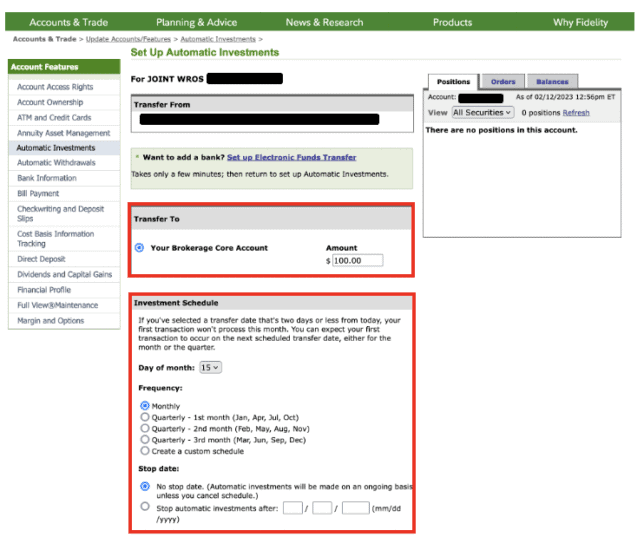
    This is the feature that lets you buy additional shares of a TF fund at Fidelity for $5. Has anyone used it recently?
    It used to be that you could schedule automatic investments of funds monthly or quarterly. But now, you must schedule automatic investments weekly, every two weeks, or monthly. I suppose that's helpful if one is making investments from periodic paychecks, but otherwise this seems excessive.
    If there was an announcement about this change, I missed it.
    The interface used to look like this:
    image
    Fidelity has also added the ability to schedule automatic (weekly, biweekly, or monthly) ETF and stock investments. They are executed as market orders on the specified dates. I don't know the time of day that the orders are executed.
    https://www.fidelity.com/trading/recurring-investments
  • Lewis Braham Does Gold …
    Article Title: - ”Don’t Miss Out on the Rally in Gold Mining Stocks. Here’s What to Buy Now.”
    Author - Lewis Braham
    Source - Barron’s September 2, 2024
    Brief Excerpt: ”Fund investors should be paying attention to these mining stocks but aren’t. While the behemoth $69.1 billion SPDR Gold Shares exchange-traded fund (ticker: GLD) for bullion is up 21% this year, the $14.7 billion VanEck Gold Miners ETF (GDX) is up an even more impressive 26%. Yet, mining-stock funds in Morningstar’s Equity Precious Metals category have seen $1.7 billion in outflows; the VanEck ETF, the largest, alone has lost $1.3 billion. Meanwhile, SPDR Gold Shares, in Morningstar’s Commodities Focused category, has lost $1.8 billion.”
    Some funds mentioned in article:
    First Eagle Gold / SGGDX
    iShares MSCI Global Gold Miners / RING
    OCM Gold / OCMAX
    SPDR Gold Shares / GLD
    VanEck Gold Miners / GDX
    VanEck International Investors Gold / INIYX
    VanEck Junior Gold Miners / GDXJ
    Lewis knows an awful lot about investing. I’m a bit struck by the exuberance on display here. But I concur with his long term bullish sentiment. Unfortunately, owning mining stocks can sometimes feel like riding in the Bumper-Cars at a carnival. You’ll probably need a subscription to read the article. I’ll attempt to LINK.
  • The Thrilling 36 Funds
    Kinnel seems to imply you have to subscribe to M* Institutional database to run the screen. I haven't tried it in Fund investor. But why publish articles for individual investors based on a screen only available to high end clients?
    It was never possible to replicate his screen at the M* retail level. Years ago he wrote how to approximate his screen with Premium Screener and with some third party screeners.
    https://www.morningstar.com/funds/making-fund-screeners-fantastic
    Here's the 2017 "Fantastic 43" version that he mentions.
    https://www.morningstar.com/funds/kinnel-43-fantastic-funds
    In it, he answered your question "why include closed funds" in much the same way that @WABAC did: "Many people still own them and want to know if they still make the grade."
    He stated the purpose of his (then) $25K limit on min investment as "to help you get a list you can use."
    Comparing how one could use the old Premium Screener as described in the piece with today's Investor screener reveals just how far M* has fallen in supporting retail users.
    M* used to have a whole series of articles each with a different screen that Premium subscribers could run. They even contained a link to run the screen. Here's one example (via Wayback Machine):
    Finding Stock Funds with Big Yields
    Unlike Kinnel's "Fantastic" and "Thrilling" series where he gives all the results, these other pieces named only a few of the results (3 of 19 in the Big Yields piece). While somewhat helpful, they carried a whiff of a sales pitch, telling you that if you were a Premium subscriber you could see all the results.
    "That's where Morningstar's Premium Fund Screener comes in."
  • DJT in your portfolio - the first two funds reporting (edited)
    BaluBalu said
    "I have not been following this thread well. So, pardon my enquiry. Why are you guys following the price ticks of this thing? Is there are catalyst, such as vesting, dilution, etc., tied to a price level? "
    many reasons those fascinated with the financial sector are following djt.
    the history of scams in financial markets is endless, but never has such a influential and powerful politician continuously checked every box known to be a marker or EVIDENCE of a market scam.
    in summary, this is very different from any other meme event in history, and a substantial number of retail investors are still HOLDING and BUYING djt.
    am not going to recap the whole redflag history here of the controlling shareholder and the step-by-mistep evolution of djt.
    the complexity of the the lockup and lawsuits pose an amazing real life case of game theory, for those more interested in just the mathematics.
    i would end with the notion that out of those who had invested among the entire history of financial scams, one will find the label 'rube' quite apt. newsflash, many on the internet use much worse terminology daily, including the djt namesake.
    https://www.cnn.com/2022/11/10/politics/pence-book-excerpt-trump-power/index.html
  • Buying Savings Bonds via IRS Tax Refunds to Discontinue from 1/1/25
    My state stopped mailing 1099-G's. So I'm not going to pay state taxes any more. :-)
  • Buying Savings Bonds via IRS Tax Refunds to Discontinue from 1/1/25
    I probably won’t buy any more for one simple reason. They don’t mail you 1099 Interest forms at the end of the year. You have to download them from their site, which is no big deal unless you forget. I ended having to file an amended tax return this year after realizing that.
  • Buying Savings Bonds via IRS Tax Refunds to Discontinue from 1/1/25
    Well that's disappointing, though the limit was so low that it doesn't really affect much.
    ... and losses in US Mail are cited as reasons
    If you've got a problem, don't fix it (improve USPS), avoid it.
    The USPS lost one of my refund bonds a few years ago. That was a pain to replace. Wait months to ensure bond was really lost before one can request a replacement, wait for replacement to arrive in the mail (with luck), then mail it back to convert to electronic form.
    It's not just paper savings bonds that are being discontinued. You used to be able to have the Treasury Dept retain part of your refund to buy electronic savings bonds (this didn't increase your $10K limit). That's also being eliminated. No great loss there.
    The newest draft of Form 8888 contains this little What's New item:
    Purchase of savings bonds discontinued. The program allowing for your refund to be deposited into your TreasuryDirect® acccount to buy savings bonds, as well as the ability to buy paper bonds with your refund, has been discontinued. Form 8888 is now only used to split your direct deposit refund between 2 or more accounts or to split your refund between a direct deposit and a paper check. For more information go to https://treasurydirect.gov/research-center/faq-irs-tax-feature/.
    https://www.irs.gov/pub/irs-dft/f8888--dft.pdf
  • Buying Savings Bonds via IRS Tax Refunds to Discontinue from 1/1/25
    Treasury is discontinuing the program to buy additional $5K in paper Savings Bonds through IRS tax refunds from 1/1/25. Lack of demand, higher costs and losses in US Mail are cited as reasons.
    The electronic purchase limit of $10K is unchanged.
    IMO, with the US deficits and debt rising, the Treasury should improve its Savings Bonds program. Instead, it's gradually making it more difficult to buy and sell them. And the response time of Treasury Direct for many issues is weeks.
    https://www.treasurydirect.gov/research-center/faq-irs-tax-feature/
  • The Thrilling 36 Funds
    If you don't like TRAIX as an example of a fund share class that slipped through the cracks, here's another share class that Kinnel missed: NCRLX.
    Kinnel requires just one manager to have invested $1M. It doesn't even have to be the longest tenured one. For example, in VEXPX, only 1 of 9 managers has $1M invested, and it isn't the most senior one. Likewise, in NCRLX, one of the managers, Bradley Tank, has $1M invested. That's enough.
    There's also the matter of the fund outperforming its benchmark for the duration of a manager's tenure. Here too, Kinnel doesn't say that has to be the longest tenured manager, just one with at least five years on the job. So I looked at performance during Tank's stay. He started in April 2009.
    The M* performance chart (set for "month end") shows that for the past 10 years (from Sept 2014 through Aug 2024), NCRLX modestly outperformed its benchmark index, 1.79% annualized to 1.57% annualized. I compared the performance of NCRLX with AGG between April 2009 and Aug 2014 and it was no contest. Portfolio Visualizer shows that NCRLX returned a total of about 50% while AGG returned just half of that.
    That's not a misquote or an error on my part. The vast majority of the difference came from 2009. That's confirmed in the 2010 prospectus. For all of 2009, NCRLX returned 18.13% vs. 5.93% for the US Aggregate Bond Index.
    The other screening criteria:
    • Lowest quintile expense ratio in category (i.e. fee level - broad): low (per M* screener)
    • M* risk lower than high: Above average (per M* screener)
    • M* medalist (Bronze+): Bronze
    • Parent pillar better than average: Above average
    • Share class accessible to investors with min not more than $50K: Accessible at Vanguard w/$500 min
    • Not a fund of funds: holds nearly 900 individual bonds
    • Rated by M* analysts: 100% analyst driven
    How did Kinnel miss NCRLX?
    My guess is that it was because he was looking at the "official" min for shares. But all that is required is that the share class be accessible somewhere for not more than $50K.
    With respect to expense ratios, he was clear in saying that the figures come from the prospectuses. With mins, he didn't impose that restriction. Possibly because lots of funds are available through brokerages with lower mins than stated in their prospectuses.
  • The Week in Charts | Charlie Bilello
    The Week in Charts (08/30/24)
    The most important charts and themes in markets and investing, including:
    00:00 Intro
    00:20 Free Wealth Path Analysis
    01:06 Topics
    01:59 Priced for Perfection
    07:28 The AI Arms Race
    13:11 Berkshire Joins the Trillion Dollar Club
    17:22 The Return of Sound Money
    25:09 Shrinking Salaries
    28:55 Double the Down Payment
    31:18 Is the Lock-in Effect Starting to Ease?
    37:00 More Affordable Rents
    Video
  • Stable-Value (SV) Rates, 9/1/24
    Stable-Value (SV) Rates, 9/1/24
    TIAA Traditional Annuity (Accumulation) Rates
    Rates down by 25 bps
    Restricted RC 5.25%, RA 5.00%
    Flexible RCP 4.50%, SRA 4.25%, IRA-101110+ 4.50%
    (TIAA Declaration Year 3/1 - 2/28)
    TSP G Fund pending (previous 4.125%).
    Options outside of workplace retirement plans include m-mkt funds, bank m-mkt accounts (FDIC insured), T-Bills, short-term brokered CDs.
    #StableValue #401k #403b #TIAA #TSP
    https://ybbpersonalfinance.proboards.com/post/1632/thread
  • WealthTrack Show
    Thanks, O1.
    Reason for not owning bonds - Bill does not think the Fed will be in an aggressive easing mode, unless unkown, unkowns become real.
    He looks for secular revenue growth as a percentage of GDP. Looks for long term growth themes and sites AI! He is primarily in Tech, HC, smattering of Energy and Financials (MC, JPM, FDHC (India)).
  • Good Ol’ Fidelity +1
    Today I rearranged the deck chairs by consolidating down from 9 roughly equal positions + cash to 7 roughly equal positions + cash. There are no new funds - just adding to existing ones and retiring some stock holds and one etf. Working in both the Trad and Roth, “available” cash was tight. Didn’t want to overshoot and submit an order for something without adequate cash to cover. Got complicated. Thought I’d done my homework, but at first blush the numbers didn’t add up. Had to cancel several pending OEF “buy” orders - some twice - before I caught an obvious oversight. With 5 minutes left until the 4 PM close I got it all figured out and the 5 pending OEF purchases lined up to go through overnight. One CEF and one ETF went through same day. Whew!
    It’s a tribute to Fidelity's excellent platform that I didn’t “kill the goose” somewhere along in the process - or worse yet, end up with half goose and half turkey.
  • WealthTrack Show
    Thank you for the summary, @observant1.
    Two points are of particular concern.
    US debt to GDP ratio was probably 50% or 60% but is now at 120%.
    The Fed balance sheet has grown 10 times during the past 20 years!

  • DJT in your portfolio - the first two funds reporting (edited)
    According to filings, the lock-up period is scheduled to expire for Trump on September 25, but it could come even earlier.
    The lock-up would lift if Trump Media’s share price equals or exceeds $12 for any 20 trading days within a 30-trading day period starting on August 22. As long as the stock doesn’t keep plunging, this would translate to the restrictions lifting as soon as September 20.
  • Treasuries on Track for Best Rally Since 2021 Ahead of Rate Cuts
    ”Treasuries have returned 1.7% this month through Aug. 28, on pace for a fourth straight monthly gain, according to the Bloomberg US Treasury Total Return Index. The gauge has been rallying since the end of April as investors grew more confident in the case for lower US borrowing costs, extending its gain for the year to 3%.”
    Yahoo Finance (Originally from Bloomberg)