
Howdy, Stranger!

It looks like you're new here. If you want to get involved, click one of these buttons!

Here's a statement of the obvious: The opinions expressed here are those of the participants, not those of the Mutual Fund Observer. We cannot vouch for the accuracy or appropriateness of any of it, though we do encourage civility and good humor.
  • New Fidelity Funds announced
    @Sven, see Q&A. Fido has all kinds of ETFs - nontransparent, semitransparent, transparent; also, passive, Active.
    Q8: Will these ETFs be “non-transparent” or “semi-transparent”?
    A: The ETFs will be fully transparent and disclose holdings on a daily basis.
    Q9: Does Fidelity have any other transparent active equity ETFs?
    A: Yes, Fidelity launched disruptive ETFs in June 2023 that are transparent active equity
    ETFs: Fidelity® Disruptive Automation ETF (FBOT), Fidelity® Disruptive
    Communications ETF (FDCF), Fidelity® Disruptive Finance ETF (FDFF), Fidelity®
    Disruptive Medicine ETF (FMED), Fidelity® Disruptive Technology ETF (FDTX), and
    Fidelity® Disruptors ETF (FDIF). Fidelity also offers 12 actively managed fully
    transparent fixed income ETFs, as well as a number of passively managed fully
    transparent ETFs that utilize third-party and proprietary indexes.
    Q10: What other ETFs does Fidelity offer?
    A: As part of its overall ETF offering, the 64 Fidelity ETFs this month will include twentyone actively managed equity ETFs, twelve fixed income ETFs, thirteen equity factor
    ETFs, six passive thematic ETFs, eleven passive equity sector ETFs, and Fidelity ONEQ.
    As a leading provider of ETFs, Fidelity’s platform offers individual investors and
    advisors access to more than 2,500 ETFs, available for online purchase commission-free,
    with more than $930 billion in ETF client assets as of October 31, 2023. As part of
    Fidelity's commitment to financial education, the company offers educational resources
    to help investors review ETF investing ideas, decide which types of ETFs may fit their
    investing needs, or browse ETFs with Fidelity’s screener:
    https://www.fidelity.com/etfs/investing-in-etfs.
  • New Fidelity Funds announced
    They are quantitatively "enhanced" index funds, though Fidelity dropped the "index" part of the name for the ETF versions.
    Fidelity converted its International Enhanced Index Fund FIENX, its Large Cap Core Enhanced Index Fund FLCEX, its Large Cap Growth Enhanced Fund FLGEX, its Large Cap Value Enhanced Fund FLVEX and its Mid Cap Enhanced Index Fund FMEIX into ETFs.
    From these funds' prospectus:
    Generally using computer-aided, quantitative analysis of historical valuation, growth, profitability, and other factors to select a broadly diversified group of stocks that may have the potential to provide a higher total return than that of [the respective index]
  • New Fidelity Funds announced
    Here is the Fidelity webpage for the ETFs you have identified:
    https://www.fidelity.com/etfs/find-an-etf?selectTab=4&imm_pid=700000001009773&immid=100826_SEA&imm_eid=ep35276482655&utm_source=GOOGLE&utm_medium=paid_search&utm_account_id=700000001009773&utm_campaign=MUT&utm_content=58700004245025695&utm_term=fidelity+sector+etf&utm_campaign_id=100826&utm_id=71700000038831601&gad_source=1&gclid=Cj0KCQiApOyqBhDlARIsAGfnyMrrbWQ4X3k711ZwQmSPfRszC7RweSFM7NLv4KqFTpkTGYe69AIcrJQaAnhVEALw_wcB&gclsrc=aw.ds
    Excerpt from Citywire's 11/13/23 article:
    ,,,The ETFs will retain the objectives and management of their mutual fund counterparts. However, their expense ratios have been reduced to about half -- FELC, FELG, and FELV will cost 0.18%, FMDE 0.23%, and FESM and FENI 0.28%. They will continue to be managed by Anna Lester, Max Kaufmann and Shashi Naik.
    ‘We continue to see demand for active ETFs as investors seek the potential for outperformance with the benefits of an ETF wrapper,’ said Greg Friedman, Fidelity’s head of ETF management and strategy. ‘The addition of these six active equity ETFs can serve as core building blocks for investors to meet this need.’ ...
  • Withdrawals w/Fractional End-Balance Goals (Infl-Adj)
    Withdrawals w/Fractional End-Balance Goals (Infl-Adj)
    Method
    1. Use #PortfolioVisualizer for #SWR (% of orig portfolio bal that can be withdrawn at yearends w/infl adj w/o running out of money ($amounts); CFI = Final Bal (infl-adj)/Initial Bal.
    https://ybbpersonalfinance.proboards.com/post/1261/thread
    2. #SWRM is % of original portfolio bal that can be withdrawn at yearends w/ infl adj, but at the end, $leftover is fraction f (=< 1) of infl-adj orig principal ($amounts).
    SWRM = SWR*(CFI - f)/CFI
    SWRMs for 01/2000 - 12/2022
    FUND CFI f = 0 f = 0.25 f = 0.50 f = 0.75 f = 1
    VWELX 2.9844 7.25% 6.64% 6.035% 5.43% 4.82%
    FBALX 2.8961 6.83% 6.24% 5.65% 5.06% 4.47%
    ABALX 2.9187 7.40% 6.77% 6.13% 5.50% 4.865%
    VFINX 2.2346 4.34% 3.85% 3.37% 2.88% 2.40%
  • GMO U.S. Quality ETF in Registration
    @WABAC: the “wide-moat” approach taken by the Van Eck MOAT considers other factors besides the existence of a narrow or a wide moat. In addition to deciding if a firm has a moat, M* establishes a fair value for the stock, expressed in stars 1 to 5, and tries to determine how far above or below that value the stock is trading. From my understanding, the fund selects 4 and 5-star for inclusion in the fund, runs some sort of screen to determine the financial strength of the company, and then, quarterly, reviews 40 of the 80 fund holdings for continued inclusion or for exclusion. A stock might be dropped for “valuation” meaning it rose enough in price to no longer be an attractive holding or it could be dropped if some material change took place. It’s also possible that more attractive candidates replace existing holdings. When MOAT came to market it had but 40 stocks, all up for review quarterly, and at one point the fund became massively overweight energy due to the PMs slavishly following the original rules. Performance suffered badly. Doubling the size of the fund and rebalancing only half of the portfolio quarterly seems to have fixed those early glitches. So, a company may have a wide moat, but it won’t become part of the fund unless it’s a “good” buy. I like my long-term mileage.
  • Perpetual CEFs vs. Limited Term?
    These CEFs with special term-structures have evolved over 2-3 years. In about 12.0-13.5 years after inception, these CEFs will liquidate, but smaller residual CEFs may continue AFTER all shareholders who want to redeem have been redeemed. Prices will be whatever they are at the time of liquidation, but premiums/discounts should disappear. But in the recent bond selloff, these have been sold indiscriminately along with others. One problem is that many think of them as new CEFs, but they have much older perpetual CEF cousins, often run by the same managers.
    Many firms have both - perpetual and special term CEFs. Several examples of CEFs with special term-structures:
    Pimco PDO, PAXS
    Nuveen NDMO, NMCO, NPFD
    Thornburg TBLD
    More info
    https://ybbpersonalfinance.proboards.com/thread/22/funds-series?page=1&scrollTo=436
    https://ybbpersonalfinance.proboards.com/thread/515/cefs-newer-term-structures-nuveen?page=1&scrollTo=1214
  • GMO U.S. Quality ETF in Registration
    A brief story on QLTY and active etf's at CNBC that is not behind a paywall.
    According to GMO’s website, as of November 17th, the ETF’s top holdings include Microsoft, UnitedHealth and Johnson & Johnson
    ″[These companies] can do things competitors can’t. Moats around their business. They have strong balance sheets,” he said. “These are battleship companies that are going to remain relevant and important going forward.”
    Yet, the stocks’ performance is mixed so far this year. Microsoft is up almost 54% so far this year. Shares of UnitedHealth are virtually flat while Johnson & Johnson is down more than 15%.
    Random thoughts generated:
    Anybody that looks at M* could understandably feel moated out.
    However, MOAT doesn't actually own any of those three in its top ten. Surprised me.
    And this from the same article:
    ETF Store President Nate Geraci sees active ETFs as natural evolution in the industry.
    “If you think of an active manager attempting to generate after tax alpha, the ETF wrapper helps lower that hurdle. It offers a better chance at outperformance,” Geraci said.
    He adds ETFs can give active managers a better chance at long-term success.
    Random question springs to mind:
    Has buying the cap-weighted market lost it's luster? Since January 2000 the CAGR for VFINX has been 6.37, if I have set this up correctly.
    I know I haven't done better than that, but I like cash. OTOH, it's paying off now since we aren't liquidating assets to finance our lifestyle in retirement.
    DODGX, for one, has done better, with a CAGR of 8.93%. And they only charge a penny more than QLTY.
    VFINX did win the fin de siecle of the 20th century. It was a lot easier to make money in the market in those days.
    YMMV
    BTW,my amateur interest in naval history prompts me to add that battleships have not been relevant for a very long time.
  • 2023 capital gains distribution estimates
    Conestoga Mutual Funds
    Conestoga Funds Distributions:
    At this time, we are expecting a long-term capital gains distribution in the Conestoga Small Cap Fund of $0.615220/share, payable to shareholders with a record date of December 1, 2023, with a payable/ex-dividend date of December 4, 2023. Currently, we are not expecting to have capital gains distributions in the Conestoga SMid Cap, Micro Cap, or Mid Cap Funds.
    For complete information, go to https://www.conestogafunds.com/mutual-funds
  • Econ conditions & hard-landing inflation again in detail; was other stuff, insurance bundling ....
    Heard a bit about AMICA for insurance. Comments?
    Amica has been rated by Consumer Report as the best insurance for decades now. I tried them several times. We have 3 insurance products auto, home, and umbrella and I need one company to handle all of them.
    We had State Farm for 10+ years but they wanted to triple our auto insurance when the kids started to drive. I changed to Liberty for "only" 50% increase. My kids had several accidents and 3 totals, and Liberty was great. Liberty raised my auto insurance only once for 6 months. Every 3-5 years my agent was able to keep it low by writing a new auto policy, but Liberty got rid of the local agents and I had to fight myself.
    Earlier this year, Liberty wanted to increase our auto insurance by 50%, after about 20 years I changed to Allstate at only a 20% increase.
    Every time I called Amica, they could match only the Umbrella(which is the simplest) but not the auto + home insurance (at least double +).
  • Barron's on Funds & Retirement, 11/18/23
    @stillers, you got to the right place. Invesco/VZ is a leader in the equal-weight fund space and has a whole bunch of them. Most are ETFs, but some OEFs also. For the fund you found, there are multiple classes with varying availabilities.
    VADAX, Investor class, ER 0.53% (high), no-load/NTF at Fido and Schwab. May have front-load elsewhere.
    VADDX, Institutional class, ER 0.28% (so-so), min only $1K. It seems that Invesco has restricted access and that may be why Fido and Schwab don't offer it on their platform.
    VADFX, Retirement R6 class, ER 0.19% (lowest). Restricted to large plans.
    AUM in all classes $6.1 billion.
    But there is a huge ETF version RSP, ER 0.20%, AUM $41.2 billion. That seems like the best deal for retail investors as the general choice is VADAX or RSP.
  • Barron's on Funds & Retirement, 11/18/23
    "Go-anywhere moderately-aggressive-allocation (70-90% equity) EKBAX"
    is a worthy OEF in its category.
    But...with an over 52% Tech allocation and a relatively paltry 14% YTD TR, we'll instead use FSELX (63% YTD), FBGRX (50%) and/or FSPTX (46%) for our hi-flying exposures.
    @yogibearbull: Sorry if a bit off-topic. We're looking for an SP, equal-weighted index OEF. So far researching VADAX. Are there other OEFs like it to consider?
  • Barron's on Funds & Retirement, 11/18/23
    A deductible is the amount you have to pay before any insurance kicks in. The highest deductible a Part D plan is allowed to have is $545; some may have lower deductibles.
    https://www.medicare.gov/drug-coverage-part-d/costs-for-medicare-drug-coverage/yearly-deductible-for-drug-plans
    After you pay the deductible, then you are charged copay (fixed dollar amount) or coinsurance (percentage of the negotiated cost). This is called the "initial phase". Once you've paid $5030 for drugs (including the deductible) you enter the "gap coverage phase" aka the "donut hole".
    https://www.medicare.gov/drug-coverage-part-d/costs-for-medicare-drug-coverage/copaymentcoinsurance-in-drug-plans
    These are all 2024 figures. 2023 figures are a bit lower.
    Here's an inexpensive (50¢/mo premium) Part D plan in Honolulu. It has a $545 deductible; after that it charges 50% for non-preferred brand name drugs. Assuming you've met your deductible, then for a non-preferred brand name drug that cost $800, you'd pay $400 and the insurer would pay the rest.
    Wellcare Value Script S4802-164-0
    Another plan might have a $100/mo copay for non-preferred brand name drugs. In such a plan, once you met the deductible, you'd pay $300 for a 90 day supply of the drug.
    Is this extortion? That's an economic, a business, and a political question. If you have investments in pharmaceutical companies, you are getting some benefit from this system. Not nearly as much as it is costing you on the consumer side, but this is the system that was set up in 2003.
    In a poll taken in the week that President Bush signed the new Medicare law, 47 percent of senior citizens opposed the changes, and only 26 percent voiced their approval. Among people of all ages who said they were closely following the Medicare debate, 56 percent said they disapproved of the legislation, and 39 percent supported it (ABC News/Washington Post Poll 2003).
    ...
    Pharmaceutical manufacturers could now expect a higher demand from their best customers, and they prevailed on all three of their priority issues: no direct administration of benefits by the federal government, no explicit cost control measures, and no legalization of drug reimportation.
    A Political History of Medicare and Prescription Drug Coverage, 2004.
    https://www.ncbi.nlm.nih.gov/pmc/articles/PMC2690175/
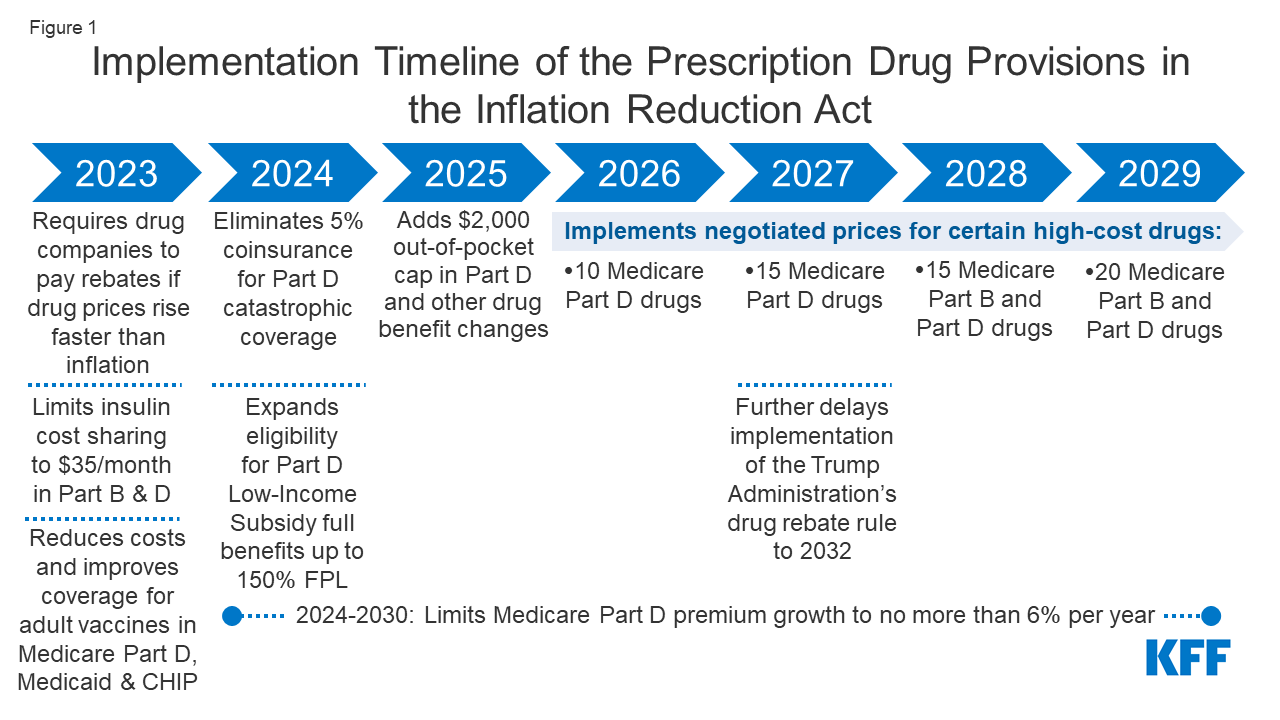
    Only now, 20 years later, are we beginning to see changes. The $2K out of pocket cap doesn't become effective until 2025.
    image
    https://www.kff.org/medicare/issue-brief/how-will-the-prescription-drug-provisions-in-the-inflation-reduction-act-affect-medicare-beneficiaries/
  • Barron's on Funds & Retirement, 11/18/23
    @msf. "...$545 legal maximum." I thought it was $2k/year, now.
    Are you talking about a single-purchase maximum copay for the criminally expensive drugs?
    Some that my Dr. prescribed come over, or close to $400/single purchase co-pay. So, what kind of extortion racket would you call that?
  • Barron's on Funds & Retirement, 11/18/23
    Traditional Medicare lets me sleep nights and I have to chase down no eligible doctors and hospitals.
    There are some (an admittedly small number) of providers who have opted out of Medicare entirely. In this sense, Medicare too has a network, it's just a very large network.
    https://data.cms.gov/tools/provider-opt-out-affidavits-look-up-tool
    Medicare PPOs cover all providers who have not opted out of Medicare. PPOs typically do not require referrals. The claim that MA restricts you to networks while Original Medicare does not is close to a canard. The only network that Medicare PPOs restrict you to is the Medicare network.
    IMHO the key differences between MA and Original Medicare are: MA plans require preapprovals for some procedures; and costs differ. MA plans come with built in (max out of pocket) caps and often fixed dollar co-pays (as opposed to Medicare's uncapped 20% coinsurance). Though it does cost more to go out of network than stay in network with a PPO.
    Medicare Supplemental plans that contain costs and cover coinsurance are not cheap. They often cost more than Medicare Part B itself. One doesn't need, and cannot buy, a Medicare Supplemental plan with a MA plan. However, a MA plan will tend to have higher out of pocket costs compared to Original Medicare plus Medigap.
    Cost differences between MA and Original Medicare could explain why MA participants tend to be poorer than Original Medicare participants.
    2024 MAPD plans in each Hawaii county (from Medicare.gov):
    Hawaii: 6 plans, 4 are PPOs
    Maui: 9 plans, 7 are PPOs
    Kauai: 11 plans, 10 are PPOs
    Honolulu: 17 plans, 13 are PPOs
    Kalawao: 2 plans, both are PPOs
    Sample plans (not saying these are especially good, just providing examples):
    Humana Choice PPO H5216-233-1, $0 premium, $0 drug deductible is available in Honolulu county.
    Humana Choice PPO H5216-233-2, $0 premium, $0 drug deductible is available in Maui and Kauai counties.
    HMSA Akamai Advantage Standard PPO H3832-007-0, $0 premium, $400 drug deductible is available in Hawaii, Kalawao, Kauai, and Maui counties.
    Most standalone Part D plans have substantial drug deductibles, often the $545 legal max.
  • QRA, quarterly refunding announcement
    $259K federal debt per US taxpayer. IMHO the debt issue discussion will be here for keeps. 20 year auction on 11/20 and 30 year auction on 12/12. I am watching to see if this slowly develops into a simple supply/demand issue disregarding other macro events. Most equities on US exchanges are priced in dollars.
  • Econ conditions & hard-landing inflation again in detail; was other stuff, insurance bundling ....
    Definitely need to look at the financial strength of the insurance company you go with....what is also whacked is that the insurance business is something like your cable company...the newer customers get the best deals (or so it seems?) You'd have to be naive that someone like me who has been with State Farm for over 46 years..you think they don't have algo's that know exactly how much they can raise me every year and I won't shop them/leave? They tell me I am grandfathered in with my type of coverage and wouldn't get the same policy if I started new with them today. Also as I own 3 homes in different states and 4 automobiles with a rather large umbrella policy, I do like that they have national representation/coverage. Always, always great service with State Farm.
    What I don't like is all the monies being spent on the sport ballers/commercials.
    What I do recommend, go to a high end body shop and ask the owner of what insurance company provides the best service, doesn't always push for offshore crap part replacement, pays right away etc, sometimes lowest price is not best value. The body shop in my major metro area that works on all the Ferrari's Porsche's etc..told me the best insurance companies were State Farm, Chubb and Amica. Chubb is for ballers/very high worth folks, not for the common folk...
    BTW, even more off topic...the guys who work there get to drive all the high end cars...best all time next level I am told is a 2005 Ford GT...blows everything else out of the water...
    My wife's ex boss who retired as a very high level executive for a Fortune 500 company always shopped for insurance every year and went with the top rated/lowest quotes every year...he prolly saved a bunch of money doing that...insurance companies must know that human nature has inertia built into it and take advantage.
    I do think I'm going to get a quote from Erie just out of curiousity...
    Best Regards,
    Baseball Fan
  • Econ conditions & hard-landing inflation again in detail; was other stuff, insurance bundling ....
    @Crash - Who you gonna believe? Your own eyes … or a report by the NHSTA? :)
    Gotcha. Some federal agency had way too much money to burn. Next, they can compute the risk of me walking outside of the painted bars in the crosswalk. JAYZUZ.
    The 2011 study by the National Highway Safety Transportation Authority was follow up to an earlier 2009 study which reached similar conclusions.
    From page 19 of study:
    ”Overall, the odds ratios indicate that the odds of an HE vehicle being in either a pedestrian or bicycle crash are greater than the odds of an ICE vehicle being in a similar crash. The odds ratio for an HE versus an ICE vehicle involved in a pedestrian crash was 1.35, and the odds ratio for an HE versus an ICE vehicle involved in a bicycle crash was 1.57.”
    (HE - Hybrid & Electric motor vehicles / ICE - Internal combustion vehicles)
    The Study: https://crashstats.nhtsa.dot.gov/Api/Public/ViewPublication/811526
  • The week that was, global etf's, various categories + heat map. Week ending May 17, 2024.
    The graphic is set for the 5 days ending November 17, Friday; for the best to worst % returns in select etf categories. SpaceX uses the term 'unscheduled disassembly' when a destructive event occurs during any stage of a pre-orbit launch. With about 6 weeks of equity/bond markets trading remaining for the year, our house is hoping there will not be any Unscheduled Portfolio Disassembly. Fingers crossed for no UPD, as numerous investment areas will have decent year ending performance.
    Remain curious,
    Catch
  • Econ conditions & hard-landing inflation again in detail; was other stuff, insurance bundling ....
    @Crash - Who you gonna believe? Your own eyes … or a report by the NHSTA? :)
    The 2011 study by the National Highway Safety Transportation Authority was follow up to an earlier 2009 study which reached similar conclusions.
    From page 19 of study:
    ”Overall, the odds ratios indicate that the odds of an HE vehicle being in either a pedestrian or bicycle crash are greater than the odds of an ICE vehicle being in a similar crash. The odds ratio for an HE versus an ICE vehicle involved in a pedestrian crash was 1.35, and the odds ratio for an HE versus an ICE vehicle involved in a bicycle crash was 1.57.”
    (HE - Hybrid & Electric motor vehicles / ICE - Internal combustion vehicles)
    The Study: https://crashstats.nhtsa.dot.gov/Api/Public/ViewPublication/811526