
Howdy, Stranger!

It looks like you're new here. If you want to get involved, click one of these buttons!

Here's a statement of the obvious: The opinions expressed here are those of the participants, not those of the Mutual Fund Observer. We cannot vouch for the accuracy or appropriateness of any of it, though we do encourage civility and good humor.
  • What is happening in healthcare?
    Have they determined that the health benefit outweighs any long-term problems? I remember the hype about amphetamines in the 50s.
    From the same NYTimes piece:
    The Institute for Clinical and Economic Review, an influential nonprofit group, asked about a year ago if the new weight-loss drugs are cost-effective, meaning that their value in terms of a better quality of life, a longer life and benefit to society exceeds their cost.
    Wegovy [approved for weight loss], the group reported, was not cost-effective. But the institute relied on an early and less precise estimate of the drug’s net price.
    When shown Wegovy’s estimated net price in the A.E.I. research, the group’s chief medical officer, Dr. David M. Rind, said that if the calculations were correct, Wegovy was cost-effective but “still poses major budget challenges.”
  • What is happening in healthcare?
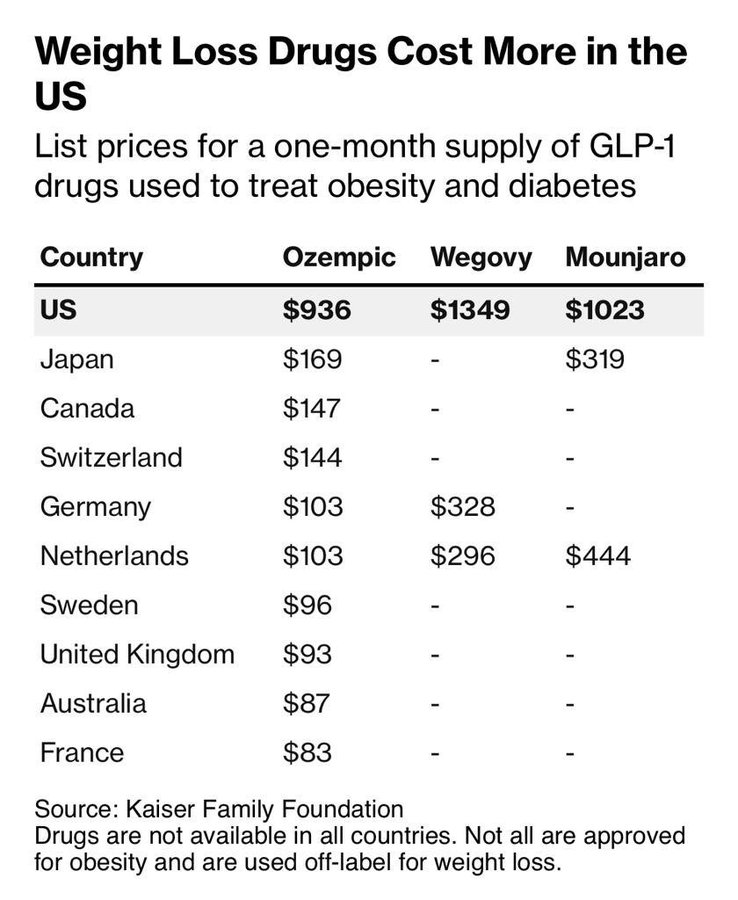
    New diabetes/obesity drug prices per month (image below should open), https://twitter.com/Jason/status/1692641465363493146
    Only injectables, no oral tabs yet.
    Most insurance cover them only for diabetes, not obesity.
    image
    The key word in the graphic is list, as in list prices. The NYTimes gives a nice summary of an AEI study on what these drugs actually cost, net. That AEI study also notes that Rybelsus - with the same active ingredient (semaglutide) and same manufacturer (Novo Nordisk) as Ozempic and Wegovy - is delivered in tablet form.
    https://www.nytimes.com/2023/10/22/health/ozempic-wegovy-price-cost.html
    https://www.novomedlink.com/semaglutide.html
    https://www.aei.org/wp-content/uploads/2023/09/Estimating-the-Cost-of-New-Treatments-for-Diabetes-and-Obesity.pdf
    Current discounts from list price (from NYTimes reporting on AEI report):
    Net prices, the revenue divided by the number of prescriptions in their analysis, appear to be around $700 every four weeks for Wegovy, or about $650 less than the list price; about $300 for Ozempic, or nearly $650 less than the list price; and approximately $215 for Mounjaro, or about $800 less than its list price.
    The NYTimes quotes "Jalpa Doshi, professor of medicine and director of the economics evaluation unit at the University of Pennsylvania" as speculating that prices will drop as competition increases. I'm not so sure. These will all be patented drugs (high barrier to entry) with a limited number of players, suggesting de facto (implicit collusion) oligopoly pricing.
    OTOH, evidence that competition has at least some impact (again from the NYTimes):
    Wegovy, the same drug as Ozempic, is approved for weight loss. [Ozempic is not, though it also causes weight loss.] But the price of Ozempic is substantially lower than Wegovy’s price.
    The reason may be that Ozempic has a direct competitor in Mounjaro.
    ... and ...
    An effective cure for [hepatitis C] initially cost as much as $84,000, leading to dire warnings that the cost would be comparable to “total spending in the United States on all drugs.”
    The list price of the hepatitis C treatment plunged, as competitors entered the market. Pharmacy benefit managers, which negotiate with drug makers, had more leverage as companies competed. Net prices fell accordingly.
    Actual prices paid and insurance coverage are all over the map. As the NYTimes notes, "Those on Medicare, for instance, have no insurance coverage for Wegovy because Medicare is prevented by law from covering weight-loss drugs."
    Other insurance may cover the drugs but with high co-pays and deductibles that keep them out of reach of many patients.
  • What is happening in healthcare?
    Hell, ozempic even made Barron’s this week - not necessarily in a good way:
    Ozempic, a GLP-1 receptor agonist, is a weekly injection aimed at reducing people’s appetite for addictive foods, helping them lose weight. It’s been a problem for many stocks. But GLP-1 drugs were originally designed to treat diabetes, and the market fears they will do such a good job of combating the kind of overeating that causes diabetes that people won’t need to buy DexCom’s (DXCM) continuous glucose monitoring devices, or CGMs, anymore. DexCom stock has dropped 43% during the past three months as a result.
    The “Hits” just keep on rolling!
  • What is happening in healthcare?
    New diabetes/obesity drug prices per month (image below should open), https://twitter.com/Jason/status/1692641465363493146
    Only injectables, no oral tabs yet.
    Most insurance cover them only for diabetes, not obesity.
    image
    Well, someone has to pay for all the advertising ....
  • What is happening in healthcare?
    Here’s another potential lead to “What happening in health care?”
    Title: ”Moderna shaves off $7 billion in value after Pfizer warning”
    https://gulfnews.com/business/markets/moderna-shaves-off-7-billion-in-value-after-pfizer-warning-1.98912855
    Above article relates to shrinking demand for Covid vaccines.
    I am not an 'active' investor. I tend to set it and forget it …”
    Sounds right to me. Can’t react to every bit of news. Markets run to extremes. I’ve recently picked up a few additional shares of the food conglomerate I mentioned earlier at lower prices.
  • What is happening in healthcare?
    New diabetes/obesity drug prices per month (image below should open), https://twitter.com/Jason/status/1692641465363493146
    Only injectables, no oral tabs yet.
    Most insurance cover them only for diabetes, not obesity.
    image
  • Brokerage firm won't allow me to add to my TRAIX (Institutional class of PRWCX)
    @Jim0445,
    Same here, I was able to access closed funds doing rollover directly to TRP, they were very friendly, and it was easy to do as I already had accounts with them. 6 months later my 401k brokerage opened up an entire slew of closed finds. Alight did not require liquidation as I am still on that plan with current employer.
  • M* JR on Rolling Returns
    Re StockCharts Rolling Returns with ROC(n), the free version has a limit of n = 600. So, in Daily display, that is 2.31 yrs max and in Weekly display, 11.53 yrs max.
    So, one should switch to Weekly display and use n = 156 for 3 yrs, 260 for 5 yrs, 520 for 10 yrs.
  • What is happening in healthcare?
    In mid-2010, there was a great rally in biotechs but then there were huge numbers of biotech IPOs. That basically was a big negative as many hyped and unprofitable IPOs flamed out.
    It is notable that NVO is so crazy now that it has market-cap larger than its home country - Denmark. Moreover, it has the largest market-cap in Europe. Imagine if something like that happened to the US LLY.
  • Leuthold: the lights have all turned red, time to lighten up on stocks
    @racqueteer
    To be clearer, and to support my statement, FPACX has done better 3y, 1y, and ytd.
    Cumulative. I do not look at, care about, or judge by single years.
    That's all. Don't own any of them currently, but wish I had for the last decade.
    >> ... can’t see a good reason to prefer it over the other two.
    Again, as I said, whether UI matters. (Also the matter of availability.)
    I don't want to come off as being argumentative generally, but I think this is an important point...
    The 3y and 1 yr figures are heavily influenced by the ytd figures. In a sense, you're counting them over and over this way. As a result, recent returns skew those two values. That's why I prefer to look at rolling or annual results for decision-making, but not "single years". I think it potentially gives one much more insight into performance. That FBALX and PRWCX have dominated during an 11-year period makes me prefer them long-term. That FPACX is performing well in the last couple of years makes it interesting as a current choice. That it is available, whereas PRWCX is not, is certainly a point in its favor.
    Now, at the risk of appearing ignorant, and because I've been unable to come up with an answer independently, what is "UI" again?
  • What is happening in healthcare?
    I’ve never dealt with the sector. On a broader note, the near obsession with weight reducing drug ozempic is having far reaching effects on businesses, including the health care industry. To be sure, the medication is intended for specific medical conditions (like diabetes), but its success at lowering appetite / weight is receiving a lot of attention. It’s quite expensive and insurers have balked at covering it. But that is expected to change as health benefits become clearer. (There are other similar / competing drugs.)
    An excerpt from the linked article shows how a medication that’s healthy for consumers might turn out to be unhealthy for certain health care providers.
    “The news from Novo Nordisk wasn't as well received by shareholders of dialysis treatment companies. Shares of DaVita dropped 17% in premarket trading, while Fresenius Medical Care's stock was down 16% before the market opened Wednesday morning … Dialysis stocks have already been under pressure from advances related to Ozempic and similar drugs. To the extent that treatments are effective in halting the progression of kidney diseases and avoiding renal failure, fewer patients might need to get regular dialysis treatment. DaVita and Fresenius are among the top providers of dialysis services, so it's understandable that they're taking sizable hits on the news.
    https://www.fool.com/investing/2023/10/11/ozempic-is-moving-a-bunch-of-stocks-wednesday-morn/
    It goes way beyond the example cited. I’m riding a large food conglomerate I think is a good long term play. But like other food providers, it’s been taken to the woodshed lately based at least in part on the ozempic hysteria. (Walmart has documented that people picking up the drug at their pharmacies are buying less food / with fewer calories.)
    Other potential effects as the global population slims down:
    - Airlines should profit as passenger’s average weights fall leading to fuel savings
    - Hospitalization and care for cardiovascular health issues should see a sharp decrease, affecting health care providers. The drug(s) have been shown to lower the incidence of such diseases.
    - Health insurance companies should benefit from fewer serious medical claims. On the other hand, they may be saddled in paying for these expensive drugs.
    - Agriculture could suffer and, correspondingly, agricultural land prices might fall..
    - John Deere? I just checked. It’s off 11.5% YTD. Wouldn’t ya know? :)
    It gets really silly. The real impact remains to be seen.
    Here’s some related articles. Unfortunately, not all are accessible without subscription.
    https://www.nytimes.com/2023/09/02/business/dealbook/weight-loss-drugs-diet-companies-ozempic.html?smid=nytcore-ios-share&referringSource=articleShare
    https://www.reuters.com/business/healthcare-pharmaceuticals/corporate-america-weighs-risks-ozempic-effect-2023-10-19/
    https://www.washingtonpost.com/business/2023/10/09/ozempic-weight-loss-drugs-impact/
    https://www.msn.com/en-us/money/companies/it-s-overblown-beer-stocks-take-plunge-after-major-corporation-warns-ozempic-weight-loss-drugs-could-affect-sales/ar-AA1i095V
  • What is happening in healthcare?
    @randynevin: You raise an important issue. I had been a long-time investor in healthcare stocks and CEFs. I have but one token MF holding now. As you rightly point out, the top of the market was in 2015 and this was particularly true for biotech which, I believe, was fueling much of the performance. Just yesterday I read that PrimeCap funds’ performance has suffered in recent years because of their continued over allocation to healthcare. It may be that big pharmaceutical stocks have suffered of late, say since the 2020 election, because there are serious efforts to force the manufacturers to negotiate drug prices with MediCare. Investors don’t like uncertainty, as the saying goes. Certainly there was speculative money to be made on COVID vaccine makers, but that did not represent a bump in the entire sector.
  • M* JR on Rolling Returns
    The average business cycle is about 4 years; not strangely, the US Presidential cycle is also similar. So, I like to look at 3- or 5- year rolling returns, where available.
    Portfolio Visualizer has a Rolling Return tab that has built-in 3- and 5- year Rolling Returns. It isn't customizable.
    StockCharts can be fooled into providing Rolling Returns using the ROC (n) feature. It gives %change over n periods, so, in Daily charts, use 780 days for 3-yr and 1,300 for 5-yr.
  • What is happening in healthcare?
    First, apologies as I am not an 'active' investor. I tend to set it and forget it, so I'm usually late to the party.
    I have been noticing over the last few years that investing in healthcare (for example PRHSX T Rowe Price Health Sciences, which we are in) has really sucked (relative to the market as a whole). From 2000 to mid-2015 it consistently outperformed the s&p500. That all turned around in mid-2015 and it has been underperforming ever since. I've been patiently waiting for the worm to turn. (Did some seismic event happen in mid-2015 to damage this whole sector?)
    Lately I've noticed FSMEX Fidelity Select Med Tech & Devices, a real world-beater from 2000 to late-2021 has gotten hit. Flat in 2022 relative to the market, and in a real nosedive in 2023.
    What is going on in this sector, and is it something that will eventually reverse?
    Thanks for your thoughts on this.
  • M* JR on Rolling Returns
    The 20 year period data is more meaningful since it over several economic cycles. One can see the ups and downs and the overall effect on the asset class returns.
    Shorter time frame of 1, 3 and 5 year returns tend to be less reliable in my honest opinion. Several variables were not discussed including asset class correlation, interest rates, currencies, sub-categories within an asset class, plus other macro factors.
    Bonds are a good example in this year. There are those that done well while others lag the broader total bond index. US stock is another example of how to reconcile the “magnificent seven” tech stock’s contribution to S&P 500 while the 493 stocks in the index are essentially flat.
  • Fund Stories from Barron's (Paper & Online), 10/21/23
    BULLISH. Asset/money managers (AB, AMG, BEN, BLK, FHI, IVZ, TROW; dividend yield 0.0-8.9%; fwd P/E 7.2-17.3; market-cap 3.0-94.4 billion; should benefit from rising investor interest in bonds)
    FUNDS – INCOME. GOLD is rising due to inflation and geopolitical tensions. Gold-bullion ETFs are GLD, IAU, etc. Gold-mining ETFs are GDX, GDXJ, etc. Some gold-miners pay variable dividends. Attractive are NEM, FNV, etc. (Ratio GDX:GLD or $XAU:$GOLD has lot of catching up to do – i.e., the gold-bullion has moved but the gold-miners not so much yet.)
    FUNDS. Stock picks by AI have been disappointing as seen by lagging performance of AI-powered ETFs AIEQ, KOMP, WIZ. A problem is that the AI selections are based on lots of historical data and overweighted industrials and financial but underweights techs: Their proponents say that beating the market isn’t their objective, and that they should be used as supplements for other holdings (remember that when you see their ads next time).
    FUNDS – Q&A. David SAMRA, international value ARTKX. He looks for undervalued stocks with strong balance sheets and good management; the expected return is 30%+ (time?). In some cases, his fund/firm becomes a minority shareholder – important in Europe to effect changes. Consumer-oriented companies are attractive now due to high inflation and rates. He also looks for indirect beneficiaries of AI.
    EXTRA, FUNDS. With long-term rates rising (bond vigilantes are back), bonds and bond-proxies have slumped. Consider these DIVIDEND-ETFs: Dividend-growth VIG, current-dividend VYM, dividend-blend SCHD, international VIGI. M* recently upgraded some ratings on them and calls them “best in class”.
    EXTRA, FUNDs (some duplication). After the SEC setbacks in the courts, and the SEC decision not to appeal the most recent adverse court ruling in SEC vs GBTC/Grayscale, there is hope in the market for the approval of physical/spot-crypto ETFs within months (pending are from BLK, Fidelity, IVZ, ARK, Grayscale, etc). The most immediate beneficiary may be Grayscale GBTC (at double-digit % discount now) if its conversion to ETF is also approved. But the court has only asked the SEC to reconsider and to come up with new reasons for rejection (as its old reasons weren’t valid) or approve it; GENSLER/SEC may continue to foot drag by claiming a new 240-day review period for GBTC to take into account the changed situation, but that is seen as unlikely.
    https://ybbpersonalfinance.proboards.com/thread/516/barron-october-2023-market-week
  • Knowledge Leaders Developed World ETF is being reorganized
    https://www.sec.gov/Archives/edgar/data/1318342/000139834423019521/fp0085690-2_497.htm
    97 1 fp0085690-2_497.htm
    Knowledge Leaders Developed World ETF
    Ticker: KLDW
    A series of Investment Managers Series Trust (the "Trust")
    Supplement dated October 20, 2023, to the Prospectus and
    Statement of Additional Information ("SAI"), each dated September 1, 2023
    *** IMPORTANT NOTICE REGARDING PROPOSED FUND REORGANIZATIONS ***
    Based on the recommendation of Knowledge Leaders Capital, LLC (the “Advisor”), the investment advisor of the Knowledge Leaders Developed World ETF (the “Fund”), the Board of Trustees of the Trust (the “Board”) has approved the reorganization of the Fund into the AXS Knowledge Leaders ETF (the “Acquiring Fund”), a newly created series of Investment Managers Series Trust II (the “Reorganization”). The Reorganization will occur pursuant to an Agreement and Plan of Reorganization (the “Plan”). The Plan provides for the Fund to transfer all of its assets to the Acquiring Fund in return for shares of the Acquiring Fund and cash in lieu of fractional Acquiring Fund shares (if any) and the Acquiring Fund’s assumption of the Fund’s liabilities. Each shareholder of the Fund will receive shares of the Acquiring Fund and cash in lieu of fractional Acquiring Fund shares (if any) equal to the value of the shares of the Fund owned by the shareholder prior to the Reorganization. The Reorganization is not generally expected to result in the recognition of gain or loss by the Fund or its shareholders for U.S. federal income tax purposes (except with respect to cash received by shareholders in lieu of fractional shares, if any). AXS Investments LLC will bear the costs related to the Reorganization.
    The Acquiring Fund has an identical investment objective, investment strategy and fundamental investment restrictions as the Fund. If the Reorganization is completed, AXS Investments LLC (“AXS”) will become the investment advisor to the Acquiring Fund. The Fund’s current portfolio manager, Steven Vannelli, CFA, will become an employee of AXS and will continue to serve as a portfolio manager of the Acquiring Fund. The Advisor will not be involved in the management of the Acquiring Fund.
    The Board will call a meeting of the shareholders of the Fund to vote on the Plan. Management of the Trust expects the shareholder meeting to be held on or about December 20, 2023, at the offices of Mutual Fund Administration, LLC, 2220 E. Route 66, Suite 226, Glendora, California 91740. If the Reorganization is approved by Fund shareholders, the Reorganization is expected to take effect in the fourth quarter of 2023.
    Shareholders of the Fund will receive a combined prospectus/proxy statement with additional information about the shareholder meeting, the proposed Reorganization, and the Acquiring Fund, including information about the Acquiring Fund's investment strategies, risks, fees and expenses. Please read the proxy materials carefully, as they will contain a more detailed description of the proposed Reorganization.
    Please file this Supplement with your records.