
Howdy, Stranger!

It looks like you're new here. If you want to get involved, click one of these buttons!

Here's a statement of the obvious: The opinions expressed here are those of the participants, not those of the Mutual Fund Observer. We cannot vouch for the accuracy or appropriateness of any of it, though we do encourage civility and good humor.
  • Q: what does it actually MEAN when I see a neg. P/E?
    On Averages
    Averages are often misused in the financial industry. Almost everything is averaged arithmetically (i.e. simple average) when other averages such as geometric averages (for TR, etc), harmonic ratios (for P/E, P/B ratios, etc) may be more appropriate; in some cases, no averaging method is applicable but simple averages are used anyway (SD, Sharpe Ratio, etc).
    BTW, the M* document @msf linked also says (my bolds),
    "Morningstar generates this figure in-house, based on the most-recent portfolio holdings submitted by the fund and stock statistics gleaned from our internal U.S. equities databases. (Our U.S. equities department receives prices from ComStock, a division of Interactive Data Corporation. , and gathers earnings information from a company's most-recent annual and quarterly income statements.) Negative P/Es are not used, and any PE greater than 60 is capped at 60 in the calculation of the average." https://awgmain.morningstar.com/webhelp/glossary_definitions/mutual_fund/mfglossary_Price_Earnings_Ratio.html
    I think that Stock Rover (SR) also uses harmonic averages for ratios (P/E, P/B, etc), but then goes ahead and uses simple average for SDs - I cannot find a link now. SR was also making some other errors in handling cash, m-mkt funds, yearend CG distributions, and after several back-and-forth communications to get to the right person/team, SR fixed them. https://ybbpersonalfinance.proboards.com/thread/318/stock-rover-sr
    As for contacting organizations for errors or data, the worst are Yahoo Finance and Vanguard - either they don't respond, or they don't care and send form letter responses. The best in this respect are Fidelity, Portfolio Visualizer (PV), StockCharts, StockRover (SR).
  • Q: what does it actually MEAN when I see a neg. P/E?
    Despite its faults, I'm so familiar with the layout at M* that I still use it consistently----- though not by itself to make any final decisions about whether to buy or sell anything. So, I've become accustomed to their use of the "weighted harmonic" beast. Surely, they are not the only ones doing it. I see stocks listed in the neighborhood of 13-14, and more richly valued ones at 23 or so. That's "the page I'm on" with it.
    And my ENTIRE portfolio, which I maintain at M*, tells me the whole thing holds a P/E of 14.14. And it tells me it's a 25% lower value than the average for the full SP500. THANK you all for answering my question.
  • Q: what does it actually MEAN when I see a neg. P/E?
    Aside from various ways of handling outliers as Yogi described, there are a couple of different ways of calculating the average P/E. One is by taking a simple (weighted) arithmetic average of the P/Es. Another way, IMHO more meaningful, is to take the (weighted) harmonic average of the P/Es.
    Effective November 30, 2005, we [Morningstar] will ... use a harmonic weighted average, rather than an arithmetic weighted average. The harmonic method prevents outliers from skewing the result...
    https://awgmain.morningstar.com/webhelp/glossary_definitions/mutual_fund/mfglossary_Price_Earnings_Ratio.html
    Computing the harmonic weighted average is equivalent to adding up all the earnings of each holding weighted by the size of the holding (E), then dividing it into the total value of the portfolio (P) to get P/E.
    For example, suppose a fund holds shares of two companies: $10 of company A with a P/E of 20, and $15 of company B with a P/E of 15. Company A gets weighted 0.4, company B gets weighted 0.6.
    The total earnings from the first holding are $10 x earnings/dollar = $10 x1/20 = $0.50
    Total earnings from the second holding are: $15 x 1/15 = $1.
    Total earnings of portfolio = $1.50
    Total value of portfolio = $25
    P/E = $25/$1.50 = 16.67
    Weighted harmonic average = 1 / (0.4 x 1/20 + 0.6 x 1/15) = 1 / (.02 + .04) = 1/.06 = 16.67
    OTOH, weighted simple average = 0.4 x 20 + 0.6 x 15 = 8 + 9 = 17.
    Yahoo Finance is clueless. It reports VFIAX's P/E as 0.05, while reporting the P/E of a different share class VOO of the same fund as 22.19.
  • Record Outflows from TIPS ETFs
    Hold individual TIPS to maturity to keep up with inflation. Try 5-yr TIPS.
    [snip]
    I recently purchased individual TIPS for the first time.
    Bought a sizable amount (for me) of the 5-year TIPS at the latest auction.
    Plan to hold these TIPS (1.832% real yield) to maturity for inflation protection.
  • What drives markets? Fund Flows? Market structure has changed
    That’s a dour viewpoint @Baseball_Fan. A favorite old expression of mine begins, “Well, I don’t know … that may be so ….”
    The trouble is that the markets, by and large, have kept moving higher during most of my 75+ year lifetime. Optimists have done much better than pessimists over that time. Sure, there have been setbacks along the way. 2007-09 was miserable. And had you been 100% invested in Japan in the 90s you’d probably be poorer today. (Most of us weren’t 100% invested in Japan.)
    There’s just too many unknowns to predict how various markets will perform year to year or decades out. So the target-date (structured / programmed inflows) are a part of the picture. But they’re not the entire story. I’ve always felt that given enough time all paper curriencies depreciate in value. Makes me want to invest in good businesses, real estate, metals, infrastructure - just about anything other than paper.
    Allocation to large-cap / S&P stocks should be / would be expected to be higher if investors’ time horizons are longer. Heck, with a 50 year time horizon that type concentration may be desirable. As retirement draws nearer the target date funds I’m familiar with reign in that risk. Checked TRP’s 2025 retirement fund (TRRHX) and find it just a tad over 30% invested in U.S. large cap stocks. Last time I looked at the average 401K / retirement fund balances for U.S. workers, those averages were pathetically low. We are to believe these same savers have propelled U.S. equity markets into the stratosphere?
    What drives equity markets over the shorter run - day to day, month to month? In other words, what causes some stocks to move up or down unpredictably? Don’t know. Not strictly fundamentals because they rarely change so rapidly. I’d guess computer driven programmed buying and selling is one actor. Also, hedge fund managers trying to get a leg up on the next one (or a leg down if selling something short). Also reaction to bits and pieces of macro news as they emerge. (This week it may be the FOMC minutes which get published.) The sheer size of some funds like PRWCX (and now its cousin TCAF) may be partially responsible. Even very small (as a % of holdings) buys / sells of their enormous holdings may be large enough to send vibrations through equity markets for weeks on end as, it’s likely they try to stagger these buy / sell orders over time to try and minimize the impact. And what do you think happens when Buffet sells off a holding or adds a new one?
  • Record Outflows from TIPS ETFs
    TIPS should perform well during periods where inflation is higher than expected.
    Breakeven rates can be used to compare TIPS to nominal Treasuries of the same term.
    There was a 5-year TIPS auction on 06/22/2023.
    From David Enna on Tipswatch.com:
    "At the auction’s close at 1 p.m. EDT, a 5-year Treasury note was trading with a nominal yield of 4.03%,
    creating an inflation breakeven rate of 2.2% for this TIPS.
    That is the lowest auctioned breakeven rate for this term since an auction in December 2020.
    Although 2.2% is a relatively 'highish' breakeven rate by historical standards,
    it seems quite reasonable at a time when U.S. inflation is running at 4.0%.
    In indicates that this TIPS is cheaply priced versus the nominal Treasury of the same term."

  • Twitter is Now Also "Closed"
    @yogibearbull,
    I signed into twitter and was able to see all your posts, which is what I needed (just read). Then I made the mistake of clicking on the "Follow" button and your posts are no longer visible. Same problem with all 15 posters I tried to Follow. I get this message, "Something went wrong. Try reloading." Tried and did not work. Is Twitter down?
  • January MFO Ratings Posted
    @Sven.
    @yogibearbull.
    @Junkster.
    Finally had chance to review the "longest bear market since the 1940s" statement in NYT and Barron's. Had several of us questioning.
    I believe this declaration works if what's being measured is the time between the minimum level of bear market (trough ... greatest drawdown from previous peak) to time it takes to grow 20% from that minimum.
    Using month ending (not daily) returns, it took 9 months ... from October 2022 to June 2023 to accomplish. With the Tech Bubble, it took slightly less at 8 months. With Post WWII cycle in 1940's, it took 23 months.
    So, interesting, but not really indicative of pain we all feel during a bear market. For example, in 1930's it only took 2 months for S&P to gain 20% over its abyss of -83% in May 1932 ... but the bear market, measured from last peak to tough took 33 months ... and then another 151 months or 12.5 years to get back above water.
    Certainly not how we measure length of bear market, which is time from previous peak to trough.
    Perhaps a better definition would be time enters bear territory (down 20% from previous peak) to time in climbs 20% above trough.
    In any case, the bull and bear cycle declarations are only known in retrospect, ex post.
    I also think they become more credible historical markers if each cycle results in a new all-time high. We need another June-like gain for that to happen with the current cycle ... The Great Normalization.
    Fingers-crossed!
    Plan to include updated cycles' table in David's July Commentary.
  • Q: what does it actually MEAN when I see a neg. P/E?
    When a company has loss, P/E is negative.
    If earnings are near 0, P/E can be very large.
    For funds, the P/E calculation differs by data source. Some treat negative P/E as 0 and also cap high P/Es. Others may use P/E as they are.
    For BRUFX P/E,
    Yahoo Finance 0.06.
    M* 13.86
  • The Next Crisis Will Start With Empty Office Buildings
    @operation_twist The headline is "The Next Crisis Will...," not "The Current Crisis Is..."
    +1.
  • What drives markets? Fund Flows? Market structure has changed
    Listenening to Michael Green on a recent podcast...he makes an argument that what has been driving the markets is a change in market structure. Meaning fund flows. employment. Weekly contribs to 401k goes into SPY etc thru Vanguard, BlackRock, Fidelity...target date funds, share buy backs. Fundamentals don't matter anymore. Inclusion into SPY does. Most (many?) target dates go something like 80/20 into US/Intl stonks, thus driving SPY higher. Only trouble is what happens when a lagging indicator like emploment (BLS bullshit stats?) go the other way? That's why he like call options. Hmmm.
  • Record Outflows from TIPS ETFs
    There were substantial TIPS ETF inflows from May 2020 through December 2021.
    Like many other bond funds, moderate and high duration TIPS ETFs experienced large declines in 2022.
    For example, 2022 returns for TIP, SCHP, and LTPZ were -12.24%, -12.02%, and -31.68% respectively.
    It's not surprising that investors were disappointed with TIPS performance last year when inflation was high.
    "Nearly $17 billion has exited from Treasury-inflation securities ETFs over 10 consecutive months of outflows, an unprecedented streak in data going back to 2016, Bloomberg Intelligence data show."
    "That rush to the exits follows a bruising stretch of underperformance for the asset designed to protect against inflation. While TIPS weather against price erosion, real yields — which strip out the impact of inflation — have soared over the past year, shredding returns even as price pressures remain stubbornly high. That’s soured the appetite of investors who piled into TIP and similar ETFs to curb inflation."
    "The distaste for TIPS-tracking ETFs contrasts with reignited demand for the securities in the primary market. Investors snatched up about 96% of the $19 billion in Treasury Inflation Protected Securities auctioned last week, leaving less than 4% to firms authorized as primary dealers."
    Link
    (Bloomberg subscription may be required)
  • Larry Summers and the Crisis of Economic Orthodoxy
    see if you can read this thread
    https://twitter.com/paulkrugman/status/1675075725122994176
    ... the misery index — unemployment plus inflation — is all the way back to where it was when Biden took office ....
  • Matt Levine / Money Stuff: Stress tests
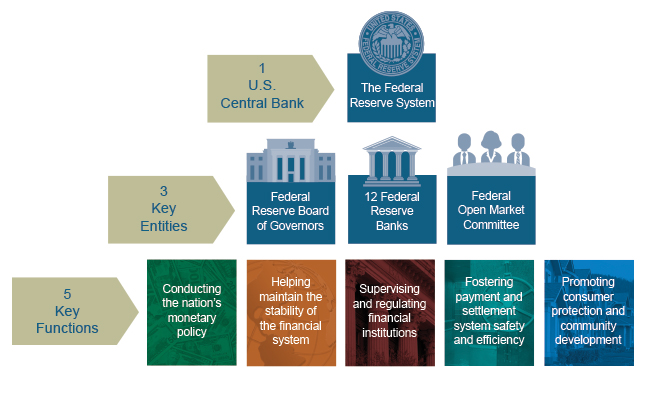
    Federal Reserve is the US central bank responsible for monetary printing policy. It is also a bank regulator.
    Just imagine how many people are needed to serve hot coffee at the FOMC meetings? Running the ACH electronic payment system alone may require a few hundred. https://www.federalreserve.gov/aboutthefed/structure-federal-reserve-system.htm
    Org Chart
    image
  • The Next Crisis Will Start With Empty Office Buildings
    Barron's this week has a positive Cover story and a positive Q&A on real estate. Suggestion is to start bottom fishing cautiously. Sure, there are concerns and lots of bad news, but when everything is hunky-dory, prices would have moved up already.
    +1. Could not agree more. As Barron’s pointed out, ex office buildings the commercial real estate market is in good shape. One of the few open end bond plays in CRE is RCRIX which I have previously mentioned. It is on track for a double digit year up 5.49% YTD. It holds nothing in office buildings. The manager makes a compelling case for double digit returns both this year and next. I have a few issues with this fund however.
    Another bond fund which I am intimately acquainted with has 13% in commercial real estate and it is up around 7% YTD. It has been a sneaky good year for some areas in Bondland. Many still seem to be underinvested in bonds. Either scarred by last year’s bond bear market or fearful of continuing tightening by the Fed. The 5% yield of many money market funds is another reason investors have no urge to venture into the riskier areas of Bondland.
  • Oakmark Bond Fund OAKCX
    Some have mentioned Dodge and Cox. I’m a fan, having owned both DODLX and DODIX in the past. Both carry moderate fees (.41% & .45% respectively). However, neither is without risk if short term volatility bothers you. DODLX has had two years since inception a decade ago where it lost more than 6%. And DODIX lost nearly 11% last year. That was a one-time exception to an otherwise stellar record. However, that longer term record was due in part to the decades long bond bull market. Most bond funds enjoyed a strong tail-wind during those years. There’s no assurance it will do as well in a period of rising rates.
    So much about bonds / bond funds relates to the macro winds. Get some heavy inflation and sharply rising rates over a multi-year span and they’ll stagnate or tank. To the contrary, in the event of a deep recession - or depression - they should excel as interest rates plummet. (“Ya pays your money and ya takes your chances.”)
    Yogi’s above mention of Oppenheimer funds is a good reminder of what can happen to a “high returning” bond fund (reaching for yield) when managers over-reach and make bad macro calls as well. That’s why simply comparing performance for 1, 3, 5 years isn’t enough. How did they achieve those numbers? What risks were undertaken?
  • Oakmark Bond Fund OAKCX
    @Crash said Can't find apples to apples anywhere. Crud
    That’s because bond funds are nearly impossible to compare. Too many moving parts: Credit quality, average duration, average maturity, countries & regions included, dollar hedged or non-hedged (if outside the U.S.) Throw into that sauce the manger’s philosophy, his / her appetite for risk, prior experience and their overall view of the domestic or global macro picture. One big attribute you do have control over is the ER. That’s a bigger factor with fixed income funds than with stock funds generally because the expected return is lower and that ER takes a bigger bite out of the expected return. That .74% doesn’t look cheap on the surface, but I don’t know enough about how the fund invests to say it’s out of line. hedging / short selling / use of leverage / investing in lower quality bonds all cost more (if it so engages). International investing, if included, also increases cost.
    Look for a website that shows things like average duration and the dispersion among credit qualities ranging from AAA (government backed) all the way down to C (in default). Tells you a lot about the risk (and is one good way to compare different funds). I think M* will display that if you click the “holdings” tab. And I’m pretty sure Fido’s website will as well.
    Past performance? Was that during the 30+ year bond bull market dating back to Paul Volker? Or are we talking about the bear market of the past 2 years when when rates stabilized and than spiked sharply? Or maybe we’re looking at some “combo” performance figure including portions of both the bull and bear markets … :)
    -
    @Crash said, And HARRIS is involved, somehow. Sub-advisors?”
    Harris Associates, Chicago, operates the Oakmark Funds. I believe Harris was independent at one time. For many years now it has been owned by the giant NATIXIS of France. Nothing wrong with Natixis. Well regarded, but a bit pricey. Many of their funds are front-loaded. I’ve owned some funds under the Natixis umbrella over the years - most recently GATEX, which I sold more than a year ago.
    ”Harris Associates L.P. is a Chicago-based investment company that manages $86 billion[1] in assets as of September 30, 2022. Harris manages long-only U.S. equity, international equity, and global equity strategies which are offered through its mutual fund company, the Oakmark Funds, and other types of vehicles. Harris is wholly owned by Natixis Investment Managers, an American-French financial services firm that is principally owned by BPCE. Harris Associates retains full control of investment decisions, investment philosophy, and day-to-day operations.”
    Wikipedia: https://en.wikipedia.org/wiki/Harris_Associates
  • Stable-Value (SV) Rates, 7/1/23
    Stable-Value (SV) Rates, 7/1/23
    TIAA Traditional Annuity (Accumulation) Rates
    +25 bps changes in all except New IRA.
    Restricted RC 6.75%, RA 6.50%
    Flexible RCP 6.00%, SRA 5.75%, Newer IRAs 5.20%
    TSP G Fund hasn't updated yet (previous monthly rate was 3.875%).
    Options outside of workplace retirement plans include m-mkt funds, bank m-mkt accounts (FDIC insured), T-Bills, short-term brokered CDs.
    #401k #403b #StableValue #TIAA #TSP
    https://ybbpersonalfinance.proboards.com/post/1091/thread
  • Twitter is Now Also "Closed"
    "The list of "closed"/member-only sites is long and growing."
    So, that forces one to sign up with each site, even if one wants to just read. Most sites these days say one can sign in with "Google" / "Apple" or go through a multi step process and give the site all sorts of personal information to create an account with them, and site specific user name and password.
    From a consumer privacy and getting hacked (i.e., collateral damage) perspective what is safer: creating accounts with each site or signing in with "Google" / "Apple"?
    Just set up one 'dummy' account you use for news sites / forums - or use things like HideMyEmail or Apple's email-guard service. That way if it gets compromised at one site, it won't impact anything more sensitive in your life. The new login/authentication technology called 'passkeys' will probably make this situation much better in the coming years, too.
    FWIW saying I'm more concerned about credit cards, which are more of a PITA to change than an email address. I use Privacy.Com to generate a limited- or one-time use Visa card for every magazine, subscription, or one-off site I might use. That way, not only is is keeping my 'real' bank/credit card accounts safe, but if I forget to cancel a service (eg, a streaming site I wanted to catch 1 series on) I'm only out up to the (fairly low) limit I set on the card. In fact just yesterday, I got notification from Privacy.Com that a # I used once 2 years ago (and had been auto-cancelled after use) was declined for a charge at a store I never heard of in Georgia ... so that only reinforces the notion that credit card # compartmentalization is a good thing.