
Howdy, Stranger!

It looks like you're new here. If you want to get involved, click one of these buttons!

Here's a statement of the obvious: The opinions expressed here are those of the participants, not those of the Mutual Fund Observer. We cannot vouch for the accuracy or appropriateness of any of it, though we do encourage civility and good humor.
  • What happened to CCOR?
    DIVO holds these 24 stocks:
    MICROSOFT CORP
    VISA INC
    JOHNSON & JOHNSON
    PROCTER AND GAMBLE CO
    UNITEDHEALTH GROUP INC
    MCDONALDS CORP
    CHEVRON CORP NEW
    MERCK & CO INC
    JPMORGAN CHASE & CO.
    GOLDMAN SACHS GROUP INC
    APPLE INC
    UNITED PARCEL SERVICE INC
    DEERE & CO
    HOME DEPOT INC
    WALMART INC
    LOCKHEED MARTIN CORP
    GENERAL MLS INC
    DUKE ENERGY CORP NEW
    MARATHON PETE CORP
    SCHLUMBERGER LTD
    COCA COLA CO
    STARBUCKS CORP
    DOW INC
    VERIZON COMMUNICATIONS INC
    and also this:
    UPS US 07/21/23 C190
    GS US 07/21/23 C370
    DUK US 07/21/23 C97.5
    DE US 07/21/23 C440
    MPC US 07/21/23 C125
    SLB US 07/21/23 C52.5
    DOW US 06/30/23 C53
    UNITEDHE CLL OPT 07/23 510
    GIS US 07/21/23 C85
    JOHNSON CLL OPT 07/23 170
  • Financial Markets History & Evolution of Financial Advice
    The ICI spreadsheet indicates the total number of mutual funds has declined
    since peaking in 2001 (8,268) and 2002 (8,223).
    But, do investors really need 7,393 mutual funds to choose from?
  • Financial Markets History & Evolution of Financial Advice
    A danger in many myths is that they contain a kernel of truth. Individual participation in the stock market really took off in the 1990s. "Everyone" invested in the stock market and so they shifted focus from the size of their paychecks to how their little nest eggs were growing. Workers now cheered on CEOs getting larger and larger percentages of profits (from their generous stock compensation packages).
    That little kernel of truth behind the myth of democratization changes perceptions. It doesn't require people to have sizeable amounts invested to shift their focus, any amount will do. The ratio of CEO to worker wages has risen from 20x in the 1960s to over 350x in 2000, and is now sitting around 280x.
    https://www.epi.org/publication/ceo-compensation-2018/
  • Financial Markets History & Evolution of Financial Advice
    Interesting history, worth reading for some of it, but it also perpetuates some false mythology about the democratization of the stock market and “everybody getting rich” off it. The vast majority of Americans who own stocks or stock mutual funds, own them in very small quantities so that the top 1% still owns most of the market just like they always have. Moreover, one of the reasons for the ostensible democratization is that workers were losing their pension plans and being put by their employers into 401ks with stock mutual funds. So now they’re stock owners. The end result was a massive increase in wealth inequality. So, to say everyone was getting rich in the 1990s simply isn’t true.
    [snip]

    Although wealth inequality was not the focus of the article,
    you are correct that the very wealthy own a disproportionate share of stocks.
    According to the Federal Reserve, the wealthiest 1% of the population
    owned more than 50% of corporate equities and mutual fund shares in Q1 2023.
    Link
    USA Facts provides more detailed 2019 data regarding stock ownership.
    Link
  • Doug Ramsey, Leuthold CIO, on investing in the markets ahead
    Unfortunately, LSLTX doesn't have a longer history. Comparing VS the SP500 after a huge 5 years run and then losing for the next 10 years isn't fair either.
    2009-10 IMO is fairer.
  • Doug Ramsey, Leuthold CIO, on investing in the markets ahead
    I have a lovely collection of small cap funds . . . that I bought at the end of 2021 when they were less undervalued than they are now.. :)
    Average stock likely to perform much better over the next 3-5 years than the average index because the average index is so beholden to a few vastly overextended stars.
    I've got average too.
    Making a list.
    Find the cost of opportunity.
    Leuthold sings: "Don't believe me? Just watch."
    Working by hindsight.
  • Financial Markets History & Evolution of Financial Advice
    Notice the conflating of the stock investing with all security (including fixed income) investing:"mutual fund assets jumped ... The charge was led by money market funds"
    That leads naturally to the matter of pensions. Agreed that after 1981 pensions shifted from defined benefit (traditional) plans to defined contribution (401(k)) plans. Still, pensions were prominent prior to 1981. Companies must have been investing that pension money somewhere. It was most likely in fixed income, which is why conflating investing in stocks and investing in all securities muddies the narrative.
    Of course where companies invested pension money prior to 1974 (ERISA) was ... nowhere. Pensions were not required to be adequately funded. See Studebaker.
    This "democratization" of stock trading, however little or much, took time. In 1992, trading a few shares of stock could still cost much more than the purported "bad old days" rate of 1%-3%:
    whenever fewer than 100 shares are being traded it may be important to ask how minimums -- the rock bottom charge for a trade, however small -- will affect the fee. In such trades, the discount houses may not always be less costly.
    A discount broker like Fidelity Investments would charge its current $54 minimum to sell 25 shares of a $30 stock. At Quick & Reilly the minimum would be $37.50 and at Schwab it would be $42.75. At Shearson Lehman Brothers, a full-service house, the sale would result in a $50 minimum commission. This compares with Shearson's 1987 schedule of charges, when no minimums applied. Back then the trade would have cost $20 plus a $12 odd-lot premium.
    https://www.nytimes.com/1992/12/05/news/strategies-buying-stock-ways-to-save-on-brokers-commissions.html
  • Doug Ramsey, Leuthold CIO, on investing in the markets ahead
    the valuation on small caps relative to large caps is as extreme as the late 1990s. Remember that the S&P 50 corrected by 50% in 2000-02. The S&P Equal Weight index and small caps vastly outperformed back then.
    That’s been my (uneducated) opinion for some time. For a glimpse, I just looked at an old time TRP small cap fund PRNHX. It lost 34% in 2022, but is up over 12% this year. Not too shabby. Ignoring common sense, I’ve been clinging to a tiny (less than 2%) holding in a small holding company (think of a “Mini-Berkshire”) that holds a couple dozen small caps (auto dealers, TV stations, publishers, etc.). Highly recommended in Barron’s a year ago. Haven’t lost anything. But haven’t made much either. Still waiting for “lift-off” . :)
    On the topic of Barron’s - It’s easy to dismiss them for too many reasons to recount here. But I’ll say one thing … Some of their stock analysis is well reasearched. They have the resources to look into things like balance sheets, cash flow, book value, potential break-up value, recent insider “buys & sells”, changes in short positions, acquisition potential etc. that many of us have neither time nor resources to investigate - especially if doing so for a number of different stocks.
  • Doug Ramsey, Leuthold CIO, on investing in the markets ahead
    I posted 2009 or 2010. Since 2010, 2011 the SP500 did much better. The SP550 had a huge run of 250% in just 5 years 1995-1999 https://schrts.co/ykvzeewQ
    In the next 10 years 2000-2010 it lost money. https://schrts.co/wVEarbKn
    A chart since 2010 shows that VFINX made 398% and much better than LSLTX at 248%. That's "only" 150% more
    https://schrts.co/KzDIWqjt
  • Financial Markets History & Evolution of Financial Advice
    Interesting history, worth reading for some of it, but it also perpetuates some false mythology about the democratization of the stock market and “everybody getting rich” off it. The vast majority of Americans who own stocks or stock mutual funds, own them in very small quantities so that the top 1% still owns most of the market just like they always have. Moreover, one of the reasons for the ostensible democratization is that workers were losing their pension plans and being put by their employers into 401ks with stock mutual funds. So now they’re stock owners. The end result was a massive increase in wealth inequality. So, to say everyone was getting rich in the 1990s simply isn’t true. Here is one problematic excerpt:
    We went from 1% stock market ownership in 1929 to 19% in 1983 to nearly 60% by 2000.
    Almost 60% of households who owned stocks had purchased their first share after 1990. One-third of all buyers entered the market in 1995 or later.
    It didn’t hurt that the S&P 500 was up 20% or more for 5 straight years from 1995-1999 while the Nasdaq Composite was up a blistering 41% per year in that same stretch.
    Everyone was getting rich and the rise of the internet broke down even more barriers to entry as companies like E-Trade brought a whole new segment of investors into the market.
  • Financial Markets History & Evolution of Financial Advice
    Select excerpts are listed below.
    "Nearly 95% of all stocks in the 1940s and 1950s were owned by individual investors. They were mostly buy-and-hold investors, just looking to earn some dividends. More than 95% of all trading was done by individual investors. Today that number is more like 2% with 98% of trading being carried out by institutional investors and machines."
    "The precipitous decline in fees can be traced back to both Vanguard and a change in rules instituted by the SEC back in 1975. That’s when the SEC abolished fixed-rate commissions for stock trading. Before then investors were paying an average of 1-3% to buy or sell a stock. So the costs didn’t scale even if the size of your trades went up. Plus the bid-ask spreads were wide enough to drive a truck through."
    "During the 1980s, mutual fund assets jumped from $241 billion to $1.5 trillion. The charge was led by money market funds, which soared from $2 billion to $570 billion, accounting for almost half the increase."
    "We went from 1% stock market ownership in 1929 to 19% in 1983 to nearly 60% by 2000. Almost 60% of households who owned stocks had purchased their first share after 1990. One-third of all buyers entered the market in 1995 or later."
    "The S&P 500 lost around 10% in total during the first decade of the 21st century, a 10 year stretch that saw the market get chopped in half twice. Things felt pretty bleak coming out of the Great Financial Crisis of 2008."
    Link
  • Doug Ramsey, Leuthold CIO, on investing in the markets ahead
    Interestingly, Leuthold Select Industries, LSLTX, has beaten VFINX, the Vanguard S&P 500 fund, since its inception but lagged VIMAX, the Vanguard mid-cap index fund. Depending on how you want to define the Leuthold fund, you could call that success. It is currently categorized, though, as mid-cap.
    LSLTX beat VFINX because the SP500 lost money in 2000-2010. Starts at 01/2009 or 01/2010 and VFINX easily beat it.
    https://schrts.co/jsNPGjKR
  • Debate Over 60/40 Allocation Continues …
    You can do a lot worse than 60/40. A good example is someone who owns 10-15 funds...or someone with overlapping securities, underperformance, and diversification that isn't good enough.
    Blackrock have an interesting article about it. As expected, they also try to sell you these funds https://www.blackrock.com/us/individual/insights/60-40-portfolios-and-alternatives
    Key points
    * The 60/40 portfolio today – Inflation poses a challenge to the traditional stock-bond portfolio. The diversifying nature of the two assets can be sensitive to the level of inflation, which makes rethinking portfolios more critical than ever.
    * Rebuilding resilience – A sensible evolution of portfolio construction can include complementing traditional asset classes with alternative sources of return that provide additional diversification.
    * Three Ds of alternative diversifiers – When looking for liquid alternatives that can improve portfolio resilience, we believe buyers should look for diversification, durability, and defensiveness.
  • Doug Ramsey, Leuthold CIO, on investing in the markets ahead
    With the current popularity of index funds, it's interesting to note the launch of the Vanguard 500 Index
    (initially named First Index Investment Trust) was not a success.
    The plan in 1976 was to raise $150 million but only $11.32 million was raised.
    Vanguard 500 Index grew to $100 million in 1982 but $58 million of this amount was attributed to a fund merger. This fund also had an 8.5% sales charge!
    Excerpted from Charley Ellis' book The Index Revolution:
    "In the fall of 1974, Nobel Laureate Paul Samuelson had written 'Challenge to Judgment,' an article arguing that a passive portfolio would outperform a majority of active managers and pleading for a fund that would replicate the Standard & Poor’s (S&P) 500 index. Two years later, in his regular Newsweek column, Samuelson reported, 'Sooner than I expected, my explicit prayer has been answered' by the launch of the Bogle-LeBaron First Index Fund."
    "Samuelson notwithstanding, the First Index launch was not a success. Planned to raise $150 million, the offering raised less than 8 percent of that, collecting only $11,320,000. As a 'load' fund, with an 8.5 percent sales charge, aiming to achieve only average performance, it could not gain traction. The fund then had performance problems. While outperforming over two-thirds of actively managed funds in its first five years, in the next few years it fell behind more than three-quarters of equity mutual funds. High fixed brokerage commissions were one problem. A larger problem came with 'tracking' difficulties. To minimize costs, the portfolio did not own all the smaller-capitalization stocks in the S&P 500. Instead, it sampled the smaller stocks just as that group enjoyed an unusually strong run, so the fund failed to deliver on its 'match the market' promise."
    "Renamed Vanguard Index 500 in 1980 and tracking the index closely, the fund grew to $100 million in 1982, but only because $58 million—more than half—came by merging into the fund another Vanguard fund 'that had outlived its usefulness.' Finally, as index funds began to gain acceptance with some investors, the Vanguard fund reached $500 million in 1987."
  • Debate Over 60/40 Allocation Continues …
    Jack Hough from Barron's writes about perceived problems with the 60/40 asset mix.
    Jared Woodard, head of the Research Investment Committee at BofA Securities,
    states there is strong evidence that 60/40 is broken now.
    He believes investors in popular index funds will be disappointed in the future.
    Mr. Woodard suggests investors pursue "less-crowded sources of yield and growth."
    "BofA recommends preferred stocks for high, stable yields through, for example, the Global X U.S. Preferred ETF (PFFD); municipal bonds for relative value, as in iShares National Muni Bond (MUB); convertible bonds for growth and yield, like in SPDR Bloomberg Convertible Securities (CWB); and a smidgen in something short and safe, such as Schwab Intermediate-Term U.S. Treasury (SCHR)."
    "For the stock side, BofA Securities estimates that equal-weight index funds such as the Invesco S&P 500 Equal Weight ETF (RSP) are now priced for double the return of traditional funds that weight companies by market value."
    Link
  • Doug Ramsey, Leuthold CIO, on investing in the markets ahead
    I have great respect for Leuthold and think they may well be right in this particular case, but having been to Vanguard's offices, I can't help remembering this framed poster described here:
    https://ritholtz.com/2014/02/the-best-investment-advice-youll-never-get-2/
    In July 1971, the first index fund was created by McQuown and Fouse with a $6 million contribution from the Samsonite Luggage pension fund, which had been referred to Fouse by Bill Sharpe, who was already teaching at Stanford. It was Sharpe’s academic work in the 1960s that formed the theoretical underpinning of indexing and would later earn him the Nobel Prize. The small initial fund performed well, and institutional managers and their trustees took note.....
    ...But even in San Francisco, as in the country’s other financial centers, Fouse and McQuown’s findings were not a welcome development for brokers, portfolio managers, or anyone else who thrived on the industry’s high salaries and fees. As a result, the counterattack against indexing began to unfold. Fund managers denied that they had been gouging investors or that there was any conflict of interest in their profession. Workout gear appeared with the slogan “Beat the S&P 500,” and a Minneapolis-based firm, the Leuthold Group, distributed a large poster nationwide depicting the classic Uncle Sam character saying, “Index Funds Are UnAmerican,” implying that anyone who was not trying to beat the averages was nothing more than an unpatriotic wimp. (That poster still hangs on the office walls of many financial planners and fund managers.)
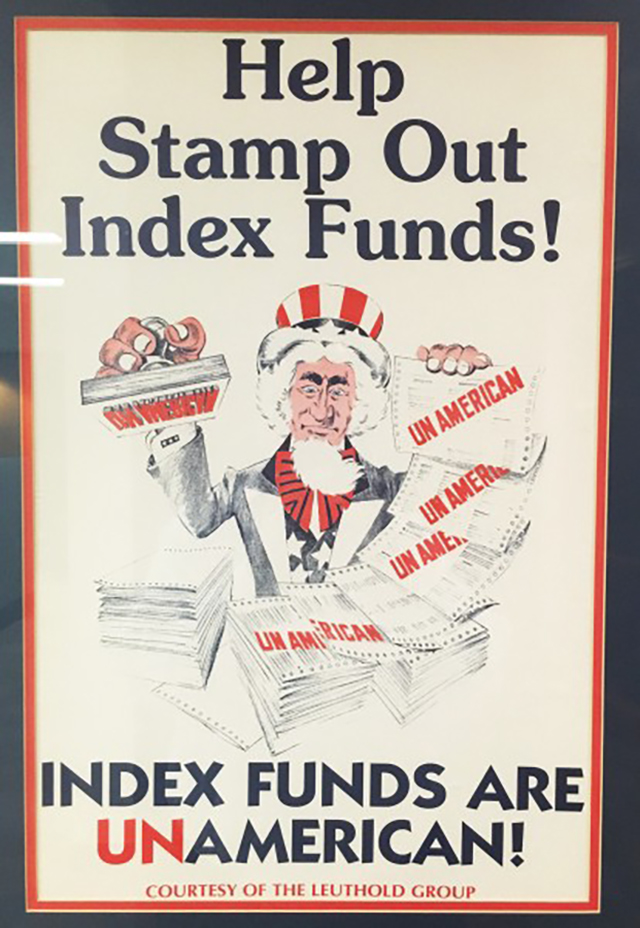
    I suspect that poster might be a collector's item now. Bogle welcomed the challenge and found it amusing.
    image
  • Wealthtrack - Weekly Investment Show
    The June 23 episode featuring Christine Benz was previously broadcast.
    Episode #1941 was originally broadcast on April 07, 2023.
  • advised and subadvised
    My first recommendation is always to drop a quick note to Charles, Master of It All. He's Charles@ followed by the name of our site.
    My second recommendation is to choose "Management" in the screener then either Adviser or Sub-adviser but not both. Using both seems to have and embedded "and" in the underlying search, so it looks for funds which are simultaneously advised and sub-advised by Wellington, of which there are none.
    The screener shows 137 sub-advised funds though Wellington is not the sole sub on all of those.
    For what that's worth, David