
Howdy, Stranger!

It looks like you're new here. If you want to get involved, click one of these buttons!

Here's a statement of the obvious: The opinions expressed here are those of the participants, not those of the Mutual Fund Observer. We cannot vouch for the accuracy or appropriateness of any of it, though we do encourage civility and good humor.
  • Does anyone have a fav fund or two LOOKING FORWARD
    Started to nibble at hstrx.
    Not a bad pick if you can buy NTF. There’s a fee at Fido. I looked at that one yesterday and was surprised it hasn’t done better this year with both gold and bonds having a decent year. Your question doesn’t define the time frame. For most nowadays a year seems an eternity. Some have much shorter and will eject after a month or two or three when a fund heads south.
    I must not have any favorites because I have 20 different holdings. The largest 4 come in at 10% of portfolio each. They represent different variations on alternative and asset allocation type funds where I’m most comfortable at my age. While each could loose 5 or 10% in a terrible year, as a group they are fairly stable - very much “set it and forget it” type holdings. I rationalize a somewhat expensive L/S alternative by considering the overall cost of my funds and also by holding a few individual stocks to reduce costs.
    You mention EM funds. I have a very small 1-2% hold in one. Bought in at the depths last year, so it’s already gained some. Before it gets back to any kind of reasonable valuation I will sell and roll the $$ into a broadly diversified balanced fund at the same house. In that case you’re paid to wait because by most accounts EM valuations are still compelling. I have a very small 2% bite on SPDN - an 1X inverse S&P. That’s to moderate volatility on down days. I think there are many other areas that will perform much better than the S&P over the next several years. With that inverse offset it allows taking on a bit more risk in other areas. International funds plus a few individual socks stocks are some I like. Japan is a long-shot. But exposure there might add a bit of diversification relative to domestic markets.
    Inserted later - Non dollar-hedged Japan adds a currency play. I suspect that’s the better way to go at this point. Check back in a year.
    Whoever said PRPFX in @MikeM’s thread made good sense to me. With some funds, throw away the performance numbers and look at what’s inside. If you see a case for precious metals, foreign currencies, real estate, and some AAA government bonds for defense in the future you might like the fund. I do. Albeit, some criticize it saying fees are too high for what amounts to a passive investment approach.
  • Wealthtrack - Weekly Investment Show
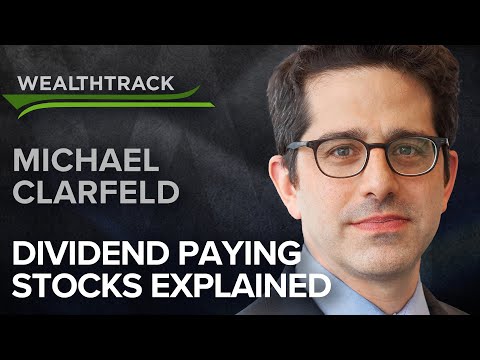
    Dividend-paying stocks are gaining new respect among investors, and they are proving to be a protective asset in times of market volatility. ClearBridge Investments’ Dividend Strategy Fund has been named one of “The Best Dividend Funds” for 2023 by Morningstar. Michael Clarfeld, co-portfolio manager of the fund, is with us to explain why high-quality companies with histories of growing their dividends are particularly valuable now.

  • CDs versus government bonds
    Don’t know about your finance situation and risk tolerance. So here it goes for your questions on CDs:
    1. As of today the only CDs that yield 5% are those with shorter duration ones, 9-12 month. Creating a CD ladder is necessary in order to maintain cash flow (income) as you desired. For example, a one-year ladder consisting of 4 CDs with each maturing every 3 months would provide income every 3 months. So it boils down to how much extra income you want from your CDs. Don’t forget that the interest accrued from CDs is taxed as ordinary income with both federal and state tax applies. Treasury bills/notes are federal tax-exempt but state tax is still applied.
    2. CDs are safe (FDIC insured) but they are not liquid during the investment period. Some bank CDs pay interest monthly, but they pay at lower yield. Brokered CDs at your brokerages pay higher yield, but majority of them pay at maturity, not monthly. Treasury bills (1 -12 months), on the other hand, are highly liquid and one can sell them on secondary market if necessary. Creating T bills ladders will provide periodic income just as CD ladders.
    3. At current inflation rate (CPI as of Feb 2023 is at 6.2% y-o-y), you are losing future buying power each year by investing in CDs alone. Thus, other investment vehicles such as stocks, bonds, and others are required as part of the “growth” component of your retirement income.
    Within this MFO discussion forum, you are getting opinions from other investors. The best answer should come from your financial planner. At least you have something to consider as a starting point. Best wishes.
  • Buy Sell Why: ad infinitum.
    I bought GS 2 days ago and SCHW today. Hard to pull the trigger but that’s when you need to do it
    +1.
  • CDs versus government bonds
    I’m 70 and still working. I have about 700k in savings and CDs, home is paid off and I plan to retire in a year.
    I am considering putting a portion of the $ into long-term CDs since the interest rates are near 5%.and relatively safe.
    I figure if the worst possible scenario happens, I can always withdraw from the CDs and pay the penalty, From what I understand government bonds could be less forgiving in that if the interest rates fall I would have to sell the bonds at that price.
    I just want to have some extra income coming in after I retire and am tempted to invest in 5 or even even 10 year CDs.
    Any advice would be appreciated.
  • Do others have a favorite fund, or two?
    PRWCX
    RWMGX (AF WaMu Investors 0 where 100% of my 403b is parked)
    PRBLX/PRILX is a good one I've held, too. Wish there was an ETF version b/c it pays out big each year.
  • Morningstar charts not working
    In my email: a correction notice from wonderful Morningstar. I don't even think I was affected, because I never use the "My View" feature, and don't use the phone for data.
    The text:
    Dear Morningstar Customer,
    We wanted to make you aware of a recent error you may have encountered.
    Between February 2022 and March 2023, Morningstar displayed incorrect Analyst Ratings for a subset of Funds and ETFs. The incorrect Analyst Ratings would have been visible to users in the Desktop "My View" or the Mobile App "Portfolio View.” The issue has since been corrected.
    During the same period, ratings were displayed correctly within the default Tracking view in legacy Portfolio Manager, as well as on the securities’ quote pages.
    Should you have questions, please contact our support team at
    (312) 424-4288.
    Thank you,
    The Morningstar Investor team
  • King Cash
    Good, pithy, valuable read. Thank you, @Mark.
    ...Just saw something else, doing some homework for a friend. They're in Fido. I'm attempting to find out the current interest rate being generated by the Fidelity "Cash Management" account they are saving into. They started out from zero, and their balance is still just a few hundred.
    The fine print says that deposits are "swept" into bank accounts? I have a sweep acct. at TRP, but the money is put into Treasuries and repurchase agreements. WTF? The posted rate at Fido is just 2.34%. Am I missing something? TRP "sweep" is offering 4.31% and my own "Personal Rate of Return" since inception is 3.24%.
    https://www.fidelity.com/cash-management/fidelity-cash-management-account/overview
  • TCAF, an ETF Cousin of Closed Price PRWCX
    Steve Romick manages both FPACX and SOR Source Capital a closed end fund with a very similar portfolio
    Until 2021 or so they were almost identical. FPACX has done better since.
    Never quite understood why SOR is out there, but you can buy it for free at Schwab, although the mutual fund will cost you $50
  • TCAF, an ETF Cousin of Closed Price PRWCX
    The accounting on PRWCX has to be clean. It is not a fund-of-fund as it spells out in the prospectus.
    VGHCX is an active managed fund runs by Wellington and VHT is passively managed ETF runs by Vanguard Quantitative Group. They may share some stocks but their weightings and mandates are different. Their performance and risk profile are not identical.
    Another case, FPA Crescent is an allocation fund with a great record. The same team also runs a new global equity ETF, FPAG. They share some stocks in the top 10 holdings, but FPAG is more volatile along with oversea stocks and small % of emerging market. I much prefer the Crescent fund.
    @Mike W, going to ETFs has their trade off. Running active managed mutual funds is a highly competitive business on the stock picking and tactical moves in fast changing environment. That is their edge against their competitors. Smaller cap funds working with thinly traded stocks are particularly susceptible to being front-run by someone else to bid up the stock price while they are building up the position, or vice versa.
    By the time the managers talk openly about their portfolio, they have already bought enough for the new positions and made sizable changes/exiting certain stocks probably months afterward.
    We will see how Giruox runs this ETF, but I think it will be mostly stocks and little exposure to bond allocation. Thus it will not be a clone fund.
  • Where are you placing your RMD withdrawals ?
    I like the 'In-Kind" strategy:
    You don’t need to distribute cash. There’s no need to sell an asset in order to make the RMD. You can take the RMD in property, known as an in-kind distribution. That keeps your asset allocation unchanged.
    For most IRAs, this involves simply directing the custodian to transfer a certain number of shares of a mutual fund or stock from the IRA to a taxable account. You have to be sure the value of the shares on the day of the distribution is at least equal to your RMD. The value on the day of the distribution is your tax basis in the asset. So, you’ll owe capital gains taxes in the future only on the appreciation after that day.
    An in-kind distribution can be especially profitable when an asset’s value has declined and you believe the decline is temporary. Distribute the depressed asset and the value on that day will be taxed as ordinary income to you. But you’ll owe only tax-advantaged capital gains taxes on the appreciation that occurs after that.
    8-strategies-for-optimizing-rmds-from-iras
  • Vanguard Dividend Growth Manager Stepping Down
    Here is the SEC filing concerning his departure. Notice the name of the "project" on top of the filing.
    https://www.sec.gov/Archives/edgar/data/734383/000168386323002522/f24809d1.htm
    It used to state "fall out boy".
    Noticed they just changed the "project" in prior link:
    https://www.sec.gov/Archives/edgar/data/734383/000168386323002584/f24877d1.htm
  • Kopernik Global All-Cap Fund to close to new investors
    https://www.sec.gov/Archives/edgar/data/890540/000139834423006578/fp0082730-1_497.htm
    497 1 fp0082730-1_497.htm
    THE ADVISORS’ INNER CIRCLE FUND II
    (the “Trust”)
    Kopernik Global All-Cap Fund
    (the “Fund”)
    Supplement dated March 24, 2023
    to the Fund’s Summary Prospectus, Prospectus and Statement of Additional Information (the “SAI”), each
    dated March 1, 2023
    This supplement provides new and additional information beyond that contained in the Summary Prospectus, Prospectus and SAI, and should be read in conjunction with the Summary Prospectus, Prospectus and SAI.
    Effective as of the close of business on June 1, 2023 (the “Effective Date”), the Fund will be closed to certain new investments because Kopernik Global Investors, LLC (the “Adviser”), the Fund’s investment adviser, believes that carefully managing the Fund’s capacity provides the opportunity to continue to invest in the most attractively priced companies it can find and maintain the ability to take advantage of investments across different markets, countries, industry/sectors, and across the market capitalization spectrum.
    While any existing shareholder may continue to reinvest Fund dividends and distributions, other new investments in the Fund may only be made by those investors within the following categories:
    •Direct shareholders of the Fund as of the Effective Date and the date of the new investment;
    •Participants in qualified retirement plans that offer shares of the Fund as an investment option as of the Effective Date; and
    •Trustees and officers of the Trust, employees of the Adviser, and their immediate family members.
    The Fund reserves the right to modify the above criteria, suspend all sales of new shares or reject any specific purchase order for any reason.
    PLEASE RETAIN THIS SUPPLEMENT FOR FUTURE REFERENCE
    KGI-SK-009-0200
  • TCAF, an ETF Cousin of Closed Price PRWCX
    @Sven Giroux updates his top 10 holdings monthly usually within a week of the beginning of the month. I check this frequently to see what he is doing. His biggest increase this past month was in UNH, which I found interesting. For the new ETF I really hope he doesn’t provide these updates on a daily basis. It doesn’t seem like it would be in the shareholder interest.
  • Expense ratio on Schwab's MM fund, SWVXX
    Between March 14th and 17th SCHW insiders bought over 128,000 shares of SCHW stock. I guess they expect to make more by doing that than the 4.5% Schwab's MMFs are paying.
  • JOHCM Credit Income and the JOHCM Global Income Builder Funds to be liquidated
    https://www.sec.gov/Archives/edgar/data/1830437/000119312523078651/d465390d497.htm
    497 1 d465390d497.htm 497
    Filed pursuant to Rule 497(e)
    File Nos. 333-249784 and 811-23615
    JOHCM FUNDS TRUST
    JOHCM CREDIT INCOME FUND
    Institutional Shares, Advisor Shares, Investor Shares, Class Z Shares
    JOHCM GLOBAL INCOME BUILDER FUND
    Institutional Shares, Advisor Shares, Investor Shares, Class Z Shares
    Supplement dated March 24, 2023
    to the Prospectus and Statement of Additional Information
    dated January 27, 2023
    On March 16, 2023, The Board of Trustees (the “Board”) of the JOHCM Funds Trust (the “Trust”) approved a plan of liquidation and termination (the “Plan”) for the JOHCM Credit Income Fund and the JOHCM Global Income Builder Fund (each a “Fund” and collectively the “Funds”) pursuant to the provisions of the Trust’s Amended and Restated Agreement and Declaration of Trust.
    The liquidations of the Funds are expected to take place on or about May 26, 2023 (the “Liquidation Date”). Effective March 24, 2023, shares of the Funds will no longer be available for purchase by new or existing investors, other than through the automatic reinvestment of distributions by current shareholders. The Funds reserve the right, in their discretion, to modify the extent to which sales of shares are limited prior to the Liquidation Date.
    Pursuant to the Plan, on or before the Liquidation Date, each Fund will seek to convert substantially all of its respective portfolio securities and other assets to cash or cash equivalents. Therefore, each Fund may depart from its stated investment objectives and policies as it prepares to liquidate its assets and distribute them to shareholders. During this period, your investments in the Funds will not reflect the performance results that would be expected if the Funds were still pursuing their investment objectives. Any shares of a Fund outstanding on the Liquidation Date will be automatically redeemed on that date. As soon as practicable after the Liquidation Date, each Fund will distribute pro rata to the Fund’s shareholders of record as of the close of business on the Liquidation Date all of the remaining assets of such Fund, after paying, or setting aside the amount to pay, any expenses and liabilities of the Fund.
    At any time prior to the Liquidation Date shareholders may redeem their shares of a Fund pursuant to the procedures set forth under “How to Redeem Shares” in the Fund’s Prospectus. Shareholders may be permitted to exchange their Fund shares for the same class shares, in another series of the Trust, as described in and subject to any restrictions set forth in the section in the Prospectus entitled “How to Exchange Shares”. Such exchanges will be taxable transactions for shareholders who hold shares in taxable accounts.
    The Funds may each make one or more distributions of net capital gains on or prior to the Liquidation Date in order to eliminate Fund-level taxes. Redemptions on the Liquidation Date will generally be treated like any other redemption of shares and may result in a gain or loss for U.S. federal income tax purposes. Shareholders should consult their own tax advisors regarding their particular situation and the possible application of state, local or non-U.S. tax laws. Please refer to the sections in the Prospectus entitled “Taxes” for general information.
    This Supplement and the Prospectus should be retained for future reference.
  • Vanguard Dividend Growth Manager Stepping Down
    @Observant1 and @yogibb, Thanks for the info. VDIGX is a fund I invested in for a long time and will continue to do so.