Howdy, Stranger!

It looks like you're new here. If you want to get involved, click one of these buttons!

Here's a statement of the obvious: The opinions expressed here are those of the participants, not those of the Mutual Fund Observer. We cannot vouch for the accuracy or appropriateness of any of it, though we do encourage civility and good humor.
  • Donut day for
    How can PRPFX get a 5 for Tax Efficiency from Lipper?
  • Quirk in Schwab TF pricing on small buys
    Software programmer may have been math challenged.
    He/she simply calculated fee on the total amount, whether with or without fee.
    Correct procedure for "with fee" is as follows:
    Total amount $434, amount without fee X, solve X + 0.085X = 434, so X = 434/1.085 = $400.
    Or, the programmer knew what he/she did - i.e. docked customers $2.89 for the convenience of using with the "fee option".
  • Vanguard Unveils Target-Date Series With Annuity Access
    "Vanguard, the nation’s leading provider of target date solutions*,
    is deepening its commitment to retirement innovation through a collaboration with TIAA,
    a pioneer and leader in guaranteed lifetime income.
    This collaboration brings together two trusted names in the retirement industry to deliver
    a retirement income solution designed to provide retirees access to a guaranteed income stream for life."
    "'Retirement isn’t one-size-fits-all, and for those who want more predictability,
    guaranteed income can provide added peace of mind alongside their savings,'
    said Lauren Valente, Managing Director and Head of Vanguard Workplace Solutions.
    'In working with TIAA, another mission-driven organization, we’re giving participants
    an option to turn a portion of their savings into income they can count on for life.'"
    https://corporate.vanguard.com/content/corporatesite/us/en/corp/who-we-are/pressroom/press-release-vanguard-launches-target-retirement-lifetime-income-trusts-120325.html
    * Source: Based on AUM market share of the TDf industry. Sources: Vanguard and Morningstar, Inc.,
    as of September 30, 2025.
  • Vanguard Unveils Target-Date Series With Annuity Access
    "The Vanguard Target Retirement Lifetime Income series follows the same glide path as the flagship funds
    until age 55, when it begins allocating to the TIAA Secure Income Account, a savings annuity.
    A savings annuity lets you build up money over time and later convert it into an income stream for life
    backed by the insurance company. By age 65, the annuity portion will reach 25% of the portfolio,
    and investors can decide whether to convert that portion into lifetime income payments.
    This series will only be available through defined-contribution plans, such as 401(k)s."
    "The TIAA Secure Income Account carries no explicit expense ratio, so total costs are expected to be the same
    or lower than Vanguard’s standard Target Retirement Funds.
    Fees start at 0.08% for the mutual fund and can be lower for collective investment trusts,
    depending on plan size."
    https://www.morningstar.com/funds/vanguard-unveils-first-new-target-date-series-since-2003
  • T bill buy for tomorrow, WED.

    7-Day Yields as of 12/03/2025
    VANGUARD FEDERAL MONEY MARKET (VMFXX) 3.90%
    SCHWAB PRIME ADVANTAGE MONEY INVESTOR (SWVXX) 3.84%
    FIDELITY GOVERNMENT CASH RESERVES (FDRXX) 3.69%
    FIDELITY GOVERNMENT MONEY MARKET (SPAXX) 3.63%
    CME FedWatch indicates there is an 87% probability of a 25 bps rate cut at the Dec. 10 Fed meeting.
  • Quirk in Schwab TF pricing on small buys
    Different brokerage platforms seem to have their own quirky idiosyncrasies.
    I own two TF funds in a Fidelity account.
    Recurring transactions (only $5) were initiated today to avoid paying a $49.95 TF.
    The earliest allowable transaction date was Dec. 9 — three business days after the current day.
    IIRC, Fidelity previously allowed recurring transactions to start on the next business day.
  • Stewart Investors Worldwide Leaders Fund will be liquidated
    https://www.sec.gov/Archives/edgar/data/1806095/000119312525307683/d69831d497.htm
    497 1 d69831d497.htm 497
    STEWART INVESTORS WORLDWIDE LEADERS FUND
    A SERIES OF DATUM ONE SERIES TRUST
    Supplement dated December 4, 2025
    to the Summary Prospectus, Prospectus and Statement of Additional Information dated July 29, 2025
    The Board of Trustees (the “Board”) of Datum One Series Trust (the “Trust”) has approved the liquidation and termination of the Stewart Investors Worldwide Leaders Fund (the “Fund”). The Board approved the liquidation pursuant to the provisions of the Trust’s Amended and Restated Declaration of Trust.
    Effective November 26, 2025, shares of the Fund were no longer available for purchase by new investors. The liquidation of the Fund is scheduled to take place on or about December 16, 2025 (the “Liquidation Date”).
    On or before the Liquidation Date, the Fund will seek to convert substantially all of its respective portfolio securities and other assets to cash or cash equivalents. Therefore, the Fund may depart from its stated investment objectives and policies as it prepares to liquidate its assets and distribute them to shareholders. Any shares of the Fund outstanding on the Liquidation Date will be automatically redeemed on that date. As soon as practicable after the Liquidation Date, the Fund will distribute pro rata to the Fund’s shareholders of record as of the close of business on the Liquidation Date all of the remaining assets of the Fund, after paying, or setting aside the amount to pay, any expenses and liabilities of the Fund. At any time prior to the Liquidation Date, shareholders may redeem their shares of the Fund pursuant to the procedures set forth under “How to Redeem Shares” in the Fund’s Prospectus.
    The Fund may make one or more distributions of income and/or net capital gains on or prior to the Liquidation Date in order to eliminate Fund-level taxes. For taxable shareholders, the automatic redemption on the Liquidation Date generally will be treated like other redemptions of shares generally, that is, as a sale by the shareholder that may result in a gain or loss to the shareholder for U.S. federal income tax purposes.
    This Supplement and the Prospectus should be retained for future reference.
  • Quirk in Schwab TF pricing on small buys
    Schwab is supposed to charge 8.5% on small purchases (until that exceeds the flat fee amount). If you say that you want to buy $400 not including the fee, it adds $34 to your total. But if you say that you want to buy $434 including the fee, it charges $36.89 (8.5% of $434).
    Either way, it's supposed to be 8.5% of principal.
    https://www.schwab.com/mutual-funds/costs-fees
  • Sentiment & Market Indicators, 12/3/25
    SENTIMENT & MARKET INDICATORS, 12/3/25
    AAII Bull-Bear Spread +13.5% (above average; big change)
    CNN Fear & Greed Index 26 (fear-low)
    NYSE %Above 50-dMA 56.70% (positive)
    SP500 %Above 50-dMA 54.4% (positive)
    These are contrarian indicators.
    INVESTOR CONCERNS: Fed, dollar, debt, budget, tariffs, inflation, jobs, recession, geopolitical, Russia-Ukraine (196+ weeks), Israel-Hamas (67+27 weeks; fragile peace).
    For the Survey week (Th-Wed), stocks up, bonds down, oil up, gold up, dollar down.
    FOMC is expected to cut rates on Dec 10. IRS Math Act requires more error details & remedies in IRS letters. Vanguard caved in on cryptos & that provided support to falling cryptos. December is a good month for TLH & tax planning.
    #AAII #CNN #Sentiment
    https://ybbpersonalfinance.proboards.com/post/2330/thread
  • Rare Thanksgiving week S@P buy signal
    On the theme of torturing the data...
    Typically, when the S&P 500 has effectively doubled (or nearly doubled) in a 3-year window, the subsequent 12 months are often a "hangover" period.
    In 6 out of the 7 historical cases, the market either crashed, corrected, or went flat in the year immediately following the peak. The only major exception was the late 1990s Dot-Com bubble, where the market continued to rally for two more years before eventually busting.

    ...
    Summary: History suggests the odds of a negative or flat year in 2026 are elevated, simply because the market rarely sustains a >20% annualized pace for four years straight.
    This is my thinking. Call it "mean reversion" or "bubble bursting" or anything at all, it still makes me wary.
    On a few notable occasions in my lifetime, I had belated wished I had stepped back and protected gains. And with many bond oefs looking to perform well in a falling rate environment, it may be a little less stressful to step away from FOMO?
    One can have a great time, and leave the party early to avoid the hangover. Do the "lessons of the past" apply here? In any case, at 66 years old, perhaps it is time to back off of risk some more and act my age? My current plan is to take another 5-10% off of equities in the next month or two.
  • Catastrophe Bond Funds
    Interesting Article on a unique approach by North Carolina's State Insurer "of last resort" regarding the use of CAT Bonds for disaster preparedness for individual NC property owners.
    As the Trump administration stalls federal funding for projects intended to make states more resilient to climate change and private insurers decline to cover properties in high-risk zones, North Carolina just proved there’s another way to fund disaster preparedness: a $600 million catastrophe bond that rewards homeowners and their insurer for installing “super roofs.”
    the-game-changing-cat-bond-incentivizing-adaptation?srnd=homepage-americas
    Related Articles:
    How 'Super Roofs' Reward Insurers, Cat Bond Investors and Homeowners
    NC Expands FORTIFIED Roof Grant Program With Another $20 Million
    The threat of wild fires was one of the reasons we re-roofed with metal shingles when we were living just down the road from the forests of the Coast Range in NorCal. Another advantage is that they supposedly don't store heat the way traditional shingles do. So we are considering another re-roof in Arizona.
  • welcome to the MFO discussion board: civility is most important when all around you are turn toxic
    "Lastly, it’s pretty obvious you’re not here to talk about investing, because most of your posts focus on politics while the main purpose of this site is investing."
    Let me explain: Well @FD1000, I can't talk much about investing at this time because we've made our pile, same as you, and now we're just protecting what we've got, so there's not all that much to say. The old-timers here are fully aware of how we did it, and unlike you I have no need to constantly brag about such things. For many years before you troubled MFO with your presence I participated in investment discussions just like most of us here.
    How about YOU, FullyDeceptive? All we ever hear from you is how smart you are and how well you did predicting all the market highs and lows and making great moves accordingly. This will come as a shock, but not too many folks here believe a word of it.
    image
  • Rare Thanksgiving week S@P buy signal
    On the theme of torturing the data, some food for thought (via AI, not cross checked for accuracy)
    Typically, when the S&P 500 has effectively doubled (or nearly doubled) in a 3-year window, the subsequent 12 months are often a "hangover" period.
    In 6 out of the 7 historical cases, the market either crashed, corrected, or went flat in the year immediately following the peak. The only major exception was the late 1990s Dot-Com bubble, where the market continued to rally for two more years before eventually busting.
    Here is the performance of the S&P 500 in the 12 months following each of these massive 3-year runs.
    The "Next 12 Months" Performance Table
    | 3-Year Peak Era | Streak End Date | Next 12 Months Return | What Happened? |
    |---|---|---|---|
    | Roaring 20s | Aug 1929 | ~ -30% | The Great Crash. The market peaked in September and crashed in October. |
    | Depression Rebound | Feb 1937 | ~ -35% | The "Mistake of 1937." The Fed tightened rates prematurely, causing a massive recession. |
    | WWII Victory | May 1946 | -6.4% | Post-War Adjustments. Inflation spiked as price controls were removed, spooking the market. |
    | Post-War Boom | Aug 1956 | -5.6% | The Eisenhower Recession. The market entered a bear market the following year (1957). |
    | Pre-1987 Crash | Aug 1987 | ~ -14% | Black Monday. The market crashed 22% in a single day (Oct 19, 1987) just two months after the peak. |
    | Dot-Com Bubble | Dec 1997 | +28.6% | The Exception. The bubble kept inflating. The market didn't peak until 2000. |
    | COVID Stimulus | Dec 2021 | -18.1% | The Inflation Bear. Rates rose rapidly to fight inflation, causing the 2022 bear market. |
    | AI Boom (Current) | Nov 2025 | ? | We are here. |
    Key Takeaways
    * Mean Reversion is Powerful: When the market runs too hot (75%+ in 3 years), it borrows returns from the future. In almost every case, the market had to "digest" those gains through a decline or sideways movement.
    * The "1997" Exception: This is the one scenario bulls hope for today. In 1997, despite hitting high rolling returns, the internet boom was just getting started. The market ignored valuations and surged for two more years (1998 and 1999) before eventually crashing in 2000.
    * Speed Kills: The most dangerous peaks (1929, 1987) were the ones where the gains happened the fastest at the very end of the cycle.
    Summary: History suggests the odds of a negative or flat year in 2026 are elevated, simply because the market rarely sustains a >20% annualized pace for four years straight.
  • Rare Thanksgiving week S@P buy signal
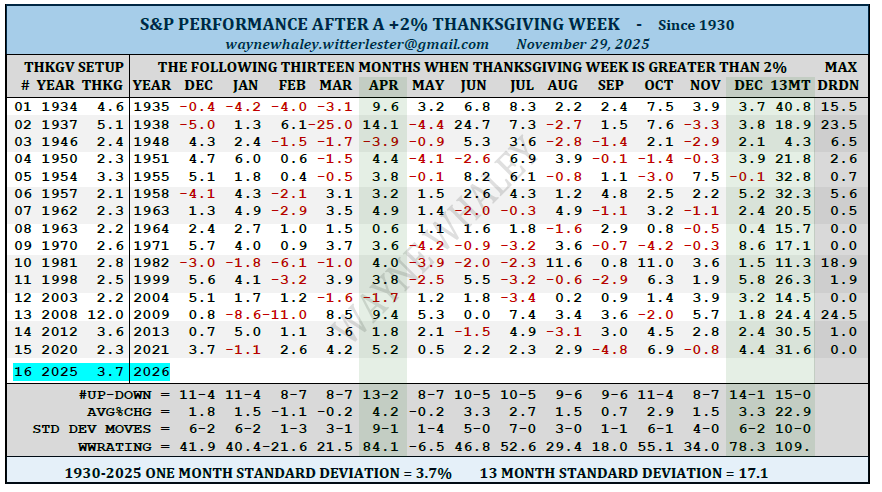
    With +25% S&P gains for 2023 and 2024, and a +16% 2025 YTD, an average gain of 22.9% (or higher) for 2026 EOY?
    Interesting. When was the last 4-yr period of 90% S&P gains? Never mind the higher Nasdaq gains?
  • Rare Thanksgiving week S@P buy signal
    Thank you both.
    If we have number crunchers - data miners in the forum, it would be good to know,
    Which one of those 15 Novembers ended with negative to less than 1% gain?
    Which one of those 15 subsequent years are mid-term election years?
    YBB, a number of instances in the last column show 0.0. Is it not for Max Drawdown during the 13 month period? Clue me in pl.
    Edited to fix the missing %age sign.
  • Rare Thanksgiving week S@P buy signal
    Yes, I know this could be considered playing with numbers and curve fitting etc. I only post it because it comes from legendary technical analyst Wayne Whaley. Last week the S@P had a 3.7% gain. Since 1930 there have only been 15 Thanksgiving weeks that saw 2%+ gains. Over the ensuing 13 months to the end of the following year all 15 signals were positive with an average gain of 22.9%. 3%+ gains are even rarer with average gains of 29.8%. In the investment world the less amount of signals historically the most potent its relevancy. The reason for that we can debate another time.
    Since I can’t post tables etc. maybe @yogibearbull could post the table showing drawdowns etc.
  • Buy Sell Why: ad infinitum.

    Put on a new 5/4 combo spread on ALT out to Jan 27. Their GLP-1 contender could be snapped up by someone. Was pleased they changed CEOs recently, maybe this one will be more active in exploring potential acquisitions.
    (Was pleased that Schwab saved me 4 cents / spread on my limit price, which was a nice surprise.)
  • Talk (NYC area) - Black-Scholes/Merton in Five Easy Pieces
    From the description: Whether you're steeped in quantitative finance or just curious how modern markets really work, this talk offers a simplified (and powerful) lens for understanding the mathematics behind the money.
    It's local, but if you're in the area next week, it sounds very interesting. Well, to me, anyway :-) The Museum of Mathematics is focused on making math accessible and fun (yes, really) to all people. Including, e.g. Mark Hamill (use the math, Luke, the math):
    image
    MoMath is pleased to announce the 2025 edition of Simplified, a lecture honoring the memory of Peter Carr, a Founding Trustee of the National Museum of Mathematics.
    The Black-Scholes-Merton model transformed finance by showing how to value an option using expected payoff and stochastic calculus. But just five years later, Stephen Ross proved that no probability was required at all — just a careful accounting of prices and cash flows over time. In this talk, Keith Lewis revisits and extends Ross’s breakthrough, offering a clean, intuitive framework for understanding derivative valuation. By treating cash flows and prices as equal components of any trading strategy, Lewis shows how we can model and manage risk without heavy technical machinery. Whether you're steeped in quantitative finance or just curious how modern markets really work, this talk offers a simplified (and powerful) lens for understanding the mathematics behind the money.
    Thurs, Dec 11 6:30-8:00
    225 5th Ave, NYC
    Registration required (free)
    https://momath.org/simplified/