
Howdy, Stranger!

It looks like you're new here. If you want to get involved, click one of these buttons!
Here's a statement of the obvious: The opinions expressed here are those of the participants, not those of the Mutual Fund Observer. We cannot vouch for the accuracy or appropriateness of any of it, though we do encourage civility and good humor.
  • We want the junk -- Apologies to George Clinton
    Just finished reading Prof. Snowball's piece on junk bonds in which much is made of the virtue of investing in junk, as opposed to "equities."
    Just for fun ("Gonna turn this mother out.") I decided to back-test FAGIX versus an equal-weight widows-and-orphans portfolio of FSUTX and FDFAX not subject to rebalancing. I had no idea how this would turn out.
    The Vanguard 500 is included as the benchmark. Results since 1986 in this link. Junk has the lower standard deviation. But how many people pay attention to SD versus "Worst year I spent with this portoflio?" Junk had the worst year versus W&O at 31.9% to 27.36%. I also notice that W&O lead on Sharpe and Sortino numbers. They also made twice as much money for you, and beat the 500 index just for fun.
    How about other time periods? Prof. Snowball looks at 15 years. FAGIX pulls slightly ahead of W&O, but still has the worst year.
    And 20 years. W&O are back in the money lead, but FAGIX pulls ahead on Sharpe and Sortino numbers.
    Prof. Snowball also runs through numbers from all the periods of The Great Distortion, which I am too lazy to run. But I will run two of my favorites from MFO premium: Since COVID, and TGN. Portfolio Visualizer does not account for monthly starts, so the first test dates from 202001, and the second from 202201.
    Since COVID, W&O eke out a win in money, Sharpe, and Sortino numbers. And they do much better in the worst-year category.
    Since TGN, W&O have lost less of your money. And there is something to be said for that in a period of rising rates.
    A person can have more fun with this PV by adding 100% VWELX or PRWCX as the third portfolio entry.
  • Roth Conversion calculator and Tax impact
    A few other things to keep in mind:
    1. ACA - for those "younger" (pre-65) folk, subsidies get phased out based on income. KFF.org seems to have a decent calculator for these subsidies. I haven't checked it out extensively, but IMHO KFF is one of the most complete and accurate sources of information on health care.
    https://www.kff.org/interactive/subsidy-calculator/
    2. State help with Medicare drug coverage. This depends on state and income level. For example, NYS has its Elderly Pharmaceutical Insurance Coverage (EPIC) program that may help with co-pays for individuals with income up to $75K (individual) or $100K (married).
    3. Cap gain/ qualified divs - this can get messy for an obvious reason and one that's more complicated:
    a) Cap gains are "outside" of ordinary taxes. They have their own rates and brackets. The conversion calculator assumes all AGI is ordinary income. Whether cap gains or ordinary income, all income affects IRMAA the same way. But how much to convert to fill an ordinary income tax bracket depends on how much of your income is taxed as ordinary income and how much is taxed as cap gains.
    You can fake out the calculator by just giving it the ordinary income part of your AGI to fill your bracket. Then recalculate with this amount plus your cap gains income (no extra conversions) to see the IRMAA impact.
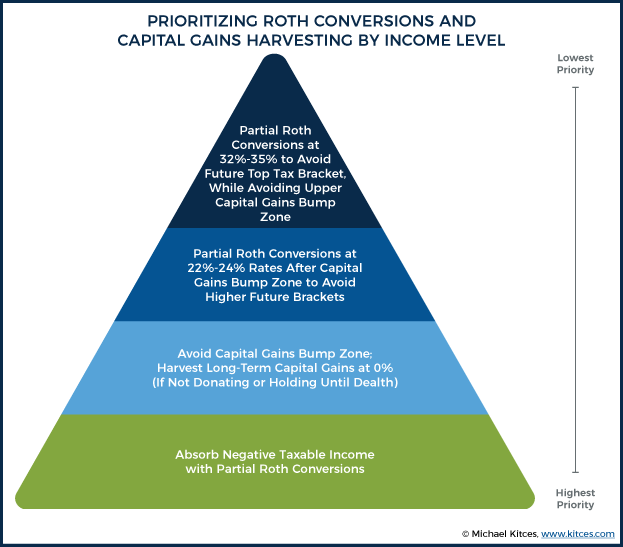
    b) If your income is at the level where some cap gains are taxed at 0% and some at 15%, then every extra dollar you earn (convert) is taxed at 15% plus your ordinary tax rate. Kitces calls this region of income the "bump zone". A simple rule of thumb is "go long (convert until you're well past the bump zone) or go home". Kitces provides a more thorough analysis for Roth conversions and bump zones.
    image
    https://www.kitces.com/blog/long-term-capital-gains-bump-zone-higher-marginal-tax-rate-phase-in-0-rate/
    FInally, a petty observation. The conversion calculator doesn't seem to include Part D IRMAA (around 1/5 of Part B IRMAA). "It is not commonly known, but the more you earn, the more you pay for Medicare Part B."
    Apparently even less well known is that Part D also has IRMAA charges. :-)
    https://www.medicare.gov/drug-coverage-part-d/costs-for-medicare-drug-coverage/monthly-premium-for-drug-plans
  • SLADX, FAIRX, MetWest Total Return and GIM
    Saba is doing a tender offer for 45% of GIM and will rename it SABA. The AUM is $437 million. It will become a big fund for Saba (existing ETF CEFS & CEF BRW).
    Twitter LINK
    https://www.cefconnect.com/fund/GIM
    Edit/Add. https://www.businesswire.com/news/home/20231106482750/en/
  • The Relationship of M2 and Stocks
    I wanted to share this recent (Nov 2023) article regarding M2 money supply and its recent contraction:
    The significance of this decline is twofold. To start with, there are economic implications of having less capital in circulation. With core inflation still well above historic norms due to higher shelter expenses, consumers may be forced to pare back their discretionary purchases. In other words, declining M2 sets the stage for a potential downturn in the U.S. economy.
    money-supply-great-depression-big-move-in-stocks
    Another article (Feb 2021) discusses M2 and its inconsistent implications on stocks:
    ...it is clear enough that big surges in M2 are followed by big surges in the stock market. It is less clear whether or not big dropoffs in M2/GDP lead exactly to stock market declines, but they do seem to at least bring periods of increased volatility. So that is what we can look forward to if the Fed ever decides that it will try to put the M2 genie back into the bottle.
    understanding_m2_and_stocks
  • The Week in Charts | Charlie Bilello
    The Week in Charts (11/05/23)
    The most important charts and themes in markets, including...
    00:00 Intro
    00:24 Bouncing Back With a Vengeance (Equities)
    03:17 Investing in a Drawdown
    06:08 Improving Bottom Line (Earnings)
    09:54 Loosening Labor Market (Jobs Report)
    15:49 Pause, Pause, Pause, Cut (Fed, FOMC)
    21:54 Nothing From the 40 in 60/40
    26:23 Mortgage Industry Decline (Housing Market)
    29:35 More Affordable Rents (Rental Market)
    Video
    Blog
  • The BOND KING says
    They're all just shooting for their 15 minutes of fame. All it takes is one right guess.
  • the Samhain edition of MFO is live
    David. Thanks as always. Haven’t gotten too far in … But intrigued by your mention of LCORX. $10,000 minimum. 1.28% ER. Apparently very overweight fixed income presently. A few short positions. And what appears to be a stellar long term risk adjusted record.
    One interesting observation, however - If Yahoo Finance is to be believed, the fund fell 27.4% in 2008. Not bad compared to the roughly 50% drop in equities globally that year. Still, a bit more than I’ve have expected from such a cautious bunch.The nice thing is that the fund has such a long term record to be compared. A lot of us, self included, own things that weren’t around in 2008. That’s the year “the rubber really hit the road” or “the Kool-Aid hit the fan”. Whatever ….
    https://finance.yahoo.com/quote/LCORX/performance?p=LCORX
  • When the Market is Rising
    “ You have heard the saying, "Buy low, sell high," correct?”
    So, my thinking goes, “why not wait a little longer…rest in the mmkt sweet spot with 5%+ for a while. The 3,6,12-month t-bills ain’t bad either.”

    Well said, Level5.
    Especially since, "The stock market just finished its best week in almost a year, but lurking beneath the euphoric surface are fears about Corporate America’s profit outlook.
    Among companies that have issued guidance this earnings season for next quarter and beyond, more have been providing estimates that trail analysts’ expectations. A gauge of forward guidance that compares corporate forecasts with the Wall Street consensus has been lower only once since 2019, data compiled by Bloomberg Intelligence show."

    There is also the prospect of a prolonged government shutdown and a market that is still relatively expensive. The Fed's inflation target remains at +2% and rate hikes are still possible.
    As a conservative and retired investor, I prefer to err on the side of caution and feel quite comfortable earning a risk-free 5.3%+ in CDs and a Treasury Floating Rate Bond ETF at this time.
    Good luck,
    Fred
  • Covered Call ETFs
    Yogi,
    Thanks for your response.
    I now understand the context for this statement.
    You're referring to the call writing process itself while I compared the fund's performance
    to its S&P 500 benchmark.
  • Covered Call ETFs
    Echoing what yogi wrote, according to M*'s analysis, JEPIX even without the options overlay holds a defensive portfolio with a beta only 0.8 of the market. For example, unlike VFIAX, it doesn't hold AAPL, NVDA, or TSLA. In broader terms, it holds about half as much technology as the index and about 50% more energy stocks than the index.
    The other covered call funds mentioned could have different equity strategies and behave differently.
  • Covered Call ETFs
    Lower volatility or downside of JEPI comes from other things (not call writing) - in the SP500 universe, it finds undervalued stocks with lower volatility. M* shows %equity at 85%; rest 15% is used to support equity-linked notes (ELNs), securities lending, etc. On the whole, its effective-equity is 68%.
  • Covered Call ETFs
    "Covered-calls don't offer downside protection (beyond the small premium received)."

    @yogibearbull,
    Can you elaborate?
    One facet of the JEPIX approach "seeks to deliver a significant portion of the returns associated
    with the S&P 500 Index with less volatility, in addition to monthly income."

    The fund's 3-year beta was 0.63 as of 09/30/2023.
    Since launch, the worst year for JEPIX was a -6.98% loss while the max drawdown was -18.33%.
    The corresponding stats for VFIAX during this period were -18.15% and -23.89% respectively.
    Portolio Visualizer
  • Covered Call ETFs
    JP Morgan Equity Premium Income ETF (JEPI) has become the largest active ETF ($29.1B AUM) since its launch in May 2020.
    The fund had inflows of approximately $12.3B thus far in 2023.
    Now other firms want a piece of the action.
    Morgan Stanley launched Parametric Equity Premium Income ETF (PAPI).
    Blackrock introduced BlackRock Advantage Large Cap Income ETF (BALI).
    Golman Sachs launched the Goldman Sachs S&P 500 Core Premium Income ETF (GPIX) and
    the Goldman Sachs Nasdaq-100 Core Premium Income ETF (GPIQ).
    Covered call ETFs may appeal to investors seeking income creation with some downside protection.
    These ETFs reside in Morningstar's Derivative Income category which had inflows of $20.4B this year.
    Citiwire article (may be paywalled)
    Link
    Morningstar also published a related article recently.
    Link
  • Wildermuth Fund: "you mean ... we're through???"
    There was an unusually thorough explanation of the end of the Wildermuth Fund. Wildermuth was, by their description, an illiquid, closed-end interval fund that launched in 2014 but also a series of open-end funds that launched in 2017. In November of 2022, the fund lost its status as a registered investment company; the filing notes that a tax hit was coming but I don't see any explanation of how they managed to lose their legal status. Odd.
    An SEC filing enumerates the pieces of the dismantling:
    Effective November 1, 2023, Wildermuth Advisory, LLC was terminated adviser to the Fund.
    Daniel Wildermuth and Carol Wildermuth each resigned from the Board of Trustees.
    Daniel Wildermuth also resigned as Chairman of the Board.
    Daniel and Carol Wildermuth also resigned from their positions as officers of the Fund, including Daniel’s resignation as portfolio manager.
    An interesting side note is the existence of a specialty industry in managing fund liquidations The Wildermuths have been succeeded by BW Asset Management Ltd, a sort of undertaker for condemned funds which has overseen liquidation of over $1 billion in assets. Currently they’re providing end-of-life / beginning-of-death services for a Mauritius regulated fund with $110 million AUM; five private funds under voluntary liquidation with combined assets of $120 million; and “various funds in provisional or official liquidation with combined assets of $300 million.”
    Maximizing returns of the remaining portfolio assets and distributing the results is an honorable task.
    At the same time, it brings to mind the work of the prison cook charged with preparing last meals for condemned prisoners. I'm sure they try hard but, really, who's going to report that they put way too much salt in the ragout?
  • The week that was, global etf's, various categories + heat map. Week ending May 17, 2024.
    “It was a GLOBAL rally.”
    Of course. I had a lot of other things rise last week (as did anyone who’s not sitting 100% in cash). Was just pointing out the sharp reversal in one segment (small caps). There’s been one or more recent threads in that regard.
    "It's Almost Time to Buy Small-Caps" - from October 11
    https://www.mutualfundobserver.com/discuss/discussion/61579/it-s-almost-time-to-buy-small-caps#latest
  • The week that was, global etf's, various categories + heat map. Week ending May 17, 2024.
    It was a GLOBAL rally.
    "FOR THE WEEK (index changes only), DJIA +5.07%, SP500 +5.85%, Nasdaq Comp +6.61%, R2000 +7.56%. DJ Transports +7.06%; DJ Utilities +5.80%. (Rotating spot long Treasury TLT +3.86%) US$ index (spot) -1.40% (remains too strong over 100), oil/WTI futures -5.88%, gold futures +0.15%.
    A good week in EUROPE (Denmark +5.72%, Norway +2.07%) and a good week in ASIA (New Zealand +4.27%, Philippines +0.45%). (A GLOBAL RALLY week)"
  • The week that was, global etf's, various categories + heat map. Week ending May 17, 2024.
    Nice chart @Catch22
    What’s not to like? 5 day return is a very short period to be sure. One stock I have that’s been comatose for over a year (gone nowhere) spiked 7+% in the last 2 trading days. It’s a conglomerate made up of a dozen or so small cap companies. That at least suggests small caps may be awakening.
    The Russell 2000 on @Catch’s chart is showing +7.57% gain for the past 5 days. That’s in keeping with my own (limited) experience. For sure, the falling interest rates had much to do with this. Many of these companies borrow heavily and at higher interest rates than larger companies.
  • High yield long term CDs
    The Fidelity site now has no CDs available for terms 2 years or longer. This is probably just a temporary repricing in the market, but I expect available yields will drop. Fortunately, I purchased my latest 5-year ladder just before the changes. Unfortunately, I have a lot of CDs and Treasuries maturing in the next few months, so I may need to reinvest at lower rates (or return to bond funds).
  • The BOND KING says
    This discussion reminds me of why I like to stay away from ”rock star” managers.
    Bill Gross Slams Jeff Gundlach: “To Be A Bond King or Queen You Need a Kingdom”
    https://www.businessinsider.in/stock-market/news/billionaire-investor-bill-gross-slams-jeff-gundlach-over-shared-bond-king-nickname-to-be-a-bond-king-or-queen-you-need-a-kingdom/articleshow/103606510.cms
    Eee Gads! Who needs it? I like StarTreck’s approach (in spirit) - “go where no man has gone before.”
  • The week that was, global etf's, various categories + heat map. Week ending May 17, 2024.
    Wacky weed, Mary Jane and related leads the pack (MJ etf). One may presume this seems appropriate during these turbulent times; whether rolling one's own, baking some brownies or having a gummie.
    I set the chart for the 5 day return, for the best to the worst % returns from last week.
    Remain curious.
    Catch