Howdy, Stranger!

It looks like you're new here. If you want to get involved, click one of these buttons!

Here's a statement of the obvious: The opinions expressed here are those of the participants, not those of the Mutual Fund Observer. We cannot vouch for the accuracy or appropriateness of any of it, though we do encourage civility and good humor.
  • AAII Sentiment Survey, 6/7/23
    AAII Sentiment Survey, 6/7/23
    Vow! Bullish became the top sentiment (44.5%; above average) & bearish became the bottom sentiment (24.3%; below average); neutral remained the middle sentiment (31.2%; near average)
    Big changes from a week ago based on whether the debt-ceiling deal will pass which it did ! The bulls went from 29% to 40% in one week.
  • Treasuries Flood is Coming
    Liesman/CNBC dissects Treasury's "gradual" euphemism. I also double-checked - it's Liesman, not Leisman.
    https://twitter.com/SquawkCNBC/status/1666766270052679680
    @Crash, TIPS should be affected to the extent of the correlation between nominal and real rates, but no direct impact.
  • AAII Sentiment Survey, 6/7/23
    AAII Sentiment Survey, 6/7/23
    Vow! Bullish became the top sentiment (44.5%; above average) & bearish became the bottom sentiment (24.3%; below average); neutral remained the middle sentiment (31.2%; near average); Bull-Bear Spread was +24.3% (above average). Investor concerns: Inflation (moderating but high); economy; the Fed; dollar; crypto regulations; market volatility (VIX, VXN, MOVE); Russia-Ukraine war (67+ weeks, 2/24/22- ); geopolitical. For the Survey week (Th-Wed), stocks were up, bonds down, oil up sharply, gold down, dollar down a bit. Post-debt-ceiling, yields to rise, financial liquidity to drain due to huge Treasury issuances. #AAII #Sentiment #Markets
    https://ybbpersonalfinance.proboards.com/post/1062/thread
  • Concerning SPY and concentration in top 5 holdings
    Anyone know if the concentration of holdings in a relative few companies is historically significant? I know the index is cap weighted but is todays concentration out of the ordinary? Thanks for your replies.
    Not responsive to your specific question, but I have spent a few hours the last few weeks comparing RSP vs IVV and IVE, also VONE vs VONV, also the gaming value outliers SCHD and DIVO and CAPE.
    While looking hard at UI.
    Even VONE all by itself has a breadth that (as you might think) counters the top-heavy IVV. Counters meaning underperforms.
    5-3-1y and 8mos. I use M* and Fido to do longer comparisons, as they exist.
    Anyway, if I were really smart I would be able to convey what the lessons are which I have learned. IVV or VONE in combo w low-UI DIVO looks like a winner. He said.
    (How's this for unhelpful?)
  • Anybody Investing in bond funds?
    DT: Good on ya. Can't tie up my $$$ for very long like that. Of course, I'm investing, and that's long-term. What you're doing with CDs, I'n doing with bond OEFs.
    Crash, I understand. I am retired and focused on preserving principal, while making a decent TR with CD interest payments. After I retired, I focused on making 4 to 6% TR, but CDs paid nothing, and so I chose to focus on low risk bond oefs. Loved those years with PIMIX from which I collected monthly income payments that were very predictable and dependable. I had several other bond oefs that I did well with--SEMMX, VCFIX, NVHAX, etc. When the FEDs got serious about raising interest rates, bond oefs got less appealing to me, but CDs became attractive alternatives. I have no idea how long I can ride the CD gravy train, but for now, I will enjoy the stress free 5% returns during my "golden years". I keep watching Floating Rate Bank Loan funds, which I played with for a few years, and keep wondering when they will start benefiting from the rising interest rate period.
  • wow, financials. 5 day comparison
    IYF +4.83%
    XLF +4.44
    VFH +5.21
    ...BHB..... um... +18%. Glad for it. But what's their secret sauce?
  • Posting Images
    Here's some info regarding the use of ImgBB, as referred to above by Yogi. It's a screen capture of an account at ImgBB, showing the steps necessary to transfer an image from ImgBB to MFO.
    image
    Use of ImgBB is free for smaller personal accounts.
  • Anybody Investing in bond funds?
    Purchased a 6 month CD through Schwab brokerage yesterday, paying 5.3%. CD rates above 5% are commonplace from 3 months to 18 months. Anything longer, falls below 5%. If longer term CDs inch above 5%, I would be tempted to consider them, to replace some maturing CDs coming up over the next couple of months.
  • Concerning SPY and concentration in top 5 holdings
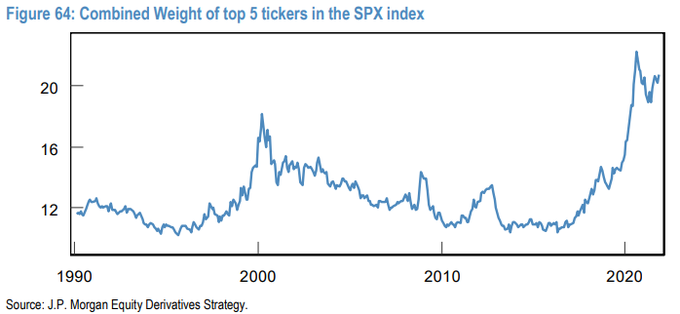
    Top 5 now are 21.95% of SP500 (M* data; combining GOOG & GOOGL, 2 classes of the same Alphabet).
    An old chart from December 2021 Twitter LINK.
    image
  • Concerning SPY and concentration in top 5 holdings
    AAPL Apple Inc 7.52%
    MSFT Microsoft Corp 6.97%
    AMZN Amazon.com Inc 3.07%
    NVDA NVIDIA Corp 2.66%
    GOOGL Alphabet Inc 2.09%
    GOOG Alphabet Inc 1.83%
    META Meta Platforms Inc 1.68%
    BRK.B Berkshire Hathaway Inc 1.65%
    TSLA Tesla Inc 1.57%
    UNH UnitedHealth Group Inc 1.30%
    XOM Exxon Mobil Corp 1.20%
    That's 31% (I am including both classes of Google and so all in 11 tickers make the top 10).
  • Concerning SPY and concentration in top 5 holdings
    Anyone know if the concentration of holdings in a relative few companies is historically significant? I know the index is cap weighted but is todays concentration out of the ordinary? Thanks for your replies.
  • The Next Crisis Will Start With Empty Office Buildings
    Banks have many reasons to worry. Rising interest rates have devalued other assets on their balance sheets, especially government bonds, leaving them vulnerable to bank runs. In recent months, Silicon Valley Bank, First Republic, and Signature all collapsed. Regional institutions like these account for nearly 70 percent of all commercial-property bank loans. Pushing down the valuation of office buildings or taking possession of foreclosed properties would further weaken their balance sheets.
    Municipal governments have even more to worry about. Property taxes underpin city budgets. In New York City, such taxes generate approximately 40 percent of revenue. Commercial property—mostly offices—contributes about 40 percent of these taxes, or 16 percent of the city’s total tax revenue. In San Francisco, property taxes contribute a lower share, but offices and retail appear to be in an even worse state.
    Empty offices also contribute to lower retail sales and public-transport usage. In New York City, weekday subway trips are 65 percent of their 2019 level—though they’re trending up—and public-transport revenue has declined by $2.4 billion. Meanwhile, more than 40,000 retail-sector jobs lost since 2019 have yet to return. A recent study by an NYU professor named Arpit Gupta and others estimate a 6.5 percent “fiscal hole” in the city’s budget due to declining office and retail valuations. Such a hole “would need to be plugged by raising tax rates or cutting government spending.”
  • The Next Crisis Will Start With Empty Office Buildings
    https://msn.com/en-us/money/companies/the-next-crisis-will-start-with-empty-office-buildings/ar-AA1ceEKg?ocid=msedgdhp&pc=U531&cvid=606d641185224a20a6248989fb2c9e82&ei=10
    Post-pandemic, kids are back in school, retirees are back on cruise ships, and physical stores are doing better than expected. But offices are struggling perhaps more than most casual observers realize, and the consequences for landlords, banks, municipal governments, and even individual portfolios will be far-reaching. In some cases, they will be catastrophic. But this crisis, like all crises, also represents an opportunity to reconsider many of our assumptions about work and cities.
    During the first three months of 2023, U.S. office vacancy topped 20 percent for the first time in decades. In San Francisco, Dallas, and Houston, vacancy rates are as high as 25 percent. These figures understate the severity of the crisis because they only cover spaces that are no longer leased. Most office leases were signed before the pandemic and have yet to come up for renewal. Actual office use points to a further decrease in demand. Attendance in the 10 largest business districts is still below 50 percent of its pre-COVID level, as white-collar employees spend an estimated 28 percent of their workdays at home.
    With a third of all office leases expiring by 2026, we can expect higher vacancies, significantly lower rents, or both. And while we wrestle with the effects of distributed work, artificial intelligence could drive office demand even lower. Some pundits point out that the most expensive offices are still doing okay and that others could be saved by introducing new amenities and services. But landlords can’t very well lease all empty retail stores to Louis Vuitton and Apple. There’s simply not enough demand for such space, and new features make buildings even more expensive to build and operate.
    With such grim prospects, some landlords are threatening to “give the keys back to the bank.” Over the past few months, the property giants RXR, Columbia Property Trust, Brookfield Asset Management, and others have collectively defaulted on billions in commercial-property loans. Such defaults are partly an indication of real struggles and partly a game of chicken. Most commercial loans were issued before the pandemic, when offices were full and interest rates were low.
    The current landscape is drastically different: high vacancy rates, doubled interest rates, and nearly $1.5 trillion in loans due for repayment by 2025. By defaulting now, landlords leverage their remaining influence to advocate for loan extensions or a bailout. As John Maynard Keynes observed, when you owe your banker $1,000, you are at his mercy, but when you owe him $1 million, “the position is reversed.”
  • ESG investing, maybe - cartoon
    ORFN has 52 holdings.
    So on average, each holding is weighted about 2%,
    Chevron (CVX) is 4.34% of the fund, i.e. roughly overweighted by 2x.
    iShares ESG Aware MSCI USA ETF (ESGU) has 304 holdings.
    So on average each holding is weighted about 0.33%.
    Chevron (CVX) is 0.65% of the fund, i.e. roughly overweighted by 2x.
    One purports to do bad, one purports to do good.
  • Treasuries Flood is Coming
    Well, those are the words Treasury used, but "billions" in a very short time may be called a "flood" - any way, I did that here*. Treasury had drawn down balances to the extent that it was issuing 3-day, then 1-day, T-Bills pre-debt-ceiling resolution. Much of Treasury balances will be restored by 6/14/23.
    *No originality is claimed as I have seen that term used at Twitter, by Bloomberg, etc. https://www.bloomberg.com/news/articles/2023-06-05/treasury-s-flood-of-bill-issuance-is-a-new-headache-for-banks#xj4y7vzkg
  • manufacturing boom
    Fixing it for you:
    Where Trump’s trade war failed, Biden’s incentives have succeeded
    And adding: Mr. Krugman, thank you for including the tune by Larkin Poe. Long time fan here.
  • Income vs Total Return
    Example - VWINX, VWELX, PRWCX, Benchmark VFINX (SP500)
    Terminal Balances PRWCX (highest), SP500, VWELX, VWINX (lowest)
    Intrinsic Income (including CGs) covered the withdrawals.
    3-yr SDs SP500 (highest), PRWCX, VWELX, VWINX (lowest)
    Max Drawdown SP500 (highest), PRWCX, VWELX, VWINX
    Total Return (TWRR) PRWCX, SP500, VWELX, VWINX
    These results were in line with expectations. Note that while PRWCX is often in the moderate-allocation category, it is a capital appreciation fund with the goal to beat the SP500 with less volatility, and it has been successful in that.
    PV run is from 01/1987 (without PRWCX, it could run from 01/1985) PV RUN2
  • Fidelity funds single stock limit waiver
    Here's the proxy for 12 Fidelity funds to become non-diversified. There may be an unrelated 13th fund floating around somewhere.
    https://www.sec.gov/Archives/edgar/data/35348/000120677423000176/fgf4137113-def14a.htm
    Sometimes, not always, one can get around Bloomberg's paywall by reading Google's cached copy. Bloomberg says that the funds' combined AUM was about $140B as of Nov 30th. So if you're desperate for that 13th fund, check on the other 12's AUM around the end of Nov, subtract from $140B, and then search for a Fidelity fund with that much in assets as of late Nov.
    I'm not that desperate :-)
    Bloomberg also says that the filings were made the week of Dec 1.