
Howdy, Stranger!

It looks like you're new here. If you want to get involved, click one of these buttons!

Here's a statement of the obvious: The opinions expressed here are those of the participants, not those of the Mutual Fund Observer. We cannot vouch for the accuracy or appropriateness of any of it, though we do encourage civility and good humor.
  • Trump officials cancel major solar project in latest hit to renewable energy
    From LA Times that would add content and number behind China’s effort on solar energy, and the wattage power they can provide.
    Chinese government officials last month showed off what they say will be the world’s largest solar farm when completed high on a Tibetan plateau. It will cover 235 square miles, which is the size of Chicago
    https://latimes.com/environment/story/2025-08-21/china-races-to-build-worlds-largest-solar-farm-to-meet-emissions-targets
    In order to feed their manufacturing capacity, China has becoming more advanced in power generation than solely on coal. Large dams have been built to feed their power grids across many miles. Large scale solar farms is another example.
  • the debasement trade
    Howdy folks,
    The debasing of the fiat currencies around the world, ever since we went off the gold standard, and particularly here at home, has bothered me for much of my adult life. I wrote a paper on it in Econ 318 Money, Credit and Banking back in '78 tracing it back to Aristophanes in Frogs,
    "This city, it often seems to me
    treats our best and worthiest citizens
    the way it does our old silver coins,
    our new gold ones, as well.(40) This money
    was never counterfeit—no, these coins
    appeared to be the finest coins of all,
    the only ones which bore the proper stamp.
    Everywhere among barbarians and Greeks
    they stood the test. But these we do not use.
    Instead we have our debased coins of bronze,
    poorly struck some days ago or yesterday."
    The US dollar has been the bedrock of international banking for quite a while, but those days are coming to an end. Lots of reasons such as Trump and his trade war, but Russia invading Ukraine and having us freeze a lot of their assets tied to the greenback was huge. The rest of the world, went WTF!?!, what are our alternatives. They've been switching to them ever since. On the margin, I grant you, as no one wants to spook the market they're selling into, but they have been selling dollars and buying lots of stuff. You see it in gold, crypto, corporate stocks, etc. With the debt levels and politization of the banking systems . . . geez, we have $39T in official debt and well over $100T in unfunded liabilities. Gov't takes in about $5T a year. Duh. They have two choices - break promises such as Social Security and Medicare and gov't pensions or debase the currency and pay off the debts with cheaper money. Either way, I'm really riding the PMs, particularly silver. Hell, I've been a Stacker since 3rd grade. Right now, the silver market is experiencing a major short squeeze as London is running short of physical silver. They mostly only deal with paper silver, but many contract holders as asking for Delivery of physical instead of a rollover and payout. Much silver was shipped to the US to avoid potential tariffs. Now folks around the world are asking for their real silver and the LBMA doesn't have it. Their risk of default is greater than zero. They're so desperate for bullion, the refiners here in the US are no longer taking 90% silver because they don't have time to purify it to 999%. It still has value, but 'not right now'. [note to any Stackers, the premium on 90% is the lowest it will ever be.]
    So, if fiat currencies are not the place to invest our hard earned money, where should we invest? I am really interested in your thoughts. This group has the best set of minds available for free. Always has had.
    https://finance.yahoo.com/news/great-debasement-debate-rippling-across-233000819.html
    and so it goes,
    peace,
    rono
  • Changes to BBH Select Series -Large Cap Fund and/or Mid Cap Fund
    https://www.sec.gov/ix?doc=/Archives/edgar/data/1342947/000121390025098474/ea0260859-01_497.htm
    Reorganization
    Target Fund--------------------------------------> Acquiring Fund
    BBH Select Series — Large Cap Fund → BBH Select Large Cap ETF
    BBH Select Series — Mid Cap Fund → BBH Select Mid Cap ETF
  • Trump officials cancel major solar project in latest hit to renewable energy
    Soon to be Abel's Berkshire.
    Under an environmental compliance strategy spearheaded by Greg Abel, chairman and chief executive of Berkshire Hathaway Energy, the company’s utilities have repeatedly and successfully resisted calls to install SCR scrubbers. That has saved billions of dollars, according to company disclosures, and afforded Berkshire plants lower operating costs.
    Same Reuter's article as cited above.
    "Abel declined to comment for this story."
  • Trump officials cancel major solar project in latest hit to renewable energy
    Surely you understand that figure
    Reference points are most effective when people have incorporated an intuitive sense of them. Manhattan is barely two miles from side to side, while San Francisco is seven miles wide. (I've walked both.) This disparity in linear sizes (and difference in shapes) may distort people's sense of area. As does the fact that Manhattan, while often perceived as most of NYC (outside of JFK) covers but 8% of NYC's land area.
    How good is your sense of the size of an acre? My parents had a friend who headed a nature/education center. On an open field he laid out markers for the four corners of an acre. Until I visited there I did not have a good sense of the area covered by an acre.
    In a similar vein, consumption without normalizing for land area (let alone population) is misleading. Japan consumes "only" 4.87% as much coal as China. But its land area is just 3.93% that of China's. So it is consuming nearly 1¼ as much coal as China given its size.
    Sources:
    world coal consumption https://www.worldometers.info/coal/coal-consumption-by-country/
    (unknown year); see also here
    country land areas: https://www.visualcapitalist.com/countries-by-share-of-earths-surface/
    Perhaps a more important problem with the China pollution claim is that it conflates consumption with air pollution. SO₂ (wet) scrubbers can reduce emissions by 90%. (Coal fired power plants "are major contributors of air pollution, especially the primary gas-phase pollutant sulfur dioxide (SO2). SO2 is a precursor to fine particulate matter (PM2.5) sulfate...") One can likewise reduce NOx emissions with catalytic (SCR) scrubbers. So consumption doesn't necessarily correlate that closely with pollution.
    OTOH, there's Berkshire Hathaway:
    Berkshire plants produce the most coal-fired electricity in the industry without the use of selective catalytic reduction systems, or SCR scrubbers, a technology that can reduce a coal plant’s NOx emissions by more than 80%. Available since the 1990s and more broadly adopted by Berkshire competitors, SCR scrubbers as of 2023 were employed at plants that generate 62% of the coal power in the U.S., EPA data show. At Berkshire, only 27% of its coal power was generated at coal-plant boilers with SCR scrubbers.
    https://www.reuters.com/investigations/buffetts-berkshire-hathaway-operates-dirtiest-set-coal-fired-power-plants-us-2025-01-14/
    A documentary (Counted ≠ Out) about how people need to and can understand numbers better tosses out this joke: If you insert a single statistic into an assertion people are 92% more likely to accept it without question.
    Again, pollution in all forms is IMHO a critical problem. I'm questioning the numbers and contexts posted, not that conclusion. I'm questioning the conflating of consumption and production. I'm asking about technologies deployed and even how much it matters who creates that technology so long as it is utilized. I'm questioning investing in companies like BRK, that does whatever it can to avoid literally cleaning up its act.
  • Backstop for Argentina.
    Found the soon to go away school lunch budget that 20B might have funded. Guess they will find it in the fed worker salary line item and play more delete: "The estimated 2025 federal budget for the National School Lunch Program is $17.4 billion, with the School Breakfast Program costing an additional $6.1 billion." (AI Google answer)
  • Trump officials cancel major solar project in latest hit to renewable energy
    Right now, China produces more air pollution than the rest of the world combined
    What's the definition of "air polution"? For example, China is responsible for "only" 30.1% of all global greenhouse gas emissions (2023 data; see Table 1 on p. 10 of this 2024 EU report)
    I'm not minimizing the seriousness of the problem. From the data I've seen (I'm currently taking a course in environmental politics), we've already passed the 1.5°C threshold. I just like to understand what numbers mean when they're bandied about. Does the size of Manhattan really matter? After all, it's only half the size of San Francisco. 23 sq miles vs. 46 sq miles, though I couldn't tell you whether that counts only land area or includes surrounding water.
    And the EU considers fossil gas (i.e. methane, a GHG) and nuclear power to be "sustainable energy". As of 2022. Definitions matter.
    https://www.politico.eu/article/top-european-court-rules-nuclear-power-green/
  • TIPS Watch
    I agree that the cap on I bond purchases limits their usefulness as a major portion of one's portfolio. But since you were looking only at I bonds purchased in 2021 (when the caps were in place) you might replace those I bonds with new, better (higher yielding) bonds, one-for-one.
    That doesn't help increase your holdings though. It also doesn't help replace the value of those 2021 I-bonds because they've appreciated (four years interest).
    Also, and I'm being pedantic here, the $5K purchase allowed with tax returns was per tax return. A couple could buy $10K with their tax refunds only if they filed separately. Regardless, that refund purchase went the way of the dodo when paper bonds were discontinued.
    The three month penalty technically doesn't reduce liquidity. Though I appreciate the hesitance to incur that penalty. In that sense the penalty is doing its job of reducing outflows.
    One often sees suggestions to invest in longer term CDs for the short term if their yield after early withdrawal penalty is better than a shorter term CD held to maturity. With this in mind, I tend to give less weight to small (3 month) penalties than other people. Each person's take on withdrawal penalties is a little different.
    Finally, inflation is determined (set?) by BLS. And that is not an independent agency like the Fed but a part of the Department of Labor. Which may be even more disconcerting. The September CPI figure has already been delayed from Oct 15th to Oct 24th. This figure affects I-bond rates and SS COLA. And is it being released despite a government shutdown. All of those factors make the figure suspect.
    I'm about as far as one can get from a conspiracy theorist, but one has to wonder about a figure produced by a department that recently fired its head (Erika McEntarfer) and couldn't get a hack appointment (E.J. Antoni) confirmed. A department that furloughed its employees only to call them back to produce this number.
    I suspect that like most government employees, they're not being paid. Though I'll bet they know how much they're owed, down to the penny. :-)
  • I guess he didn’t learn from liberation day!
    Cui bono?
    I wonder who made the big bucks on the TACO trade between Friday and Monday? Who got the tip the Friday threat was coming? I've read that there were some profitable shorts in crypto on Friday.
    https://cryptoslate.com/the-big-bitcoin-short-who-shorted-btc-before-trumps-tariff-post-to-bank-200-million/
    Putting AI to use.
    Equity and ETF Markets
    Trading data from major short-oriented exchange-traded funds (ETFs) show a clear increase in volume ahead of the announcement. The Direxion Daily FTSE China Bear 3X Shares (YANG) and ProShares UltraShort FTSE China 50 (FXP) — funds that profit when Chinese equities decline — experienced abnormally high trading volumes in the days leading up to October 10, when Trump first issued the tariff warning. The surge in those bearish funds coincided with a 6–7% plunge in U.S.-listed Chinese stocks immediately following the threats. This pattern suggests that some traders were positioning for downside risk before the news became public.

    Crypto Markets and Insider Speculation
    Separate reports indicate large short positions in Bitcoin and Ether placed roughly 30 minutes before Trump’s tariff announcement. The ensuing market crash wiped out almost $400 billion in crypto market value, while the anonymous investor allegedly made up to $200 million within 30 minutes. Analysts from CoinDesk said the timing and magnitude of those short positions “raise suspicion of information asymmetry,” fueling speculation that some traders may have had advance knowledge of the White House’s move.
  • TIPS Watch
    Thanks @msf for your explanation. The challenges we have with I-bond is several folds. One is the small allocation annual allowance -$10K plus 5K from tax return per person (a total $30K per family of two). For us the amount is too small to move the needle in the fixed income bucket.
    Second, I bond has a five-year holding period without incurring a 3-month penalty. To us that is a bit long on the liquidity side. I may give up a bit by building a 5 year ladder consisting of 6 months T bills. At least there will be fund available every 6 months as T bill matures.
    Third, this is my opinion only. Will the FED remain independent and what is the probability of manipulation of the inflation rate by future board?
  • TIPS Watch
    Curiously, one of those more attractive options is ... I bonds.
    Swapping your current 0% (fixed rate) I-bond for a new one paying 1.1% will cover the early withdrawal penalty (3 months interest) in about 8 months (3.98% vs 2.86%). After that, you'll be getting a rate that's 1.1% higher than your current rate.
    If you wait until next spring to swap, you may get a fixed rate that's lower the current offering of 1.1% for the life of the I-bond (or however long you choose to hold it). And you'll only be saving a quarter of the penalty, since a replacement I-bond now will have made up 3/4 of the penalty by then.
    Tax considerations:
    The penalty for early withdrawal is pre-tax - a reduction of the interest declared, not a payment of post-tax money to the Treasury Dept. (Still looking for what I consider an authoritative source to connect the dots between forfeiture of interest and tax treatment, but believe this to be correct.)
    The interest on your current I-bond is fully tax-deferred until you cash out the I-bond or until it matures in 2051 (30 year final maturity). It is also state tax exempt. You would owe taxes whether you cash out as you wrote or you swap for another I-bond (that's still a redemption).
    Paying tax now might not be a bad thing if you're in the 12% tax bracket.
    If you are in a low bracket and also drawing Social Security, the added income could raise the amount of SS subject to income tax. (For many people the percentage of SS that's taxable is between 50% and 85% computed in a somewhat inscrutable manner.) It's possible (don't know, wild guess) that the effective tax rate on a dollar of added income might move from 12% closer to 22%. Experimenting with last year's tax software should give a clue.
    My perspective on I-bonds is that they are cash, not bonds. They have a known, always rising value, like a bank CD (including its early withdrawal penalty). This is unlike a bond that can lose value or a brokered CD that is nearly illiquid.
    I agree that there are better options for investing if you're thinking about some bond choices. Are there better options for cash (or "near cash") in a taxable account? I don't know.
    Using T-bills as a benchmark, a new six month CD will yield around 3.7% (Fidelity estimate). It will be pretty liquid (just a small potential loss in secondary market). It will be taxed in 2026. In comparison, a new I-bond will yield 3.98% for its first six months. It will be tax-deferred and unredeemable (for a year). Or, given your thoughts on the I-bonds now, perhaps irredeemable :-)
  • TIPS Watch
    We invest in I bond in 2021 when inflation was more than 5%. Since then we have not add more since there are more attractive options. In spring 2026 the i bond will mature and we will invest elsewhere.
  • I guess he didn’t learn from liberation day!
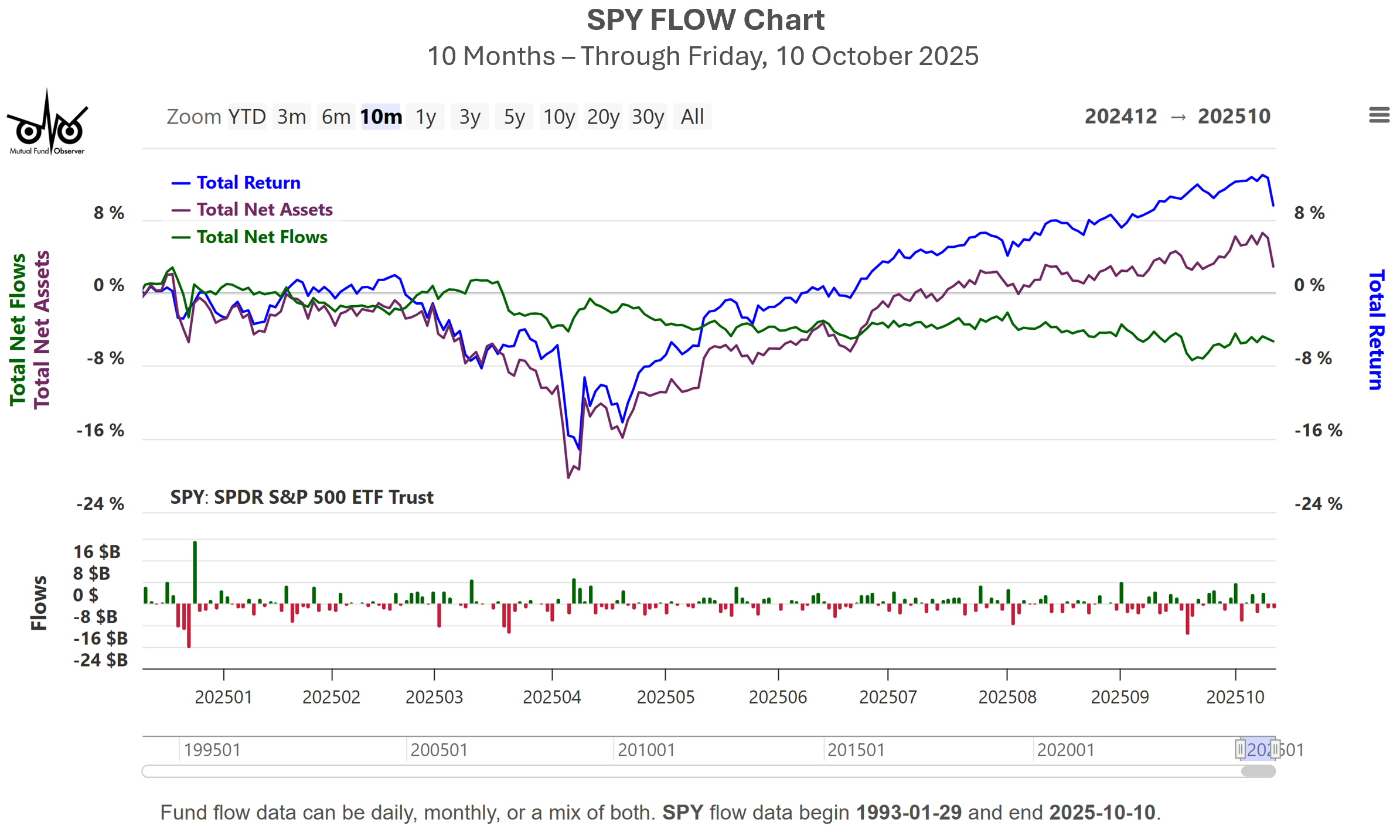
    Unlike April, bonds behaving normally again, seems like. After Friday's swoon, SPY -2.7% (QQQ -3.5%), pretty massive, as @Junkser points out. But TLT up an impressive 1.6%.
    +1
    I made money last Friday and my portfolio is at all time high.
  • I guess he didn’t learn from liberation day!
    Unlike April, bonds behaving normally again, seems like. After Friday's swoon, SPY -2.7% (QQQ -3.5%), pretty massive, as @Junkser points out. But TLT up an impressive 1.6%.
  • January MFO Ratings Posted
    Just posted all ratings to MFO Premium site, using Refinitiv data drop through Friday, 10 October 2025. Monthly flow tools updated through September and the daily FLOW tool updated through Friday, when stocks headed south.