Howdy, Stranger!

It looks like you're new here. If you want to get involved, click one of these buttons!

Here's a statement of the obvious: The opinions expressed here are those of the participants, not those of the Mutual Fund Observer. We cannot vouch for the accuracy or appropriateness of any of it, though we do encourage civility and good humor.
  • Current New Issue CDs
    Fido has similar CD rates for the 1 year at 3%, but the 10-year new issue CDs aren't that much higher at 3.80%. Would be nice to see longer-term CD rates well above 4%, then I would nibble....or maybe gobble.
  • the underreported boondoggle of fracking
    Thanks, @msf. Schwab is charging me 1.26% for my NTF A shares, SVFAX. I made an error in my post.
  • Your buy - sells July forward
    Sold all TCHP. Up 14+% since buying it about 4 weeks ago. Spread the proceeds around in cash & some more conservative holdings. (Suppose folks will start piling in now.)
  • Several Rockefeller Funds to be liquidated
    I have a small $ amount in the Rockefeller Climate Solutions Fund, which they set up from their LLP that has been running for several years. The Rockefeller foundation and family office have dumped XOM etc and are trying to make up for John D's creation of the global oil industry.
    As the press release below indicates, the fund is run by the Asset Management company. I don't know what the role of "Trust for Professional Mangers" is although there are a lot of other funds, some pretty well known on that list
    https://www.businesswire.com/news/home/20210923005097/en/Rockefeller-Asset-Management-Launches-Climate-Solutions-Fund-Expanding-Audience-for-Strategy-with-9-Year-Track-Record
    Rockefeller Asset Management Launches Climate Solutions Fund, Expanding Audience for Strategy with 9-Year Track Record
    September 23, 2021 08:00 AM Eastern Daylight Time
    NEW YORK--(BUSINESS WIRE)--Rockefeller Asset Management (RAM), a division of Rockefeller Capital Management, recently launched the Rockefeller Climate Solutions Fund (RKCIX), seeking long-term capital growth by investing in companies focused on climate change mitigation or adaptation solutions across the market capitalization spectrum. The Fund, which launched with nearly $100mn in assets and several underlying investors, was converted from a Limited Partnership structure with the same investment objective and a 9-year track record. In addition, the firm has partnered with Skypoint Capital Partners as the Fund’s third party wholesale marketing agent.
    “Climate change is becoming a defining issue of our time. We believe investors can generate alpha and positive outcomes by investing in companies producing climate mitigation or adaption solutions with distinct competitive advantages, clear growth catalysts, strong management teams, and attractive earnings potential.”
    RAM, in collaboration with The Ocean Foundation (TOF), established the Climate Solutions Strategy nine years ago based on the belief that climate change will transform economies and markets through changing regulation, shifting buying preferences from next-generation consumers, and technological advancements. This global equity strategy deploys a high conviction, bottom-up approach to investing in pure-play companies with meaningful revenue exposure to key environmental sectors such as renewable energy, energy efficiency, water, waste management, pollution control, food & sustainable agriculture, healthcare mitigation, and climate support services. The portfolio managers have long believed that there is significant investment opportunity in these public companies producing climate mitigation and adaptation solutions and that they have the potential to outperform broader equity markets over the long-term.
    Rockefeller Climate Solutions Fund is co-managed by Casey Clark, CFA, and Rolando Morillo, who lead RAM's thematic equity strategies, leveraging the intellectual capital built from RAM's three decades of Environmental, Social & Governance (ESG) investing experience. Since the inception of the Climate Solutions Strategy, RAM has also benefited from the environmental and scientific expertise of The Ocean Foundation, a non-profit dedicated to conserving ocean environments around the world. Mark J. Spalding, the President of TOF, and his team serve as advisors and research collaborators to help bridge the gap between science and investing and contribute to the strategies, idea generation, research, and engagement process.
    Rolando Morillo, Fund Portfolio Manager, says: "Climate change is becoming a defining issue of our time. We believe investors can generate alpha and positive outcomes by investing in companies producing climate mitigation or adaption solutions with distinct competitive advantages, clear growth catalysts, strong management teams, and attractive earnings potential."
    “RAM has been committed to continuously reinvesting in its investment team and ESG-integrated platform to support significant demand for its strategies, including thematic offerings like Climate Solutions, globally. The original LP structure was designed for clients of our family office. After nearly a decade, we are excited to make the strategy accessible to an expanded audience through the launch of our 40 Act Fund,” said Laura Esposito, Head of Institutional and Intermediary Distribution.

  • FOMC Statement, 7/27/22
    Among the post-FOMC data this week, Q2 GDP was yesterday (bad; -0.9%), and today were PCE (also bad; +6.8%, core +4.8%) and UM Sentiment (improved a bit to 51.5 from June low of 50 that spooked Powell at the June FOMC).
    https://www.cnbc.com/2022/07/29/inflation-figure-that-the-fed-follows-closely-hits-highest-level-since-january-1982.html
    https://news.umich.edu/consumers-adjust-to-inflation-as-labor-market-expectations-worsen/
  • Fund Allocations (Cumulative)
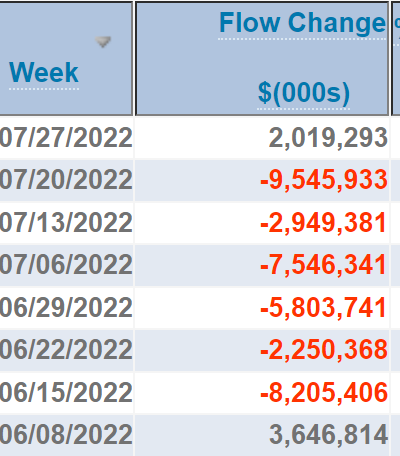
    Weekly equity fund flows have turned positive, Lipper data via WSJ tweet. https://twitter.com/GunjanJS/status/1552820684014948352
    image
  • Fund Allocations (Cumulative)
    @BaluBalu, the MONTHLY fund ASSET data only suggest that there MIGHT be equity fund outflows but other data do indicate outflows from equity and other fund categories, and inflows into m-mkt funds. The long-term asset pattern is that after the %Equity allocation bottomed in March 2020, it peaked in March 2022 and is now the lowest since. Other data:
    1. ICI WEEKLY data on fund FLOWS indicates steady fund outflows.
    2. Barron's WEEKLY data on 4-week moving average (4-wMA) of fund flows show outflows from stock and bond funds, and inflows into m-mkt funds (currently inflows of +$7 billion/week).
    3. Anecdotal data from posters here and other forums that they have sold or reduced stock/bond exposure and have moved into Treasuries, and lately into m-mkt funds.
    4. Rates have gone up and m-mkt funds are now starting to pay some interest.
  • Fund Allocations (Cumulative)
    Fund Allocations (Cumulative), 6/30/22
    There were notable declines in the equity fund allocations. The changes in the totals are based on a total OEFs & ETFs AUM of about $30.25 trillion in the previous month, so +/- 1% change is about +/- $302.5 billion. Also note that these changes are from both fund inflows/outflows & price changes.
    OEFs: Stocks 51.00%, Hybrids 7.14%, Bonds 21.50%, M-Mkt 20.36%
    ETFs: Stocks 80.33%, Hybrids 0.54%, Bonds 19.13%, M-Mkt N/A
    OEFs & ETFs: Stocks 57.35%, Hybrids 5.71%, Bonds 20.99%, M-Mkt 15.96%
    https://ybbpersonalfinance.proboards.com/thread/245/fund-allocations-cumulative-monthly?page=1&scrollTo=717
  • the underreported boondoggle of fracking
    It's worth noting that the linked piece is labeled as "Opinion," so it is not a news piece. Errors MSF pointed out aside, I think there is important information in it: Between 2010 and 2020, the cost of solar power fell 90 percent, and the cost of wind and battery power fell nearly as much. That kind of information matters if we're going to stave off climactic disaster and invest in a greener future. And there's no question in my mind that the coverage of Solyndra this opinion piece mentions was far more severe in many media outlets than that of Chesapeake.
  • AAII Sentiment Survey, 7/27/22
    Just an FYI -
    On June 1, Bear sentiment was at 37% and the Bear - Bull spread was only at 5%. The following week, those readings changed to 47% and 25%, respectively - not sure what the catalyst was but the readings got worse (58%, (3 SD) and 39%, respectively) when the June CPI report was released.
  • FOMC Statement, 7/27/22
    that there is only one company in the world presently capable of supplying the most advanced chip-manufacturing equipment
    A minor point - ASML is the clear leader in lithography, but the manufacture of semiconductors, broadly speaking encompasses four phases - lithography (the laying down of the pattern), etching (the actual carving out of the circuitry), deposition (depositing each layer of silicon to be etched), and polishing. If I'm a little off, it's been the better part of a decade since I did any real work in this field. And most of what I did was in etch, though we dabbled with litho - just enough for me to appreciate the complexity.
    As near as I can see (looking at ASML's website), it doesn't offer equipment for most of the steps.
    https://www.asml.com/en/products
    Then there's metrology - the equipment used to take measurements at various phases.
    https://sst.semiconductor-digest.com/2018/02/top-semiconductor-metrologyinspection-equipment-vendors-continue-to-increase-share-of-total-market/
    Don't forget the software, APC/SPC.
    https://www.lntinfotech.com/blogs/advanced-process-control-semiconductor-manufacturing/
  • the underreported boondoggle of fracking
    I completely agree that the focus on numbers is wrong. I didn't pick it. The thesis of the opinion piece was that from a financial perspective, fracking is a sham.
    A piece that presents readers with dubious assertions creates impression that it can't make its case objectively. It is easy to attack, especially by those with an opposing perspective. Ultimately it is harmful as it doesn't persuade and leaves readers suspicious.
    I don't appreciate hit pieces on any side of any issue. They're problematic regardless of whether they are more prevalent on one side or another.
    Aside from all of that ISTM that it was worth the space saying a little bit about how one looks at cash flows, capital intensive investments, and tax subsidies. There are a number of people investing in MLPs getting "tax free" payments courtesy of the industry's tax breaks: K-1 line 1 ordinary income "May be negative in early years due to accelerated depreciation, but become positive over time."
    https://tortoiseecofin.com/media/2581/the-abcs-of-mlps_053018.pdf
    2020 - the year that oil futures turned negative. If there was any time in the past few years that the industry would go through a shake out, that was it. OTOH, the piece you cited states that between 2015 and 2020 the industry filed more than 500 bankruptcies. So while the 107 given for 2020 may have been the high for that time span, it doesn't seem that far out of line with the other years.
    Again, a frame of reference would help. What is the size of the companies that failed? What percentage of the industry did that represent? The point of the original piece was that "fracking companies" were not profitable, yet aside from Chesapeake which was pretty much a pure play, what even constitutes a fracking company? Haliburton? Schumberger? Are oil companies the same as fracking companies or are we conflating things here? (That was another problem with the original piece.)
    harmful emmissions should not only be measured but taxed significantly.
    Maybe, or maybe cap and trade would work better. They're not quite the same, and sometimes one can be better than the other. (The former sets the price of emissions and lets the market decide the amount, while the latter sets the amount and lets the market set the price.) Of course in the end either is far superior to the status quo.
    https://www.brookings.edu/blog/planetpolicy/2014/08/12/pricing-carbon-a-carbon-tax-or-cap-and-trade/
  • the underreported boondoggle of fracking
    @MSF I don't doubt your numbers, but I do doubt your focus, given what's at stake environmentally. Part of the problem with finance's fixation on traditional cash flow metrics is it ignores the triple bottom line and the old saying what gets measured gets managed applies. This is why the SEC's movement to force each company to provide comparable statistics on their carbon emmissions matters. And those and other kinds of harmful emmissions should not only be measured but taxed significantly. Not only that but the total carbon/environmental impact of products manufactured should be measured. What then would the fossil fuel industry's cash flow be when adjusted for environmental and social impact? I am aware of course that no industry including for instance solar panels is impact free. Yet the right wing's fixation on alternatives and ESG every time there's a problem like Solyndra is far more of a hit piece if you ask me. Consider another potential "hit piece" comparing Solyndra to the military: https://vox.com/2015/1/5/7490593/F-35-vs-solyndra The fact is we should be investing in real alternative fuel sources whether they're good short-term financial investments or not. That should be the focus. Despite our missions to Mars, there still is no planet B. I would also add that Chesapeake's problems were not an isolated incident: https://ogv.energy/news-item/over-100-oil-and-gas-companies-went-bankrupt-in-2020
    @WABAC Although the technology may have advanced since this article was published, as far as I know biofuels are not an adequate environmentally-friendly solution: https://scientificamerican.com/article/biofuels-bad-for-people-and-climate/
  • FOMC Statement, 7/27/22
    The Netherlands company to which I referred, ASML, is currently up 4.8% today, while the general technology index is down some 2.3%.
    That would seem to suggest that the market is reacting to conditions specific to the chipmaking industry and has little to do with "MSFT's unexpectedly strong guidance".
    Disclaimer: I currently hold a position in ASML.
    Hmmm...scoring at home, that would indicate to me at least that ONE company is outperforming today but it has little-to-no positive effect on the overall market.
    You're a bright guy and a great resource of info. But you are wrong about this point.
    Yesterday was a Fed and Big Tech move as shown in the link and detail I provided.
    Today? Market is DOWN 0.40%. Tech is DOWN 0.40%. But semis are DOWN 1.40%.
    How does your thesis explain that?
    I can link at least 20 articles that the writers/analysts opined yesterday's market move was largely due to overall tech strength (esp GOOGL and MSFT) and the Fed doing what it was expected to do, along with positively received comments by Powell.
    But why bother? It's widely accepted as the reason for yesterday's sharp move UP. The semi news was simply a small cherry on top. End of the debate for me.
  • the underreported boondoggle of fracking
    For a variety of environmental reasons, I'd like to see the end of fracking. But that doesn't diminish the appearance of the cited NYTimes Op-Ed piece as a polemic, grounded in misleading, cherry picked data.
    Start with the except quoted. Here's an alternative description of 2014, just as factually accurate and just as misleading: With oil prices plummeting over 50% in 2014, it's not surprising that the oil industry failed to make a profit that year.
    Is it really true that the domestic industry cannot make a profit with oil at $100/bbl? A graphic by the Dallas (yes, I know) Fed asserts that oil companies can make a profit on drilling new wells at WTI prices ranging from $48 to $69 depending on the oil field (including fracking). See p. 35.
    https://www.dallasfed.org/-/media/Documents/research/energy/energycharts.pdf/
    The Op-Ed piece draws your attention to oil, while using Chesapeake as a poster child. What it doesn't say is that Chesapeake "was far slower than many of its peers to pivot to tapping shale formations for oil, which turned out to be much more lucrative than gas."
    https://www.wsj.com/articles/fracking-trailblazer-chesapeake-energy-files-for-bankruptcy-11593374287
    What caught my eye in the Times Op-Ed was this part: "Previously, from 2002 to 2012, Chesapeake, the industry leader, didn’t report positive cash flow once, ending that period with total losses of some $30 billion"
    Negative cash flows are to be expected in capital intensive industries when they first start out. They have to put a lot of cash into equipment and oil fields for payoffs down the road. It's a balancing act. Expand too slowly and you get killed by fixed costs. Expand too rapidly and you're crushed by debt. The WSJ I cited reports that Chesapeake failed the latter way: "Chesapeake’s breakneck growth left it highly leveraged." That's an indictment of Chesapeake management (ousted by Icahn in 2013), not of the industry.
    Let's talk about that $30B in losses for 2014. While I'm not fond of non-GAAP figures, in some industries one should also look at EBITDA. The oil industry gets tremendous subsidies from the federal government in the form of accelerated depreciation and depletion allowances. It is curious how this taxpayer subsidy is not mentioned. Perhaps because it could call the dollar losses into question - are these real losses or just financial manipulations?
    $30B is surely a ton of money, but it's presented for shock value without a frame of reference. Here's one (also misleading, but in the other direction): while the industry leader lost $30B in ten years (in a capital intensive industry where it invested for the future), Uber lost the same amount of money in just five years, spending that money not on capital but on capturing market share. They lost money on every ride but made it up in volume.
    Limited cites to data, no links given (e.g. "the single best and most thorough account of the fracking boom", so the writer says); this stands in stark contrast to copious citations and links presented for environmental concerns. Not even a link to a Chesapeake financial statement? (Here's the 2014 10K, showing a $2B net profit, even after writing off $2.7B in depreciation, depletion, and amortization.)
    The conclusion may be right or wrong. One can't tell because in the end, this is just a hit piece.
  • Mystery no more: Portfolio allocation, income and spending in retirement
    How do people manage their income and spending in retirement? How do they adjust their asset allocation as they transition into retirement? Certainly, there is survey data on the subject and much informed speculation. Yet the full picture—based on empirical evidence that shows how people actually behave—has remained elusive.
    JPMorgan Chase data for around 62 million households, we studied 31,000 people as they approached and entered retirement between 2013 and 2018.
    This data offers the very first holistic financial view of households in transition. From it, we created a rich mosaic showing retirees’ income, spending and wealth. Real data about real behaviors, we believe, can deliver the most useful insights.
    The research reaffirmed some of our assumptions and in other ways proved surprising.
    retirement-insights/retirement-portfolio-allocation
    Study was commented on in this retirement blog:
    The study was a rare look into how 31,000 people manage their money in retirement. Not surprisingly, a lot of people seem to be making some mistakes (no Roth conversions come to mind). It’s understandable, given the complexity of the topic and the reality that learning to manage your money in the “decumulation phase” is an entirely different skill set than those used in the “accumulation phase.”
    how-real-people-manage-their-money-in-retirement/
  • FOMC Statement, 7/27/22
    BIG surprise this morning is NEGATIVE Q2 GDP! That is 2 quarters of negative GDP now. Atlanta Fed GDPNow has been predicting that for a while.
    When Powell was asked yesterday about it, he said that he had no clue about GDP but don't trust 1st reported GDP as it can be revised. I thought that was a weird comment, but on hindsight, he was already addressing possible negative Q2 GDP. He even said that he doesn't think that the US is in recession now. But this debate will start fresh.
    https://www.cnbc.com/2022/07/28/gdp-q2-.html
  • Several Rockefeller Funds to be liquidated
    Midwest-based "Trust for Professional Managers" runs several funds subadvised by other advisors. Apparently, the funds run by "famous" Rockefeller & Co. LLC are being shut due to their poor records.
    https://docoh.com/company/1141819/trust-for-professional-managers
    https://sec.report/CIK/0001141819
  • AAII Sentiment Survey, 7/27/22
    For the week ending on 7/27/22, Sentiment continued to improve: Bearish remained the top sentiment (40.1%; high) & bullish became the bottom sentiment (27.7%; low); neutral became the middle sentiment (32.2%; near average); Bull-Bear Spread was -12.4% (low). Investor concerns included recession; inflation & supply-chain disruptions; the Fed/FOMC (rate raised +75 bps; more hikes to come; QT continues); market volatility (VIX, VXN, MOVE); Russia-Ukraine war (22+ weeks); geopolitical. For the Survey week (Thursday-Wednesday), stocks were up, bonds up, oil down, gold up, dollar down. #AAII #Sentiment #Markets
    https://ybbpersonalfinance.proboards.com/thread/141/aaii-sentiment-survey-weekly?page=7&scrollTo=716
  • What's on your buy list?
    I will be adding to ET. The share price is still below my current cost-basis. The political feces everywhere is resulting in good results on my investment in that stock. I see Analysts estimating Fair Value between $15 and $17. That's about a 30% upside. With the regular dividends, I intend to just let it ride, long-term. QAT might be a target for a small amount.