
It looks like you're new here. If you want to get involved, click one of these buttons!
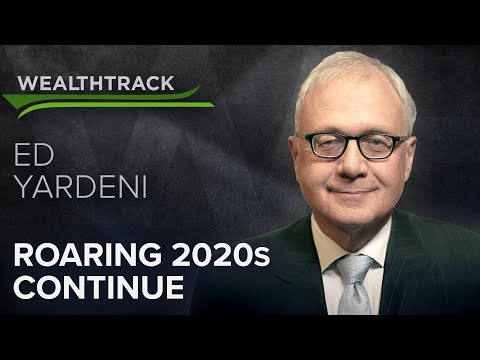
In 2020, influential strategist Ed Yardeni predicted the economy & markets were entering a “Roaring 2020s” decade. So far, he’s proven the naysayers wrong. He explains why the economy should continue to expand and the markets to advance in 2026 and beyond.
© 2015 Mutual Fund Observer. All rights reserved.
© 2015 Mutual Fund Observer. All rights reserved. Powered by Vanilla
Comments
since yardeni never makes unambiguous prospective recession\depression calls, i have have a hard time attributing his 'buy major index' strategy to much other than using the trend factor.
Until the market broadens out to the other 493 stocks, what keeps the Mag 7 stocks going in 2026?
Edit:. The circular investment among the AI companies is worrisome. Is Oracle’s earning report this week a sign of something big to come ? .
Add: Yardeni is cited in this week's Barron's as making that "roaring market" call with specificity only through 2026. With only a 1 year window I don't think I'll mortgage my home and throw it all into stocks.
My take on all of this - "Newton's first law states that every object will remain at rest or in uniform motion in a straight line unless compelled to change its state ..."
Often stated as ...
"Don't buck the trend"
"Go with the flow"
"Don't fight the market"
"Don't fight the Fed"
"The trend is your friend"
"Past is prologue"
"Take the path of least resistance"
"It's hard to stop a moving locomotive"
"Up Up and Away (in my beautiful balloon)"
Here are a few more...
"The Market Climbs a Wall Of Worry" and six more:
https://schwab.com/learn/story/wall-street-jargon-7-market-cliches
JPMorgan's take on this recent "wall of worry":
https://privatebank.jpmorgan.com/eur/en/insights/markets-and-investing/tmt/wall-of-worry-markets-are-climbing-it-anyway
Siegel basically has 2 long term opinions
1) Mr. Siegel is stocks perma bull. He has 2 main predictions annually: stocks will make money next year.
2) Stocks will make more than bonds.
The above is not a brain surgery, just common sense BUT NOTHING MUCH because
1) The SP500 was up over 80% in the last 40 years. He has no clue what % the SP500 will go up or what years will go down. Generic 10% range predictions don't mean much
2) Of course, stocks will make more than bonds, they have that for decades, especially when the 10 year treasury went to 0.5% in 2020...duh.
Stocks:
As expected, Siegel was wrong every down year
1) 03/2001 (link): about stocks "they are probably a better bet now than they were a year ago. You can buy them at cheaper prices.” FD: from 03/2001 to 09/2002, which is about 1.5 years, the SP500 lost over 22%, see (link)
2) 2008 (link) "I think the stock market will have another winning year in 2008." FD: The SP500 fell more than 50% and finish 2008 at -37%.
3) 2018 (link): U.S. equities will end the year with gains of as much as 10%. FD: the SP500 was negative at -4.5%.
4) 2019(link) "Jeremy Siegel says stocks could rally between 5 and 15 percent in the new year." FD: the SP500 made 31.5% more than double of what Siegel predicted.
These self-aggrandizing individuals should attempt to write a book as influential as Stocks for the Long Run.
Perhaps this book would be named Bonds for Brief Periods?
Named after Farken Dumass, a rando who prowled investment websites for decades, and was often the subject of much derision. It came to be recognized as a subset of narcissistic personality disorder.
- Ed's been in the investment business 40 years. (I've been investing for longer - over 55 years - but won't hold that against him.)
- Ed draws many parallels between today's markets and the 1920s.
- Importantly, many have predicted a recession during this decade but none has occurred, nor does he see one coming.
- In the 1920s there were no recessions until the end of decade.
- His biggest regret is not having poured 100% of his money into the NASDAQ and shut his eyes decades ago.
- He sees the prolonged rapid rise in the equity markets as similar to the 1920s and highly stimulative. Should that upward momentum go into reverse, he concedes it could trigger a recession.
- He notes friends and relatives are taking expensive cruises and inviting him along. He declines because he gets seasick easily. However, these friends' stock portfolios are growing faster than they can spend them down.
- He sees even 4% on money market funds as stimulative. Savers are being rewarded much more now than 5-10 years ago when rates were near zero and then spend the extra money.
- He makes brief reference to the resumption of QE (bond buying) by the Fed, characterizing it as creating "instant money" out of thin air.
- He focuses on dramatic increases in productivity. In tech he remembers having to load data into computers by manually punching holes in cards.
- He sees the Fed as having the back of investors. They learned their lesson in '07-'09 and now know how to prevent such disasters.
- He mentions Trump's talk about sending out tariff rebate checks and appears to think such talk alone is stimulative; it's also emblematic of the degree to which the Administration will go to spur growth.
- Overall, Ed sounds like a raging bull. He "can see" the S&P 500 at 10,000 by decade end.
- However, his crystal ball appears clear at best only out to about a year. He often hedges by saying, "I'm assuming" ... I'm assuming ..."
Thanks for linking these interviews @bee / Mack attracts some excellent guests. (It should go without saying that I don't necessarily agree with Ed Yardeni.)