
Howdy, Stranger!

It looks like you're new here. If you want to get involved, click one of these buttons!

Here's a statement of the obvious: The opinions expressed here are those of the participants, not those of the Mutual Fund Observer. We cannot vouch for the accuracy or appropriateness of any of it, though we do encourage civility and good humor.
  • "Markets have false sense of security"
    Today's Ed Yardeni column is titled : "Soft Patch Getting Softer Possibly Raising Odds of Fed Rate Cut in September & Stock Market Meltup"
    Bad news is good news. until...bad news is bad news?
    [S]aid Mr. Dooley, “no matther whether th’ constitution follows th’ flag or not, th’ supreme coort follows th’ iliction returns.
    Perhaps the Fed anticipates them?
  • "Markets have false sense of security"
    Today's Ed Yardeni column is titled : "Soft Patch Getting Softer Possibly Raising Odds of Fed Rate Cut in September & Stock Market Meltup"
    Bad news is good news. until...bad news is bad news?
  • WealthTrack Show
    Thanks @bee. I particularly like Ed Yardeni. Short summary:
    1. AI is a mathematical tool. His early adaptation to AI for writing monthly reports have encountered many errors. Cited several cases where AI encountered its limits on reliable usage.
    2. Fewer rate cuts than expected due to strong consumer demand and tight labor market.
    3 Concerns the worsening geopolitical conflicts across the globe with the adversaries such as Russia, China, etc. Recent rise of autocratic development including those in US are particularly alarming.
    4. Still favors US stock market over foreign market, particularly S&P1500 to have exposure of mid and small cap stocks.
    As an economist and Fed watch, Yardeni’s assessment is much more reliable compared to other pundits.
  • WealthTrack Show
    March 3oth Epsiode:
    Ed Yardeni tackles why AI isn’t intelligent, economists have been so wrong and the bull market could continue.

  • WealthTrack Show
    Additionally, Yardeni see a broadening of the market beyond the large tech. He recommends S&P 1500 (so to include the smaller caps). Likely there is “no landing” this year since US economy is moving along well and low employment.
    Yardeni is the most bullish comparing to the most that I come across.
  • WealthTrack Show
    Hopefully, the end of this bull market will not be reminiscent of the Stock Market Crash of 1929!
    Ed Yardeni states that the economy and consumers are doing well.
    He believes there are opportunities available in tech, industrials, financials, and energy.
    Mr. Yardeni's "one investment for a diversified long-term portfolio" is the S&P 1500.
  • WealthTrack Show
    March 8 Episode:
    Why leading strategist, Ed Yardeni says this bull market is reminiscent of the 1920s when stock prices soared, the economy was growing and technology was leading the way.
    Podcast:
    https://soundcloud.com/wealthtrack/the-roaring-2020s
  • Interview with Ed Yardini
    The Roaring Twenties May Be Back (44 minutes)
    Featured on Bloomberg recently. A half-decent, thoughtful appraisal of the current global investment climate. Yardini lays out several different scenarios going forward and offers up some “odds” on each occurring.

    “Dr. Ed Yardeni is the president of Yardeni Research, Inc., a provider of global investment strategy and asset allocation analyses and recommendations. He previously served as chief investment strategist for Oak Associates, Prudential Equity Group, and Deutsche Bank's US equities division in New York City. Dr. Yardeni taught at Columbia University's Graduate School of Business and was an economist with the Federal Reserve Bank of New York. He is frequently quoted in the financial press, including the Wall Street Journal, the Financial Times, the New York Times, the Washington Post, and Barron's.” Source
  • S&P Enters Bull Market
    There’s a pretty bullish article in Barron’s this week supporting that cover (”The Next Bull Market is Here. Don’t Miss Out”). Brian Belski & Ed Yardeni are cited as proponents of the bull thesis. Of course, it’s all conjecture. But they’re putting their a** on the line to an extent. Could come back to bite them. They’re pretty good about owning up to mistakes. My take is they (Barron’s) are often very premature in their calls (about a year early with home builders) but usually get it right longer term.
  • Wealthtrack - Weekly Investment Show
    Wealthtrack - 04/28/2023
    We continue our interview with Ed Yardeni, an experienced economist, strategist, and Fed watcher who has been closely following the Fed throughout his 40-year investment career.
    Yardeni is the author of “Fed Watching for Fun and Profit: A Primer for Investors” and head of his own global investment strategy firm, Yardeni Research. He believes that anticipating the actions of the Federal Reserve System's Federal Open Market Committee (FOMC) is critical to successful investing.
    Despite the historically aggressive pace of interest rate hikes over the past year, Yardeni thinks the Fed is done hiking interest rates for now. We will discuss whether "Don't Fight the Fed" still works as an investment strategy.

  • AAII Sentiment Survey, 3/29/23
    I saw that on Twitter. But +20% from the recent lows applies only to Nasdaq 100 QQQ/$NDX from the late-December lows, and not to Nasdaq Comp ONEQ/$COMPQ. Other major indexes had their lows in October and are still struggling.
    Ed Yardeni, neither a perma-bull nor a perma-bear, now has 4,600 for SP500. I am watching 4,300-4,600 range myself to do some asset reallocations. https://ca.finance.yahoo.com/news/us-stocks-could-end-14-110609639.html
  • Minimizing Tesla exposure
    Bet against it inverse tsla if think more downtrends
    #Tsls
    My personal opinion is that it reached oversold states, macd crossed over, and at near 2yrs low points.... Very difficult bet against it now
    Lots analyst predictions could be 200s 300s by 12 24 months. 2030 maybe near 1000 per share. Very difficult bet against best EV Company long term
    So much speculation
    **'*Forward PEG Ratio Valuation [Updated Dec 14, 2022]
    ☑️ S&P 500: 1.6
    ☑️ S&P 500 Tech: 1.8
    Tesla
    ($157/$5.52)/48 = 0.59
    $TSLA fair market PPS = 1.8 * 48 * $5.52 = $477 ~ 3x of current price
    Ref:
    https://yardeni.com/pub/spearnrevalgrpeg.pdf
    $TSLA estimate was from on YF, next 5y growth of 48%***
    Been adding LCID TSLA + chips-techs Small amt past weeks
  • Why 2022 Has Been Such a Terrible Year for Bond Funds
    Folks (not just @hank), when you quote something, or even just state a figure, please give the source. The quote above seems to have come from here:
    https://lplresearch.com/2022/05/24/how-do-bonds-perform-during-and-after-equity-bear-markets/
    I gave figures for 10 year Treasuries. One can't get higher grade than that. Though both longer and shorter term Treasuries are included as well in aggregate figures.
    Below is the data table in the quoted piece. For many reasons (enumerated below) I discount it. The conclusion given may or may not be correct, but it is not well stated and the arithmetic is suspect.
    image
    Issues:
    1. "Falling" market, as hank described it, is different from "equity bear markets", which is in the text. However, the data itself covers "Bear (And Near Bear) Markets". This fuzzy definition doubles the number of data points (increasing the number of rows from 6 to 11).
    For bear markets and corrections, see p. 4 here:
    https://www.yardeni.com/pub/sp500corrbeartables.pdf
    2. It uses a fairly short time frame (Yogi and I provided data over twice as many years).
    3. The "average" values in the chart are unweighted. A "bear-ish" market of one month 2/19/20 to 3/23/20 counts as much as a "bear-ish" market of 2½ years 3/24/2000 to 10/9/2002. Arguably weighting is incorporated by using cumulative returns (i.e. total return over each bear-ish market), but that just fixes (weights) the numerator without adjusting the denominator for the mean.
    4. The medians are dubious. With 11 rows, the (unweighted) median should be the 6th highest (or 6th lowest) figure in each column. That's what is presented for the first column (1.8). But in the other columns, the median isn't a value in the column, let alone the middle one.
  • Importance of Consecutive 90% Down Days ????
    Dr Ed Yardeni is generally bullish but is not a perma-bull. His data oriented website has some open access. He does built his own estimates bottoms up (like Scott Black) and I find that to be useful info.
  • Importance of Consecutive 90% Down Days ????
    @yogibearbull and anybody else in the know,
    I started coming across Ed Yardeni commentary only recently and wanted to check with the MFO community if Ed Yardeni is considered as having a bullish or a bearish bent or is it difficult to label him that way?
  • Importance of Consecutive 90% Down Days ????
    While the fwd P/E for small-cap (SC) R2000 has dropped dramatically, R2000 has many unprofitable companies (30-40% ?). Looking at more selective SP MC 400 and SP SC 600, those fwd P/Es have also dropped dramatically. See these charts by Yardeni via a Twitter post,
    https://twitter.com/ayeshatariq/status/1538469641722413062
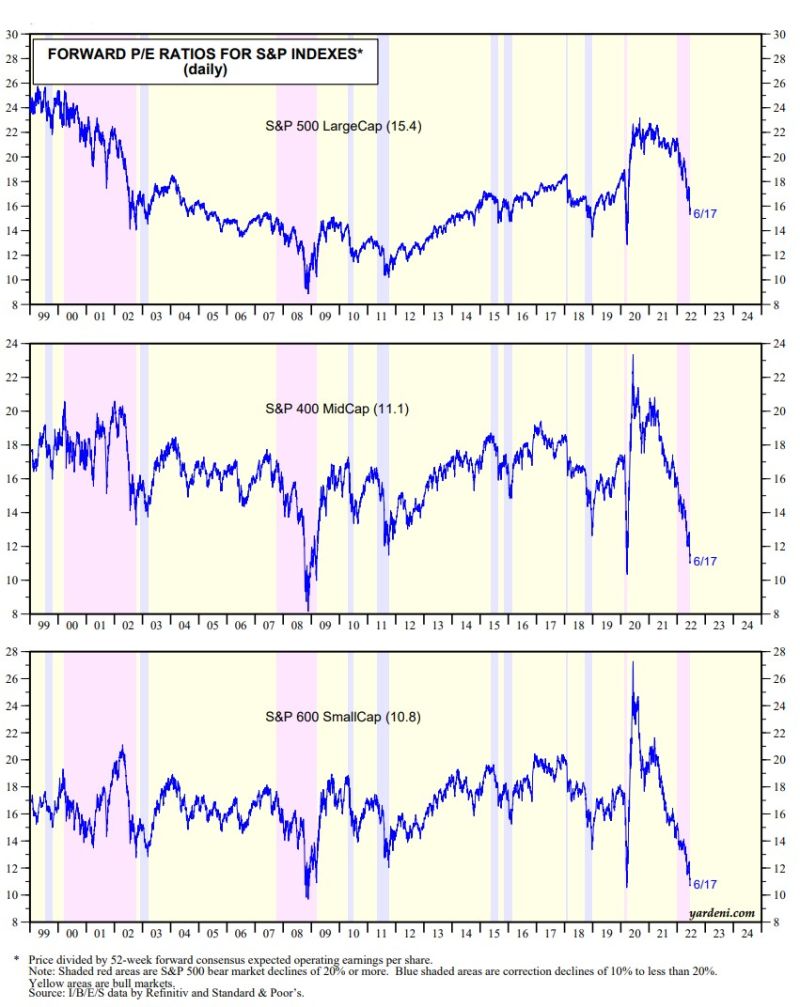
    image

    The Russell 2000 is a flawed benchmark.
    As was mentioned, it includes many unprofitable companies since it doesn't screen for profitability.
    Also, the Russell 2000 index reconstitution process enables front-running.
    The S&P 600 is a better small-cap index.
  • Importance of Consecutive 90% Down Days ????
    While the fwd P/E for small-cap (SC) R2000 has dropped dramatically, R2000 has many unprofitable companies (30-40% ?). Looking at more selective SP MC 400 and SP SC 600, those fwd P/Es have also dropped dramatically. See these charts by Yardeni via a Twitter post,
    https://twitter.com/ayeshatariq/status/1538469641722413062
    image
  • Move the Inflation Goal Post to +4.7% Avg - Yellen
    This was in Barron's, 5/30/22, LINK
    "ECONOMY. Soft-landing or hard-landing/recession? The economic data are pointing to SLOWDOWN – home sales, household savings, PMI, jobless claims, Atlanta Fed GDPNow, business inventories, layoffs, consumer confidence, rents/owners’-rent-equivalents. Rising fed fund RATES and QT combo will result in strong monetary tightening. A way out may be for the FED to just move its average inflation target from +2% to, say, +4%, so say several strategists and economists (YARDENI, own firm; ROMER, NYU; El-Erian, Allianz). Fed’s favorite inflation indicator PCE already lags others, and it is down to +4.9%, not far from +4%."
  • Barrons question
    @shipwreckedandalone, in its Market Laboratory data tables, Barron's publishes TRAILING P/Es for indexes and the current edition has for SP500 as 25.02. I don't think Barron's presented fwd P/E for major indexes in these data tables. It does have fwd P/E for Barron's 50 weekly and that is 21.20.
    But fwd P/E for SP500 is often mentioned within Barron's articles that in the current edition is 19.6 (Trader column).
    M* has fwd P/E for SPY as 20.1, for VOO 19.7 (the difference not accounted by their ER difference).
    Yardeni has fwd P/E for SP500 as 19.7 and also has a chart for P/E. Analysts may differ on this based on their outlook. Notably, Yardeni develops his own estimates. https://www.yardeni.com/pub/stockmktperatio.pdf