





On September 24, 2025, MFS Investment Management launched the MFS Active Mid Cap ETF (MMID), bringing one of the firm’s most seasoned mid-cap strategies into the ETF wrapper. The fund represents a straightforward translation of MFS Mid Cap Value – a strategy portfolio manager Kevin Schmitz has managed since 2008 – into a more tax-efficient and accessible structure. What distinguishes MMID is not novelty but pedigree: a 17-year track record, a manager who joined MFS as an equity analyst in 2002 and has spent more than two decades refining his craft, and an investment discipline that balances fundamental analysis with valuation awareness without resorting to leverage, derivatives, or sector timing.
The strategy seeks what Schmitz describes as “business quality and durability” – characteristics he believes are often overlooked in the mid-cap space. The approach combines bottom-up fundamental research (drawing on MFS’s 300+ investment professionals) with a focus on free cash flow per share growth as the primary driver of long-term returns. This isn’t a pure value fund chasing the cheapest stocks, nor a growth fund willing to pay any price for momentum. Instead, it occupies that middle ground where companies have established business models and competitive positions but haven’t yet commanded the premium multiples of large-cap darlings. The portfolio typically holds 40-60 positions with modest turnover (the mutual fund version shows 27% annual turnover), suggesting a patient approach to building positions and allowing these to play out.
MFS brings considerable credibility to this effort. The firm launched the first U.S. mutual fund in 1924 and manages $644 billion across its platform. While MFS entered the ETF space only in December 2024, it has taken a conservative approach: converting proven mutual fund strategies rather than creating new products. The parallel mutual fund strategy (available in multiple share classes, including MCVIX and MVCKX) manages over $17 billion and earned Morningstar’s Gold rating as of late 2025, along with a four-star overall rating and “Above Average People” and “High Process” pillar ratings. Morningstar analyst David Carey noted in October 2025 that the fund’s “capable managers and best-in-class approach” merited those elevated assessments.
The fund has a sort of T. Rowe Price vibe to it – a pretty consistent singles hitter that rarely strikes out. A close look at the strategy’s performance metrics over the past 16 years leads to words like solid, sensible, self-aware, and reliable. Among 30 mid-cap value funds with track records extending back to 2009, the MFS strategy ranks in the top quartile for risk-adjusted returns (Sharpe ratio of 0.64, sixth-best in the peer group) while delivering above-average absolute returns (11.6% annually, seventh-best, and about 0.9% above its peers). The maximum drawdown of -30.9% sits squarely in the middle of the pack – neither especially protective nor especially vulnerable. The capture ratios tell a similar story; it’s a bit better in both up and down markets than its Lipper peers. It captures: 94% of the S&P500’s gains in up periods (93% for peers), 107% of its losses in down periods (112% for peers). This isn’t a fund that will shoot the lights out or provide exceptional downside protection. It’s a fund that shows up, does the work, and delivers respectable results year after year.
We charted MFS against the iShares Russell Mid-cap Value ETF (IWS) for the 16 years since the current MFS team settled in. The MFS and Russell Midcap Value lines track each other closely for most of the 16-year journey, rarely diverging dramatically. But by November 2025, that initial investment had grown to $77,373 in the MFS fund versus $68,410 in the index – roughly $9,000 of additional wealth created not through heroic outperformance but through the quiet compounding of consistent, modest edge.
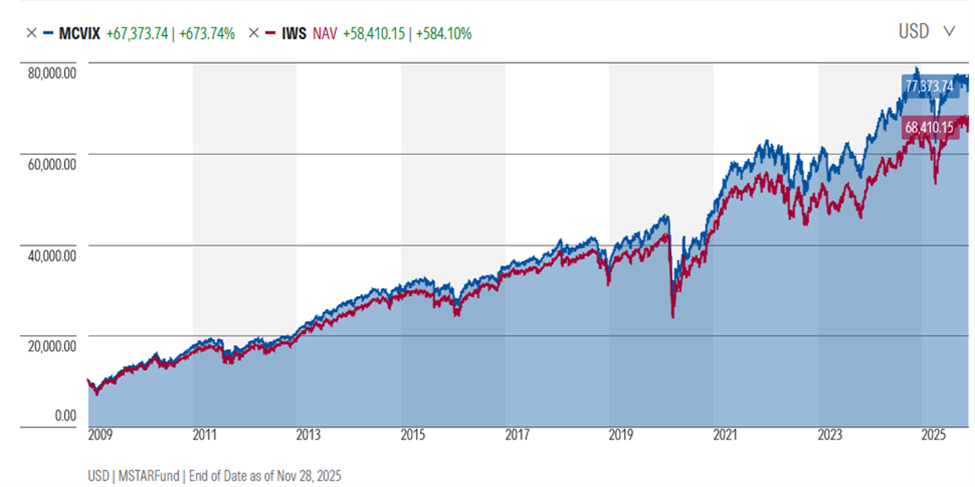
Since Taylor and Schmitz shaped the portfolio to their liking in January 2009, the mutual fund’s 12.8% annualized return through September 2025 slightly edged the Russell Midcap Value Index’s 12.5%. Impressively, the fund has never finished in the bottom quartile of the mid-cap value category in any calendar year since 2009 – a testament to the managers’ consistency if not their ability to deliver exceptional protection during market stress.
Doubters might glance at 2025’s results and conclude the strategy has lost its edge. Through November, the fund’s institutional share class gained 6.1% against the index’s 9.25% rise, lagging 73% of mid-cap value peers. Three holdings – Newell Brands, Ashland, and Teleflex – fell more than 30% and weighed on returns. Perhaps more significantly, the managers’ refusal to own richly valued names like Robinhood and Coinbase, two of the index’s largest and best-performing constituents, cost them dearly in relative terms. But this is precisely the discipline that has kept the fund from landing in the bottom quartile over nearly two decades. The managers are willing to accept short-term underperformance rather than chase expensive stocks into dangerous valuations. As Morningstar’s David Carey noted in his October 2025 assessment, “While the recent performance stings, the managers are sticking to their time-tested approach, and long-term investors should be rewarded.”
The bottom line
MMID charges 0.59% annually, 40 bps less than the fund’s retail “A” shares, and has gathered roughly $26 million in assets since launch. For investors seeking mid-cap exposure through active management, this fund warrants serious consideration.
The mid-cap space has historically offered better risk-adjusted returns than large caps with only modestly higher volatility, and it remains underrepresented in many portfolios despite constituting roughly 15% of market capitalization in cap-weighted indices. An investor looking to add dedicated mid-cap exposure – whether as a substitute for a portion of their large-cap core holdings, as a complement to existing large-cap and small-cap positions, maybe as a tactical overweight to an underappreciated market segment – owes it to themselves to put MMID on their shortlist for further research. The 17-year record of the parallel mutual fund provides substantial evidence for evaluating how this discipline performs across market cycles: consistent, competent, rarely brilliant, almost never disastrous. It will, I think, prove a compelling option for investors who value reliability over flash and who are building portfolios meant to compound steadily rather than swing for the fences.
