
Hi, Layla.
Chip and I are grateful for the help you’ve given us in learning to be a bit more physically fit, and we were delighted to hear that you were interested in learning a bit about … umm, financial fitness. I know it seems confusing and infinitely complex.
It isn’t. Really, you just need to have a bit of faith, a bit of discipline, and a willingness to get started. Not that hard. And, happily, many of the disciplines that you’ve learned as a physical trainer carry over almost perfectly into understanding this new adventure.
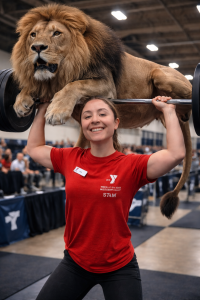 About Layla
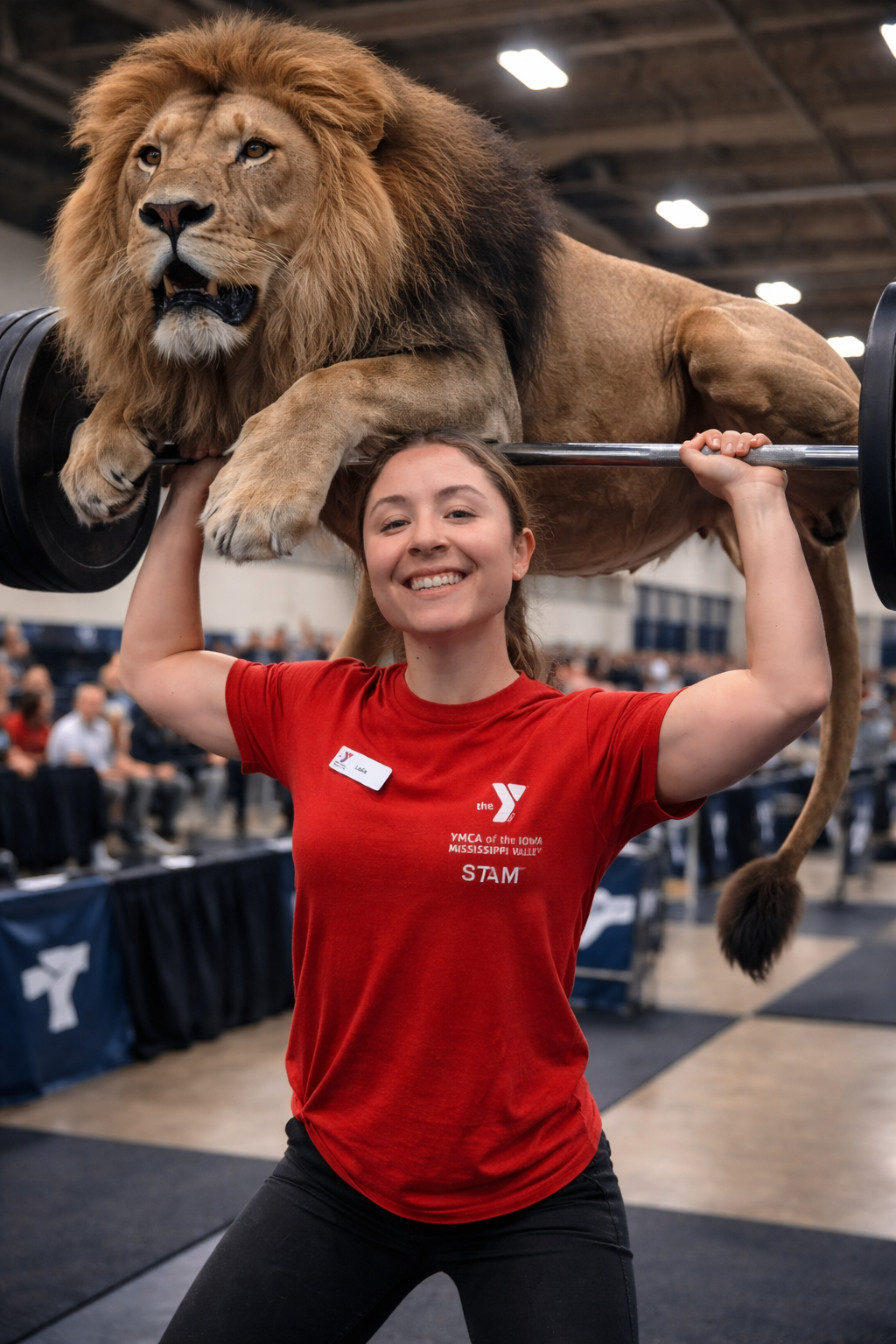
Layla Summerhays, a native Utahan, is an NASM Certified personal trainer and a staff trainer with the YMCA of the Iowa Mississippi Valley. Chip and I began working with Layla in September 2026. When we aren’t completely out of breath, we chat about life and goals, plans and aspirations. Recently, Layla volunteered that she had pretty much mastered the household budget, had set for herself the goal of learning about investing, but wasn’t quite sure where to start. I popped my hand up, at least in part to distract her from overseeing another round of “dislocators” and “dead bugs.” (Gym people have such a way with words.
This letter is written, in part, as thanks to Layla for all her time and patience in trying to help Chip and me reach one set of goals. It seemed only fair to help her learn to meet another. In a larger sense, of course, this is gentle guidance and cheerleading for an entire generation of young people who are so inundated with noise and racket – inexplicable headlines about cryptocurrencies and meme stocks and imminent catastrophes – that they’ve lost faith in their own ability to do one, simple thing: take the first step.
And so, to them all, have faith. Be brave. For now, you just need to set your feet on a path, breathe, and take one step forward. You’ve got this.
What sorts of things? Oh, start by finding the place that matches your needs – not all of us need the $300/month for access to Equinox (who knew?), have an honest talk about your needs and challenges, make a plan, start gradually, and build as you get comfortable and, most of all, be ready to forgive yourself. There will be lots of times when you have a setback or months where money’s tight (or where temptation rears its ugly head), and that’s okay.
Same thing with investing, really.
-
Pick the right platform. Almost all investments are purchased through a third-party platform these days, rather than directly from a manager. That’s good since a good platform will offer one-stop shopping with lots of options under one roof, plus they’ll do the record-keeping for you, which is useful at tax time.
My choice is Charles Schwab. Setting up an Individual Brokerage account there is free and takes about five minutes. Why Schwab? I backed into it (they bought the company that bought the company that bought the company that I originally chose many years ago), but they remain a fine option for do-it-yourself investors who aren’t looking for lots of (often expensive) hand-holding.
-
Set your goals and priorities. What are you trying to accomplish? How urgent does this stuff feel? How much time do you realistically have to fool around with it? How much can you invest just now?
One strategy to consider: buy a physical journal and write down your goals (“$1000 emergency fund by year’s end”) and commitments in it. Check in every couple of months, add notes about an experience or a change in your circumstances. Use it as external evidence of your internal pledge.
-
Become a conscientious consumer. Your investments exist as a tool to help make sure that your resources are sufficient to cover your needs. One way to help achieve that goal is to be thoughtful about what you decide you “need.” In the US alone, marketers spend about half a trillion dollars a year trying to convince you to buy stuff, and they mostly succeed.
For example, we own about three times as many outfits as the generation did 50 years ago (30 outfits vs. 9), we acquire about 70 new items of clothing a year (versus 25), we wear each item half as frequently and keep each one about half as long as they did, and discard about 80 pounds of clothes annually into landfills. Marketing researchers report that about 40% of clothing purchases are made on impulse. (They both celebrate and depend on your impulses, by the way.)
That explains, in part, why 40% of American adults don’t think they could find $400 to cover a short-term emergency.
Two strategies to consider: (1) buy the highest quality goods you can afford but don’t plan on buying a lot of them, and (2) use a 48-hour rule for online shopping. If you put something in your cart, do not click “buy now.” Wait 48 hours, go back and see if you still want it.
-
Set up your “sleep well” fund. You’ll sleep better if you know that you’d be just fine if you couldn’t – or didn’t want to – work for a couple months but still needed to pay your durn bills. So start by asking, “How much would I need to cover the essentials for the next six or eight weeks,” and target that for your emergency fund.
Look for a fund with a history of making more than inflation (say 3% a year) that pretty much never loses money.
At Schwab, check out RiverPark Short Term High Yield Fund (ticker symbol: RPHYX). Over the past five years, RiverPark has made about 4% a year with essentially zero losses ever (technically, it was down 0.22% for a month then rebounded). That compares to an average of 0.2% on a bank savings account. (Avoid them, really.)
Alternately, consider Schwab Prime Advantage Money Market (SWVXX), which has returned 3.2% with absolutely no downside and lower expenses.
To buy it: log into Schwab, search for RPHYX or SWVXX, click ‘Buy,’ enter your amount (minimum $1), and confirm. That’s it—you just became an investor. Here’s the pro tip: you want to automate the process, tell Schwab to draw $100/month from checking and put it automatically into your sleep well fund. Don’t trust yourself; think about all of those people whose New Year’s resolution was to go to the gym and ask, “How many of them are still showing up in February?” Automatic investing = automatic discipline = you win. When it hits your target, redirect that monthly amount to your eat-well fund.
-
Set up your “eat well” fund. That is, begin building the nest egg that you might want to draw on in 15 or 20 or 40 years, money for retirement or adult mischief (“I want a getaway in the mountains”). The two sides of a long-term fund are that (1) you make a lot of money in the long-term, but (2) only if you don’t look at it in the short-term.
Over the (very) long term, stocks return about 10% a year. That adds up dramatically: if you invest $1000 this year and let it grow at 10% a year, you would end up with $73,000 by retirement. If you invest $100 to start and add $100 a month, you’re around $870,000.
The catch? Markets swing wildly in the short term—losses of 40% in a year are possible, and gains of nearly 50% are too. It’s why most people fail at this: they panic and sell at the bottom. But if you can commit to ignoring those swings and just keep contributing every month, the long-term math is nearly unstoppable. That’s what T. Rowe Price Retirement 2070 (TRVSX) is designed for: it starts out super-aggressive and then gradually dials back risk as you get closer to retirement. $1 gets you in.
If you want something for goals that are years, rather than decades, away, look at a fund that combines some stocks (for growth potential) with some bonds or cash (for stability in bad markets). Chip and I chose FPA Crescent (FPACX) and Leuthold Core (LCORX or LCR, depending on whether you want a mutual fund and an ETF). Crescent made 11.1% over the past five years, but did suffer a worst loss of 17%. Leuthold made 8.5% with a worst loss of 12.9%. Rock-solid teams with an entirely admirable aversion to losing money. “But they lost money!” you cry? Well, yes. Welcome to stock investing.
$1 is all it takes to start. Discipline is what it takes to stick with it.
-
Don’t injure yourself. Please. In a gym, you can injure yourself by pushing too hard, too fast, or by using equipment you don’t fully understand. Once you’re injured, you end up in pain, with an immediate disruption of your goals and, likely, with an enduring hesitation. “I tried going to the gym, but it really didn’t work out, and so I haven’t been back in years.”
Investing is the same, dear friend. There are a thousand people out there trying to sell you on dangerous, untested, unnecessary, and expensive schemes: cryptocurrencies, can’t-miss “meme” stocks, funds that double down on the returns of a single stock, funds that invest in “disruptive technology” or “the AI revolution.” Here’s what we know about such investments: they make a huge amount of income. For the people who sell them. What about the folks who buy them? Mostly, they get injured.
Give yourself a goal. Open a Schwab account. Start your sleep well. Add a bit every single month (that you can). Once that feels doable, start your eat-well. Add a bit every single month (that you can). Don’t succumb to the temptation to roll the dice and get rich quickly.
You’re young. If you start now with just $100/month in TRVSX, you’ll have close to a million dollars by retirement—without ever thinking about it again. That’s the power of starting early. You’ve got this.
And if this all seems a bit too much like “eat your broccoli,” give yourself a little cash stash – take $10 or 20 from each paycheck, tuck it in a drawer, and use it for entirely unnecessary, irresponsible activities that make you smile. Knowing that you’re getting some rewards now makes the discipline of being strong and focused a lot more bearable.
That’s it. That’s the whole secret. Discipline to set it up, discipline to keep contributing, discipline to ignore the noise. And then—this is the important part—go enjoy life. Laugh with your friends. Build your career. Travel when you can. Love well. The portfolio’s job is to make sure money never stops you from doing those things. Your job is everything else.
You’ve got this.
Be well. Have faith,